
A breakout year for AROA: FY26 results exceed guidance on all key metrics
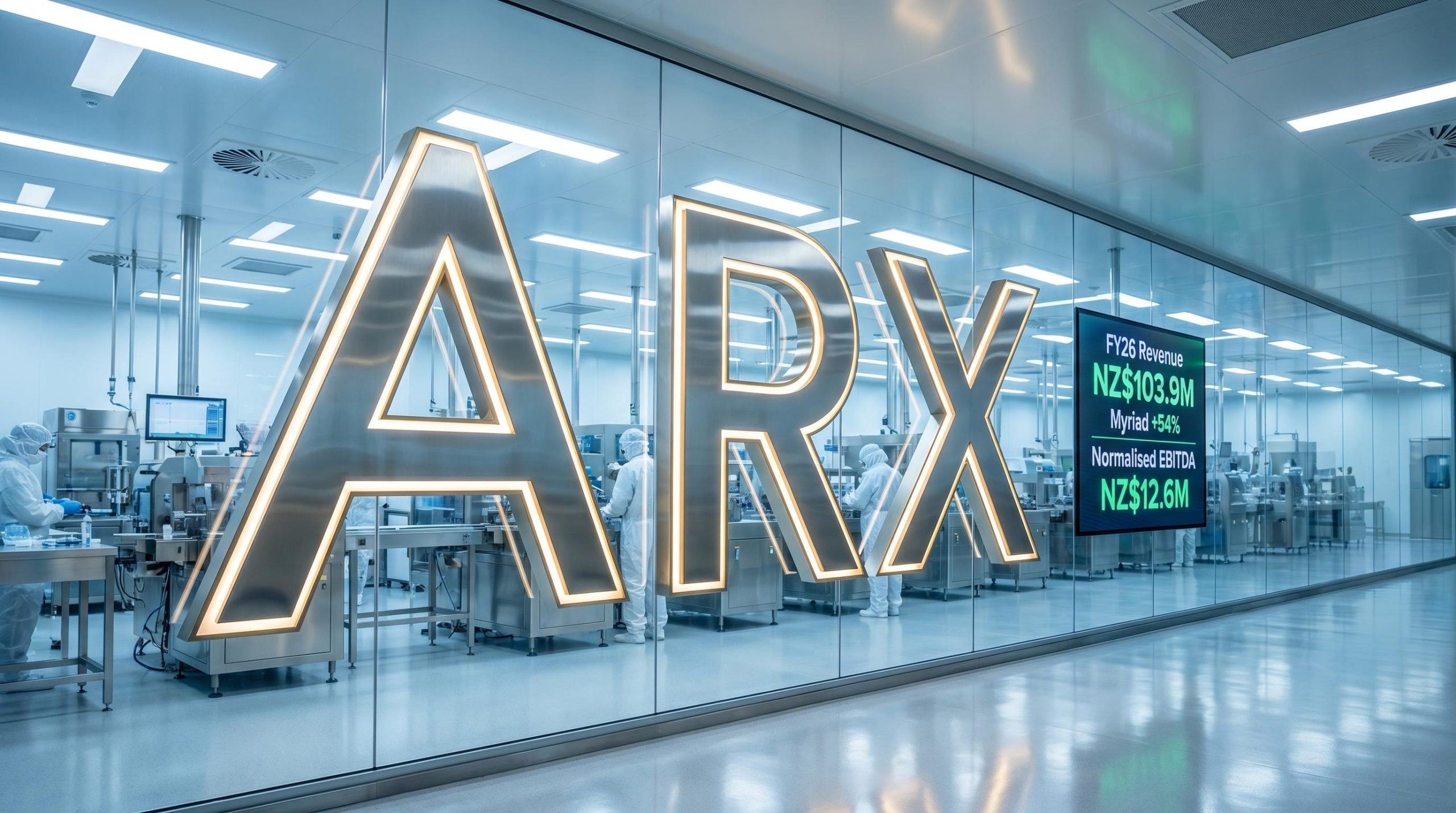
In its FY26 Full Year Results investor presentation released 26 May 2026, management outlined a standout performance from AROA Biosurgery Limited (ASX: ARX), with total revenue of NZ$103.9m on a reported basis, up 23% on FY25 and above the top of constant currency guidance of NZ$92–100m.
Normalised EBITDA reached NZ$12.6m on a reported basis (NZ$11m constant currency), representing approximately 174% of the guidance midpoint and the second consecutive year of normalised EBITDA positive. The company closed the year debt-free, with NZ$27m in cash and term deposits and NZ$5m in net cash generated, confirming self-funding status.
Three storylines define the result: the continued acceleration of Myriad, the Symphony randomised controlled trial (RCT) meeting its primary endpoint, and a deliberate NZ$9m growth investment planned for FY27.
When big ASX news breaks, our subscribers know first
FY26 financial results in detail
Guidance exceeded on both measures
On a constant currency basis using a NZ$/US$ exchange rate of 0.60, AROA delivered total revenue of NZ$101m against guidance of NZ$92–100m, and normalised EBITDA of NZ$11m against guidance of NZ$5–8m. On a reported basis, those figures rose to NZ$103.9m and NZ$12.6m respectively.
A key quality signal sits beneath the headline: normalised operating expenses grew only 11% against 23% revenue growth, demonstrating meaningful operating leverage. Product gross margin held at 85.5%, essentially flat on FY25’s 85.6%, confirming the high-margin character of the revenue base is intact.
| Metric | FY25 | FY26 | YoY Change |
|---|---|---|---|
| Total revenue | NZ$84.7m | NZ$103.9m | +23% |
| Product gross margin | 85.6% | 85.5% | Flat |
| Normalised EBITDA | NZ$4.2m | NZ$12.6m | +201% |
| Operating cash flow | (NZ$2.6m) | NZ$10.5m | +NZ$13.1m |
| Net cash generated | NZ$1.9m | NZ$5.1m | +167% |
Cash generation and balance sheet strength
Operating cash flow returned to positive in FY26, swinging from negative NZ$2.6m in FY25 to positive NZ$10.5m, a NZ$13.1m improvement. Total net cash flow reached NZ$5.1m, up 167% year-on-year.
Other FY26 financial highlights (reported basis):
- 85.5% product gross margin, maintained at high levels
- NZ$10.5m operating cash flow, up NZ$13.1m on FY25
- NZ$27m cash and term deposits, debt-free
- NZ$5m net cash generated, confirming self-funding growth
What’s driving the growth — and what’s coming next
Myriad: the compounding growth engine
Myriad grew +54% on a reported basis (+52% constant currency) in FY26 to NZ$49m, continuing a compounding trajectory that has seen the product line expand from a standing start just four years ago:
- FY22: NZ$4m
- FY23: NZ$14m
- FY24: NZ$23m
- FY25: NZ$32m
- FY26: NZ$49m
The growth matters beyond the headline number. Myriad is AROA’s highest-margin product family, carrying gross margins above 90%, and is sold entirely through the company’s own direct US sales force with no partner distribution cost. It operates within a stable US reimbursement environment and is supported by prospective clinical evidence, including MASTRR registry data from Lawlor et al. (2024, n=130) and Cormican et al. (2026, n=49).
Management has committed approximately NZ$5m in FY27 to accelerate commercial leadership, expand sales headcount, and strengthen infrastructure to sustain Myriad’s growth trajectory.
Symphony — the CMS reform opportunity
The US Centers for Medicare and Medicaid Services (CMS) introduced a significant reimbursement change in 2026: skin substitutes are now reimbursed on a flat-fee basis rather than as a percentage of product cost. This is a major reset of a multi-billion-dollar US market. Under the old model, high-priced products were rewarded regardless of clinical evidence. Under the new flat-fee model, the margin advantage shifts to products with strong efficacy data, particularly those with RCT-grade evidence, since payers and hospital systems face de-listing pressure on products that cannot demonstrate clinical outcomes.
The Symphony RCT in diabetic foot ulcers (DFUs) met its primary endpoint, placing AROA among a small group of competitors with the clinical threshold that many others cannot match. The presentation frames Symphony as positioned in the hospital outpatient department channel and supported by AROA’s existing surgical portfolio.
The complex wounds total addressable market (TAM) is estimated at greater than US$1.8B, and the CMS reset is described as a “major time-sensitive reset,” a disruptive event rather than a structural threat to AROA’s positioning. Management is investing approximately NZ$4m in FY27 sales infrastructure to support the Symphony launch and convert the reimbursement opportunity into revenue.
OviTex — recurring high-margin partner revenue
AROA is the exclusive manufacturer of OviTex (a Reinforced Tissue Matrix), with TELA Bio acting as the North American and European distributor. Under this structure, AROA carries none of the sales-force cost for the OviTex segment, contributing approximately 75% gross margin at no associated sales expense.
OviTex and OviTex PRS revenue grew +8% in FY26. For FY27, sales to TELA Bio are conservatively assumed to be flat, reflecting hospital contracting headwinds. The presentation notes this dynamic as a temporary constraint rather than a structural concern, with OviTex continuing to provide accretive, recurring revenue and exposure to the hernia and breast reconstruction markets.
FY27 outlook — investing to accelerate
Management has issued FY27 guidance on a constant currency basis (NZ$/US$ 0.60) of total revenue of NZ$115–125m, representing growth of 13–23%. Direct revenue growth is guided at 24–40% versus FY26, with OviTex sales to TELA Bio assumed flat.
Normalised EBITDA guidance of NZ$8–11m represents a deliberate step down from FY26’s NZ$12.6m, driven by a NZ$9m growth investment: approximately NZ$5m for Myriad commercial scaling and approximately NZ$4m for the Symphony launch. Management frames this as investing from a position of strength, not retreat.
The five FY27 operating priorities outlined in the presentation are:
- Sustain Myriad momentum in the operating room
- Accelerate rep productivity across the expanded team
- Convert the Symphony reimbursement opportunity into FY27 sales
- Achieve deeper penetration within existing customer accounts
- Drive wider adoption across integrated hospital systems (IDNs)
Upcoming clinical catalysts to track include:
- FY27 Q1: MASTRR pressure injury study (n=9), India Study (n=83)
- FY27 Q2: Symphony RCT publication (n=143), MASTRR interim analysis (n=423)
- 2027: COVER RCT
The investment thesis presented is that of a profitable, self-funding medtech operating across a TAM of greater than NZ$3B, with five consecutive years of revenue growth, a strengthening RCT evidence advantage, and a deliberately funded investment year ahead aimed at cementing commercial leadership in both Myriad and Symphony.
Don’t Miss the Next ASX Healthcare Breakout
Big News Blast delivers FREE breaking ASX healthcare news directly to your inbox within minutes of release, complete with in-depth analysis. Join 20,000+ subscribers already staying ahead of the market. Click the “Free Alerts” button to start receiving alerts the moment market-moving announcements hit the ASX.