

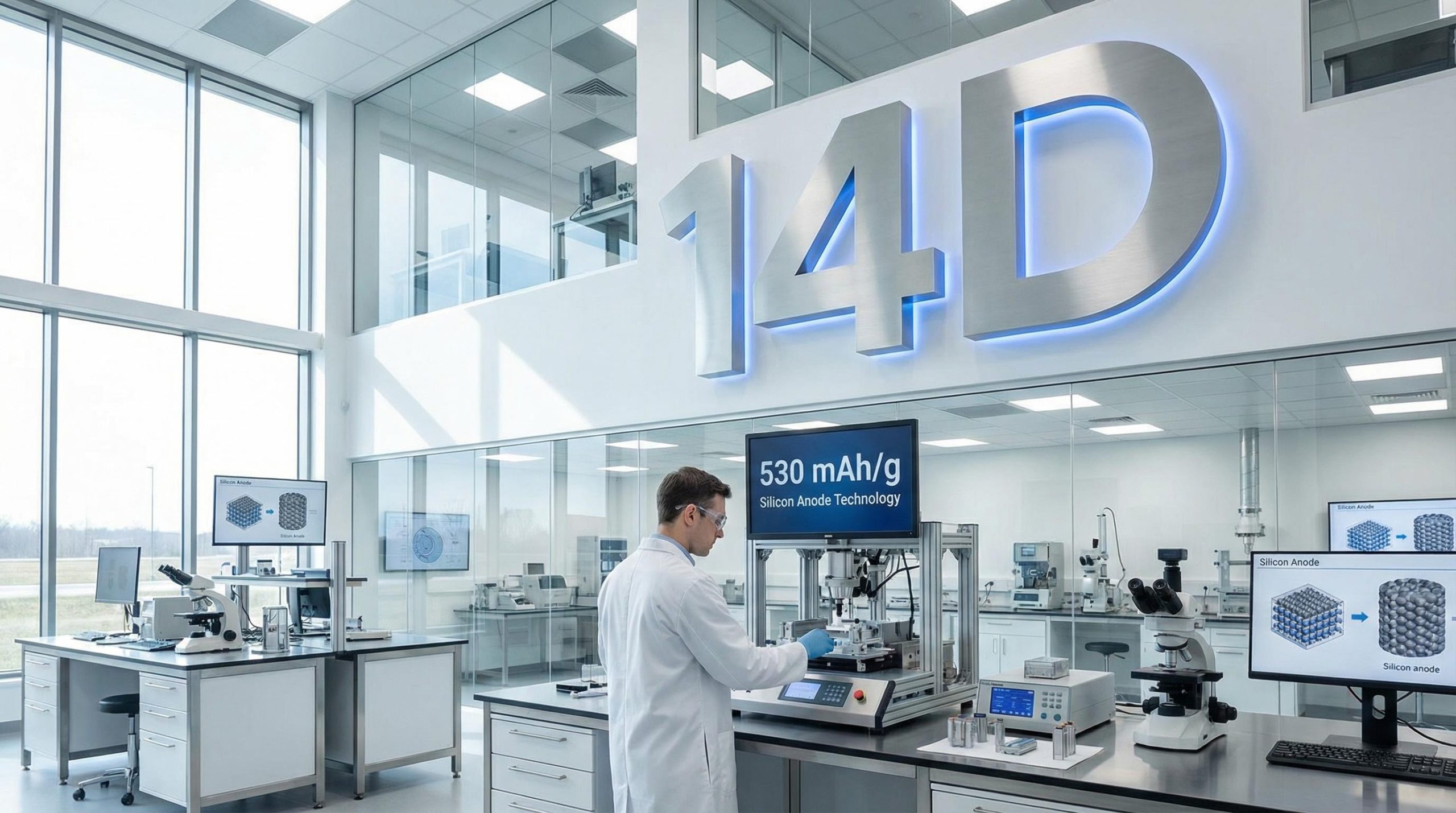
1414 Degrees has demonstrated 530 mAh/g specific capacity in laboratory testing of its SiNTL Silicon Anode programme, surpassing the previously announced 500 mAh/g milestone ahead of schedule. The result positions the company on track toward its 600 mAh/g development target, approximately 20% above current commercial silicon-enhanced anode benchmarks. Testing was conducted at George Washington University under the company’s exclusive global technology licence, using a 4-hour charge/discharge cycle between 20–80% state of charge.
1414 Degrees hits 530 mAh/g capacity milestone ahead of schedule
1414 Degrees (ASX: 14D) has achieved 530 mAh/g specific capacity in its SiNTL Silicon Anode programme, exceeding the 500 mAh/g milestone and advancing ahead of the development schedule. The result was achieved under controlled test conditions using a 4-hour charge/discharge cycle between 20–80% state of charge, with testing conducted at George Washington University under the company’s exclusive global technology licence.
The achievement represents tangible progress toward the programme’s 600 mAh/g development target, which would position the SiNTL Silicon Anode material approximately 20% above current commercial silicon-enhanced anode benchmarks. For investors, programme acceleration suggests technical validation is progressing faster than expected, potentially de-risking the commercialisation timeline and bringing forward partnership opportunities.
The key milestone comparisons are:
- 530 mAh/g — current demonstrated capacity (exceeds target)
- 500 mAh/g — previous milestone now surpassed
- 600 mAh/g — next development target (~20% above commercial benchmarks)
When big ASX news breaks, our subscribers know first
Why silicon anodes matter for battery investors
Graphite has long dominated battery anode materials, but its theoretical capacity ceiling of approximately 372 mAh/g is increasingly a constraint as electric vehicle manufacturers push for longer range and faster charging. Silicon offers a theoretical capacity of around 3,600 mAh/g, nearly ten times higher than graphite.
Commercial adoption of silicon has historically been limited by a fundamental materials challenge: volume expansion during lithium absorption degrades cycle life and electrical conductivity. That technical barrier is now being systematically addressed across the industry. Investment in silicon anode start-ups exceeded USD 4.5 billion in 2024, reflecting broad industry conviction that silicon integration is transitioning from research ambition to commercial imperative.
The key material property contrasts are:
- Graphite: ~372 mAh/g theoretical ceiling, mature technology, no expansion issues
- Silicon: ~3,600 mAh/g theoretical ceiling, volume expansion challenge, rapidly advancing solutions
For investors, 2024 represents an inflection point. Silicon anodes are no longer a future possibility but a near-term competitive requirement for battery manufacturers seeking differentiation in energy density and fast-charge performance. Early movers with manufacturable solutions could capture significant market share as the technology transitions from specialty applications to mainstream adoption.
Market opportunity reaches USD 25.8 billion by 2035
The silicon anode battery market is projected to expand from USD 0.4 billion in 2025 to USD 25.8 billion by 2035, representing a compound annual growth rate of 51.7%, according to Fact.MR’s Silicon Anode Battery Market Global Analysis Report. Multiple independent analysts project CAGR exceeding 50% through 2035, reflecting industry-wide consensus on adoption trajectory.
| Year | Market Size | Growth Multiple |
|---|---|---|
| 2025 | USD 0.4 billion | 1x (baseline) |
| 2035 | USD 25.8 billion | 64x |
The 64x expansion over ten years is driven by electric vehicle industry demand for longer range and faster charging, both of which require higher energy density battery materials. For investors, the market is projected to expand faster than the broader lithium-ion battery sector, offering substantial leverage to companies with validated, manufacturable silicon anode solutions. Positioning in this space now, ahead of mass commercialisation, offers exposure to a sector transitioning from niche to mainstream adoption.
What makes SiNTL different from competing approaches
The SiNTL process produces aluminium-coated silicon nanoparticles using a low-temperature, one-step synthesis method operating between 125–180°C. The in-situ aluminium coating forms during synthesis, producing air- and water-stable nanoparticles that directly address silicon’s volume expansion problem. The process has demonstrated yields of approximately 97% and has been independently validated as compatible with conventional anode production lines.
Where most silicon anode approaches rely on chemical vapour deposition (a high-temperature process requiring silane gas and specialised infrastructure), SiNTL operates at 125–180°C in a single step, without hazardous reagents. The process avoids hydrofluoric acid and silanes entirely, reducing both safety risks and infrastructure requirements. Battery manufacturers can integrate SiNTL material without retooling existing infrastructure, it is designed as a drop-in upgrade rather than a platform replacement.
The key technical advantages are:
- Low-temperature synthesis: 125–180°C (vs. high-temperature CVD methods)
- Single-step process: Eliminates multiple intermediate processing stages
- Hazard-free: No hydrofluoric acid or silanes required
- High yield: Approximately 97% demonstrated
- Drop-in compatible: Works with existing anode production lines
For investors, drop-in compatibility removes a major adoption barrier. Manufacturers can integrate the material without capital-intensive retooling, accelerating potential uptake and reducing the time-to-revenue timeline for commercialisation.
The SiPHyR integration pathway
What further distinguishes 1414 Degrees’ position in the battery materials value chain is the potential to integrate SiNTL with its SiPHyR methane-pyrolysis technology. SiPHyR produces low-emissions hydrogen alongside solid carbon as a co-product. Combining that carbon with SiNTL’s aluminium-coated silicon nanoparticles could deliver a streamlined, single-step pathway to finished silicon-carbon composite anode material, eliminating multiple intermediate processing steps typical of conventional approaches and potentially reducing production costs significantly.
The company is actively evaluating this integrated pathway. If validated, 1414 Degrees would control both the silicon nanoparticle intellectual property and the carbon feedstock required to produce finished anode material at scale. This represents an unusual and difficult-to-replicate position in the emerging battery materials supply chain, potentially creating a competitive moat that extends beyond the silicon anode technology itself.
Executive Chairman outlines the commercial pathway
Executive Chairman Dr Kevin Moriarty emphasised the milestone’s significance for the programme’s credibility and commercialisation pathway. The 530 mAh/g result demonstrates that the aluminium-coating approach is working as designed under real test conditions, validating the pathway to the 600 mAh/g target.
Dr Kevin Moriarty, Executive Chairman
“Surpassing the 500 mAh/g milestone and doing so ahead of schedule is a meaningful result for the SiNTL program. The 530 mAh/g figure is not just a number — it demonstrates that our aluminium-coating approach is working as designed under real test conditions, and that the pathway to 600 mAh/g is credible.”
Dr Moriarty highlighted the combination of a manufacturable, hazard-free process with compatibility with existing production lines as the key differentiator. He noted the potential integration with SiPHyR represents a further opportunity to create a uniquely integrated, lower-cost production pathway that would be difficult for competitors to replicate quickly.
Next steps and development timeline
Testing continues at George Washington University with ongoing work focused on three priority areas as the programme advances toward the 600 mAh/g milestone:
- Improving specific capacity performance to reach and potentially exceed the 600 mAh/g target
- Extending cycle life validation to demonstrate commercial durability requirements
- Progressing scalability assessment toward commercial battery applications
Cycle life characterisation is progressing as part of the ongoing validation programme and will be reported as results become available. The programme is advancing toward the 600 mAh/g milestone, with ongoing testing expected to deliver further results in the coming months. For investors, continued progress toward 600 mAh/g would further validate commercial viability and potentially accelerate partnership discussions with battery manufacturers seeking differentiated anode materials.
Get Industrials News Before the Market Moves
Join 20,000+ investors receiving FREE breaking ASX industrials alerts within minutes of release, complete with in-depth analysis. Click the “Free Alerts” button at StockWire X to get real-time coverage of battery technology, advanced manufacturing, and emerging industrial opportunities the moment announcements hit the market.