Unit4 has acquired Paris-based Napta, adding skills intelligence and capacity planning to the enterprise software it sells to professional services firms. The Unit4 Napta acquisition, announced on 6 October 2026, brings Napta’s resource management tools alongside Unit4’s enterprise resource planning (ERP), financial planning and analysis (FP&A) and human capital management (HCM) applications.
The timing reflects a persistent squeeze. Consulting, audit and engineering firms earn money when staff spend hours on client work, and every idle hour erodes margin.
This deal aims to tackle that problem inside a single vendor’s system. Here is what the combined offering is meant to do, what Napta’s customers have been told to expect, and what the purchase signals about where services software is heading.
What Unit4 gets from Napta, and what services firms get in return
Every services firm faces the same Monday-morning question: who is free, who has the right skills, and what does putting them on this project do to margin? In many firms, answering it means stitching together spreadsheets, staffing tools and finance systems by hand.
The cost of idle or misallocated hours is measurable: one survey of European accountants put the advisory capacity gap at roughly 1.46 recoverable hours per working day, a figure that shows why resourcing tools are drawing vendor attention.
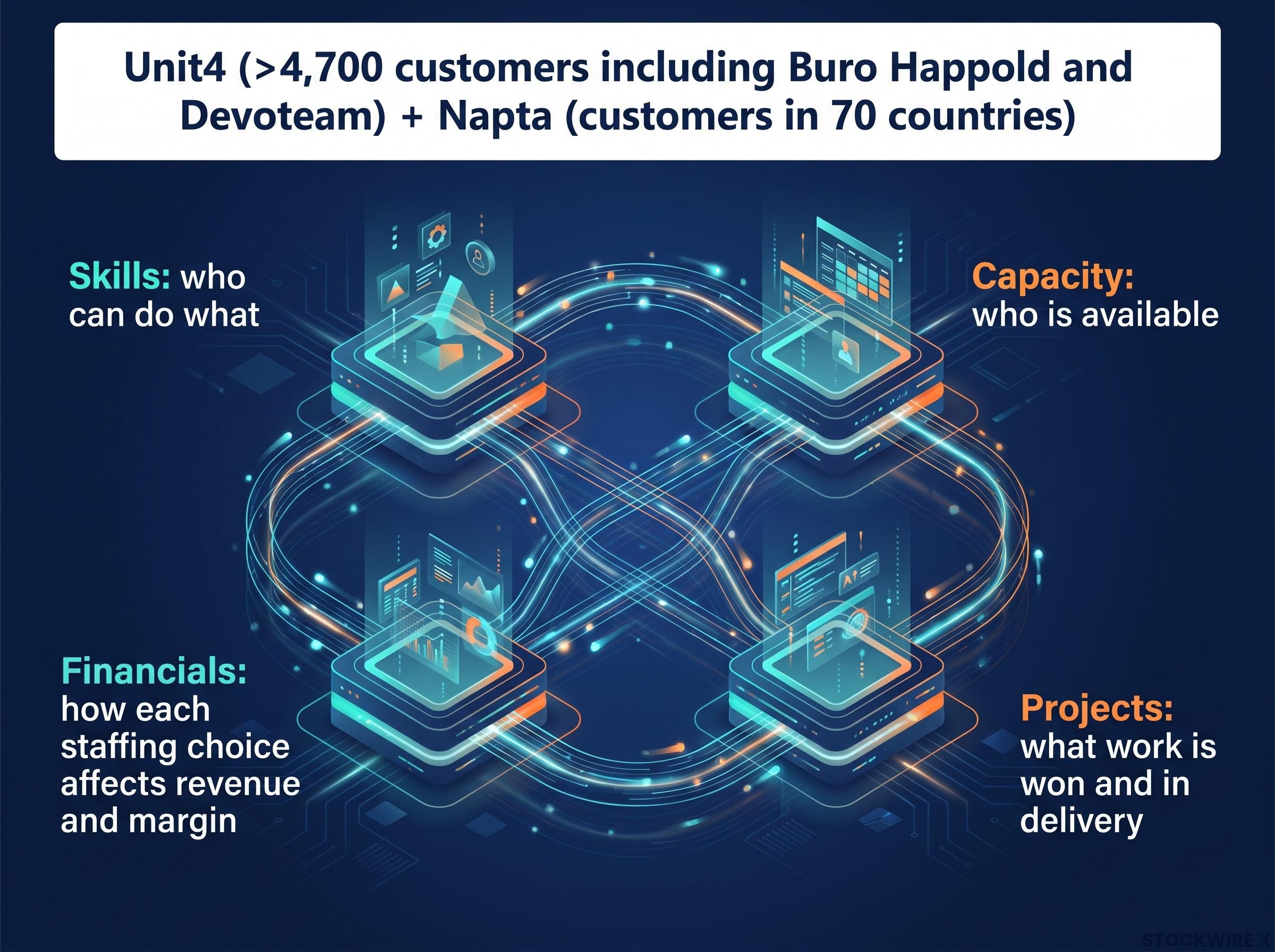
Napta handles the first two parts. It matches people to work using skills data and AI-assisted capacity planning, serving consulting, audit, IT and engineering firms with customers in 70 countries. Unit4, which serves more than 4,700 customers globally including Buro Happold and Devoteam, handles the money and the people records.
According to the companies, the combined product links four types of data:
- Skills: who can do what, so staffing matches capability
- Capacity: who is available, so idle time becomes visible
- Projects: what work is won and in delivery
- Financials: how each staffing choice affects revenue and margin
The stated goal is to cover the full lifecycle, from winning work through staffing and delivery. Constellation Research summed up the fit plainly.
Analyst view Napta “complements Unit4’s ERP, financial and human capital management applications,” according to Constellation Research.
The two companies already share customers running both platforms side by side, although none have commented publicly. If you run or buy software for a services firm, the signal is clear: Unit4 is betting that staffing decisions and financial results belong in one data model, not in separate tools reconciled manually.
What Napta customers are told to expect
Napta keeps its brand, leadership and open-ecosystem approach, and will continue serving existing and new customers. Co-founder and CEO Arnaud Caldichoury remains in charge, and all three co-founders are staying. Unit4 says its roadmap investment and worldwide reach will help Napta grow in resource management.
Where the deal fits in Unit4’s cloud and AI strategy
Napta is not a standalone bet. Unit4’s strategy rests on deeper presence in its core sectors (professional and business services, public services, non-profit and education), AI development, and moving customers to its cloud-native ERPx platform. Acquisitions sit alongside those priorities.
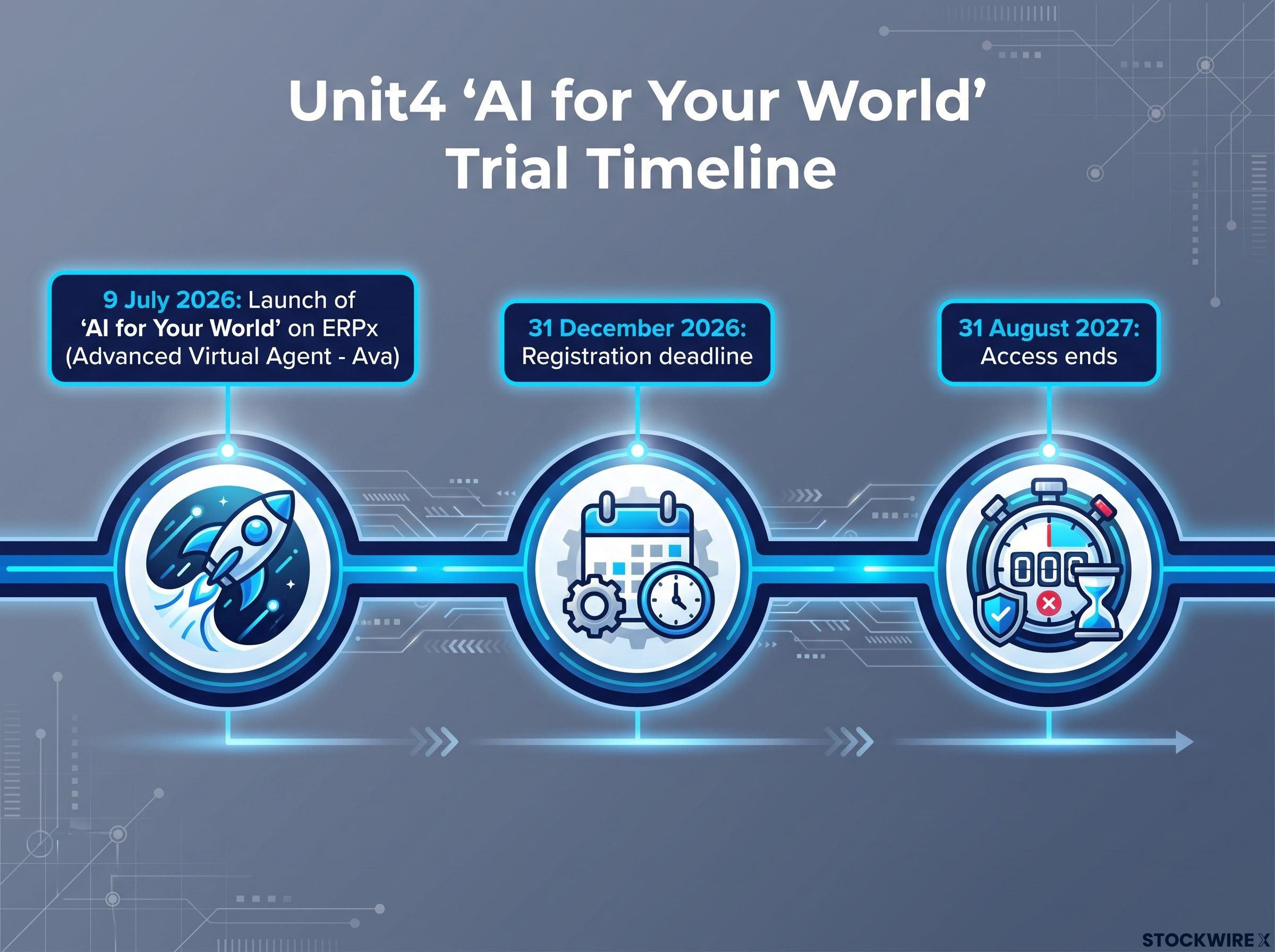
The adjacent move came on 9 July 2026, when Unit4 launched “AI for Your World”, a commitment-free AI trial for mid-market customers. ERP Today framed it as a way for those firms to test AI against real workflows before paying for it.
| Term | Detail |
|---|---|
| What | Unit4 AI tools, including the Advanced Virtual Agent (Ava), usable via tools such as Microsoft Teams across finance, HR, procurement and project management on ERPx |
| Who | New and existing Unit4 ERP customers |
| Registration deadline | 31 December 2026 (as stated by Unit4) |
| Access ends | 31 August 2027 |
| After the trial | Move to a subscription or stop using the tools; usage sits under a “generous fair use cap” |
Unit4 reads Napta’s growth as evidence that services firms want less time spent on resourcing and more on billable work. For an existing Unit4 customer, that suggests skills and capacity data could eventually feed the AI tools you are already being invited to trial, though no integration timeline has been stated.
Pricing is another pressure point for suite vendors, since per-seat pricing is increasingly challenged by AI-native rivals offering consumption-based models, which makes fair use caps like the one attached to Unit4’s trial worth watching.
What the deal signals about consolidation, and what remains unanswered
The logic that made this deal likely extends well beyond Unit4.
The buying logic sits against a backdrop of legacy software repricing, in which $1.2 trillion of early 2026 M&A showed incumbents acquiring capabilities to stay relevant as AI reshapes per-user licensing models.
Why vendors are buying, not building
- AI needs joined-up data: recommendations only work when people, skills, project and financial records are consistent
- Utilisation pressure: linking capacity to project financials shows how staffing choices hit profitability
- Suite preference: mid-market firms increasingly want ERP, HCM, FP&A and resource planning from one provider, and buying fills gaps faster than building
- Fewer vendors: small IT teams with limited budgets favour one accountable supplier
The counter-view carries weight too. Absorbing specialists can narrow choice and redirect their roadmaps.
- Risk: integration complexity and duplicated features in the interim
- Risk: Napta users outside ERPx losing priority on the product roadmap
- Risk: tighter lock-in to one vendor
- Mitigating signal: Napta’s retained brand, leadership and open-ecosystem stance
- Mitigating signal: continued investment in integrations with other ERP, professional services automation (PSA) and HCM platforms
If you use Napta on a non-Unit4 ERP, that open-ecosystem pledge is the commitment to hold the vendor to. What it means in practice is not yet visible.
What is still unknown
Price, valuation, financing and closing conditions have not been disclosed. Status is also slightly blurred: Consultancy.org and Consultancy.uk reported the deal as completed on 6 October 2026, while Digitalisation World described Unit4 as buying Napta. No shared customer has commented.
What to watch as Unit4 and Napta integrate
The deal ties skills and capacity planning to Unit4’s ERP, FP&A and HCM stack and slots neatly into its ERPx and AI direction. The terms, and how quickly the pieces connect, remain open.
Three markers will show whether the promise holds:
- Published roadmap detail on how Napta data links into ERPx and Unit4’s AI tools
- Whether integrations with non-Unit4 platforms keep pace
- The first customer accounts of using the combined product
The bigger question is whether rival suite vendors respond with resource-planning purchases of their own.
This article is for informational purposes only and should not be considered financial advice. Investors should conduct their own research and consult with financial professionals before making investment decisions. Forward-looking statements are speculative and subject to change based on market developments and company performance.