Record Highs Are Not the Risk Most Investors Think They Are
7 hrs ago


A $1,000 stake in Apple on the day Tim Cook took the helm in August 2011 is worth more than $20,000 today. That 1,924% return dwarfed the S&P 500 by a factor of more than three. The figure landed in sharp relief on 20 April 2026, when Cook announced he will leave the CEO role on 1 September.
Cook’s departure ends a 15-year run that transformed Apple from a $350 billion company into a nearly $4 trillion one, reshaping the retirement accounts, down-payment funds, and financial timelines of millions of ordinary American investors along the way. President Donald Trump publicly praised Cook just one day after the announcement, calling him “an outstanding manager and leader.” What follows breaks down exactly what Cook’s tenure delivered to long-term retail shareholders, how Apple’s return compares to rivals, and what the transition to incoming CEO John Ternus means for the stock going forward.
The numbers carry their own weight. When Cook succeeded Steve Jobs in August 2011, Apple’s market capitalisation stood at approximately $350 billion. At the time of his departure announcement on 20 April 2026, that figure had grown to approximately $3.97 trillion, a roughly 1,043% increase in enterprise value.
Cook confirmed he will step down as CEO effective 1 September 2026 and transition to the role of Executive Chairman of the Board. John Ternus, currently Senior Vice President of Hardware Engineering, was named as his successor, with the same 1 September start date.
AAPL shares dropped approximately 2.5% on the announcement day, then recovered partially before settling at $266.93 by 27 April, down roughly 2.3% for the week. The reaction was orderly rather than panicked.
The muted market reaction to the Cook-to-Ternus switch, with AAPL moving just 0.43% in the session following the announcement, reflects institutional confidence in succession continuity, though the five-month window before the September handover holds several catalyst events that could shift that calculus.
The following day, Trump weighed in publicly:
“Tim Cook is an outstanding manager and leader. He has done a fantastic job at Apple.” — President Donald Trump, Truth Social, 21 April 2026
The difference between an investor who held AAPL through Cook’s full tenure and one who sold during a downturn comes down to compounding over time. Apple shares suffered sharp drawdowns in 2015-2016, late 2018, and 2022. Investors who stayed through each of those cycles captured the recoveries that followed; those who sold at any of those inflection points locked in losses or significantly smaller gains.
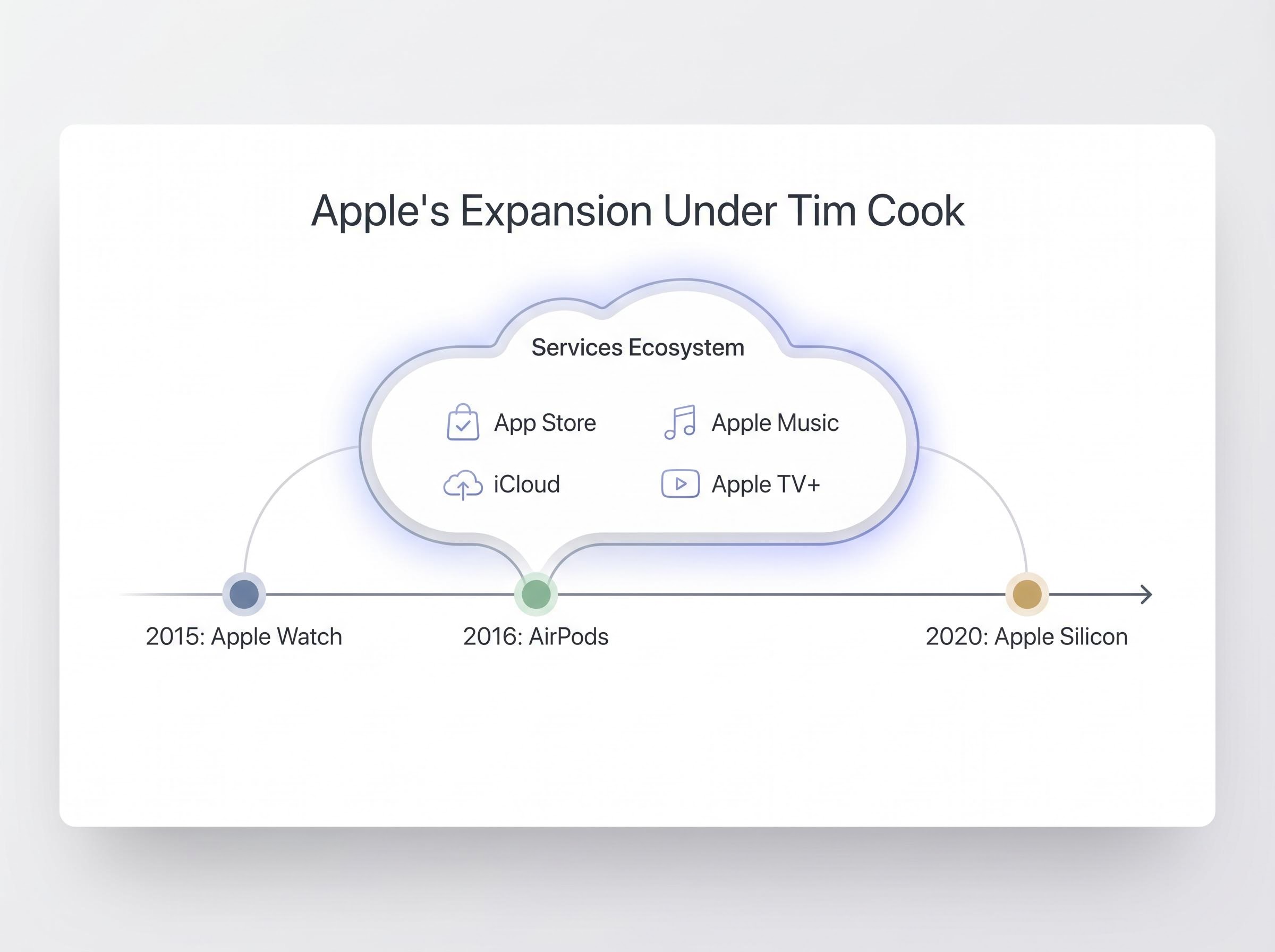
What sustained the compounding was a structural shift in how Apple made money. Under Cook, the company moved from a hardware-only business to a high-margin Services revenue model, adding recurring income from the App Store, Apple Music, iCloud, and Apple TV+. Alongside this, Cook oversaw the introduction of several product lines that expanded the hardware ecosystem:
Statista data on Apple’s Services revenue expansion shows the segment growing from approximately $20 billion to over $109 billion across a decade, a trajectory that accounts for roughly half of the company’s total sales growth and drove the gross margin improvement that made sustained share price compounding possible.
John Ternus joined Apple in 2001 and has served as SVP of Hardware Engineering since 2013. He holds a mechanical engineering degree from the University of Pennsylvania and currently oversees the engineering teams behind iPhone, iPad, Mac, and AirPods.
His 25-year tenure at Apple is the continuity argument. Analysts at Wedbush maintained a buy recommendation on AAPL, characterising the transition as a “minor blip.” Warren Buffett was reported to have commented positively on the leadership change. Wall Street’s broader reaction was described as muted but positive, with confidence centred on Apple’s product pipeline rather than any single executive.
No major public statements from Ternus regarding his strategic vision were available at the time of publication, leaving the forward picture partly incomplete.
Start with the split-adjusted price. On 24 August 2011, the day Cook formally became CEO, AAPL traded at approximately $13.44 per share. By 27 April 2026, the stock closed at $266.93.
That translates to a price return of approximately 1,886%. Sources characterise this as “almost 2,000%“; the Benzinga calculation framing $1,000 growing to more than $20,000 puts the figure at approximately 1,924% depending on precise entry date.
TheStreet’s analysis of Apple’s stock performance under Tim Cook confirms the roughly 20-fold surge in share price and the expansion of market capitalisation from approximately $350 billion to over $4 trillion, benchmarked against an S&P 500 return of approximately 503% over the same period.
| Investment | Starting Value (Aug 2011) | Ending Value (Apr 2026) | Return (%) |
|---|---|---|---|
| AAPL | $1,000 | ~$20,000 | ~1,924% |
| SPY (S&P 500) | $1,000 | ~$6,000 | ~500% |
The gap widens further when dividends are included.
Total return (dividends reinvested): More than 2,300% over Cook’s tenure, according to Investopedia analysis, compared to a total S&P 500 return of roughly six times the original investment.
During this period, Apple added approximately $3.6 trillion in market capitalisation, the largest absolute value creation of any single company under one CEO in corporate history.
The percentage returns are one story. What shareholders did with the money is another. A Reddit r/Money community thread surfaced several specific accounts of how long-term AAPL holders converted stock gains into life milestones:
These accounts remain anecdotal and self-reported. They do not represent verified financial records. Still, they translate abstract percentage returns into the specific life events that make long-term equity investing meaningful for everyday Americans rather than institutional portfolios.
Apple’s current valuation at a 34x price-to-earnings ratio, against record Q1 2026 revenue of $143.8 billion and a 9% year-to-date stock decline, creates a disconnect that investors reassessing their AAPL position amid the leadership change will need to work through carefully.
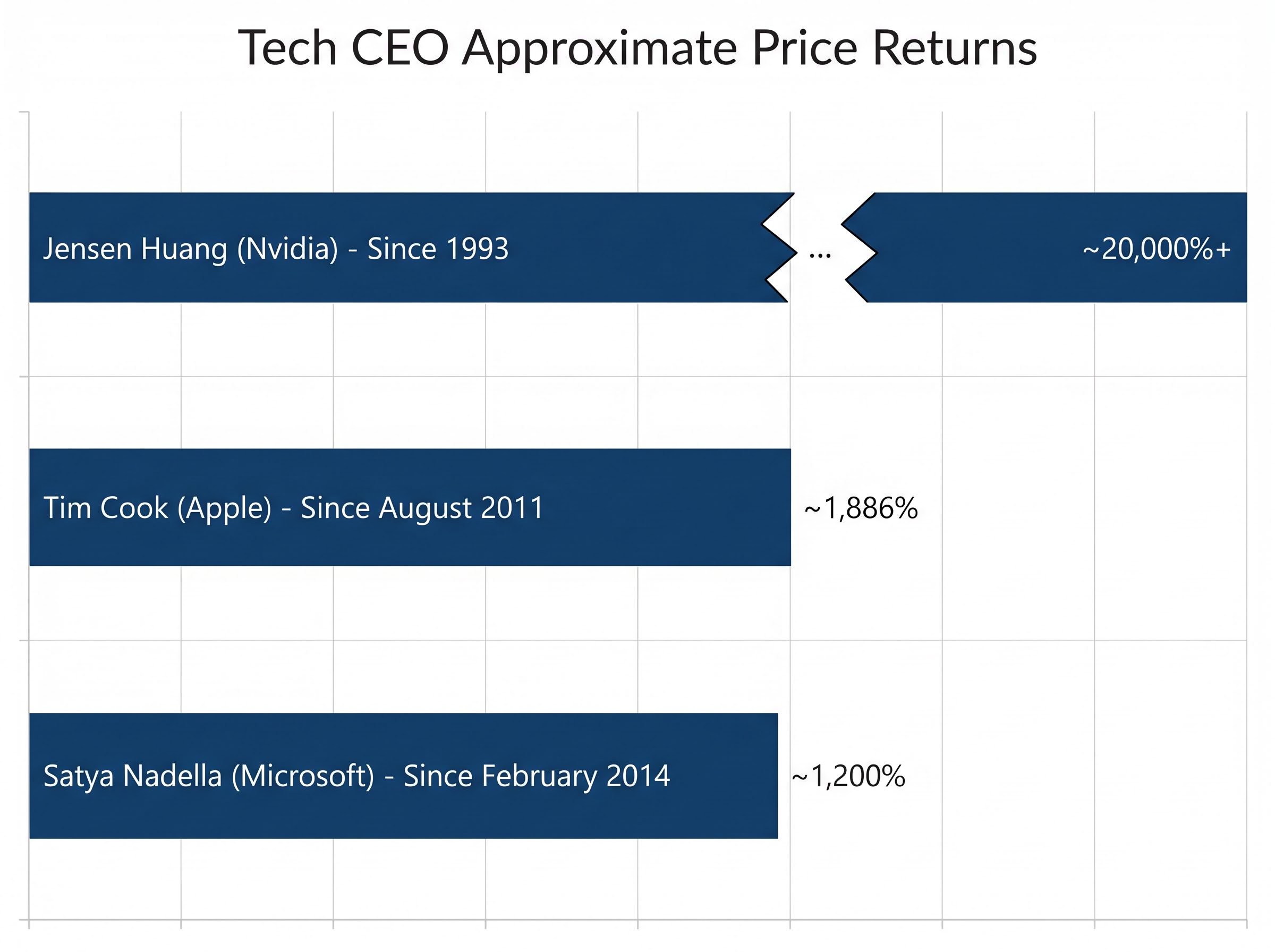
Cook’s 1,886% price return is difficult to contextualise without looking at what other technology CEOs delivered over the same period. The comparison is instructive, but it requires careful framing.
| CEO | Company | Approx. Price Return | Tenure Start |
|---|---|---|---|
| Tim Cook | Apple | ~1,886% | August 2011 |
| Satya Nadella | Microsoft | ~1,200% | February 2014 |
| Jensen Huang | Nvidia | ~20,000%+ | 1993 (co-founder) |
Nvidia’s figures reflect a significantly longer tenure window and an AI-driven acceleration from 2022 onward that reshaped the stock’s trajectory. Direct comparisons require that context; Huang’s return since 2011 alone substantially outperformed Apple, but the bulk of NVDA’s gains concentrated in the final three years of the comparison window. Confidence on exact same-timeframe figures across all peers is medium, as precise entry-point calculations vary by source.
The counterargument to percentage-only comparisons is one of scale. When Cook started, Apple was already a $350 billion company. Growing a $350 billion enterprise by $3.6 trillion in absolute terms represents a degree of difficulty that a smaller starting base does not face. Trump’s specific framing of Cook as an operationally effective relationship builder added a political-economy dimension to the public conversation, positioning Cook’s legacy as one of institutional stewardship rather than pure innovation.
The distinction matters for investors assessing what to expect from the Ternus era. Whether Cook’s Apple was a once-in-a-generation compounding story or a strong-but-not-exceptional tech performer depends on the metric chosen, and the answer shapes the forward expectations investors carry into September.
Tariff exposure and China supply chain concentration sit alongside the leadership transition as the primary risk factors that could compress Apple’s earnings multiple, with the April 30 earnings report representing the first opportunity to gauge how significantly macro headwinds are weighing on the thesis.
Past performance does not guarantee future results. Financial projections are subject to market conditions and various risk factors.
Tim Cook’s 15-year run as Apple CEO produced one of the most consequential retail investor wealth-creation stories in modern American financial history, turning a modest $1,000 stake into more than $20,000 and funding home purchases, early retirements, and life milestones for ordinary shareholders. The debate over whether Apple’s gains rank as the best in tech or merely the most broadly held does not diminish the arithmetic: Cook more than tripled the S&P 500’s return over the same period.
With John Ternus taking the helm on 1 September 2026 and Cook remaining as Executive Chairman, investors and analysts are broadly treating this as a managed transition rather than a rupture. Whether the next chapter matches the last is a question Ternus’s first product cycle will begin to answer.
This article is for informational purposes only and should not be considered financial advice. Investors should conduct their own research and consult with financial professionals before making investment decisions. Those reassessing their AAPL position ahead of the September transition may wish to consult a fiduciary financial adviser to evaluate concentration risk, tax implications on long-held positions, and how the stock fits within a diversified portfolio.
AAPL dropped approximately 2.5% on the day Cook announced his departure but recovered partially, with analysts at Wedbush maintaining a buy rating and characterising the transition as a minor blip given John Ternus's 25-year tenure at Apple.
A $1,000 investment in Apple on the day Tim Cook became CEO in August 2011 would be worth more than $20,000 by April 2026, representing a price return of approximately 1,924% and a total return exceeding 2,300% when dividends are reinvested.
John Ternus, currently Apple's Senior Vice President of Hardware Engineering, will succeed Tim Cook as CEO effective 1 September 2026, while Cook transitions to the role of Executive Chairman of the Board.
Apple delivered a price return of approximately 1,886% under Tim Cook, compared to an S&P 500 return of roughly 503% over the same period, meaning AAPL outperformed the broader market by a factor of more than three.
Investors face three primary risk factors following the transition: tariff exposure and China supply chain concentration, Apple's current 34x price-to-earnings valuation against a 9% year-to-date stock decline, and uncertainty around John Ternus's strategic vision ahead of his first full product cycle.