How Oil Approaching $100 Is Lifting Tesla and EV Stocks

Key Takeaways
- Tesla broke an eight-week losing streak with a 3.01% gain to $400.62 on April 17, 2026, as Brent crude approached $100 per barrel at $97.06.
- Gasoline prices at $4.09-$4.11 per gallon — up 33-38% year-over-year — are generating $100-$200 in monthly savings for EV owners compared to conventional vehicle drivers.
- The Middle East conflict beginning in February 2026 caused a 50% oil price surge and damaged 30-40% of Gulf refining capacity, with analysts forecasting sustained $90-100+ crude prices for months ahead.
- Used EV interest is rising sharply, with electric vehicles projected to comprise 12% of 2026 lease returns compared to just 5% in 2025 — a 140% increase signalling mainstream adoption momentum.
- Tesla's April 22 earnings and Q1 delivery guidance will be a critical test of whether elevated oil prices are translating into improved near-term demand and revenue projections.
Oil prices surging towards $100 per barrel are creating measurable tailwinds for electric vehicle stocks, with Tesla climbing 3.01% to $400.62 on April 17, 2026, breaking an eight-week losing streak. This correlation isn’t coincidental. Elevated crude prices are fundamentally reshaping vehicle ownership economics, driving both consumer interest and investor confidence in the EV sector.
Brent crude reached $97.06 on April 16, whilst gasoline prices hit $4.09-$4.11 per gallon nationally, up 33-38% year-over-year. The market responded decisively, with Tesla trading 88.9 million shares (41% above its three-month average), General Motors gaining 4.16%, and Ford advancing 3.50%. The S&P 500 closed above 7,100 for the first time, reaching 7,126, indicating broader market strength alongside specific automotive sector momentum.
Oil Nears $100 as EV Stocks Rally: Understanding the April 2026 Connection
April 17, 2026 marked a pivotal trading session where oil prices and EV stocks correlation became starkly visible. Tesla snapped its eight-week decline with a 3.01% gain, closing at $400.62 as Brent crude hovered near the psychologically significant $100 mark at $97.06. The timing wasn’t random.
Key market data from that session illustrates the dynamic:
- Brent crude: $97.06 per barrel (up from $66.17 a year earlier)
- Tesla: $400.62, up 3.01% with trading volume of 88.9 million shares (41% above three-month average)
- General Motors: up 4.16% to $81.30
- Ford: up 3.50% to $12.88
- S&P 500: 7,126 (first close above 7,100)
- Nasdaq: up 1.52%
This wasn’t speculative positioning. Elevated oil prices are fundamentally altering the economics of vehicle ownership, creating a measurable shift in consumer behaviour and validating the investment thesis for electric mobility. The following analysis explores how this correlation operates through expert forecasts, consumer data, and market outlook.
When big ASX news breaks, our subscribers know first
Why Oil Prices Affect EV Stock Performance
The relationship between oil prices and EV stocks operates through a straightforward economic mechanism. Higher gasoline prices widen the operating cost gap between electric vehicles and internal combustion engines, making EVs more financially attractive to consumers. Research from the National Bureau of Economic Research confirms gasoline prices as the primary factor in EV purchase decisions, particularly in California and early-adoption markets.
Research from the National Bureau of Economic Research confirms gasoline prices as the primary factor in EV purchase decisions, particularly in California and early-adoption markets.
> At current gasoline prices of $4.09 per gallon, EV owners can save $100-200 per month compared to conventional vehicle operators, depending on driving habits and local electricity rates.
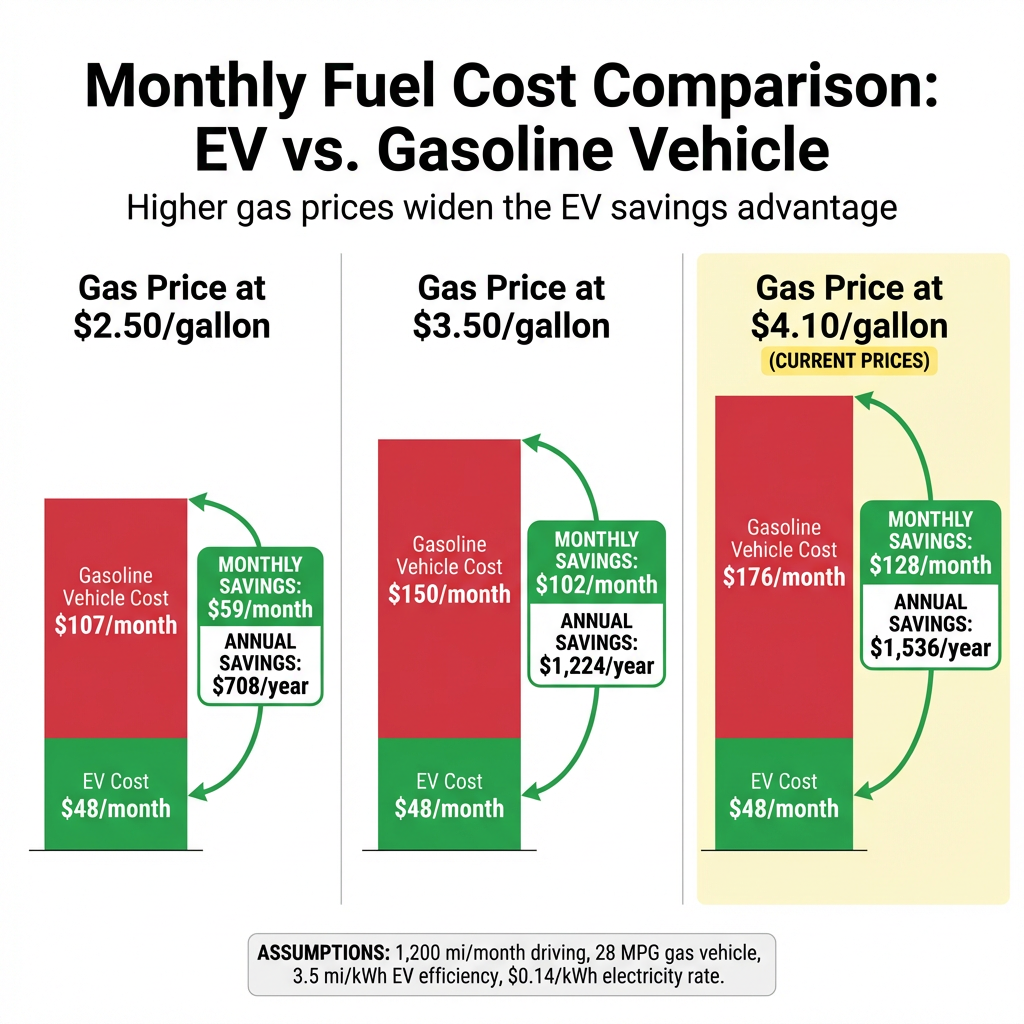
This consumer-level incentive translates directly to manufacturer performance. As more buyers shift to electric vehicles, delivery numbers improve, revenue grows, and investor confidence strengthens. The global EV fleet already displaces 1.7 million barrels per day of oil demand, according to industry data. This figure demonstrates the material impact of electric mobility on energy markets.
From an investment perspective, EV stocks increasingly function as hedges against oil volatility. When crude spikes, the economic case for electric vehicle adoption strengthens, creating positive correlation between oil prices and EV manufacturer valuations. This dynamic becomes self-reinforcing as sustained high fuel costs accelerate consumer migration to electric platforms.
What’s Driving Oil to Nearly $100 Per Barrel
Oil prices surged approximately 50% in March 2026 due to escalating conflict in the Middle East. US-Israel strikes on Iran disrupted shipping through the Strait of Hormuz, a chokepoint handling 20% of global oil supply. The conflict’s infrastructure impact continues to constrain supply months later.
The International Energy Agency describes the Iran conflict that began in February 2026 as the greatest global energy security challenge in history, fundamentally altering the energy landscape that underpins EV adoption economics.
Key supply disruption factors include:
- Damage to 30-40% of Gulf refining capacity
- South Pars gas field attack reducing production
- Ongoing Strait of Hormuz shipping risks
- April tariff escalations adding price pressure
Brent crude at $97.06 represents a $31 increase from $66.17 a year earlier, though prices have retreated from the March 9 peak of $119.49. Analysts expect sustained $90-100+ levels as damaged refining infrastructure requires months to restore. This persistence matters for EV adoption trends, as temporary price spikes have less impact on long-term purchase decisions than sustained elevation.
EV Stock Performance in April 2026: Tesla, GM, and Ford
Tesla’s 3.01% gain to $400.62 on April 17 carried particular significance, ending an eight-week consecutive decline that had pressured the stock since mid-February. Trading volume of 88.9 million shares exceeded the three-month average by 41%, signalling genuine investor conviction rather than technical bounce.
| Stock | Close Price | Daily Change | Context |
|---|---|---|---|
| Tesla | $400.62 | +3.01% | Broke eight-week losing streak |
| General Motors | $81.30 | +4.16% | Broad sector strength |
| Ford | $12.88 | +3.50% | EV transition beneficiary |
The broader market provided supportive context. The S&P 500 climbed 1.20% to 7,126, marking its first close above 7,100, whilst the Nasdaq advanced 1.52%. However, automotive stocks outperformed these indices, suggesting sector-specific tailwinds beyond general market sentiment.
According to market analysis, the automotive sector strength was attributed to elevated oil prices and developments in AI/autonomous ride-hailing technology. Investors are positioning ahead of Tesla’s April 22 earnings, which will provide insight into whether oil price dynamics are translating to improved delivery guidance. The company reported Q1 deliveries of 358,000 vehicles and 8.8 GWh of energy storage capacity.
Consumer Behavior: How $4 Gas Is Accelerating EV Interest
Gasoline prices averaging $4.09-$4.11 per gallon in early April 2026 represent a 33-38% year-over-year increase and a 38% surge since the Middle East conflict began. This is the figure consumers confront at every refuelling stop, creating immediate economic pressure.
The U.S. Energy Information Administration weekly gasoline price data provides official government tracking of retail fuel costs and crude oil benchmarks, serving as the authoritative source for verifying market conditions and price movements referenced throughout this analysis.
Cox Automotive’s Q1 2026 data shows rising used EV interest correlating directly with elevated gasoline prices. Electric vehicles are projected to comprise 12% of 2026 lease returns, compared to just 5% in 2025. This 140% increase signals mainstream market penetration beyond early adopters.
Overall consumer sentiment declined 6% through March despite increased EV consideration. This suggests electric vehicle interest is rising specifically due to economic pressure from fuel costs, rather than broader consumer confidence. The National Bureau of Economic Research confirms gasoline prices as the dominant factor in EV purchase decisions, validating the observed correlation between pump prices and adoption rates.
The sustained elevation in crude prices isn’t occurring in isolation—energy prices driving broader inflation reached 3% in March 2026, creating economic headwinds that affect consumer purchasing power across all categories, including vehicle purchases.
The next major ASX story will hit our subscribers first
Expert Forecasts: What Analysts Say About the Oil-EV Connection
Wood Mackenzie forecasts 80 million new EVs globally from 2026-2030, with adoption accelerated by oil volatility, energy security concerns, and advancing battery technology. This projection provides the macro framework supporting bullish positioning in the EV sector.
While passenger EVs dominate headlines, electric mobility adoption in commercial segments like last-mile delivery is accelerating even faster, with companies targeting revenue growth of 57-82% in 2026 as businesses seek to reduce fuel exposure.
Analysts project electric vehicles may achieve total cost of ownership parity with gasoline vehicles by 2029-30 under normal oil price conditions. However, this timeline compresses significantly at sustained high crude prices. Current crisis conditions, with Brent near $100, could accelerate TCO crossover by 1-2 years compared to baseline scenarios.
Despite positive trends, US total cost of ownership economics still favour gasoline vehicles absent sustained high oil prices or enhanced policy incentives. This represents the primary limiting factor investors should weigh when evaluating EV sector exposure. No dissenting expert views challenging the oil-EV correlation were identified in available research, suggesting broad analytical consensus on this relationship.
Market Outlook: What This Means for EV Investors
Tesla’s April 22 earnings will provide critical data on whether the oil-EV correlation is translating to improved delivery guidance and forward revenue projections. Q1 deliveries of 358,000 vehicles and 8.8 GWh of energy storage fell short of analyst expectations, making management’s outlook particularly important for confirming whether elevated fuel prices are driving near-term demand.
Key factors to monitor include:
- Sustainability of $90-100+ oil prices amid ongoing Middle East infrastructure risks
- Tesla Q1 earnings and robotaxi/AI development updates on April 22
- Used EV market growth as near-term adoption indicator
- Policy developments affecting total cost of ownership calculations
- Consumer sentiment recovery or further decline
The oil-EV correlation is supported by economic fundamentals, consumer behaviour data, and expert analysis. However, timing of mainstream adoption depends on oil price persistence and policy support for electric mobility. The current environment favours EV sector tailwinds, but investors should calibrate expectations to these variables rather than assuming linear growth trajectories.
Understanding the broader market context of oil volatility helps investors assess whether the current EV sector strength represents sustainable structural change or temporary correlation that may reverse if geopolitical tensions ease.
This article is for informational purposes only and should not be considered financial advice. Investors should conduct their own research and consult with financial professionals before making investment decisions.
Frequently Asked Questions
Why do EV stocks rise when oil prices go up?
Higher oil prices widen the cost gap between electric vehicles and gasoline-powered cars, making EVs more financially attractive to consumers. As EV demand increases, manufacturer revenues improve and investor confidence strengthens, pushing EV stock prices higher.
How much can EV owners save at $4 per gallon gasoline prices?
At current gasoline prices of around $4.09 per gallon, EV owners can save approximately $100 to $200 per month compared to conventional vehicle operators, depending on driving habits and local electricity rates.
What caused oil prices to surge toward $100 per barrel in 2026?
Oil prices surged approximately 50% in March 2026 due to escalating Middle East conflict, including US-Israel strikes on Iran that disrupted shipping through the Strait of Hormuz, which handles 20% of global oil supply, and damaged 30-40% of Gulf refining capacity.
How did Tesla stock perform on April 17, 2026?
Tesla gained 3.01% to close at $400.62 on April 17, 2026, ending an eight-week consecutive decline with trading volume of 88.9 million shares, which was 41% above its three-month average, signalling strong investor conviction.
When will electric vehicles reach cost parity with gasoline cars?
Analysts project EVs may achieve total cost of ownership parity with gasoline vehicles by 2029-30 under normal oil price conditions, but sustained high crude prices near $100 per barrel could accelerate that crossover by one to two years.