European Defence ETFs: Why 450% Gains Hit a 9.2% Correction

Key Takeaways
- European defence ETFs fell 9.2% in March 2026, their steepest monthly decline in five years, driven by profit-taking, overcrowded positioning, and drone technology concerns rather than deteriorating budget fundamentals.
- Despite the monthly correction, all three major European defence ETFs maintained strong year-to-date gains of between 14% and 17% through 19 March 2026, outperforming their category averages by up to 8.46 percentage points.
- Investor conviction remained intact during the selloff, with Europe-domiciled defence thematic ETFs attracting EUR 3.0 billion in net inflows year-to-date through March 2026.
- The European rearmament cycle is underpinned by structural budget growth targeting USD 2.6 trillion globally by end of 2026 and record order backlogs such as Rheinmetall's EUR 64 billion pipeline, providing multi-year revenue visibility.
- Forward price-to-earnings multiples of approximately 29x mean the sector has not returned to discount territory after the correction, so investors must weigh valuation risk against the multi-year spending thesis before establishing or adding to positions.
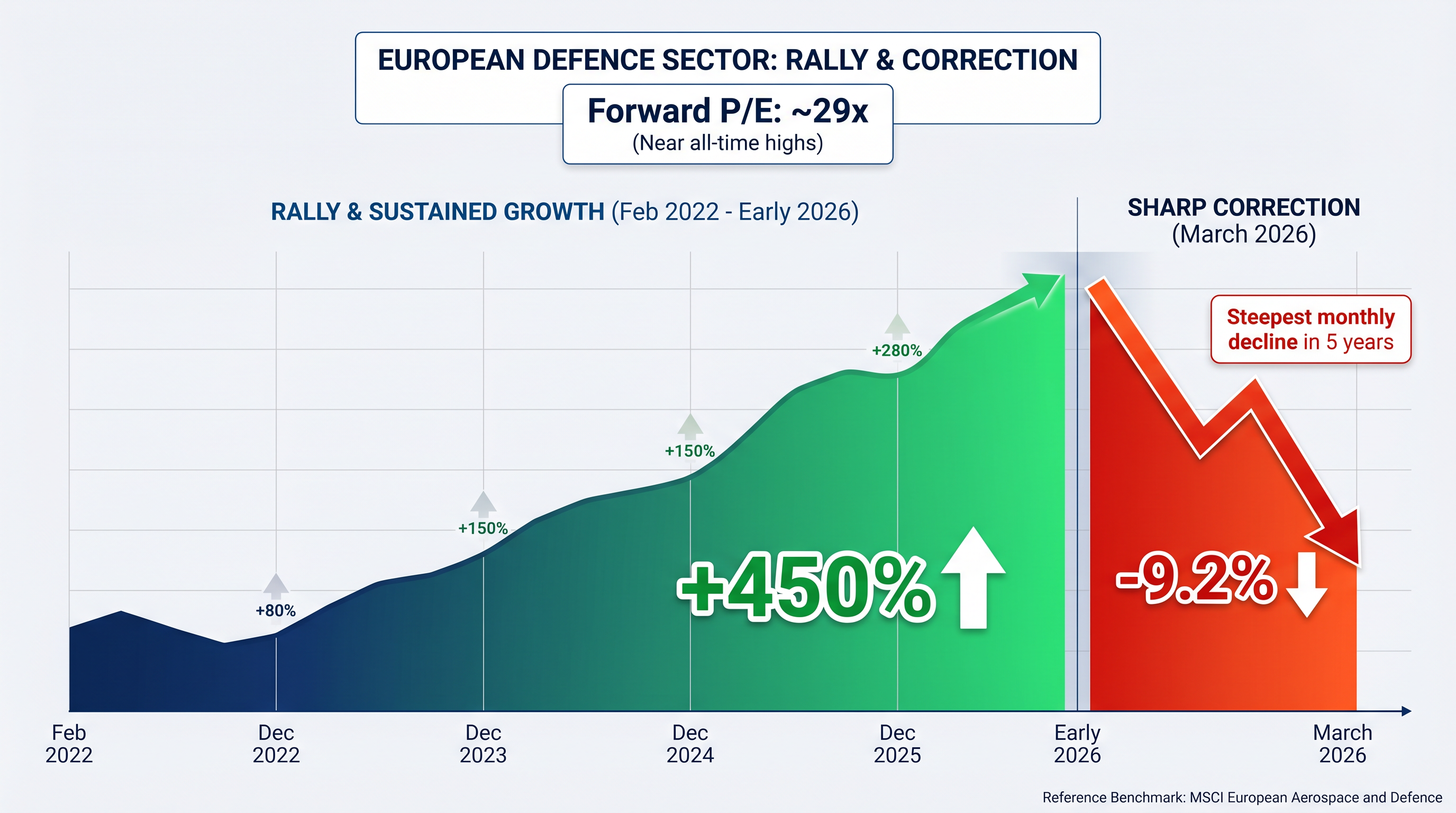
European defence ETFs delivered 450% gains since February 2022 before experiencing their steepest monthly decline in five years during March 2026, creating a pivotal decision point for investors weighing whether the pullback represents opportunity or warning. The 9.2% March correction came as profit-taking collided with fundamental questions about drone technology disrupting traditional defence spending, even as European governments maintain their rearmament commitments and ETF flows show continued investor interest.
This analysis examines the drivers behind the recent volatility, evaluates whether the fundamental investment case remains intact, and provides a framework for assessing entry points and risks for global investors considering European defence exposure.
March correction mechanics and what triggered the selloff
The MSCI European Aerospace and Defence benchmark fell 9.2% in March, its steepest monthly decline in five years. Three distinct forces converged to create the selloff rather than any single catalyst.
First, profit-taking pressure mounted after the sector’s extraordinary multi-year run pushed valuations to stretched levels. Pre-correction forward price-to-earnings multiples stood at approximately 29x, near all-time highs reached the previous year. Investors who had ridden the rally from 2022 began locking in gains.
Second, overcrowded positioning magnified the downward move. Citigroup analysis highlighted how the unwinding of heavily concentrated bullish bets accelerated price swings as both institutional and retail investors reduced exposure simultaneously. Martin Frandsen at Principal Asset Management noted this pattern of coordinated reduction across investor categories.
Citigroup’s analysis showed that overcrowded positioning in European defence equities amplified March’s price swings, with the unwinding of concentrated bullish bets creating a technical cascade beyond fundamental drivers.
Third, the Iran conflict raised uncomfortable questions about warfare evolution rather than triggering the typical wartime defence rally. Individual stock declines reflected this uncertainty: Rheinmetall and Renk each dropped approximately 10%, Saab fell roughly 12%, and CSG declined by around one-third. The factors behind this selloff:
- Profit-taking on stretched valuations after 450% multi-year gains
- Overcrowded positioning unwinding as institutional and retail investors simultaneously reduced exposure
- Warfare evolution concerns as drone technology raised questions about traditional defence spending priorities
The counterintuitive failure of the Iran conflict to generate the expected defence sector boost instead became a catalyst for reassessment, particularly around whether cheaper drone alternatives might displace demand for expensive conventional systems.
The Iran conflict’s broader geopolitical implications extended beyond defence sector volatility to energy markets, where the International Energy Agency described the situation as the “greatest global energy security challenge in history”, a dynamic that shaped the macroeconomic backdrop against which defence equities traded during March 2026.
When big ASX news breaks, our subscribers know first
ETF performance through the volatility and flow resilience
The headline monthly declines masked a more nuanced story when examining year-to-date numbers and flow data. European defence ETFs showed continued fundamental conviction despite March volatility, with price action telling one story and investor flows revealing another.
| ETF Name | Past Month Return | YTD Return | Benchmark Outperformance |
|---|---|---|---|
| WisdomTree Europe Defence | -0.51% | +16.58% | +8.46 pp |
| iShares Europe Defence | -2.24% | +15.67% | +6.73 pp |
| HANetf Future of European Defence | -4.4% | +14.27% | +4.57 pp |
All three major funds maintained strong positive year-to-date gains through 19 March 2026, significantly outperforming their category averages by between 4.57 and 8.46 percentage points. The divergence between monthly declines and YTD outperformance suggests the correction occurred against a backdrop of sustained fundamental strength rather than deteriorating investment thesis.
Flow data during the correction revealed continued investor conviction. Europe-domiciled defence thematic ETFs attracted EUR 3.0 billion in net inflows year-to-date through March 2026. More tellingly, investors continued adding to positions after the Iran conflict began, with WisdomTree reaching $1.32 billion in total 2026 inflows by March.
European defence ETFs attracted significant investor interest after the Iran conflict began, with flows continuing into March despite the 9.2% sector decline, signalling selective buying during weakness rather than capitulation.
WisdomTree’s total 2026 inflows reached $1.32 billion by March, demonstrating that institutional and retail investors continued accumulating positions even as prices pulled back. This pattern of continued net positive flows during price volatility often reveals fundamental conviction more accurately than short-term price movements, providing a signal that sophisticated capital viewed the correction as an opportunity rather than a reason to exit.
Understanding the European rearmament cycle driving defence demand
European defence spending is rising structurally rather than cyclically, underpinned by budget commitments and order backlogs that provide multi-year revenue visibility. Three pillars support this fundamental case:
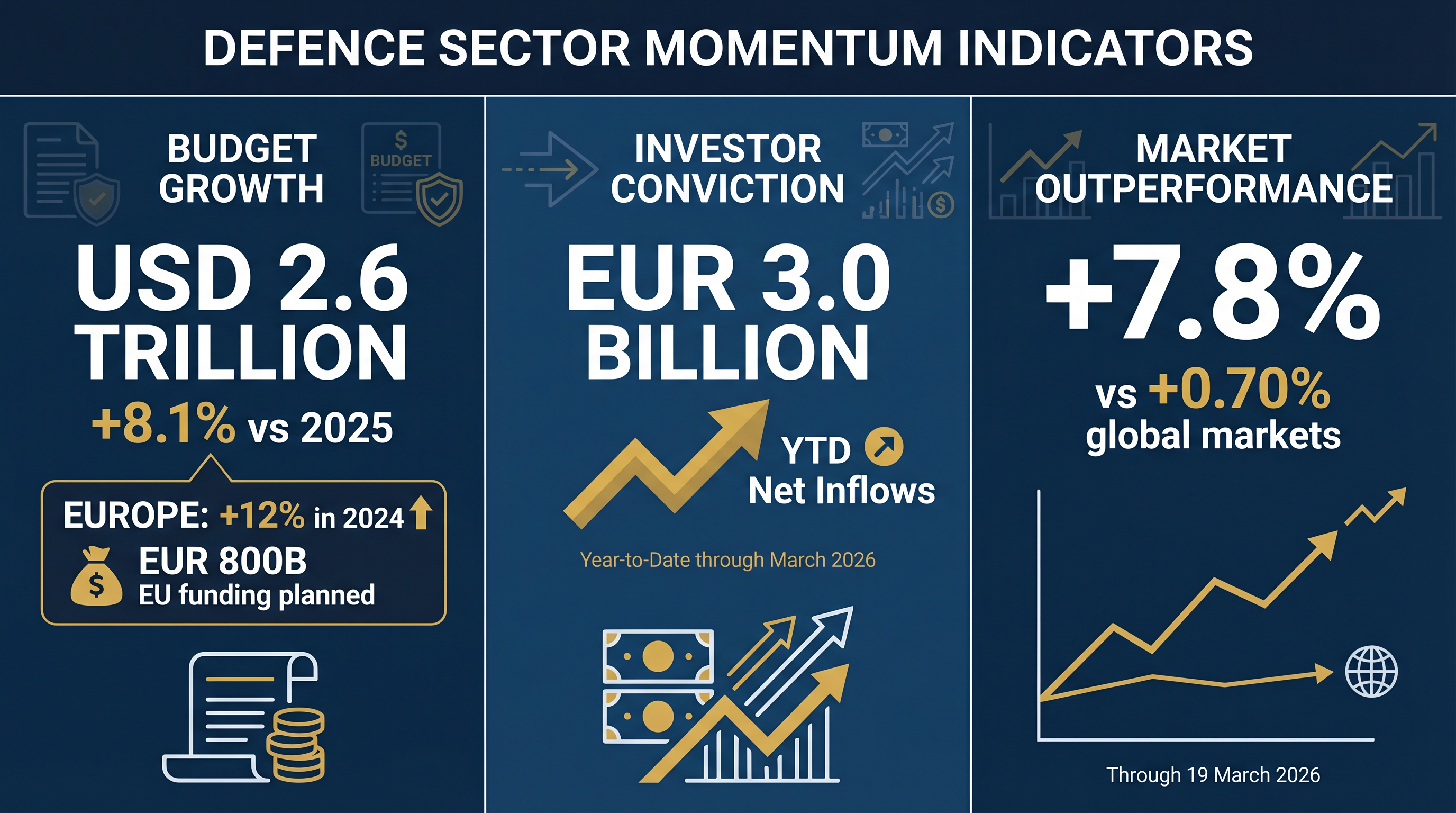
- Government budget growth: Global defence spending is projected to reach USD 2.6 trillion by the end of 2026, representing an 8.1% increase from 2025 levels. European defence spending rose nearly 12% in 2024 alone, with national budget increases across the continent reflecting a sustained commitment rather than a temporary spike.
- Strategic autonomy procurement shift: The European Commission is planning up to EUR 800 billion in defence funding as part of a broader strategic autonomy push. This initiative channels procurement specifically toward European suppliers rather than relying on transatlantic partnerships, creating a structural tailwind for European defence contractors.
- Backlog visibility: Rheinmetall’s record order backlog reached EUR 64 billion by the end of Q3 2025, up approximately 70% year over year. Recent equipment orders secured from Germany, Poland, and Hungary demonstrate continued contract wins beyond the already-substantial backlog.
According to Morningstar, “More global tension leads to higher defense budgets, which eventually means more revenue for defense companies,” a dynamic playing out across European procurement as national security priorities shift.
Morgan Stanley analysts have noted contract award delays due to budgetary constraints in France and the United Kingdom, raising questions about execution pacing. These delays represent timing risk rather than demand deterioration, with the underlying budget commitments and strategic imperatives remaining intact. The gap between contract awards and budget allocations reflects administrative and political processes rather than a fundamental weakening of the investment thesis.
Backlog visibility as revenue proxy
Rheinmetall’s EUR 64 billion backlog translates to multiple years of revenue certainty, providing earnings visibility that insulates the company from short-term cyclical pressures. Order backlogs of this magnitude represent contracted future work rather than speculative pipeline, giving investors a concrete measure of demand.
The execution risk posed by contract delays in France and the UK must be weighed against the sustained budget growth across the broader European theatre. Delays affect the timing of revenue recognition but do not eliminate the underlying demand, particularly as Germany, Poland, and Hungary continue awarding new contracts that add to already-record backlogs.
The drone disruption question and why it matters for valuations
The Iran conflict highlighted a legitimate structural risk facing traditional defence contractors: the cost asymmetry between expensive conventional systems and cheaper drone alternatives. US-manufactured Patriot anti-missile interceptors cost roughly $4 million per unit, while companies like Terra Drone are producing Ukrainian-designed interceptor drones as cheaper alternatives that can achieve similar defensive objectives at a fraction of the cost.
Amundi’s Ciaran Callaghan articulated the bear case around this technology shift, noting the perception that cheaper drone technologies might reduce demand for legacy systems. If military procurement shifts materially toward low-cost drone platforms and away from high-value conventional equipment, the revenue mix at traditional prime contractors could face pressure.
Australian defence contractor DroneShield’s $21.7 million Western military contract package, announced in February 2026, demonstrated how counter-drone technology providers are capturing procurement budgets alongside traditional prime contractors, with the company securing six standalone agreements through an established reseller channel.
According to Amundi’s Ciaran Callaghan, the perception is growing that cheaper drone technologies could reduce demand for expensive legacy defence systems, a structural risk that investors must weigh against established contractors’ ability to adapt.
The counterargument centres on established defence firms’ capacity to integrate rather than be displaced by emerging drone capabilities. Rheinmetall’s partnership with Anduril to co-develop Barracuda and Fury drone platforms demonstrates how traditional contractors are adapting their product portfolios to capture the drone opportunity rather than cede the market to new entrants.
Multiple European defence firms are investing in:
- Drone systems development and production partnerships
- Surveillance technology integration with unmanned platforms
- Counter-drone capabilities to address the defensive requirements created by drone proliferation
Whether drone technology disrupts the sector’s revenue mix or represents a new addressable market that established contractors can capture remains the key uncertainty affecting forward valuations. Investors must weigh the risk of margin pressure from cheaper alternatives against the potential for European defence firms to defend their market positions through technology adaptation and partnership strategies.
Valuation reset and what current multiples signal
The sector’s forward price-to-earnings multiple of approximately 29x prior to the March correction sat near all-time highs, raising questions about whether anticipated budget growth had been fully priced into equities. Hargreaves Lansdown analysts suggested that the rally through early 2026 had incorporated much of the expected European rearmament benefit, leaving limited room for multiple expansion without corresponding earnings delivery.
The March pullback provided some relief from the most extreme valuation levels, though the sector’s year-to-date outperformance demonstrates continued relative strength. The Morningstar Global Aerospace and Defense Index rose 7.8% year-to-date through 19 March 2026 in euro terms, compared to 0.70% for global markets over the same period.
The broader risk appetite shift that drove the Nasdaq’s 13-session winning streak through mid-April created a market backdrop favouring growth and momentum factors over defensive positioning, a dynamic that influenced relative performance across sectors including European defence during the period.
This performance comparison reveals:
- Sector outperformance: Defence up 7.8% versus 0.70% for global markets through mid-March
- Relative strength maintained: Outperformance persisted even after the 9.2% monthly correction
- Valuation context: Forward multiples near historical highs despite pullback
The correction has improved the risk-reward calculus from the most stretched levels reached in early March, but whether current multiples represent attractive entry points depends on whether investors believe the multi-year budget growth thesis can support continued earnings expansion sufficient to grow into the valuation. The sector has not returned to discount territory; it has merely stepped back from premium extremes.
For readers wanting to apply structured valuation frameworks to technology-intensive sectors experiencing divergent performance, our dedicated guide to momentum versus value assessment in technology sectors examines the specific metrics and timing considerations that distinguish chasing unsustainable momentum from recognising genuine fundamental outperformance with room to run.
The next major ASX story will hit our subscribers first
Investment framework for evaluating defence ETF exposure
Investors considering European defence ETF exposure should evaluate three key decision factors rather than relying on a single recommendation applicable to all circumstances:
- Time horizon alignment: The European rearmament cycle is a multi-year structural theme supported by budget commitments and order backlogs, not a short-term tactical trade. Investors with horizons shorter than 12-18 months may experience volatility that obscures the fundamental trajectory.
- Volatility tolerance: March’s 9.2% decline demonstrated the sector’s capacity for sharp corrections despite strong underlying fundamentals. Position sizing should reflect this volatility profile, particularly given the concentration risk in European defence portfolios.
- Technology disruption view: Whether drone technology represents a margin-compressing threat or a new addressable market for established contractors affects the sector’s earnings trajectory. Investors must form their own assessment of this uncertainty when evaluating forward multiples.
| ETF Name | Geographic Focus | AUM | Category Percentile |
|---|---|---|---|
| WisdomTree Europe Defence | European pure-play | £2,418 million | 51st percentile |
| iShares Europe Defence | European pure-play | Not specified | 45th percentile |
| HANetf Future of Defence | Global focus | £308 million | 63rd percentile |
The distinction between pure European exposure (WisdomTree and iShares) versus global defence portfolios (HANetf) affects both regional concentration risk and access to US defence primes. WisdomTree’s substantially larger asset base of approximately £2,418 million since its March 2025 launch reflects its positioning as the primary pure-play vehicle for the European rearmament theme.
Category percentile rankings place all three funds in the middle of their peer groups rather than at performance extremes, suggesting comparable execution against their respective mandates. Investors should evaluate which geographic focus aligns with their conviction around European versus global defence spending trends when selecting between these vehicles.
Conclusion
The March 2026 correction in European defence ETFs resulted from a convergence of profit-taking on stretched valuations, overcrowded positioning, and legitimate questions about drone technology disruption, rather than deterioration in the underlying demand thesis supported by rising budgets and record order backlogs. Flow data showing EUR 3.0 billion in net inflows year-to-date, combined with strong double-digit outperformance and structural spending commitments reaching USD 2.6 trillion globally, suggests the fundamental case remains intact for investors with appropriate time horizons and volatility tolerance.
The key variable to monitor is whether European defence contractors successfully integrate emerging drone capabilities or face margin pressure from cheaper alternatives, a development that will shape the sector’s earnings trajectory over the coming years. The forward price-to-earnings multiple of approximately 29x reflects optimism that the multi-year rearmament cycle can support continued earnings growth, but investors must weigh this valuation against execution risks and technology disruption uncertainties when evaluating entry points.
This article is for informational purposes only and should not be considered financial advice. Investors should conduct their own research and consult with financial professionals before making investment decisions.
Frequently Asked Questions
What are European defence ETFs and how do they work?
European defence ETFs are exchange-traded funds that track baskets of European aerospace and defence companies, giving investors diversified exposure to the sector's rearmament cycle without buying individual stocks. Major examples include WisdomTree Europe Defence, iShares Europe Defence, and HANetf Future of European Defence.
Why did European defence ETFs fall in March 2026?
The 9.2% March 2026 decline was driven by three converging forces: profit-taking after stretched valuations reached around 29x forward earnings, overcrowded positioning unwinding as institutional and retail investors reduced exposure simultaneously, and concerns that cheaper drone technology could displace demand for expensive conventional defence systems.
Are European defence ETFs still a good investment after the March 2026 correction?
The fundamental case remains supported by EUR 3.0 billion in year-to-date net inflows, strong double-digit outperformance versus global markets, and structural spending commitments targeting USD 2.6 trillion globally by end of 2026, though investors must weigh forward multiples of approximately 29x against execution risks and drone technology disruption uncertainties.
How much has European defence spending increased in recent years?
European defence spending rose nearly 12% in 2024 alone, and the European Commission is planning up to EUR 800 billion in defence funding as part of a strategic autonomy initiative that channels procurement specifically toward European suppliers.
What is the drone disruption risk for European defence companies?
The concern is that cheaper drone alternatives, costing a fraction of conventional systems like the $4 million Patriot interceptor, could reduce procurement demand for high-value legacy equipment. However, firms like Rheinmetall are responding by partnering with companies such as Anduril to develop drone platforms, attempting to capture rather than cede the emerging market.