Dollar’s Safe Haven Status Tested as Iran Crisis Triggers 0.2% Gain

Key Takeaways
- The US dollar gained 0.2% during Monday's Asian session after American forces seized an Iranian vessel and Iran closed the Strait of Hormuz, snapping a two-week decline.
- WTI crude surged 5.92% to $87.48 and Brent climbed 5.34% to $95.21, while gold fell 1.45% and silver dropped 2.35%, illustrating classic geopolitical safe-haven rotation mechanics.
- The ceasefire between the US and Iran expires Tuesday, 21 April 2026, with conflicting signals from Washington and Tehran creating elevated headline risk for currency, oil, and regional equity positions.
- Leading currency strategists argue the dollar's safe-haven status has structurally eroded in 2026, with gold, the Swiss franc, and the Japanese yen preferred as crisis hedges over a greenback estimated to be 20% above fair value.
- Asian currency moves were modest and contained, suggesting markets are still pricing US-Iran tensions as a localised risk rather than a broadening global crisis requiring major safe-haven repositioning.
The dollar gained 0.2% during Monday’s Asian session, snapping a two-week decline as geopolitical risk returned to currency markets. The advance came after American forces seized an Iranian vessel over the weekend, prompting Tehran to close the Strait of Hormuz and raising fresh doubts about a fragile ceasefire set to expire Tuesday.
The recovery tests a narrative that has dominated currency strategy discussions in 2026: whether the greenback still functions as a reliable crisis hedge. Structural overvaluation, policy uncertainty, and the rise of alternative safe havens have eroded the dollar’s traditional appeal, even as Treasury bonds continue to rally during risk-off episodes. This article explains what triggered Monday’s dollar strength, how it fits the contested safe-haven debate, and what traders should watch as the US-Iran ceasefire expiration approaches on 21 April.
Vessel seizure and Hormuz closure reignite dollar demand
American forces fired upon and seized an Iranian vessel on Sunday, alleging the ship breached a naval blockade established during recent hostilities. Iran condemned the seizure as a ceasefire violation and responded by closing the Strait of Hormuz, reversing a brief reopening late last week.
The dollar index and futures both advanced roughly 0.2% during Asian hours, reversing recent weakness. Oil markets absorbed the shock immediately, with WTI crude rising 5.92% to $87.48 and Brent climbing 5.34% to $95.21. Gold futures retreated 1.45% to $4,808.74, while silver fell 2.35% to $79.923.
The simultaneous surge in oil and retreat in gold as the dollar strengthened illustrates classic safe-haven rotation mechanics, though the scale remained modest.
Understanding how the Iran conflict developed into the greatest global energy security challenge in history provides essential context for why a single vessel seizure triggered such immediate oil market reactions and renewed safe-haven flows into the dollar despite its structural weaknesses.
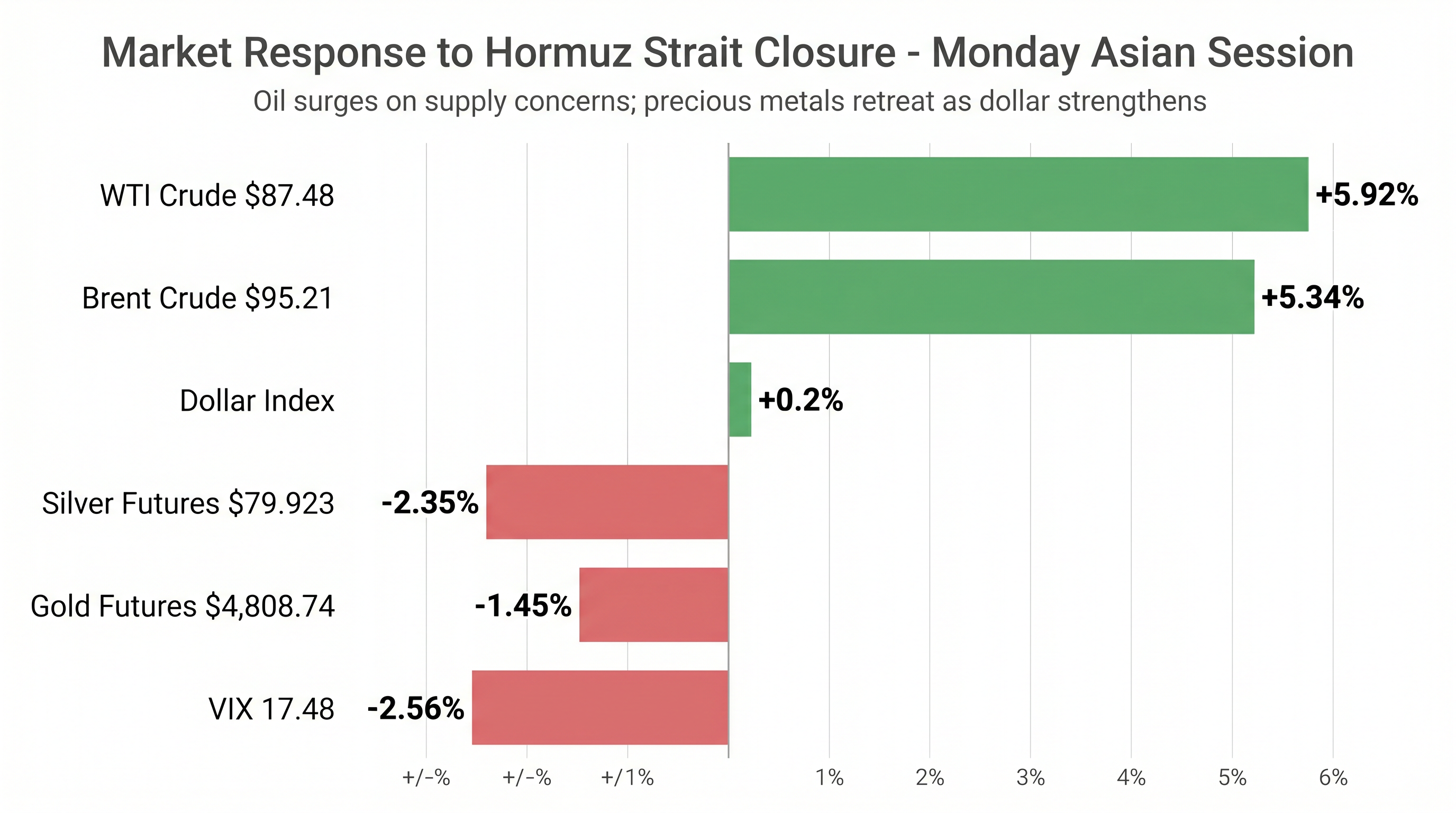
| Asset | Price | Change (%) |
|---|---|---|
| Dollar Index (Asian Session) | N/A | +0.2% |
| WTI Crude | $87.48 | +5.92% |
| Brent Crude | $95.21 | +5.34% |
| Gold Futures | $4,808.74 | -1.45% |
| Silver Futures | $79.923 | -2.35% |
Market Reaction: WTI crude surged 5.92% to $87.48, the sharpest single-session move since hostilities began, as traders priced renewed supply disruption risk.
Readers tracking portfolio exposure to geopolitical risk need to understand which assets absorbed the shock and why. The pattern suggests oil reacted to immediate supply concerns, gold responded to dollar strength rather than crisis escalation, and equity volatility remained contained.
When big ASX news breaks, our subscribers know first
Ceasefire expiration looms as diplomatic signals conflict
President Trump indicated additional negotiations with Iran were planned to occur in Pakistan in the coming days, offering a potential path toward extending the pause in hostilities. Iranian state media suggested Tehran had not agreed to participate in any new discussions, contradicting the White House signal.
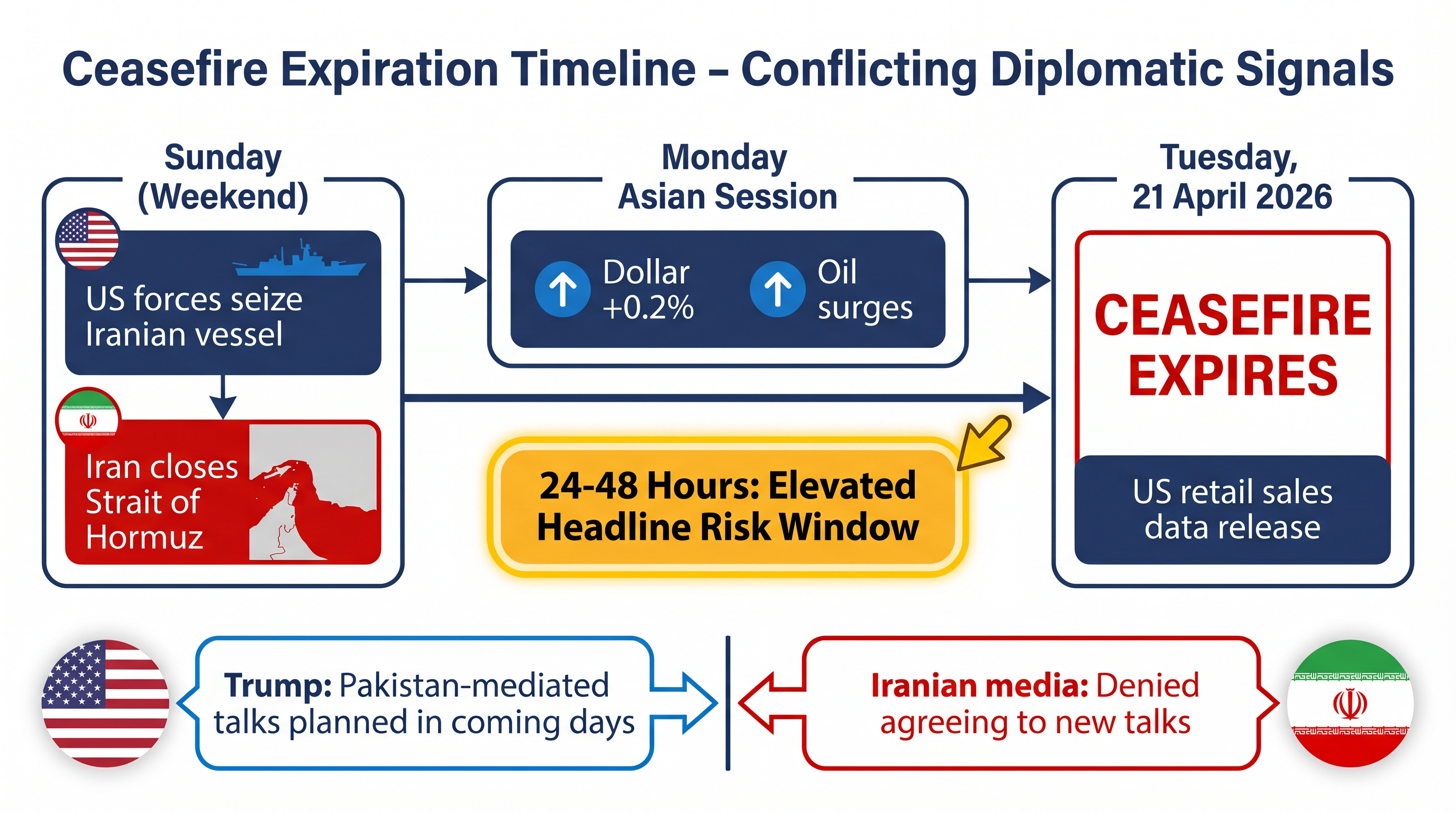
The ceasefire expires on Tuesday, 21 April 2026, less than 24 hours from the weekend’s vessel seizure. Traders cannot price in a clear resolution path when the two sides offer conflicting accounts of whether talks are even scheduled.
Critical Timeline: The ceasefire expires Tuesday, 21 April 2026, with no confirmed diplomatic framework in place to extend it.
Equity markets showed limited alarm, with the VIX falling 2.56% to 17.48 despite the geopolitical developments. The muted volatility response suggests traders still expect Washington to avoid escalation, consistent with patterns observed under the Trump administration since hostilities began.
The equity market complacency visible in Monday’s VIX decline echoes patterns seen after how the April 7 ceasefire triggered $28 billion in US equity fund inflows, suggesting traders continue to price geopolitical events as buying opportunities rather than sustained risk catalysts.
Conflicting diplomatic signals mean the next 24 to 48 hours carry elevated headline risk:
- President Trump announced Pakistan-mediated talks in coming days
- Iranian state media denied agreeing to participate in new discussions
- Tuesday ceasefire expiration creates immediate catalyst for market volatility
Readers with currency, oil, or regional equity exposure should understand why this window matters. A ceasefire extension would likely reverse Monday’s dollar gains and pressure oil prices lower. Renewed hostilities could accelerate the safe-haven rotation, though Monday’s modest moves suggest markets are pricing containment rather than full escalation.
Why strategists question the dollar’s safe-haven credentials in 2026
Monday’s 0.2% dollar gain was real, but currency strategists argue it reflects a short-term geopolitical reflex rather than confirmation of restored safe-haven status. The structural critique has built throughout 2026 as alternative havens outperformed during risk-off episodes.
Steve Barrow at Standard Bank has stated the dollar’s haven status has “vanished,” with gold, the Swiss franc, and the Japanese yen now preferred by traders seeking crisis protection. Kit Juckes at Société Générale described the current environment as “risk-averse but yield sensitive,” suggesting complex dynamics beyond simple safe-haven flows. John Hardy at Saxon Bank blamed Fed credibility gaps on inflation for eroding the dollar’s traditional appeal.
Strategist View: “The dollar’s haven status has vanished,” said Steve Barrow, currency strategist at Standard Bank, with gold, the Swiss franc, and yen gaining instead.
The Cleveland Fed has defended dollar strength via rule of law and institutional credibility, while the Reserve Bank of Australia noted the USD remains at approximately 50% of global reserves and maintains its position as the most liquid reserve currency. These institutional advantages have not prevented the safe-haven erosion strategists describe.
Harvard analysis shows the dollar 20% above fair value, creating mean-reversion pressures that persist regardless of geopolitical shocks. EUR/USD reached 1.18 earlier in April, the first time since late February, illustrating the pre-Monday dollar weakness trend that a single 0.2% gain has not reversed.
Alternative safe havens gaining prominence in 2026:
- Gold, outperforming during recent risk-off episodes
- Swiss franc, attracting safe-haven flows as dollar credibility erodes
- Japanese yen, benefiting from risk-off positioning
Monday’s 0.2% gain does not settle the debate. Readers considering the dollar as a crisis hedge need to weigh short-term geopolitical reflexes against structural overvaluation and alternative havens that have outperformed in 2026.
Structural headwinds the dollar faces
US fiscal deficits, Fed credibility gaps on inflation, and tariff policy uncertainty from the April 2, 2025 “Liberation Day” announcements undermine traditional crisis-driven dollar demand even when geopolitical risk rises.
The April 2, 2025 tariff event triggered a USD sell-off that marked a turning point in safe-haven doubts. Policy unpredictability across trade, fiscal, and monetary domains creates an environment where Treasury bonds rally during crises but the dollar weakens against the yen and Swiss franc. The decoupling suggests bond market safe-haven demand no longer translates to currency strength as it did in past crises.
These factors compound the overvaluation pressure. A dollar 20% above fair value facing structural headwinds may deliver short-term gains during acute shocks, but strategists argue the 2026 environment favours alternatives for sustained crisis hedging.
Geopolitical shocks like Monday’s vessel seizure create immediate tactical questions for investors, but portfolio strategies that have proven effective during 2026’s volatility regime prioritize defensive positioning, alternative safe havens, and sector-specific energy exposure over simple dollar hedging.
The next major ASX story will hit our subscribers first
Asian currencies retreat as traders await key data
The dollar’s Monday strength translated into specific currency pair moves across Asia, with the South Korean won emerging as the weakest regional performer. USD/KRW advanced 0.6%, the largest move among major Asian pairs, as traders repriced geopolitical risk premium.
The Indian rupee declined slightly, with USD/INR gaining 0.1%, though the rupee remains well below record highs reached earlier in April. The Australian dollar retreated 0.2% from near two-year highs, giving back some of the gains supported by Reserve Bank of Australia rate expectations that had previously driven AUD strength.
| Currency Pair | Change (%) |
|---|---|
| USD/JPY | +0.2% |
| AUD/USD | -0.2% |
| USD/KRW | +0.6% |
| USD/SGD | +0.2% |
| USD/INR | +0.1% |
| USD/CNY | +0.04% |
USD/CNY showed minimal movement, gaining just 0.04% and remaining near three-year lows despite the broader dollar strength. The contained yuan weakness suggests Chinese markets are pricing US-Iran tensions as a localised Middle East risk rather than a broader crisis requiring significant safe-haven positioning.
The Asian currency market reactions to the Hormuz incident reveal a broader pattern of risk repricing across regional forex pairs, with geopolitical premium concentrated in currencies most exposed to Middle East energy dependencies.
Traders are watching upcoming data releases for signals on whether the dollar strength can persist beyond the immediate geopolitical catalyst:
- Japanese trade balance and Tokyo core CPI later this week
- US retail sales data releasing Tuesday, 21 April
- Regional central bank commentary on currency volatility
Regional currency exposure matters for global portfolios. The contained losses suggest markets still expect Washington to avoid escalation, consistent with Trump administration patterns since hostilities began. A Tuesday ceasefire extension would likely reverse these moves, while renewed conflict could accelerate the rotation into alternative safe havens rather than sustaining dollar strength.
Conclusion
Monday’s dollar strength was real but modest, driven by a specific geopolitical trigger rather than a resolution of deeper structural doubts about safe-haven status. The 0.2% gain reversed two weeks of weakness but did not challenge the overvaluation, credibility gaps, and policy uncertainty that currency strategists cite as eroding the greenback’s crisis appeal.
The Tuesday, 21 April ceasefire expiration is the immediate watchpoint. Conflicting signals from Washington and Tehran mean traders cannot price a clear resolution path, creating headline risk for currency, oil, and regional equity positions. Beyond the immediate timeline, readers must weigh whether any sustained US-Iran crisis would drive dollar strength or accelerate rotation into alternative havens like gold and the Swiss franc.
Monitor both the diplomatic timeline and cross-asset flows for signals on whether 2026’s safe-haven playbook has genuinely shifted. The pattern so far suggests Monday’s move reflects geopolitical reflex, not restored dollar dominance.
Frequently Asked Questions
Is the US dollar still a safe haven in 2026?
The dollar's safe haven status is contested in 2026. While it gained 0.2% on Monday after an Iranian vessel seizure, currency strategists at Standard Bank and Societe Generale argue gold, the Swiss franc, and the Japanese yen have largely replaced the dollar as preferred crisis hedges.
Why did the US dollar rise during the Iran Strait of Hormuz closure?
The dollar gained 0.2% during Monday's Asian session after American forces seized an Iranian vessel and Iran closed the Strait of Hormuz, triggering a short-term geopolitical reflex into the dollar as traders repriced risk across currency and commodity markets.
How does the US-Iran ceasefire expiration affect currency markets?
The ceasefire expiring on Tuesday, 21 April 2026 creates elevated headline risk for currency, oil, and regional equity positions. A ceasefire extension would likely reverse Monday's dollar gains, while renewed hostilities could accelerate rotation into alternative safe havens such as gold and the Swiss franc.
Which Asian currencies fell the most after the Hormuz closure?
The South Korean won was the weakest regional performer, with USD/KRW advancing 0.6%, while the Australian dollar fell 0.2% and the Indian rupee declined modestly. The Chinese yuan showed minimal movement, gaining just 0.04% against the dollar.
What are the main alternatives to the US dollar as a safe haven asset?
In 2026, gold, the Swiss franc, and the Japanese yen have emerged as the primary alternatives, outperforming the dollar during risk-off episodes as structural overvaluation, Fed credibility concerns, and policy uncertainty erode the greenback's traditional crisis appeal.