#
A supersonic jet startup has signed a power supply deal worth more than $1.25 billion, and it has not yet flown a single commercial passenger.
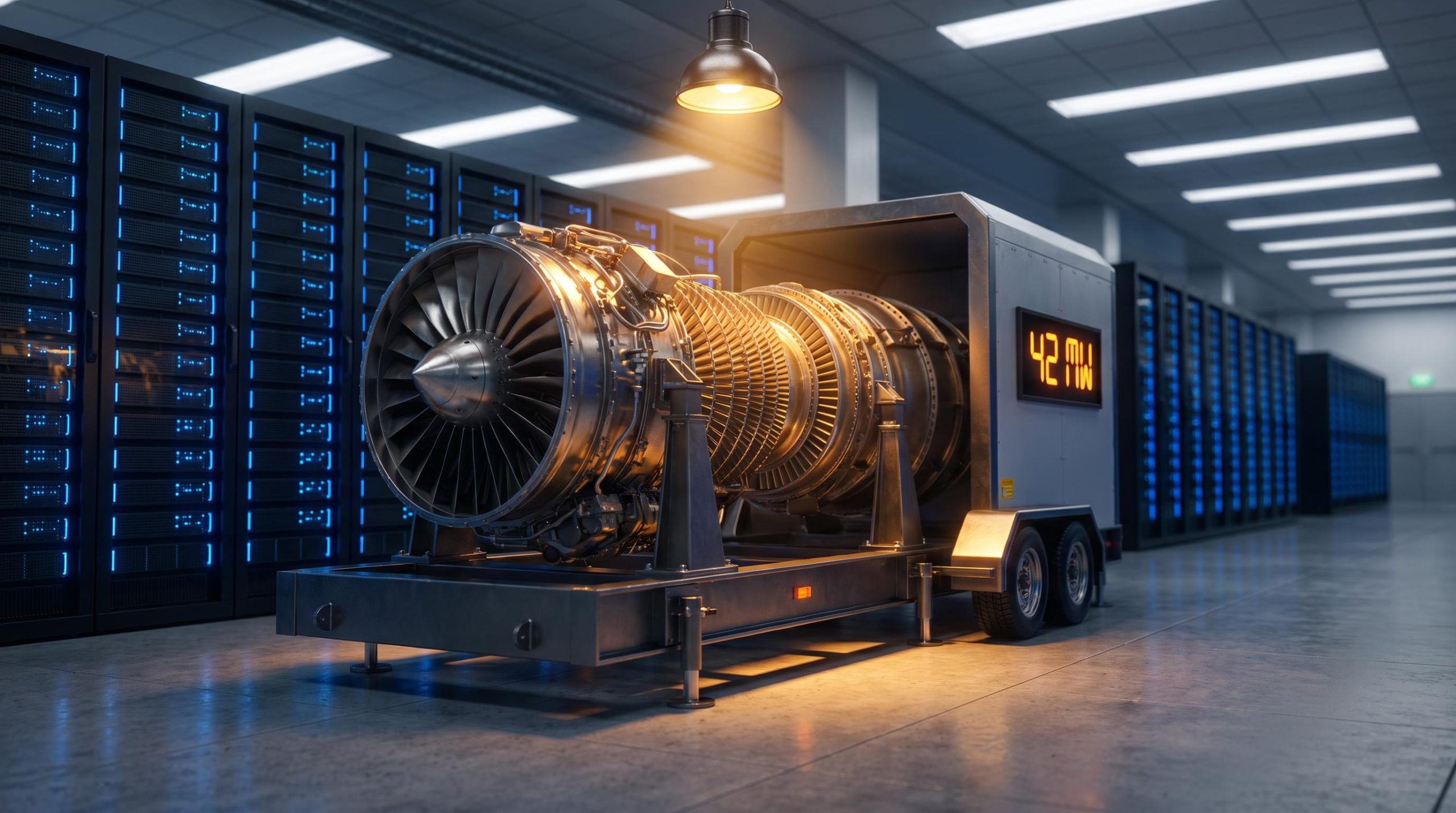
That is the anomaly at the centre of Boom Supersonic’s latest move. The company building America’s next supersonic airliner is now selling ground-based power units to data centres, using the very engine it developed to fly people faster than sound.
The timing is not coincidental. Artificial intelligence infrastructure is creating a power procurement crisis that has nothing to do with aviation, yet Boom has positioned an aerospace product directly inside it. The company does not frame this as a distraction from its flying ambitions. It frames it as the funding mechanism that pays for them.
That is the thesis worth interrogating. The logic is undeniably neat: one engineering programme, two revenue streams, with energy sales bankrolling an uncertified jet.
What follows examines whether the strategy is as elegant as it sounds, or whether the dependencies make it structurally fragile. The engineering leverage is real. Whether the sequence Boom has chosen holds together is a different question entirely.
The engine that could not wait for a runway
Boom Supersonic is developing its Symphony engine entirely in-house, and the decision to do so was born from a costly reversal. After its engine partnership with Rolls-Royce ended, the company brought the entire powerplant programme inside its own walls.
CEO Blake Scholl has been unusually candid about what went wrong the first time around.
“Outsourcing engine development to a large, established company was one of my biggest strategic errors,” Scholl has said, referencing the partnership whose collapse led many in the industry to predict Boom would fail.
The response was a manufacturing philosophy that runs against how legacy aerospace operates. Rather than outsourcing components to optimise return on assets, Boom built a vertically integrated factory where it makes turbine blades and vanes from raw materials, describing the facility as the world’s most advanced jet turbine factory. The first parts came off the line only recently, and the plant is projected to eventually scale toward multiple gigawatts of engine output per year.
The heart of the programme is the Sprint Core demonstrator, a 12-foot-long, 4-foot-diameter high-pressure spool containing the compressor, combustor, and turbine. Boom has completed an ignition test to prove flame stability, with fully operational core prototype testing targeted for 2026.
When big ASX news breaks, our subscribers know first
From turbine to transformer: the Superpower adaptation
Here is where the engineering logic turns commercial. To create the ground-based power unit, branded Superpower, Boom removes the front fan from the engine design and adds a rear generator, converting the aviation core into a stationary generating unit.
Because the aviation engine is built for sustained high-power operation at elevated temperatures, the ground derivative eliminates the need for water cooling entirely. That is a deliberate design choice, not an accident: it directly answers one of the loudest objections to modern data centre power, which is the strain heavy water consumption places on local resources.
The core specifications of the Superpower unit:
That commonality figure is the analytical crux. It tells you Boom is not building two products; it is running one engineering programme that spins off two revenue streams. That single fact reframes how the capital allocation should be judged, because every dollar spent on engine development advances both the jet and the generator at once.
Why data centres became the most urgent customer in aerospace history
Before Boom enters the picture, the demand problem stands on its own. AI-scale data centres are colliding with a physical constraint that money alone cannot fix: they can be built far faster than the grid can connect them.
AI energy demand has reshaped the power procurement calculus for every major hyperscaler, with the IEA projecting data centre and AI electricity consumption to exceed 1,000 TWh by 2026, a doubling in four years that puts sustained pressure on grid operators already running years behind build timelines.
The mismatch is the whole story. According to unverified industry estimates, modern AI data centres can be designed and built in 18-24 months, while grid interconnection queues in major markets now stretch 5-7 years, and occasionally beyond a decade. Gartner has forecast that 40% of AI data centres will face electricity deficits by 2027.
| Metric | Grid connection | Data centre build | The Superpower fit |
|---|---|---|---|
| Timeline | 5-7 years [unverified] | 18-24 months [unverified] | Behind-the-meter, bypasses the queue |
| Constraint | Interconnection backlog | Speed to power | 42MW modular unit, deployable fast |
| Result | Multi-year wait | Ready before power arrives | Closes the gap on-site |
Compounding the pressure, rack power densities have jumped from a historic 5-15 kW to 30-100+ kW for AI workloads, overwhelming existing substations. What this tells you is that the gap between a two-year build and a seven-year grid queue is not a conventional business opening. It is a structural market failure, and it creates a captive customer base for whoever can deliver reliable on-site power at scale.
Data centre power demand projections have escalated sharply enough that Citi has more than tripled its global IT load forecast to 370 GW by 2031 at a 25% CAGR, with agentic AI workloads consuming 20-30 times more compute per user than traditional generative AI compressing what was a decade-long build-out into a far shorter window.
That framing is what makes Boom’s pipeline claims worth taking seriously rather than dismissing as hype.
“Demand for this power product is the highest I have ever witnessed for any offering,” Scholl has said, citing tens of gigawatts of inbound interest in the pipeline.
Treat that as a CEO’s description of interest, not contracted revenue. What is contracted looks like this:
Boom’s stated target is to add more than 10 gigawatts of generating capacity over the next five years. The demand is real; whether Boom can convert it is the question the risk layer answers.
The aeroderivative precedent, and why Boom is running it backwards
Using aircraft engines to generate power on the ground is not novel. It is one of the most successful industrial models in the sector’s history.
Aeroderivative gas turbines, engines lifted from aviation designs and adapted for stationary power, have run industrial and marine applications for decades. GE’s LM series, spanning the LM1600, LM2500, and LM6000, delivers outputs from 13 to over 100 MW. The LM2500 family alone has accumulated roughly 140 million operating hours at approximately 39-42% efficiency.
GE aeroderivative turbine performance data shows the LM2500 family accumulating roughly 140 million operating hours at efficiencies in the 39-42% range, a commercial track record that took decades of flight-certified engine deployment to establish before the ground adaptation was ever attempted.
So the model is validated. The precedent is deep, proven, and commercially enormous. But there is a structural difference in how Boom is executing it, and it changes everything.
| Approach | Engine status at first deployment | Testing hours | Regulatory risk |
|---|---|---|---|
| Legacy aeroderivative (GE, Rolls-Royce) | Fully certified, flight-proven | Millions of flight hours accrued | Low: aviation validation already complete |
| Boom Superpower | Uncertified core, no flight history | Ground tests only, early stage | High: certification still ahead |
Read that comparison and the inversion becomes obvious. Legacy aeroderivatives were adapted after their parent aircraft engines, such as GE’s CF6-80C2, were already fully developed and flight-certified. Boom is doing the reverse: commercialising an uncertified supersonic engine core in industrial use before any flight certification exists.
The precedent tells you the aeroderivative model is not the risk. The sequence is.
The flywheel logic: can ground hours substitute for flight hours?
Boom’s justification for the inversion is a development flywheel. By deploying the engine on the ground first, the company argues, the Overture powerplant accumulates real-world operating hours, positioning it to be among the most extensively tested new jet engines ever certified.
There is genuine merit here. Ground deployment does generate reliability data, and reliability data does strengthen a certification case. Demonstrated durability across many operating hours is exactly the kind of evidence regulators value.
But the logic has a ceiling. FAA airworthiness certification requires flight-specific validation, covering behaviours at altitude, in flight envelopes, and under conditions a stationary generator never encounters. Ground hours support the case. They do not substitute for it. The distance between a running ground unit and a flight-ready engine is precisely where the risk concentrates.
Where the financial interdependency creates a fault line
The elegant dual-use narrative rests on three distinct risk vectors, and they escalate in seriousness:
Start with the regulatory exposure on the power side. Boom’s core advantage is bypassing the grid, but regulators are scrutinising large on-site loads. PJM has proposed rules limiting legacy netting treatment for behind-the-meter loads above 50 MW, with a three-year transition period. A single 42MW unit sits just under that threshold, but any multi-unit site clears it easily, and the direction of travel points toward tighter oversight of exactly the deployments Boom depends on.
Then there is the money. Boom has raised cumulative funding estimated between $900 million and $948 million. The most recent round, closed in December 2025, brought in $300 million led by Darsana Capital Partners, with participation from Altimeter Capital, ARK Invest, Bessemer Venture Partners, Robinhood Ventures, and Y Combinator, placing the company at a roughly $1.5 billion post-money valuation.
“Recent capital raises combined with initial Superpower revenue fully support the ongoing development of the Overture supersonic airliner.” This is Boom’s stated position, not an independently verified financial disclosure.
Here is where the fault line runs. That $1.5 billion valuation is priced on a dual-revenue thesis that real deployment has not yet stress-tested. If Superpower slips on timeline, whether through regulatory friction, technical delay, or slow commercial ramp, the funding runway for Overture’s certification is affected directly and simultaneously.
The interdependency is the feature when both streams run on schedule. It becomes the single point of failure when either one does not. That is the specific risk to price into any assessment of the company, not a vague sense that pre-revenue startups carry danger.
The dual-revenue aerospace model Boom is running has a partial analogue in the eVTOL sector, where Beta Technologies built a diversified strategy spanning cargo, charging infrastructure, and component supply to avoid single-stream dependency — demonstrating that pre-certification aerospace companies can construct staged revenue architectures, though Beta’s $971 million cash runway underscores how capital-intensive the certification gap remains.
Whether the pivot holds depends on what breaks first
Pull the four threads together and the picture is genuinely unresolved rather than tilted in one direction. The engineering leverage is real, evidenced by the roughly 80% hardware commonality. The market demand is structurally grounded in the grid-versus-build mismatch. The aeroderivative precedent is validated by decades of industrial use.
The novel risk is the sequence. No direct historical analogue exists for commercialising an uncertified engine core industrially before flight certification, which means the flywheel argument cannot be checked against a prior case.
One variable determines the outcome above all others: whether Boom can deploy Superpower units at commercial scale before its funding runway requires Overture to start generating its own revenue. That is a sequencing question, not a binary verdict.
The milestones that matter most
The next 12-18 months offer concrete signposts. Track these:
No independent analyst forecasts for Boom’s Superpower revenue timeline appear in the available research, so weight the company’s own projections accordingly. These four milestones will validate or invalidate the dual-use model more decisively than any further capital raise.
This article is for informational purposes only and should not be considered financial advice. Investors should conduct their own research and consult with financial professionals before making investment decisions. Past performance does not guarantee future results, and financial projections are subject to market conditions and various risk factors. Forward-looking statements are speculative and subject to change based on market developments and company performance.