Apple Gains China Share as Market Falls 4%, Rivals Struggle

Key Takeaways
- Apple shipped 13.1 million iPhones in China in Q1 2026, achieving 20% year-over-year growth while the overall market contracted 4%.
- Apple's 19% market share secured second place behind Huawei, with growth momentum nearly three times that of the market leader.
- Superior supply chain capabilities allowed Apple to absorb rising memory chip costs without raising prices, giving it a decisive competitive edge as rivals passed cost increases to consumers.
- Xiaomi's 35% shipment collapse redistributed significant market share, directly benefiting Apple and reinforcing the concentrated nature of China's top-six smartphone landscape.
- With fiscal Q2 2026 earnings due 30 April 2026 and Counterpoint Research projecting continued Apple outperformance, China remains a critical growth engine for investors to monitor.
Apple defied a contracting Chinese smartphone market in Q1 2026, posting 20% year-over-year shipment growth while the overall market declined 4%. The Cupertino-based tech giant shipped 13.1 million iPhones during the January-March period, capturing 19% market share and securing second place behind Huawei, according to preliminary data released by Counterpoint Research on 17 April 2026.
This performance marked the strongest growth among the top six brands, which collectively hold 94% of China’s smartphone market. Apple’s momentum came from multiple strategic advantages: strong iPhone 17 series demand, effective promotional pricing, government subsidy programme leverage, and superior cost absorption during the global memory chip shortage that pressured competitors.
Breaking Down Apple’s Q1 2026 China Performance
Apple’s 13.1 million units shipped in Q1 2026 represented a substantial increase from 9.2 million units in the same quarter last year. The preliminary data from Counterpoint Research, released 17 April 2026, provides reliable early indicators of Apple’s performance in the world’s largest smartphone market.
The market reaction to the 17 April data release showed investor enthusiasm for Apple’s China performance, with the stock advancing while broader tech showed mixed results that day.
| Metric | Q1 2025 | Q1 2026 | Change |
|---|---|---|---|
| Shipments (units) | 9.2M | 13.1M | +20% YoY |
| Market Share | Data not specified | 19% | Second place |
| Overall Market Growth | Baseline | -4% | Market contraction |
Counterpoint Research identified several growth drivers behind Apple’s outperformance. The iPhone 17 series generated strong consumer demand in China’s premium segment. Apple deployed strategic promotional pricing at key moments to capture market share, whilst effectively leveraging government subsidy programmes designed to stimulate smartphone upgrades.
Apple effectively leveraged the State Council’s consumer electronics subsidy framework designed to stimulate smartphone upgrades, which created policy tailwinds for premium device sales throughout 2025-2026.
Perhaps most significantly, Apple absorbed rising memory chip costs without passing price increases to consumers. This operational capability proved decisive as the top six brands maintained 94% market concentration, but the overall market declined 4% due to supply chain disruptions and component cost pressures that forced competitors to raise entry-level device prices.
When big ASX news breaks, our subscribers know first
Understanding China’s Smartphone Market Dynamics
China’s smartphone market operates as a highly concentrated battleground dominated by six major players holding 94% of total share. Domestic brands compete intensely on price and features, creating a challenging environment for foreign manufacturers. The market represents the world’s largest smartphone consumer base, making performance here critical for global device makers.
The 4% market decline in Q1 2026 stemmed from multiple converging factors:
- Global memory chip shortage (rising component costs forced manufacturers to raise prices or absorb margin pressure)
- High 2025 baseline (government subsidies in 2025 pulled forward demand, creating tough comparisons)
- Supply chain disruptions (ongoing logistics challenges affected production and distribution)
- Consumer caution (economic uncertainty dampened discretionary spending on device upgrades)
Apple’s 20% growth against a 4% market decline required taking share directly from competitors, not simply riding market tailwinds. This share capture occurred whilst competitors faced the same component cost pressures, highlighting Apple China market share gains as a genuine competitive achievement rather than a market expansion benefit.
Competitive Landscape: How Apple Stacks Up Against Huawei and Chinese Rivals
Huawei maintained the top position with 20% market share and 7% year-over-year growth to 13.9 million units, its highest shipment levels since Q4 2020. However, Apple’s 20% growth rate nearly tripled Huawei’s expansion, demonstrating superior momentum despite the second-place ranking.
| Brand | Market Share | YoY Growth | Key Driver |
|---|---|---|---|
| Huawei | 20% | +7% | Flagship devices and affordable Enjoy 90 series |
| Apple | 19% | +20% | iPhone 17 demand and cost absorption strategy |
| Xiaomi | 12% | -35% | Tough prior-year comparison base |
| Vivo | Data not specified | +2% | Lunar New Year sales boost |
| Oppo | Data not specified | -3% to -5% | Price pressure challenges |
| Honor | Data not specified | -3% | Market contraction impact |
Xiaomi experienced a dramatic 35% shipment collapse, falling from 13.3 million units in Q1 2025 to 8.7 million units in Q1 2026. Market share plummeted from 19% to 12%. Whilst partly explained by tough prior-year comparisons following strong 2025 government subsidy-driven sales, this represented significant market share redistribution that benefited both Apple and Huawei.
Rising memory chip costs created a competitive advantage for Apple according to Counterpoint Research. As competitors raised entry-level device prices to offset component costs, Apple’s premium positioning remained stable. The company’s superior supply chain capabilities enabled internal cost absorption, preserving pricing power whilst rivals passed increases to consumers. Ivan Lam, Senior Analyst at Counterpoint Research, specifically praised this strategic positioning in his 17 April 2026 analysis.
Strategic Factors Behind Apple’s China Resurgence
The iPhone 17 series drove strong demand amongst Chinese consumers, who increasingly value Apple’s perceived three-year product durability. This longevity perception enhances the value proposition for premium purchases in a market where total cost of ownership influences buying decisions.
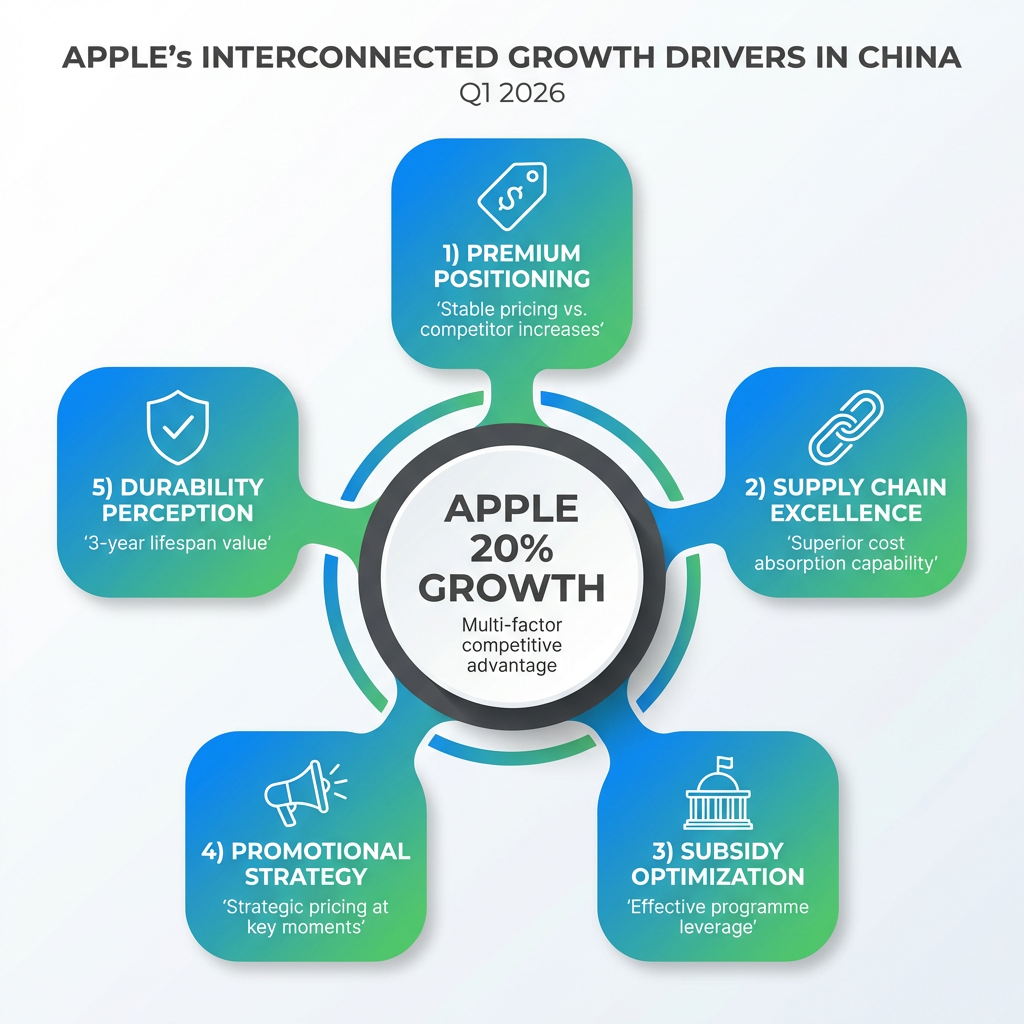
Apple’s strategic advantages identified by analysts include:
- Premium market positioning (stable pricing strategy whilst competitors raised entry-level prices)
- Supply chain excellence (superior cost absorption during memory chip shortage)
- Subsidy optimisation (effective leverage of government subsidy programmes)
- Promotional effectiveness (strategic pricing promotions deployed at key moments)
- Brand durability perception (Chinese consumers value iPhone’s three-year usable lifespan)
> Analyst Commentary
> “Apple’s premium positioning and supply chain strength enabled the company to maintain pricing stability whilst competitors raised prices amid rising memory chip costs,” said Ivan Lam, Senior Analyst at Counterpoint Research, in commentary released 17 April 2026.
Apple’s Q1 2026 calendar performance connected directly to fiscal results reported earlier. China revenue grew 38% in fiscal Q1 2026 (ending 27 December 2025), with CEO Tim Cook stating the company achieved its strongest-ever iPhone quarter in Greater China. This momentum carried seamlessly into calendar Q1 2026, demonstrating sustained rather than temporary strength.
This momentum aligned with Apple’s official investor disclosures on Greater China performance, which detailed the 38% fiscal Q1 revenue growth and management’s commentary on achieving the strongest-ever iPhone quarter in the region.
The next major ASX story will hit our subscribers first
What Apple’s China Momentum Means for Investors and the Market
Counterpoint Research expects Apple and Huawei to continue outperforming competitors in Q2 2026 as price pressures persist across the market. Premium devices are positioned to sustain momentum whilst rivals struggle with component cost management and margin compression.
Apple’s fiscal Q2 2026 earnings release is scheduled for 30 April 2026, covering the quarter ending 28 March 2026. Wall Street consensus expects 14% revenue growth. China performance will face particular scrutiny from analysts and investors assessing whether Q1 2026’s 20% shipment growth translates to similar revenue acceleration.
With the 30 April 2026 earnings release and broader risk factors approaching, investors are weighing Apple’s strong China momentum against tariff headwinds that could impact forward guidance and valuation multiples.
Apple’s 21% global smartphone market share leadership in Q1 2026 provides broader context, with strong China performance reinforcing the company’s position in its second-largest geographic market and supporting the overall growth narrative.
The Bottom Line on Apple’s China Market Share Growth
Apple’s 20% shipment growth amid a 4% market decline demonstrates strategic resilience and competitive strength rooted in operational excellence rather than temporary market conditions. Whilst Huawei leads on absolute market share, Apple commands superior growth momentum through premium positioning stability, supply chain capabilities, and effective cost management during component shortages.
With fiscal Q2 2026 earnings approaching on 30 April and Counterpoint Research expecting continued outperformance through Q2 2026, Apple China market share gains warrant close monitoring by investors. The iPhone maker has converted what represented a vulnerability in recent years into a meaningful growth engine, capturing share in the world’s most competitive smartphone market through product strength and strategic execution.
For investors considering positions based on China’s operational strength, understanding Apple’s valuation framework helps assess whether 20% shipment growth justifies current market pricing and forward multiples.
This article is for informational purposes only and should not be considered financial advice. Investors should conduct their own research and consult with financial professionals before making investment decisions.
Frequently Asked Questions
What is Apple's market share in China in Q1 2026?
Apple held 19% market share in China in Q1 2026, ranking second behind Huawei's 20%, after shipping 13.1 million iPhones — a 20% year-over-year increase according to Counterpoint Research.
How did Apple grow shipments in China while the overall market declined?
Apple leveraged strong iPhone 17 demand, strategic promotional pricing, government subsidy programme optimisation, and superior cost absorption during the global memory chip shortage, allowing it to take share directly from competitors while the broader market fell 4%.
When does Apple report fiscal Q2 2026 earnings and what should investors watch?
Apple's fiscal Q2 2026 earnings are scheduled for 30 April 2026, with Wall Street expecting 14% revenue growth; investors will closely scrutinise whether the 20% Q1 China shipment growth translates into comparable revenue acceleration.
How does Apple's China growth compare to Huawei and Xiaomi in Q1 2026?
Apple's 20% growth nearly tripled Huawei's 7% expansion, while Xiaomi suffered a dramatic 35% shipment collapse from 13.3 million to 8.7 million units, with much of that redistributed share benefiting Apple and Huawei.
Why did the Chinese smartphone market decline in Q1 2026?
The 4% overall market contraction was driven by a global memory chip shortage raising component costs, a tough comparison base from subsidy-driven 2025 demand, supply chain disruptions, and consumer caution amid broader economic uncertainty.