Dallas Federal Reserve President Lorie Logan said on Friday that the Federal Open Market Committee (FOMC) needs to deliver at least two more 25-basis-point increases. She added that a skipped meeting along the way would not alter where policy ends up. Her remarks put a firmer timeline on the next Fed rate hike debate.
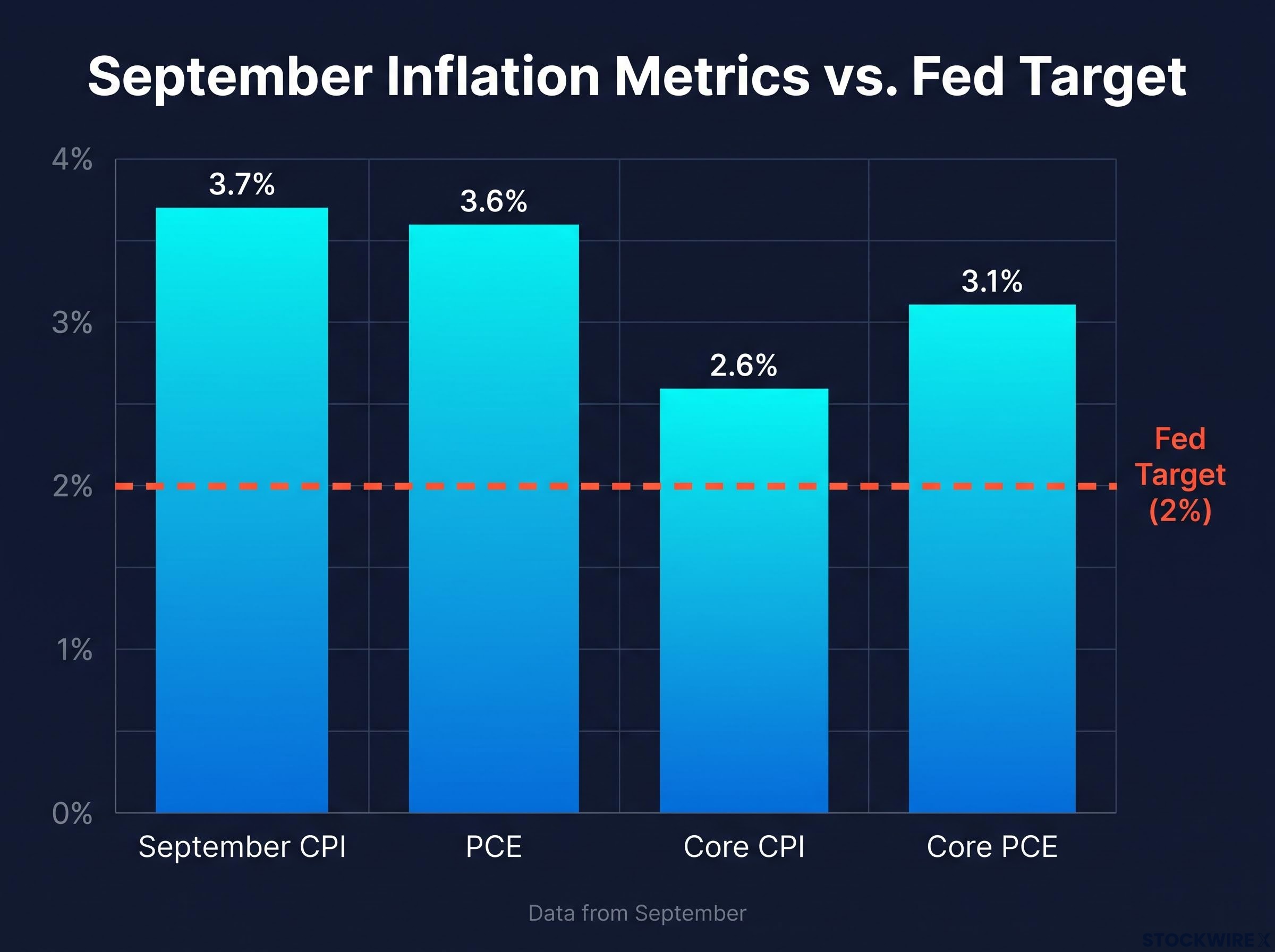
The timing matters. The federal funds target range sits at 3.75%-4.00%. September’s consumer price index (CPI) ran at 3.7% year on year, and the personal consumption expenditures (PCE) price index, the Fed’s preferred inflation gauge, came in at 3.6%. Both are well above the Fed’s 2% target.
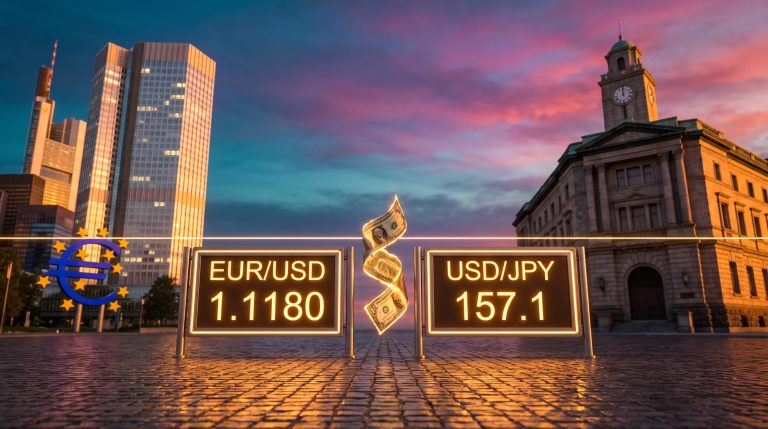
Markets had already moved on the same expectations. Gold, the US dollar and the yen all traded on the question of when the Fed tightens next.
The core message is that a pause is not the end of tightening. Here is how to read that signal across gold, the dollar and USD/JPY, and which dates decide what happens next.
How is the Fed rate hike outlook moving gold, the dollar and USD/JPY?
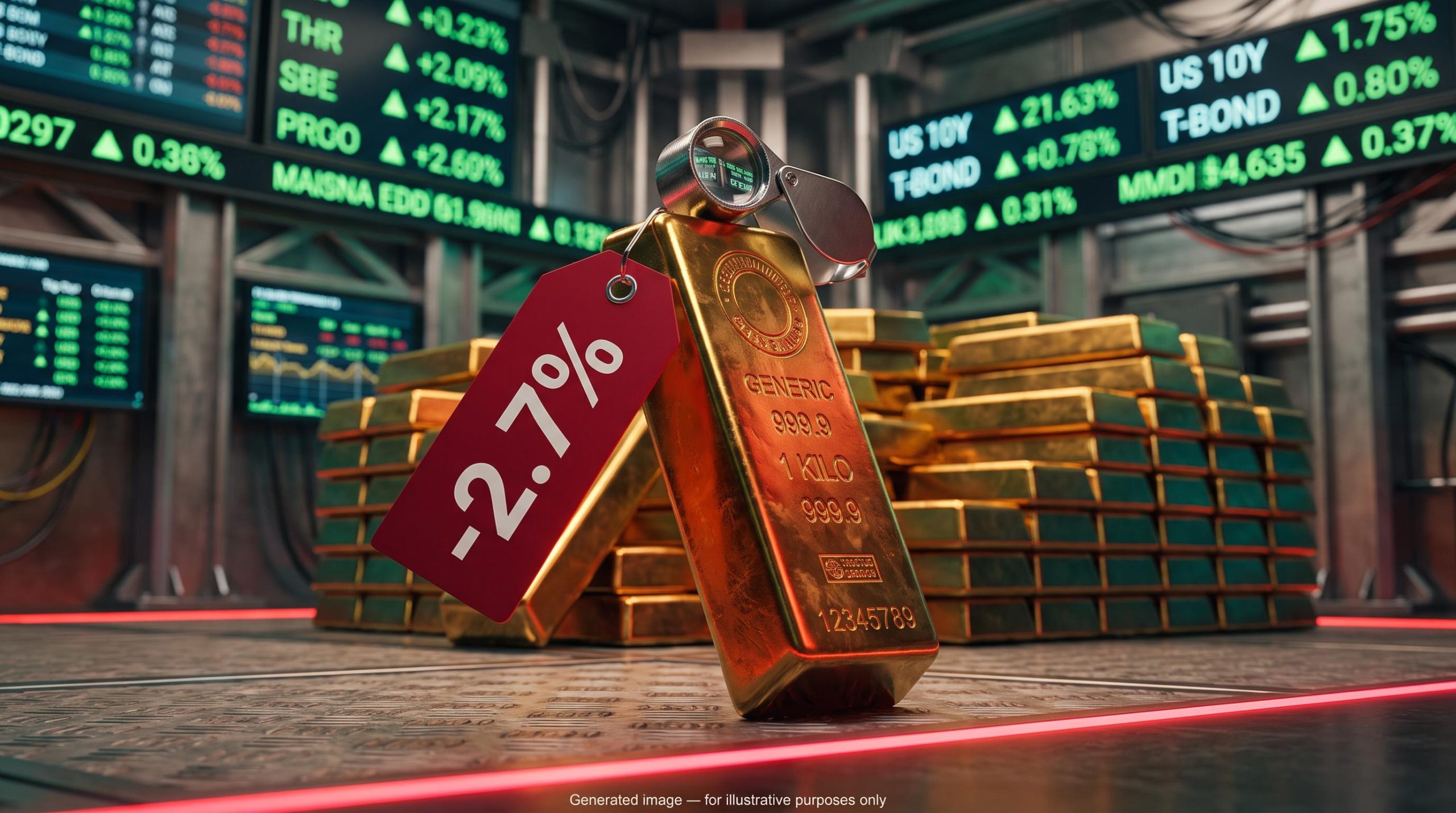
On Friday, gold changed hands around or just below $4,000 an ounce. It touched a year-to-date low of about $3,941 and is on track to finish the month lower.
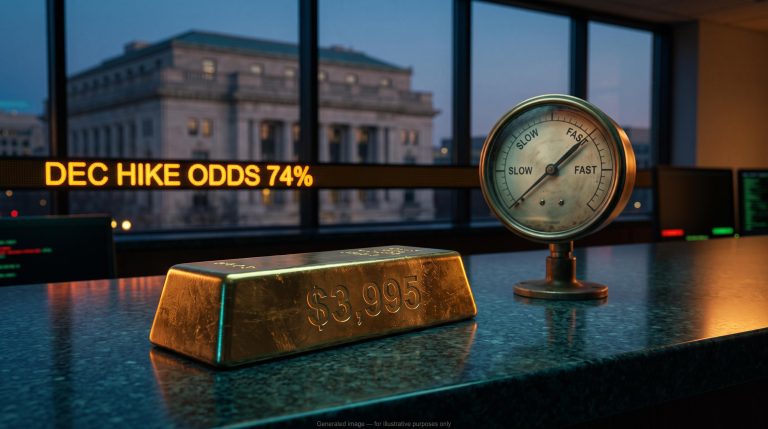
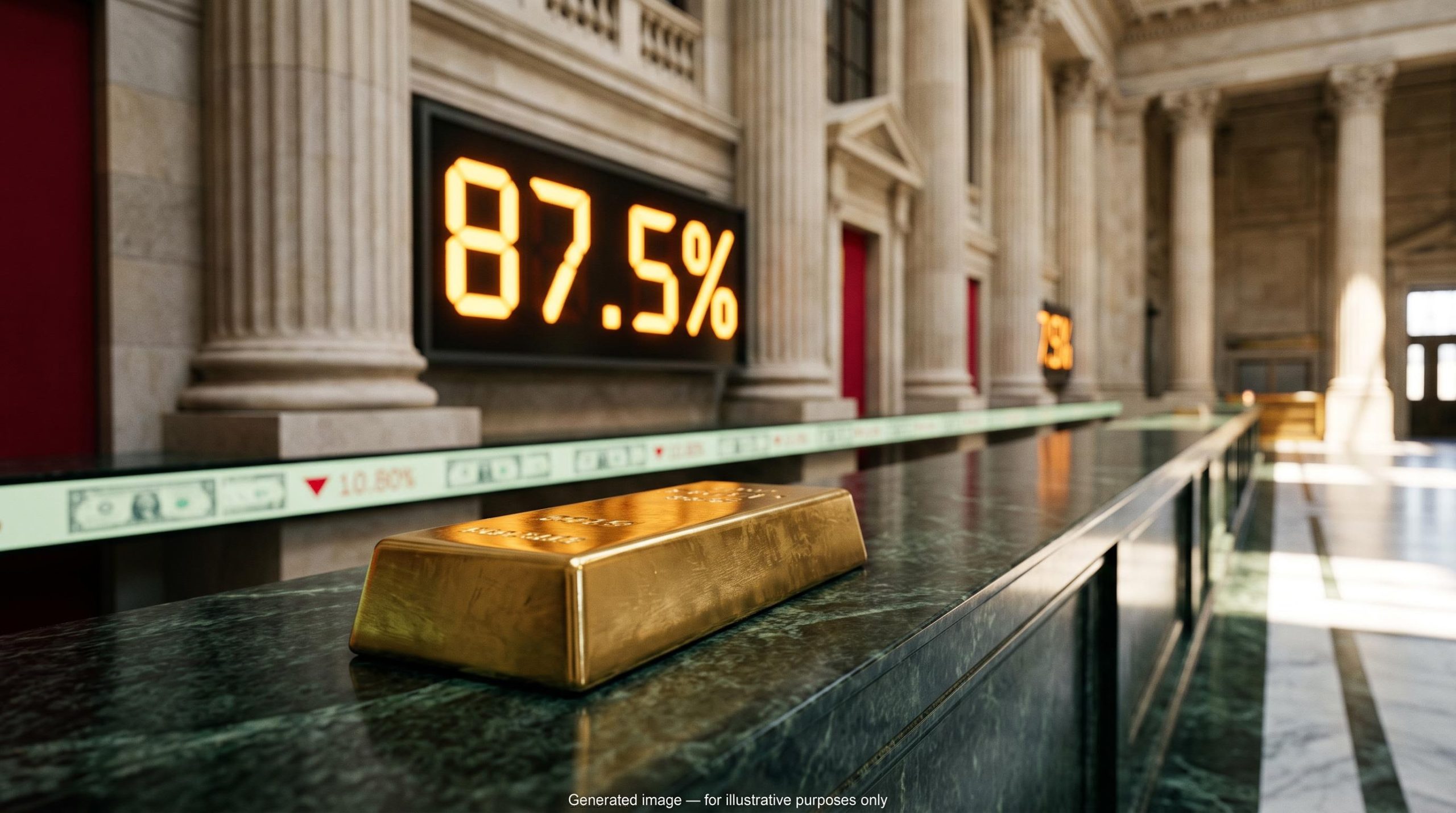
The pressure traces back to one number. CME FedWatch put the probability of a December hike at 87.5% after this week’s Fed decision, according to Admiral Markets on 30 October. That is a jump from the 73% Kiplinger reported on 29 October, an older reading that sources have since moved past.
Bank of America’s forecast of repeated 25-basis-point hikes through year-end, alongside a long US dollar position, shows how some desks expected the Fed to be more hawkish than market pricing implied.
| Asset or policy | Latest level or decision | Main driver |
|---|---|---|
| Gold | Around or just below $4,000; YTD low about $3,941 | Strong US data, hot PCE, rising December hike odds |
| USD/JPY | Around 157.00, third straight daily fall | Hawkish BoJ hold against Fed-driven dollar support |
| AUD/USD | About 0.7035 | Hot Australian CPI and RBA hike bets |
| BoJ policy rate | Held at 1.25%, 8-1 vote | Upgraded inflation outlook, December left open |
Why gold slipped
Gold pays no interest. When US yields climb, holding it costs you more in income you give up, and a firmer dollar makes it pricier for buyers outside the US. Fading hopes of rate cuts also weaken gold’s appeal as a hedge against falling real yields, which are interest rates after inflation.
Why the yen held up
Fed tightening usually lifts USD/JPY by widening the gap between US and Japanese yields. Not this week. The Bank of Japan (BoJ) held at 1.25%, but board member Hajime Takata dissented in favour of 1.50%, the bank raised its inflation outlook, and December stayed open.
The Aussie told a similar story, rising to about 0.7035 as hot Australian CPI fed bets on Reserve Bank of Australia (RBA) hikes. The dollar weakened against Asian currencies overall.
For you, the takeaway is that one Fed expectation is pulling assets in different directions. A hike signal does not guarantee a one-way dollar trade when other central banks are tightening too.
What did Logan actually say about pace, endpoint and long-term rates?
At first, her position sounds contradictory. Logan backs a pause, yet she wants more hikes.
“It remains clear to me, given the current outlook, that the FOMC needs to implement at least two more 25-basis-point rate increases,” she told Davidson College students, according to Reuters. After that, she said, it would make sense to pause and examine economic and financial developments.
The contradiction resolves once you separate speed from destination.
Logan on the path ahead “Skipping a meeting does not change the monetary policy destination.” (via Bloomberg)
She made three supporting arguments:
- Gradualism: A measured pace gives households, businesses and markets time to adjust, and lowers the risk that activity deteriorates “more sharply than necessary.”
- Financial conditions: She described conditions as a “tailwind to economic growth” and said higher market rates are “more a message that investors believe monetary policy has work to do than an independent headwind for activity,” per Reuters.
- Long-term rates: The exact timing of hikes has little effect on longer-term borrowing costs if markets understand the Fed’s plan.
Her starting point is that 50 basis points of hikes have already been delivered, which makes a pause reasonable to assess their effect. Her stated endpoint is “modestly restrictive” policy. She described growth as strong, consumer spending as solid and the labour market as balanced.
The inflation data backs her case. Core CPI, which strips out food and energy, was 2.6% in September, while core PCE was 3.1%. Headline readings of 3.7% and 3.6% remain far from 2%.
What this tells you is that a Fed pause would be a timing choice, not a retreat. Rate and yield expectations should not be marked down just because a meeting passes without a move, which is why long-term borrowing costs may stay firm either way.
Fed officials’ rate projections from mid-September already pointed to further tightening, with sixteen of 18 policymakers expecting at least one more hike, which fits Logan’s argument that a pause would not end the cycle.
Who else on the FOMC is leaning her way, and what comes next?
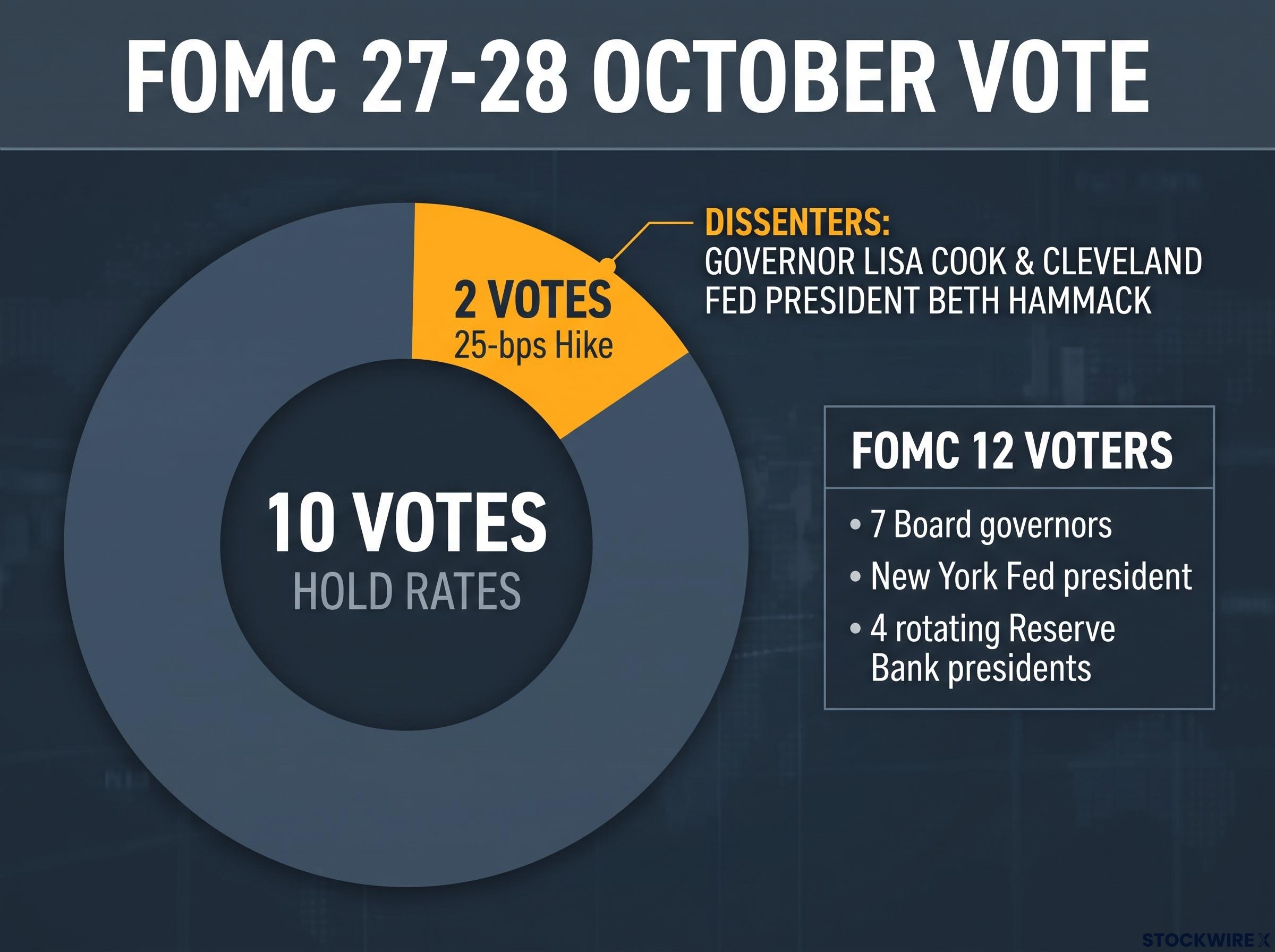
Logan is not a lone voice. At the 27-28 October meeting, the committee held rates on a 10-2 vote, with Governor Lisa Cook and Cleveland Fed President Beth Hammack preferring an immediate 25-basis-point hike.
Logan and Minneapolis Fed President Neel Kashkari had favoured a hike in July but backed the October hold. PIMCO read that as willingness to tighten gradually rather than at every meeting, describing the Fed’s stance as a pause with a clear tightening bias.
The vote count makes sense once you know how the committee is built. According to the Fed’s “About the FOMC” page, updated 29 October 2026:
- Twelve voters sit on the FOMC: the seven Board governors, the New York Fed president and four rotating Reserve Bank presidents.
- Rotation runs in one-year terms, with Dallas grouped alongside Atlanta and St. Louis.
- Eight meetings are scheduled each year, and non-voting presidents still join the discussion and shape the assessment.
That last point is why Logan’s speech matters. Her reasoning feeds directly into the committee debate.
The next meeting runs 8-9 December, with the decision due on 9 December. CME FedWatch currently prices that hike at 87.5%.
For you, the split shows the argument inside the Fed is about timing rather than direction. The data between now and 9 December will decide whether the next move is a hike or a pause.
What a gradual path means for the next Fed decision
Logan’s message reduces to one idea: a pause is not an endpoint. With markets already pricing a December move at 87.5%, the bar for surprising traders is high in either direction.
The dollar story is less simple. A hawkish BoJ and RBA hike bets are pushing back against Fed-driven dollar strength, which is why USD/JPY slipped even as US hike odds rose.
Three things are worth watching from here. The first is the 8-9 December FOMC meeting. The second is the next CPI and PCE prints, which will test whether inflation justifies the path Logan described. The third is whether the BoJ uses its December optionality, which could keep pressure on USD/JPY whatever the Fed decides.
This article is for informational purposes only and should not be considered financial advice. Investors should conduct their own research and consult with financial professionals before making investment decisions.