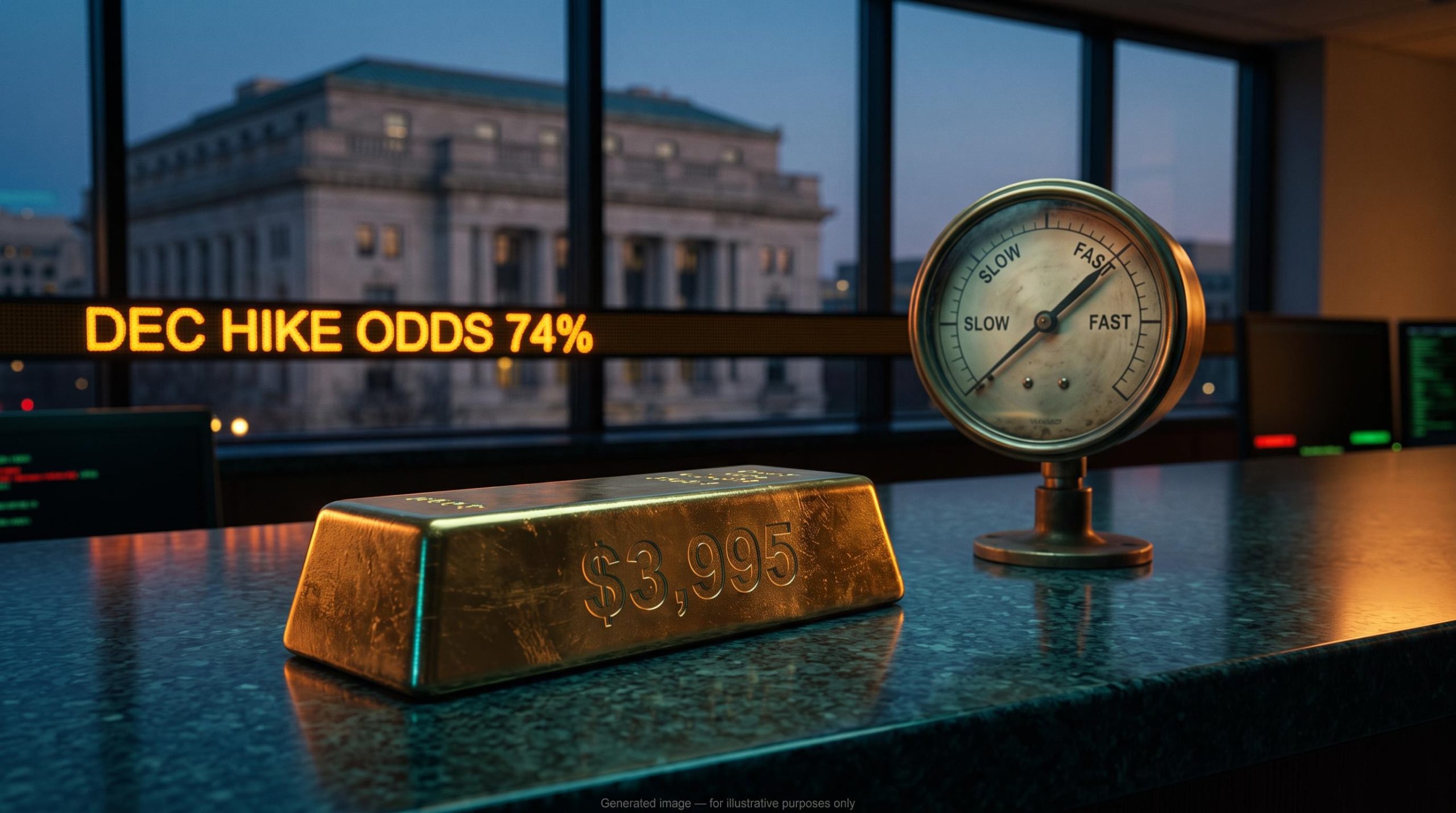
Gold traded near $3,995 an ounce on Friday, 30 October 2026, close to its lowest level since mid-July. On the same day, a senior Federal Reserve official said the argument inside the central bank has moved on from whether to keep raising rates. The question now is how fast.
Richmond Fed President Thomas Barkin told SiriusXM’s Business Briefing that the Fed’s “direction of travel” is clear and that only the pace of further tightening remains open. He backed a gradual, step-by-step approach.
He gave no size or timing for the next increase.
Barkin’s silence on size and timing fits the Fed’s current approach, in which the removal of forward guidance leaves inflation prints and speeches as the main drivers of rate expectations.
That gap matters because markets are left to price the Fed’s pace on rate hikes from data and speeches alone. Here is how one signal about pace moves the dollar, Treasury yields and gold, and which dates are worth watching before December.
Why gold and the dollar are moving on a pace signal, not a direction signal
Start with the screen. Spot gold sat around $3,995.42, with December futures near $4,005.50, according to CNBC. Gold had already touched about $3,975 on 24 October, its lowest since 20 July, Reuters reported, and the metal is on track for a second consecutive monthly decline.
The dollar told a messier story. Reuters had the dollar index (DXY, which measures the dollar against six major currencies) down about 0.2% on the session but up about 0.3% for October, heading for a second monthly gain.
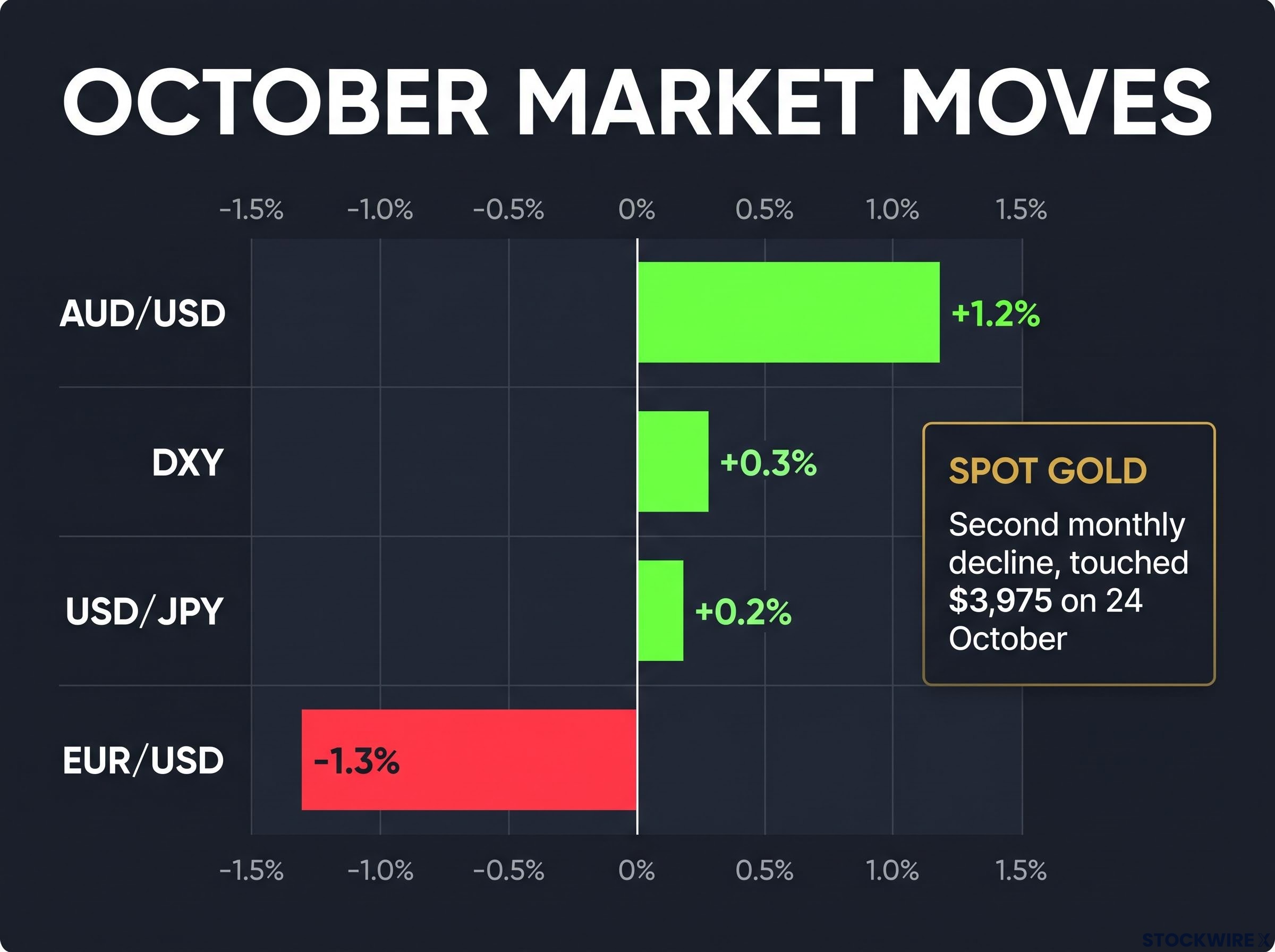
| Market | Level | Session move | October move |
|---|---|---|---|
| DXY | 101.68 | Down about 0.2% | Up about 0.3% |
| EUR/USD | $1.1178 | Sources differ | Down about 1.3% |
| AUD/USD | $0.7028 | n/a | Up about 1.2% |
| USD/JPY | Support near 157.00 | Third daily fall | Dollar up about 0.2% |
| Spot gold | $3,995.42 | Near mid-July low | Second monthly decline |
The euro reading depends on the source. FXStreet’s heat map showed the dollar up 0.16% against the euro, while Reuters described the index slipping as the euro recovered.
A dollar that is firm for the month yet soft on the day tells you the US rate story is largely priced. The next move is coming from abroad, so each currency pair can behave differently.
BoJ and RBA: why the dollar did not rally everywhere
The Bank of Japan held its policy rate at 1.25% on an 8-1 vote, with board member Hajime Takata pushing for 1.50%. Governor Kazuo Ueda said the bank would debate rates at every meeting, December included.
In Australia, September CPI rose 0.8%, lifting annual inflation to 4.3% from 4.0% in August. Markets now price roughly 85% odds of a 25 basis point Reserve Bank of Australia (RBA) hike, and Commonwealth Bank has shifted to forecasting a move to 4.85%.
When foreign yields are expected to climb too, USD/JPY and AUD/USD have less room to run, even with Fed hike bets high.
What Barkin said, and why policymakers are debating pace
Barkin on SiriusXM, 30 October The “direction of travel” is clear. The open question is pace, and a gradual, step-by-step approach fits.
His case rests partly on artificial intelligence. Barkin said the AI investment surge strains supply chains for semiconductors, electricity, data centres, construction and specialised labour, which pushes costs up. It also fuels demand-side inflation, the kind higher rates can actually restrain.
His conversations with businesses pointed the same way:
- Cost pressures have spread widely.
- Firms plan to pass higher costs on, helped by years of high inflation.
- Consumer spending has held up despite comparatively flat incomes.
- Softness shows up only among non-profits and in housing.
Barkin is not alone. The Fed held its target range at 3.75%-4.00% at the 27-28 October meeting on a 10-2 vote, with Governor Lisa Cook and Cleveland Fed President Beth Hammack favouring a 25 basis point hike. September inflation ran at 3.7% year over year, faster than expected (Reuters), and Q3 GDP also beat forecasts.
| Voice | Date | Position |
|---|---|---|
| Thomas Barkin, Richmond Fed | 30 October | Direction clear, pace the issue; gradual approach |
| Christopher Waller, Fed governor | 8 October | More hikes probably needed, not at consecutive meetings |
| Dario Perkins, TS Lombard | 28 October | Question is how many hikes follow |
| Goldman Sachs | 1 October | Moved next-hike call to December |
| Reuters poll | 20 October | All 100 economists expected a December hike |
Futures have cooled slightly. CME FedWatch put December hike odds near 74% on 29 October, via CNBC, down from 86% a day earlier and 89.5% in mid-October. These are market-implied snapshots, not decisions.
Near-unanimity on December paired with disagreement on what follows means the data between now and the meeting will set how far the dollar and yields run.
Historical comparisons show the pace of tightening can matter more than its direction, with mild cycles delivering S&P 500 gains while aggressive ones produced losses, a spread that frames why markets are fixated on speed.
How a measured Fed pace works through yields, the dollar and gold
The chain runs in four links:
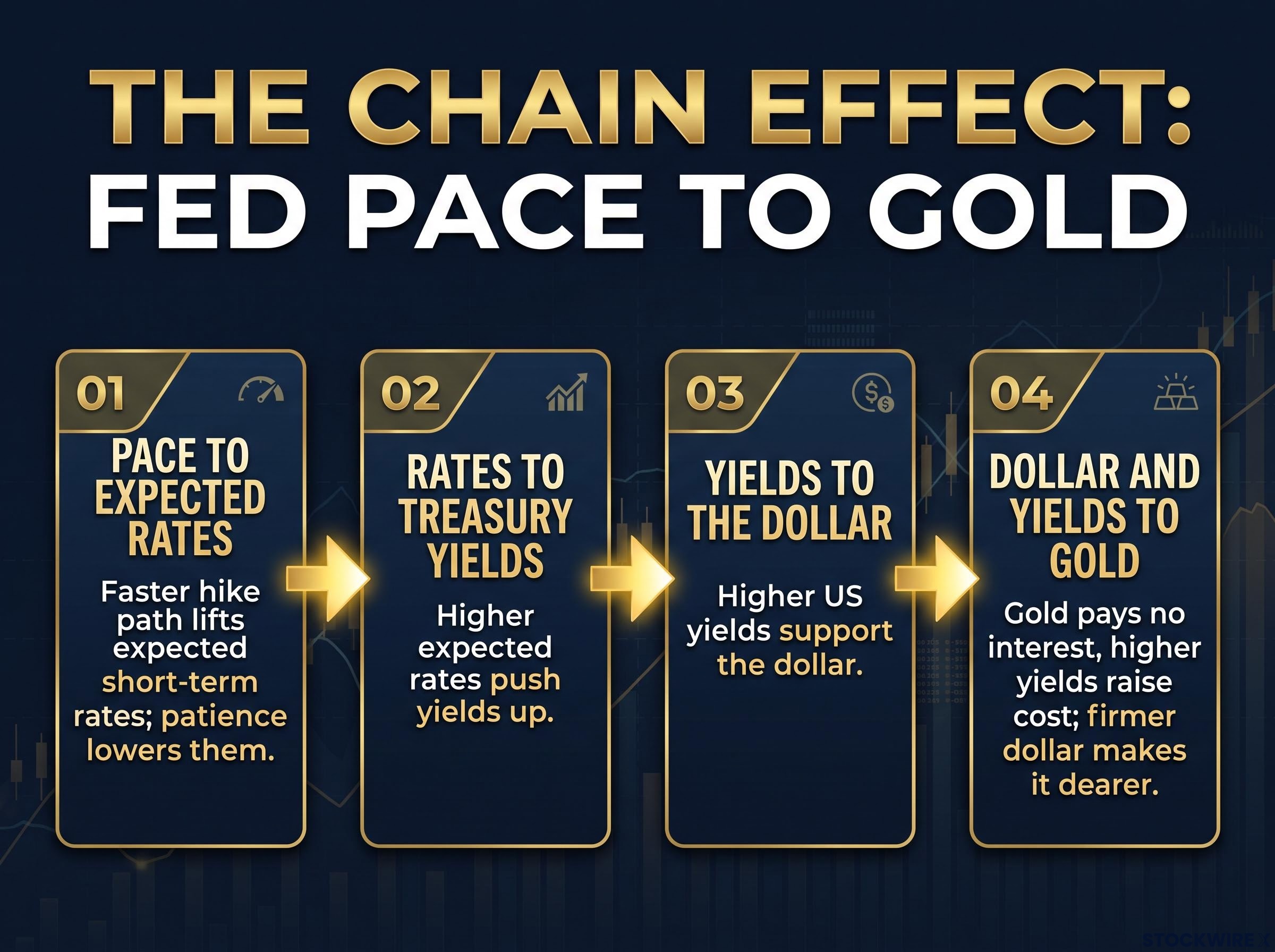
- Pace to expected rates. A faster hike path lifts expected short-term rates; patience lowers them.
- Rates to Treasury yields. Higher expected rates push yields up, especially on shorter-dated bonds.
- Yields to the dollar. Higher US yields usually support the dollar, unless foreign central banks are tightening too.
- Dollar and yields to gold. Gold pays no interest, so higher yields raise the cost of holding it, and a firmer dollar makes it dearer for non-US buyers.
StoneX’s Bob Haberkorn told CNBC on 20 October that inflation and Fed rates were gold’s major problems. Reuters reported that elevated yields and a firm dollar were the main reasons analysts trimmed 2026 gold forecasts.
Rising real yields raise the opportunity cost of holding gold and draw foreign capital to dollar assets, which is why yield direction, rather than yield level, tends to separate durable gold rallies from short-lived ones.
Spacing hikes, as Waller described, lets markets reprice between meetings. But Charles Schwab notes past tightening cycles averaged 22 months, 3.3 percentage points of hikes and a 1.4 point rise in the 10-year yield. If you hold gold or dollar-sensitive assets, a slow Fed is not automatically a soft Fed: firm inflation data can still lift the expected end point.
Two forces could change that picture. Schwab argued the AI boom could reduce the need for a prolonged cycle, and gold can still climb on safe-haven demand during market stress. Westpac’s Luci Ellis has flagged the opposite risk for the RBA: inflation becoming embedded, a trade-off the Fed shares.
What to watch before December
- Fed speeches and shifts in CME FedWatch December odds
- The next US inflation readings
- The BoJ’s December rate debate
- The RBA’s next decision
What the pace signal means for the dollar and gold into December
Direction is settled; pace is the variable. Markets are trading the cross-currents between firm Fed expectations and hawkish signals from Tokyo and Sydney, which is why the dollar can rise for the month and fall on the day.
With spot gold sitting close to its mid-July low, gold support levels near $4,100 and the $4,000-$3,900 zone are the areas technical traders are watching if yields keep climbing.
Barkin offered no size or timing, so odds near 74% remain a market estimate, not a commitment. The US inflation prints before the December meeting are the catalyst most likely to decide whether the Fed’s measured pace starts to look faster.
This article is for informational purposes only and should not be considered financial advice. Investors should conduct their own research and consult with financial professionals before making investment decisions.