Twenty Betashares ETFs went ex-dividend this morning, and the estimated distribution figures are now public. Payouts range from 11 cents per unit at the low end to 124 cents per unit at the top, spanning global equity, Australian equity, thematic, and diversified funds across the provider’s ASX-listed range.
These are estimates only. Betashares is expected to publish the final figures the following day, with payment scheduled for 16 July 2026. For investors who held units at yesterday’s close, one decision remains open this week: whether to take cash or elect the distribution reinvestment plan (DRP), with the election deadline falling this Friday.
Here is where each fund sits in the payout range, what the numbers reveal about income across different fund categories, and what you need to check before Friday’s DRP deadline closes.
The full payout table: which Betashares ETFs are paying how much
The table below lists all 20 estimated distributions for the period ending 30 June 2026, ordered from highest to lowest.
| ASX Code | Fund Name | Estimated Distribution (cpu) |
|---|---|---|
| HNDQ | Betashares Nasdaq 100 Currency Hedged ETF | 124 |
| MNRS | Betashares Global Gold Miners Currency Hedged ETF | 113 |
| QLTY | Betashares Global Quality Leaders ETF | 103 |
| A200 | Betashares Australia 200 ETF | 98 |
| AQLT | Betashares Australian Quality ETF | 97 |
| NDQ | Betashares Nasdaq 100 ETF | 90 |
| BNKS | Betashares Global Banks Currency Hedged ETF | 65 |
| HACK | Betashares Global Cybersecurity ETF | 62 |
| ARMR | Betashares Global Defence ETF | 46 |
| GAME | Betashares Video Games and Esports ETF | 37 |
| ATEC | Betashares S&P/ASX Australian Technology ETF | 35 |
| ASIA | Betashares Asia Technology Tigers ETF | 31 |
| FAIR | Betashares Australian Sustainability Leaders ETF | 29 |
| FUEL | Betashares Global Energy Companies Currency Hedged ETF | 27 |
| ETHI | Betashares Global Sustainability Leaders ETF | 26 |
| URNM | Betashares Global Uranium ETF | 22 |
| DHHF | Betashares Diversified All Growth ETF | 21 |
| GEAR | Betashares Geared Australian Equity Fund | 21 |
| QRE | Betashares Australian Resources Sector ETF | 12 |
| QFN | Betashares Australian Financials Sector ETF | 11 |
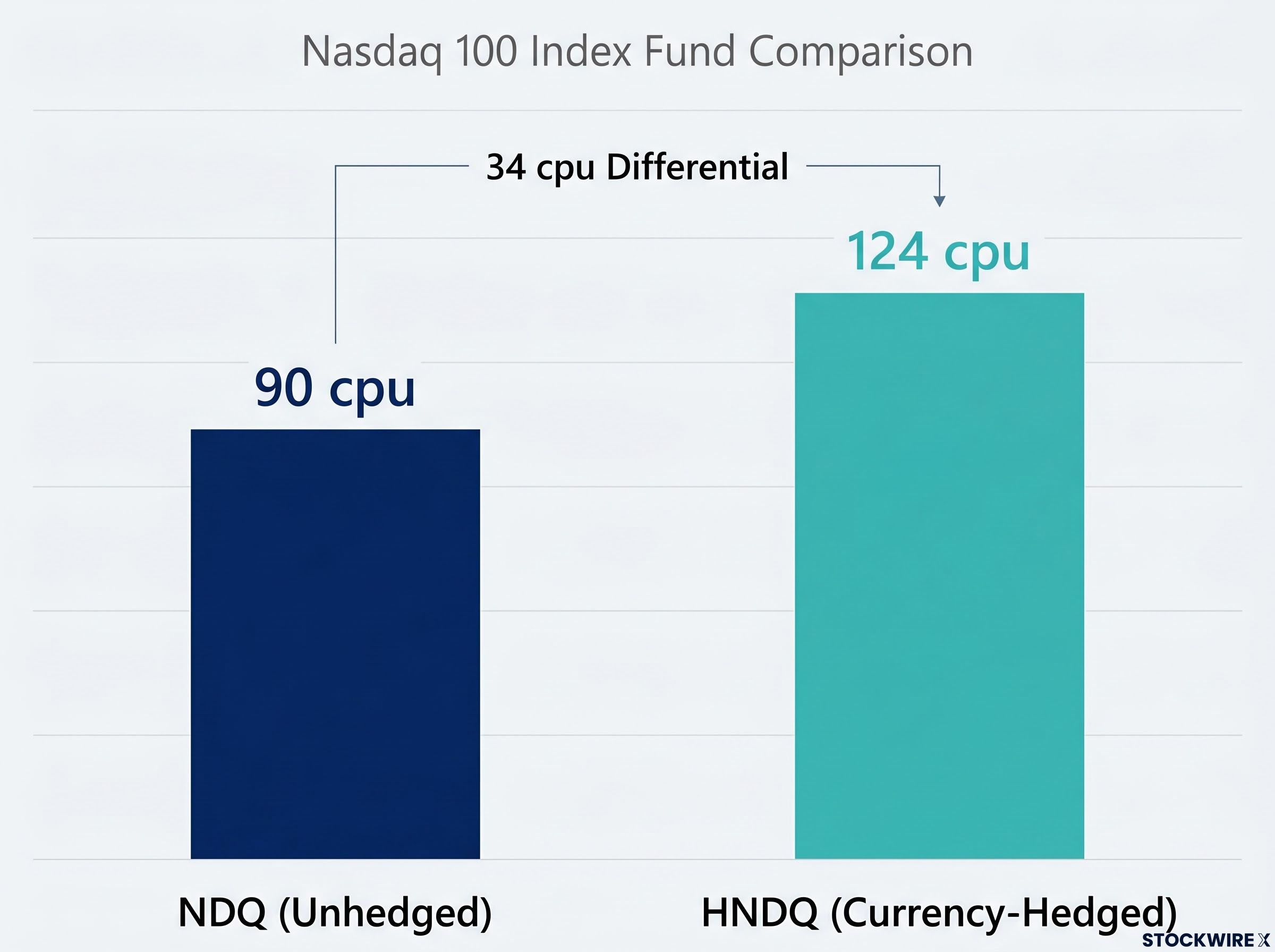
Two figures stand out when read side by side. HNDQ and NDQ both track the Nasdaq 100 index, yet the hedged version is estimated to pay 124 cpu compared with 90 cpu for the unhedged version, a 34 cpu differential.
HNDQ vs NDQ: same index, different income. The 34 cpu gap between these two funds is not driven by differences in the underlying Nasdaq 100. It is a product of the currency-hedging overlay. For investors comparing these two ETFs on an income basis, hedging is not a neutral structural choice at distribution time; it can materially shift the payout you receive.
The 34 cpu gap between HNDQ and NDQ is a concrete illustration of a hedged vs unhedged ETF outcome that varies significantly with AUD/USD movements, and the direction of that advantage reverses when the Australian dollar weakens rather than strengthens.
All figures above are estimates. Betashares will publish the verified distribution amounts the day after this announcement. Check the Betashares distributions page or ASX announcements for final figures before making financial planning decisions.
When big ASX news breaks, our subscribers know first
What the payout range reveals about income across fund categories
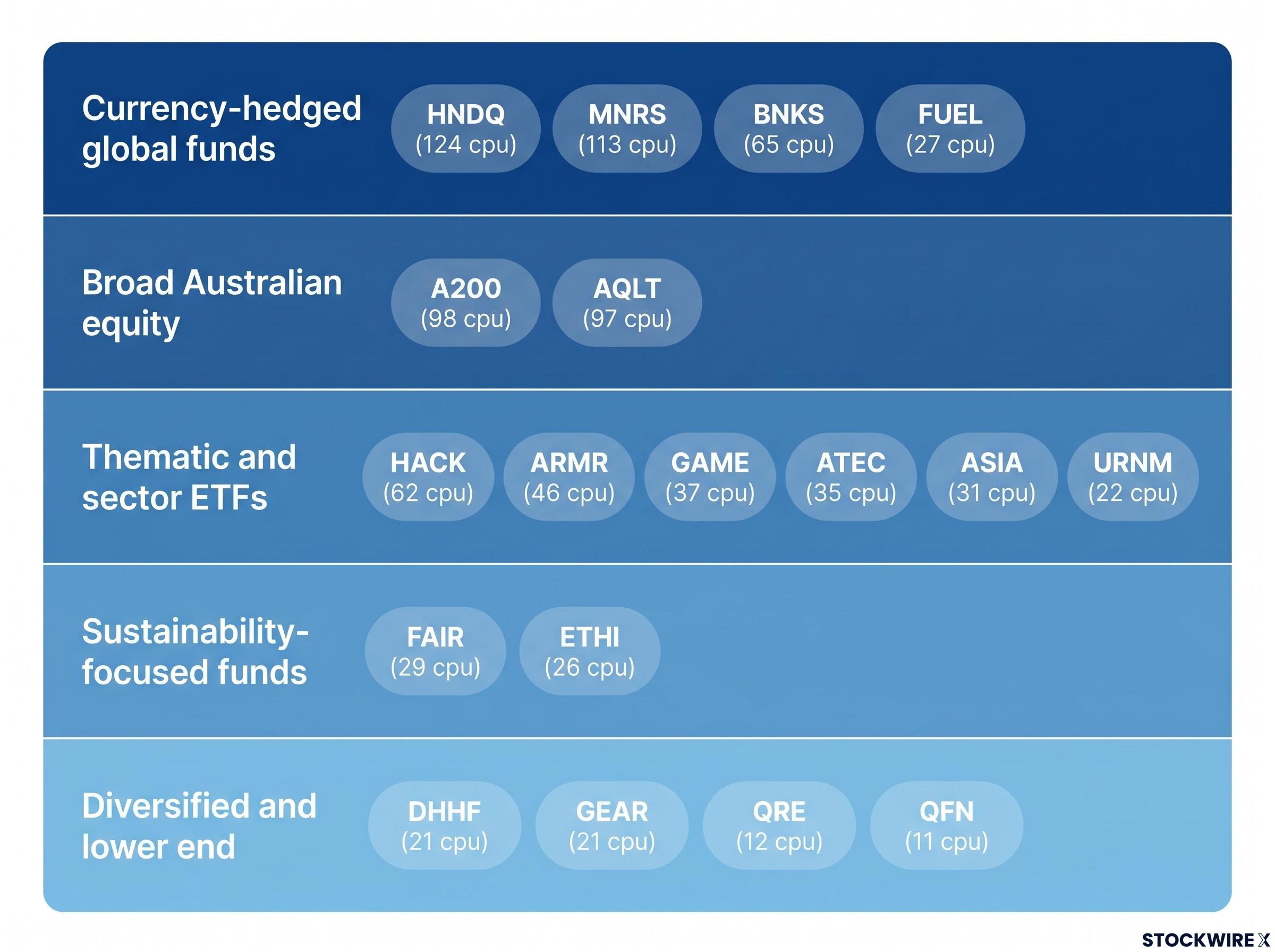
The 113 cpu gap between the highest and lowest distributions is wide, but the spread is not random. When you group the 20 funds by mandate, a pattern emerges across five observable clusters:
- Currency-hedged global funds sit at the top: HNDQ (124 cpu), MNRS (113 cpu), BNKS (65 cpu), FUEL (27 cpu)
- Broad Australian equity funds follow closely: A200 (98 cpu), AQLT (97 cpu)
- Thematic and sector ETFs show the widest internal dispersion: HACK (62 cpu), ARMR (46 cpu), GAME (37 cpu), ATEC (35 cpu), ASIA (31 cpu), URNM (22 cpu)
- Sustainability-focused funds occupy a narrow mid-range band: FAIR (29 cpu), ETHI (26 cpu)
- Diversified and leveraged structures sit at the lower end: DHHF (21 cpu), GEAR (21 cpu), with sector ETFs QRE (12 cpu) and QFN (11 cpu) rounding out the bottom
The thematic segment is where dispersion matters most. HACK at 62 cpu and QFN at 11 cpu are both sector-specific ETFs, but their underlying industries generate very different income profiles. Sector exposure, not fund structure alone, is driving the gap.
Thematic ETF dispersion in this payout cycle, with HACK at 62 cpu and URNM at 22 cpu within the same structural category, reflects the same sector rotation dynamics that produced triple-digit return gaps between resources and technology mandates across the twelve months to early 2026.
What the lower end tells you
DHHF‘s low distribution (21 cpu) is consistent with its all-growth mandate, which prioritises capital appreciation over income. GEAR landing at the same level reflects its leveraged structure rather than weak underlying performance. If you hold either fund primarily for growth, the distribution figure is functioning as designed.
The broader takeaway for investors building income-oriented ETF portfolios: a fund’s income characteristics are largely set by its mandate and structure before any active decisions are made. Comparing distributions across categories without accounting for those structural differences can lead to a misleading read of relative performance.
How the distribution reinvestment plan works and what you need to do by Friday
The DRP gives you the option to receive your distribution as additional units in the same ETF rather than as cash. Instead of a deposit landing in your bank account on 16 July 2026, the distribution amount purchases new units at a price set under the DRP rules for that period. That price is determined by the registrar’s calculation methodology, not the live market price at the time of payment.
DRP elections are managed through MUFG Corporate Markets, Betashares’ registrar. They are not lodged via the ASX or through your broker platform.
Deadline conflict: verify the exact date directly. Research sources disagree on whether the DRP election deadline falls on Friday 3 July or Friday 4 July 2026, both at 5pm AEST. Do not rely on either date in print. Contact MUFG Corporate Markets directly to confirm the deadline that applies to your holdings.
If you are already enrolled in the DRP and have not revoked your election, you will typically carry over automatically. That said, confirming your current enrolment status before the deadline is worth the two minutes it takes.
Here is the action sequence:
- Check your DRP enrolment status with MUFG Corporate Markets
- Decide whether you want cash or DRP reinvestment for each holding
- Lodge or confirm your election before the Friday deadline at 5pm AEST
- Note 16 July 2026 as the payment date in your cash flow and tax records
For investors in accumulation mode, the DRP avoids the cash drag and potential brokerage cost of manually reinvesting a distribution. Over multiple distribution cycles, that compounds meaningfully. Missing the deadline means you receive cash by default and cannot retrospectively elect reinvestment for this cycle.
ETF distributions are taxed as assessable income in the year they are received regardless of whether they are taken as cash or reinvested through a DRP, a point that affects how both options sit in the context of your overall tax position for the 2025-26 financial year.
Betashares in context: how this cycle fits the broader mid-year ETF distribution season
The Betashares announcement is one piece of a larger mid-year distribution wave across the Australian ETF market. Four other major providers made distribution announcements in the same window:
- Vanguard
- VanEck
- Global X
- iShares (BlackRock)
Each provider runs its own DRP deadline and payment schedule independently. If you hold ETFs across multiple providers, do not assume the Betashares dates apply to your Vanguard or iShares holdings. The ex-dividend dates, DRP cut-offs, and payment dates differ from provider to provider.
The April 2026 iShares distribution cycle covered 15 ASX-listed funds with per-unit payouts ranging from 15.70 cents to over $1.05, and that round also coincided with Betashares and Vanguard paying distributions on adjacent dates, a pattern that repeats at mid-year.
For investors with multi-provider portfolios, the mid-year period is a compressed window of administrative activity. Missing one provider’s deadline has real income consequences, and awareness of the broader calendar is a practical portfolio management task, not an optional one. Consult each provider’s distribution calendar directly.
Before 16 July: the steps that matter most for affected unitholders
Every action item from this announcement condenses into a single checklist. Complete it this week and the payment date becomes a confirmation exercise, not a scramble.
- Confirm entitlement: Verify you held units in each relevant ETF as of close of business 30 June 2026. Purchases made on or after 1 July 2026 do not qualify.
- Decide on cash or DRP: Determine for each holding whether you want the distribution paid as cash or reinvested.
- Lodge your DRP election: Submit or confirm with MUFG Corporate Markets by 5pm AEST on Friday (verify the exact date directly with the registrar).
- Note the payment date: Cash distributions and DRP unit allotments are scheduled for 16 July 2026. Factor this into cash flow planning and tax records.
- Check other providers separately: If you hold ETFs from Vanguard, VanEck, Global X, or iShares, consult each provider’s own distribution calendar for their respective dates.
- Monitor for confirmed figures: All amounts in this article are estimates. Betashares will issue verified final distribution amounts the day after this announcement, available on the Betashares distributions page and via ASX announcements.
All distribution figures referenced in this article are estimates only. Confirmed amounts may differ. Past distributions do not guarantee future results.
This article is for informational purposes only and should not be considered financial advice. Investors should conduct their own research and consult with financial professionals before making investment decisions.
—