Most people assume a central bank raises interest rates only when the economy is running too hot. The Bank of Canada has just done the opposite. It lifted its policy rate to 2.50%, its first increase since July 2023, while its own forecasts put growth at about 1% for 2026. Governor Tiff Macklem has since told the House of Commons finance committee that a further Bank of Canada rate hike may be needed.
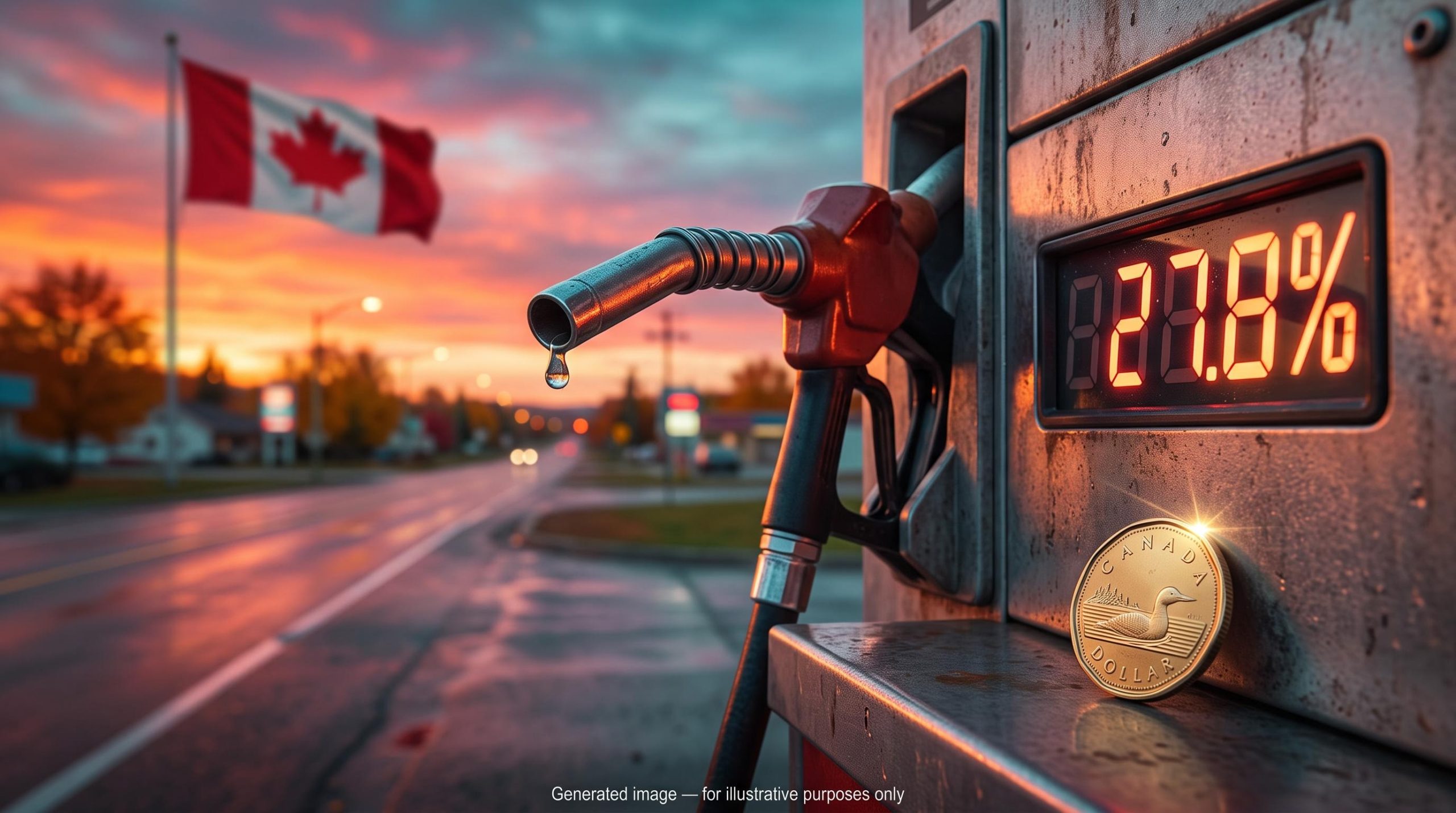
The stakes for you are concrete. Gasoline prices were reportedly up 27.8% year on year in September, variable-rate mortgage payments respond within weeks, and the loonie strengthened to about C$1.3955 per US dollar by 30 October.
The hike from 2.25% was reportedly announced on Wednesday, 28 October 2026. Those rate figures and the decision date come from research that has not been independently confirmed. The next scheduled decision falls on Wednesday, 9 December 2026.
Here is how an energy shock can justify higher rates, what the Bank’s forecasts imply for your budget, and how rate decisions, quantitative easing (QE) and quantitative tightening (QT) reach the Canadian dollar.
Why would the Bank of Canada raise rates against an oil shock?
Start with the obvious objection. A higher interest rate cannot pump a single extra barrel of oil, so why would the Bank use it against a fuel-price spike?
The answer is that the Bank is not targeting the pump price itself. Macklem told MPs, according to an FXStreet report, that the Middle East war is keeping energy costs high for an extended period, and that the real risk is those costs seeping into everything else.
Macklem’s core warning (paraphrased) More rate increases could be required because prolonged energy costs threaten to become embedded in inflation expectations, wages and business pricing. Decisions will be taken one meeting at a time.
The five channels from oil to your cost of living
Energy reaches your household budget through five routes:
- Direct household channel: pricier gasoline, diesel and heating fuel raise the consumer price index (CPI) immediately and shrink your purchasing power.
- Refinery-margin channel: the Bank flagged elevated refinery margins, meaning the gap between crude costs and fuel prices has widened, so more of the increase reaches you.
- Business-cost channel: freight, distribution, farming and manufacturing all burn fuel, and firms may pass those costs into shelf prices.
- Second-round channel: if people expect high inflation, workers push for raises and firms reprice more often, which keeps inflation going after the original shock.
- Import-price channel: costlier energy and non-energy imports add pressure, especially if the loonie does not rise enough to offset them.
Temporary shock or lasting inflation?
A supply shock can fade on its own if oil falls. What tilted the Bank was duration: prices had stayed high for months and refinery margins remained wide.
The reported September data shows the split. Headline CPI rose to 3.1% from 3.0% in August, while CPI excluding gasoline eased to 2.2% from 2.4%, and gasoline inflation climbed from 22.8% to 27.8%. At the 30 October settlement, WTI crude sat near US$104.12 and Brent near US$113.43, figures not yet independently confirmed.
Oil’s path will also depend on OPEC+ compliance, since the gap between agreed quotas and barrels physically reaching the market, not the quota headline, shapes how long energy costs stay elevated.
Desjardins Economics said raw-material, industrial-product and transportation prices suggested second-round effects were developing. Macklem added that he does not see fiscal policy making disinflation harder.
For you, the hike is an attempt to stop a fuel spike becoming a lasting rise in everyday prices. The price of that insurance is weaker demand and higher borrowing costs.
When big ASX news breaks, our subscribers know first
What do the Bank’s forecasts say about inflation and growth through mid-2028?
If the Bank expected inflation to fade quickly, it could have waited. Its October Monetary Policy Report shows why it did not.
| Forecast item | Figure | Source or status |
|---|---|---|
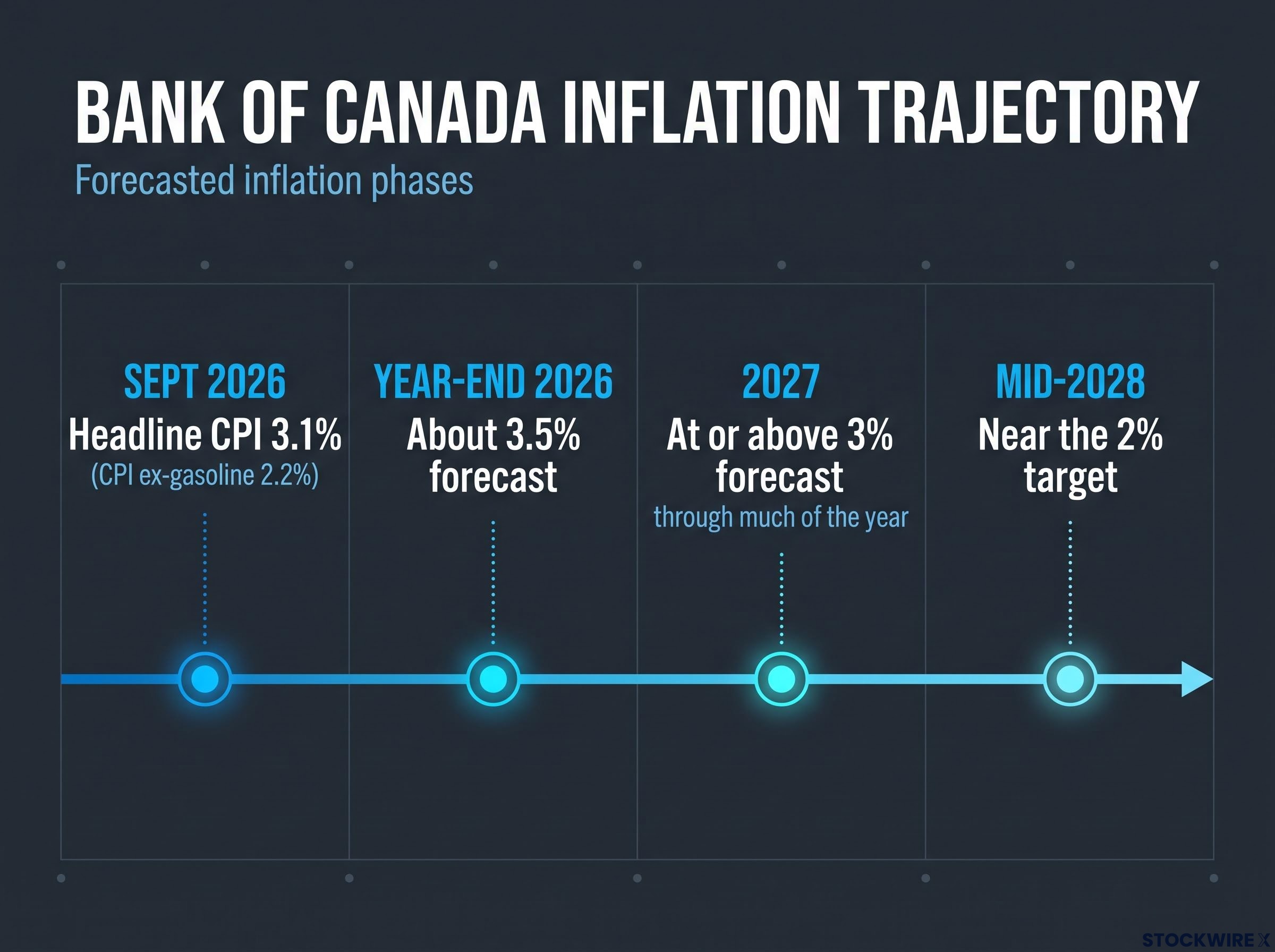
| CPI inflation at year-end 2026 | About 3.5% | Bank of Canada |
| Inflation during 2027 | At or above 3% through much of the year | Bank of Canada |
| Inflation by mid-2028 | Near the 2% target | Bank of Canada |
| Q2 2026 GDP | 3.3% annualised | Cited by Macklem |
| Q3 2026 GDP | About 2% annualised | Bank estimate |
| Q3 2026 advance industry data | 0.3% quarter on quarter | Statistics Canada, unverified |
| Annual growth 2026 | About 1% | Bank of Canada |
| Annual growth 2027 and 2028 | About 2% each year | Bank of Canada |
Read the timeline in order and a picture forms. Inflation climbs into year-end, stays uncomfortable for most of 2027, and only returns near target around mid-2028.
Growth looks resilient but bruised. Macklem expects weakness in Q4 from new US tariffs, then a recovery in 2027. The Q3 gap between the Bank’s roughly 2% and Statistics Canada’s 0.3% reflects different measures and timing; the official result is due on 30 November 2026.
That long runway explains “one meeting at a time”. The Bank cannot commit to a path when inflation sits above 3% for well over a year and growth hinges on trade policy.
Past performance does not guarantee future results. Financial projections are subject to market conditions and various risk factors.
What economists expect next
The views below were reported in late October and have not been independently confirmed:
- Desjardins Economics (23 October): one further hike in January 2027, not a rapid series.
- Royce Mendes, Desjardins (Globe and Mail, 29 October): one hike in 2027 and none for the rest of 2026.
- Benjamin Reitzes, BMO Economics (Forbes Advisor Canada, 29 October): more tightening likely, but the pace is highly uncertain.
- Bloomberg economist survey (28 October): the hike was consensus, but the path beyond 2.50% is much less clear.
- Robert Kavcic, BMO Capital Markets (Globe and Mail, 29 October): more borrowers chose variable-rate mortgages recently, so hikes hit households quickly.
The main counterargument came from Reuters, which reported core inflation measures eased below 2% in September. If you hold a variable-rate mortgage, expect pressure well beyond 9 December, though consensus points to a few more hikes rather than a repeat of 2022-23.
Rising business inflation expectations, with firms reporting a one-year outlook of 3.7%, carried more weight in the Bank’s decision than the soft core readings, which is why the hike targeted second-round risk rather than damage already done.
These statements are speculative and subject to change based on market developments.
How do rate decisions, QE and QT actually work?
To read the next announcement properly, you need to know which lever the Bank is pulling. Think of its toolkit as a ladder, from most familiar to least.
The Bank’s mandate is to keep inflation within a 1-3% target range. It holds eight scheduled meetings a year and works mainly by adjusting the overnight rate, the interest rate at which banks lend to each other for one day.
The three tools in plain terms
- Policy rate: raising it makes borrowing dearer and tends to strengthen the Canadian dollar; cutting it does the reverse.
- Quantitative easing (QE): the Bank creates money to buy assets such as government bonds, a last-resort tool that usually weakens the dollar.
- Quantitative tightening (QT): the Bank stops reinvesting maturing bonds, shrinking its balance sheet, which is usually supportive for the dollar.
A common error is calling 2009-11 large-scale QE. That period was credit easing and liquidity support; the big bond-buying programme came in 2020-21.
| Episode | Description |
|---|---|
| 2009-11 crisis response | Credit easing and liquidity facilities; policy rate reached 0.25% in April 2009 |
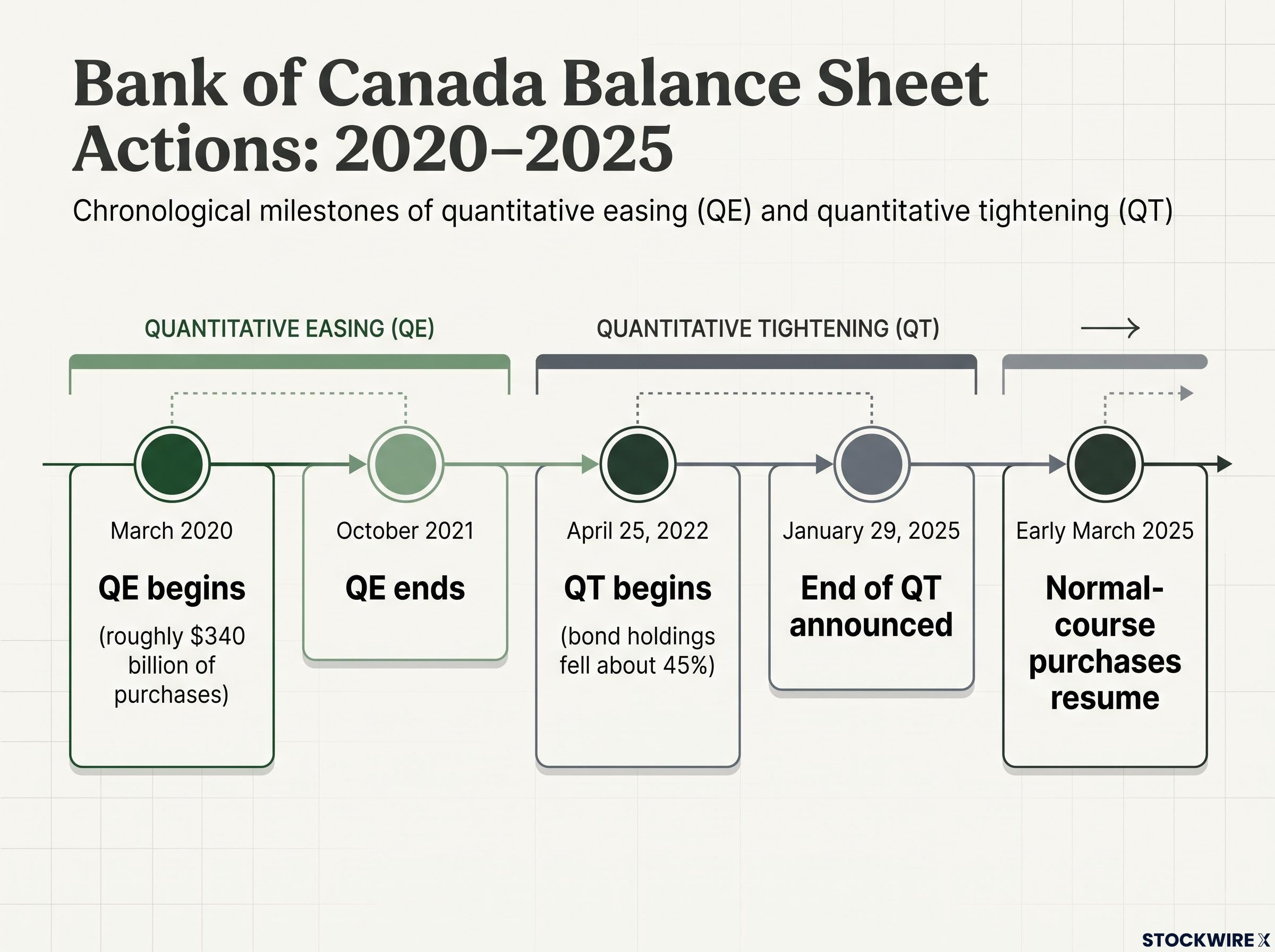
| March 2020 | Large-scale Government of Canada bond purchases (QE) begin |
| October 2021 | QE ends, followed by a reinvestment phase |
| 25 April 2022 | QT begins as maturing bonds are no longer replaced |
| 29 January 2025 | End of QT announced |
| Early March 2025 | Normal-course purchases resume to match currency growth (not QE) |
Bank research puts pandemic QE at roughly $340 billion of purchases, while its Government of Canada bond holdings fell about 45% during QT.
Where the Bank stands today
Right now the Bank is doing neither QE nor QT. It is running normal-course balance-sheet management.
That matters for you. The October hike works purely through borrowing costs and expectations, so watch the rate and the Bank’s language, not its bond holdings.
For readers wanting the mechanics behind balance-sheet tools, our full explainer on QE versus QT shows how the signaling, portfolio balance and liquidity channels move markets.
What does all this mean for the Canadian dollar?
The loonie’s October rally looks like proof the hike worked. In reality, three forces were pulling against each other:
- Higher Bank of Canada rates: higher Canadian yields draw investment, supporting the dollar.
- Higher oil prices: Canada exports crude, so better export receipts and terms of trade (the price of exports relative to imports) support the dollar.
- US tariffs and weaker growth: lower expected income and investment weigh on the dollar.
In late October, the first two won. Reuters reported, in figures not independently confirmed, that USD/CAD sat near C$1.3955 (about US$0.7166) on 30 October, after touching C$1.3943, the strongest since 16 September. The loonie gained about 2% in the month, its best since April, with Reuters crediting oil and tightening expectations despite soft GDP data.
Markets had largely priced the move before the announcement, partly because Macklem’s earlier signal of a much higher inflation forecast lifted hike odds from roughly 36% to above 75% in days.
Why the link is never mechanical
History tempers the neat story.
| Period | Policy action | CAD transmission |
|---|---|---|
| 2009-11 | 425 bps of cuts, December 2007 to April 2009, plus credit easing | Depreciation pressure, amplified by a flight to the US dollar |
| 2020-21 | QE lowered longer-term yields | Bank research found a negligible estimated CAD/USD effect for the announcement examined |
| 2022-24 | Rate hikes plus QT from 25 April 2022 | Mixed, because the Fed was also tightening hard |
US policy, global risk appetite, commodity prices and the relative pace of easing often drown out the Bank’s own moves.
So treat the loonie’s strength as a snapshot. If tariff damage deepens, household debt strain bites or oil falls, the move could reverse. A stronger dollar also cuts both ways: it eases imported inflation but hurts non-energy exporters, so weigh any US-dollar spending, travel or investments with that fragility in mind.
Three signals to watch before the December 9 decision
The Bank’s central worry is energy costs leaking into expectations and wages, and its only active tool is the policy rate, not QE or QT.
Before 9 December, watch three things:
- The 30 November Q3 GDP release: it settles the gap between the Bank’s estimate and the advance data.
- The next CPI reading: compare headline against core and gasoline.
- Oil prices and tariff developments: together they decide whether the loonie and inflation hold their course.
Decisions remain one meeting at a time, and consensus leans towards few further hikes rather than a replay of 2022-23. Use the window to check your mortgage renewal date, variable-rate exposure and any US-dollar holdings.
This article is for informational purposes only and should not be considered financial advice. Investors should conduct their own research and consult with financial professionals before making investment decisions.