The incoming Federal Reserve chair built his reputation as one of the institution’s most reliable inflation hawks. He opposed quantitative easing during the financial crisis, voted consistently for tighter policy through his 2006-2011 tenure, and spent years warning that excessive accommodation would erode price stability. Now Kevin Warsh is making a different argument: that artificial intelligence is generating productivity gains large enough to let the Fed run lower rates without reigniting inflation.
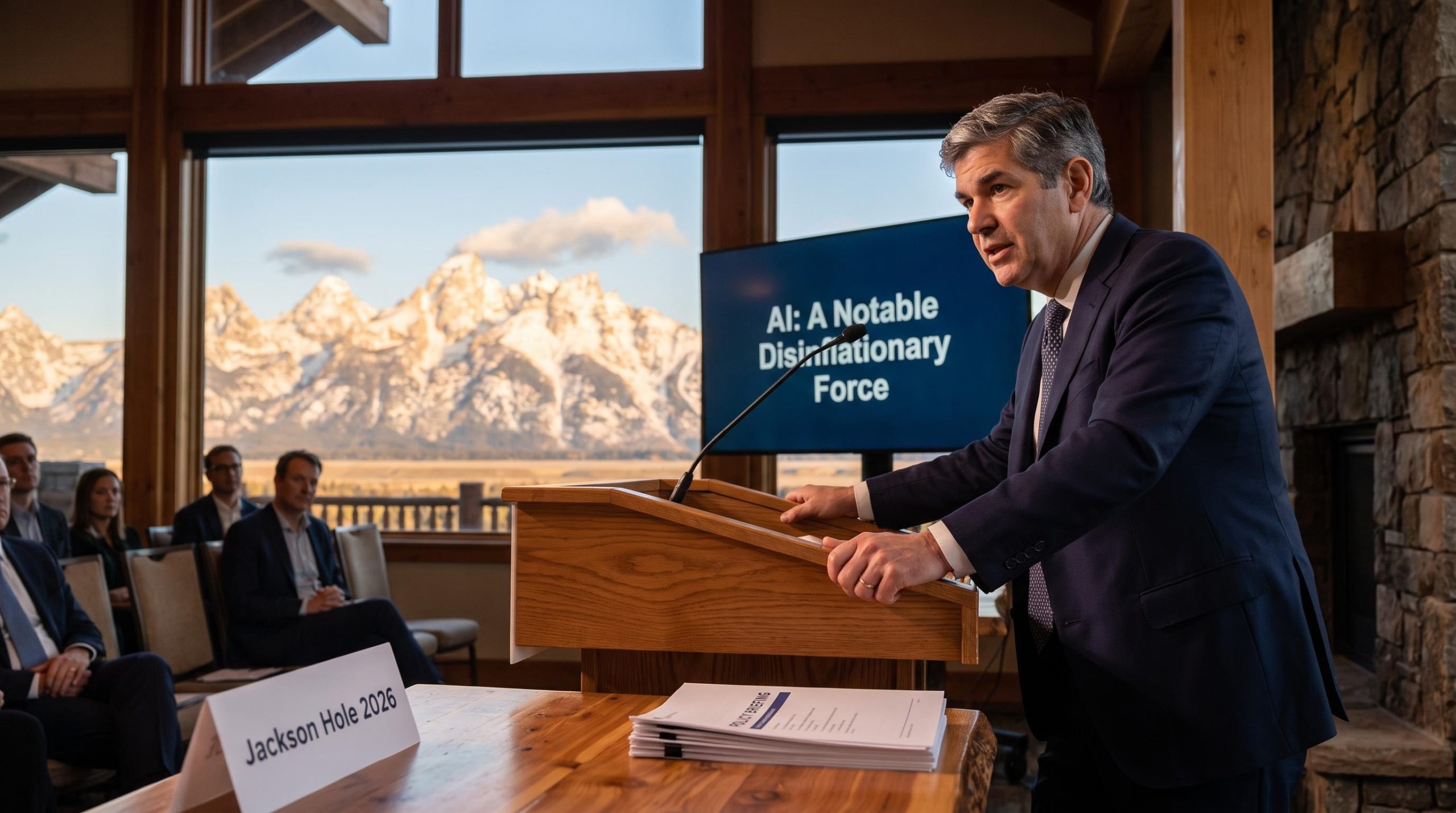
That argument arrives at its highest-profile stage today. Warsh delivers the keynote at the Jackson Hole Economic Policy Symposium on 28 August 2026, under the theme of financial innovation and payments. The speech is not expected to announce a specific rate move. It is expected to lay down an intellectual framework, the kind of address that shapes how the Fed interprets every major data release for years. For long-term positioning, this matters more than any single meeting decision.
Here is what you need from today’s address: the specific signals in Warsh’s language that tell you whether his AI thesis is gaining institutional traction, why that thesis could change how the Fed reads GDP prints and labour market tightness, and what the internal disagreement among Fed officials means for how much confidence to place in any one rate-path forecast.
Why a known inflation hawk is making the case for lower rates
The contradiction looks sharp on the surface. A Fed chair who spent years pushing back against easy money is now the most senior voice inside the institution arguing that a technology wave gives policymakers room to ease. If that sounds like an intellectual reversal, the details tell a different story.
From QE sceptic to productivity optimist
Warsh’s hawkish credentials are well documented. During his tenure as a Fed governor from 2006 to 2011, he maintained a consistently tight-policy stance and was openly sceptical of quantitative easing, though he eventually supported it. His reputation as a policy tightener followed him through the years between his first Fed role and his appointment as chair. Reporting on his path to the top job suggests that his view on AI productivity was part of what shaped his candidacy, not something he adopted after the fact.
The bridge between those two positions is a supply-side argument. In a Wall Street Journal op-ed, Warsh described AI as:
“A notable disinflationary force, enhancing productivity and strengthening American competitiveness.”
He has called the current AI boom “the most productivity-enhancing wave of [his] lifetime,” drawing a direct comparison to the late 1990s, when Alan Greenspan kept policy looser than standard Taylor-rule prescriptions and was rewarded with rising productivity and stable prices. In December remarks, Warsh went further, suggesting AI could be “structurally disinflationary,” giving the Fed “a clear route” to lower policy rates over time.
The logic is not complicated. If AI raises output per worker faster than wages and aggregate demand grow, the economy can run hotter without generating equivalent price pressure. Strong growth stops being an automatic signal to tighten. It might instead be evidence that the economy’s speed limit has moved higher.
What makes this position credible rather than convenient is precisely who is making it. A known inflation hawk arguing for lower rates via productivity is harder to dismiss as dovish drift. His history is the thesis’s armour. And for you, it signals something specific about the rate-cut argument you are most likely to hear from this Fed chair over the next cycle: it will be anchored in productivity, not economic weakness. That changes which data points matter most.
When big ASX news breaks, our subscribers know first
How AI changes the math the Fed uses to set rates
The AI thesis is not just a talking point. It rewires the way the Fed’s internal models connect economic data to rate decisions, and understanding the mechanism tells you which signals to track under Warsh’s leadership.
Start with the supply side. If AI raises output per worker, the economy can produce more goods and services without proportionally more labour or higher wages. That means a strong GDP print or a tight jobs report no longer automatically signals overheating demand. It might instead reflect an expanding production frontier, which is a fundamentally different diagnosis that calls for a fundamentally different policy response.
This connects to a concept called the neutral rate, often written as r-star. The neutral rate is the interest rate that neither accelerates nor slows the economy; it is the rate at which monetary policy is neither adding stimulus nor applying the brakes. If AI is raising potential output, the neutral rate may be shifting lower, meaning the current policy rate could already be more restrictive than the Fed realises.
In Senate testimony, Warsh framed the economics in two parts: an up-front wave of AI capital expenditure that modestly boosts demand, and a larger supply-side effect that lifts potential output “considerably” more. He described the productivity boost as “mammoth” for corporate America. A New York Fed framework paper acknowledged that AI may shift “potential output and the natural rate of interest,” requiring recalibration of policy benchmarks.
That recalibration has four practical consequences for how the Fed reacts to incoming data:
- More tolerance for above-trend growth. A run of strong GDP prints is less automatically a trigger for rate hikes if growth partly reflects a higher production frontier.
- A different read of tight labour markets. High employment and wage gains can coexist with stable inflation if productivity is rising fast enough to absorb the cost pressure.
- A lower bar for cutting from restrictive levels. If the neutral rate has fallen and AI is expected to keep inflation pressures contained, the case for cutting sooner than conventional Taylor-rule logic would suggest becomes easier to make.
- Preserving AI investment. Warsh has emphasised the need not to choke off AI-related capital formation through excessively tight policy, echoing Greenspan’s willingness to let the late-1990s economy run hot to validate a productivity boom.
Warsh built in his own caveat: policymakers “cannot yet rely” on AI gains as a primary justification for easing. The thesis is optionality-preserving, not a pre-commitment.
| Scenario | Standard Fed read | Warsh AI-adjusted read |
|---|---|---|
| Strong GDP growth | Demand overheating; lean toward tightening | May reflect higher potential output; monitor productivity before acting |
| Tight labour markets | Wage-price spiral risk; restrictive stance warranted | Productivity gains may absorb wage growth; watch output per worker |
| Inflation near target | Hold rates at current level; no urgency to cut | If AI is lifting supply, current rate may already be above neutral; cutting case strengthens |
For you, the practical implication is direct. Under Warsh’s framework, a strong GDP print or a tight jobs report is no longer automatically a sell signal for bonds. It might reflect supply expansion rather than overheating demand, which means tracking productivity data alongside the headline macro numbers becomes necessary, not optional. When Warsh talks about being “data-dependent,” the data he is watching may now include productivity metrics and AI capex figures that most investors do not have on their standard dashboards.
The Fed is not unified on this, and that disagreement is the risk
Warsh’s framework is coherent. It is also contested inside the institution he now leads, and the disagreement is not a minor footnote. It is the single largest source of uncertainty in the rate-path outlook.
The sharpest counterpoint comes from Former Vice Chair for Supervision Michael Barr, who argued that even if generative AI produces a lasting productivity boost, the equilibrium policy rate could actually rise, not fall. His mechanism: stronger investment demand and lower household saving (because people expect higher lifetime earnings) both push up the neutral rate.
Barr explicitly stated that he raised his long-term estimate of r-star because of higher productivity and does not expect the AI boom to be a reason for lowering policy rates.
That is a direct inversion of Warsh’s thesis. Same AI facts, opposite policy conclusion.
Other credible voices add further uncertainty:
- Chicago Fed President Austan Goolsbee has warned that AI could be inflationary or even carry stagflation risk, where prices rise while growth stalls.
- Minneapolis Fed analysis concludes that AI is currently “moderately heating up” the economy while the productivity rollout is “bumpy,” suggesting near-term inflationary pressure before any disinflation dividend arrives.
- J.P. Morgan Asset Management notes that the initial wave of AI capex is likely inflationary because demand hits before productivity benefits materialise, even though the longer-run effect may be disinflationary.
- San Francisco Fed President Mary Daly has stressed that policymakers must “dig deep” into AI’s impact before changing the policy path.
Fed minutes from early 2026 already show the split in the room: “several” participants expected higher productivity growth to pressure inflation downward, while others remained cautious.
The market consequence is direct. If Warsh’s view dominates the committee, the centre of gravity shifts toward greater willingness to ease as productivity data confirms his thesis. If Barr’s or Goolsbee’s views hold more sway, AI becomes a reason to hold rates higher for longer, or even raise them further.
For you, this internal split means that monitoring individual Fed official speeches and dissent patterns will be as important as watching the headline rate decision. The true policy signal under Warsh will often come from how much institutional support his AI thesis is accumulating between meetings. Treating the AI disinflation story as settled Fed consensus is getting ahead of the evidence. This is an active intellectual contest, and the outcome will materially shape the rate path over the next two to three years.
What to listen for at Jackson Hole, and what it signals about the rate path
Warsh’s deep aversion to forward guidance means today’s speech will not announce a rate path. It will establish an interpretive framework, and the value for you is knowing which phrases and framings signal which direction, so you can draw conclusions in real time rather than waiting for the consensus summary to settle.
Four concrete signposts matter most:
- How explicitly he links AI to neutral rates. Clear language that AI lowers effective neutral rates over time signals a structurally more dovish medium-term stance. More balanced language, closer to Barr’s line, would suggest a more cautious, symmetric reaction function.
- Whether he treats AI as a present or future force. Framing AI as already delivering productivity gains supports early recalibration of policy. Emphasising adoption frictions and lagged payoffs aligns with the warnings about near-term inflationary pressure.
- Any signals about AI-driven financial imbalances. References to asset froth or speculative excess driven by AI valuations would hint at a willingness to lean against bubbles even if headline inflation is contained.
- The degree of retreat from detailed forward guidance. A shorter horizon of explicit commitments, or direct criticism of over-reliance on pre-announced paths, would confirm that under Warsh the Fed intends to communicate less about specific rate paths and more about analytical frameworks.
| What to listen for | What it signals if present |
|---|---|
| Explicit link between AI and lower neutral rate | Medium-term dovish bias; rate cuts become easier to justify as productivity data arrives |
| AI framed as already delivering gains | Policy recalibration could begin sooner; current rate potentially already above neutral |
| References to AI-driven asset froth or financial imbalances | Willingness to tighten or hold despite contained inflation; macro-prudential instinct alive |
| Shortened forward guidance horizon or criticism of guidance reliance | Regime shift in Fed communication; markets will need to interpret frameworks, not path signals |
Current market pricing adds context to why the framing matters. September Fed funds futures place the odds of a rate hold at approximately 66%, with the remaining 34% assigned to a hike and every other outcome priced out entirely. From October onward, no single outcome carries better than even odds. When cumulative probabilities are totalled across the remaining meetings, the chances of at least one hike landing before December rise above 90%.
The share of outcomes in which the Fed raises no rates at all this year stands at roughly 30%, a figure that marks it firmly as a minority view and confirms that the market’s base case is action rather than prolonged patience.
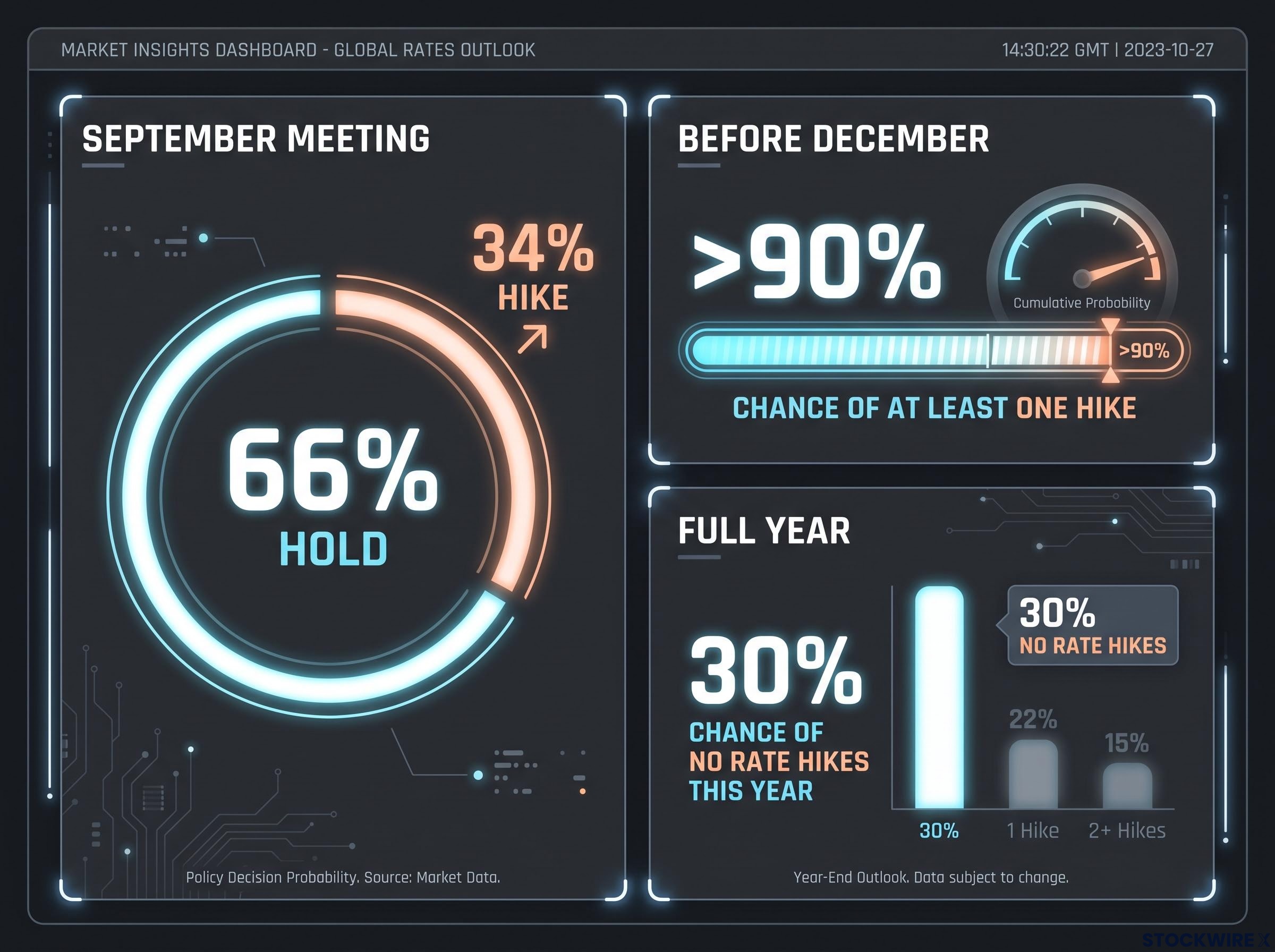
Since early August, the probability of a hike has edged lower, a shift that has unfolded alongside a rally in gold, a softening dollar, and a steadying in bond prices. Warsh’s framing today will influence which of the uncertain outcomes from October onward gains probability.
If you understand the framework he is laying down, you will be positioned to interpret the speech faster and more accurately than someone relying solely on post-speech commentary. The specific language around r-star, present versus future productivity, and the guidance horizon will tell you more than the headline takeaway.
The framework shift that will outlast any single rate decision
Today’s address is not about the September meeting. It is about how the Fed will read the American economy for the next several years.
Warsh is not offering a rate promise. He is proposing an epistemological shift: a change in what counts as evidence and how that evidence gets interpreted. Under this framework, a strong GDP print is not automatically inflationary. A tight labour market is not automatically a trigger. The question becomes whether supply is expanding alongside demand, and the answer depends on productivity data that traditional dashboards do not foreground.
The asymmetry in his reaction function is the critical detail. The AI thesis raises the bar for further hikes once inflation is near target, but it does not eliminate tightening risk if data re-accelerates. This is not simply a dovish pivot. It is a framework that is medium-term dovish by design but keeps the trigger finger live.
Warsh has described AI as reaching “escape velocity,” but simultaneously warned that policymakers “cannot yet rely” on those gains as a primary justification for easing.
That tension, between conviction in the productivity wave and caution about acting on it prematurely, is what defines the framework’s optionality. It is also what makes the internal Fed dissent so consequential: the same data that Warsh reads as supply expansion, Barr reads as demand stimulus.
For you, following the Fed under Warsh means expanding what you track. CPI and payrolls remain necessary, but productivity growth and AI capex are now the variables that can change the interpretation of everything else. The drift of FOMC dissent, visible in speeches, minutes, and voting patterns, becomes a leading indicator of rate direction in a way it has not been for a decade. The tools you need for the next cycle are the ones this framework puts at the centre.
This article is for informational purposes only and should not be considered financial advice. Investors should conduct their own research and consult with financial professionals before making investment decisions. Forward-looking statements about Fed policy, rate paths, and AI productivity effects are speculative and subject to change based on economic developments and institutional decisions.
—