
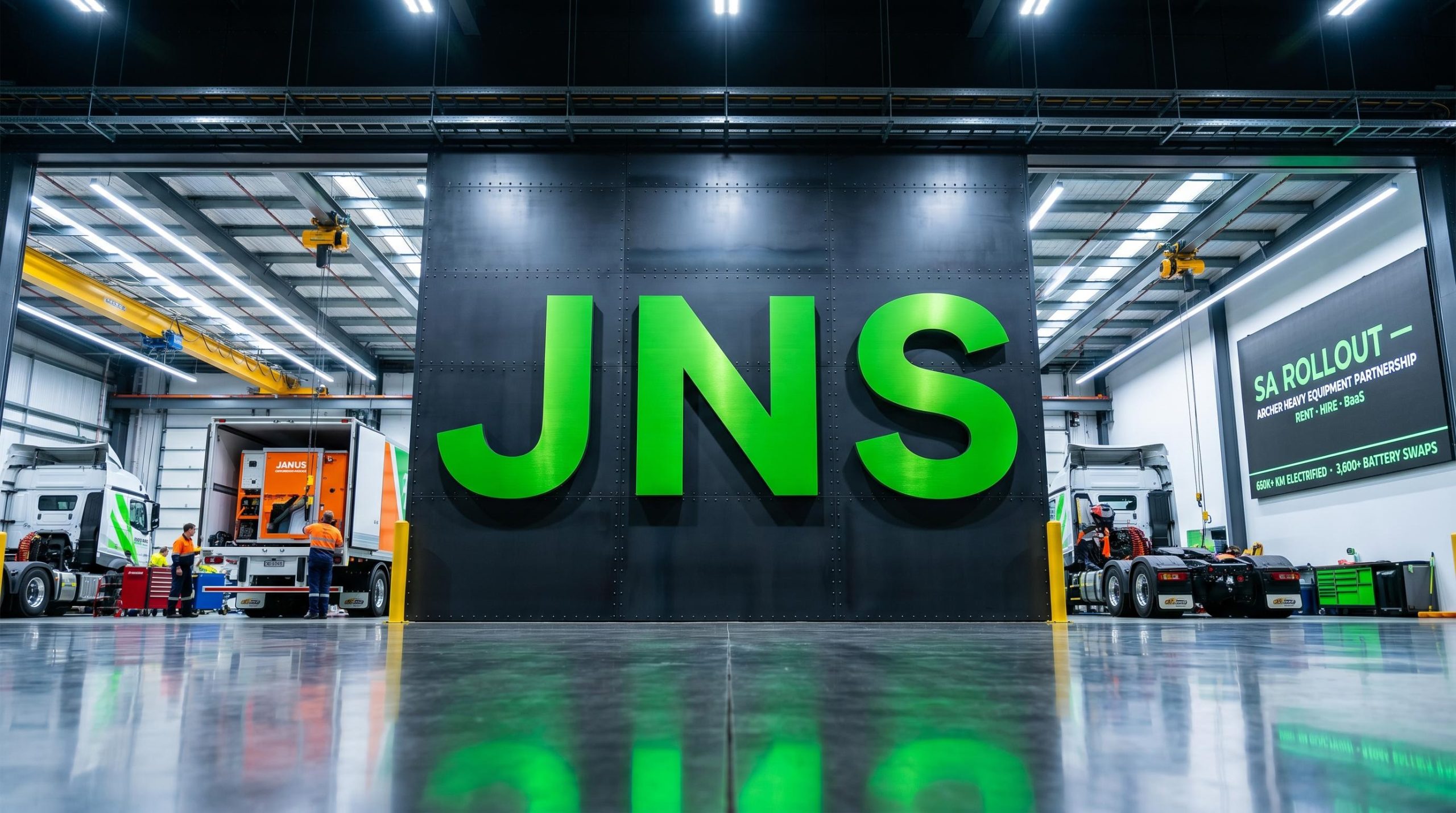
Janus Electric outlines South Australia as priority market in Smart Energy Council presentation
In its June 2026 investor presentation, delivered by Chief Executive Officer and Managing Director Ben Hutt at the Smart Energy Council’s South Australia industry event on 30 June 2026, Janus Electric (ASX: JNS) outlined its South Australian growth program and broader strategy to support the electrification of heavy freight across Australia.
The presentation anchored on three themes. Management detailed the South Australian rollout through a dealer-led partnership with Archer Heavy Equipment, a new rent and lease commercial model designed to lower the upfront capital barrier, and fresh operational data from its Moorebank Charge & Change Station, cited as a working proof of concept. The Company also profiled its new Gen 2 drivetrain as a key technical advance.
When big ASX news breaks, our subscribers know first
South Australia positioned as the lead state for electric truck rollout
The presentation framed South Australia as a priority market for the Company’s national electric truck rollout. Central to that positioning is a dealer-led conversion partnership with Archer Heavy Equipment, described as SA’s leading truck specialist, with the first conversion centre launched in April 2026.
Management outlined that the Archer facility is expected to scale to 50 truck conversions per annum initially, building to 150-200 as demand develops. The presentation noted a growing fleet operator pipeline, with operators including NJ Ashton and Symons Clark already running Janus trucks in the state.
A rent and lease model is targeted to launch in Q3 2026 to remove the upfront capital barrier, while converted trucks are expected to roll out of Janus production facilities early next quarter. The dealer-led approach is designed to create local South Australian conversion capacity and a recurring conversion pipeline.
The Archer partnership sits within a broader dealer-led conversion network that Janus is building nationally, with Victoria, Queensland, and Western Australia flagged as the next states to receive dedicated conversion centre agreements before year-end.
| Metric | What it represents |
|---|---|
| 3 | Existing Janus stations already in South Australia |
| 650K+ km | Electrified across the Janus network |
| 3,600+ | Battery swaps completed |
A new rent and lease model designed to remove the upfront capital barrier
A core element of the update addressed what the Company described as the “upfront capital barrier for fleet operators” adopting electric trucks. The presentation detailed three commercial models, giving fleets flexibility on how they fund electrification.
-
OWN (Purchase): Full truck conversion from A$150K, compared with A$500K-900K for a new electric truck. Full ownership delivers maximum long-run savings.
-
HIRE (Rent/Lease): Conversion, battery access, maintenance, software and charging support bundled together, allowing operators to trial electric in real operations with no large upfront capital.
-
BaaS (Battery-as-a-Service): Pay per kWh or per swap, shifting battery costs from capital expenditure to operating expenditure.
By lowering the capital hurdle, the model is positioned to widen the addressable fleet market, particularly for operators facing high diesel exposure and tight margins.
Moorebank station cited as working proof of concept
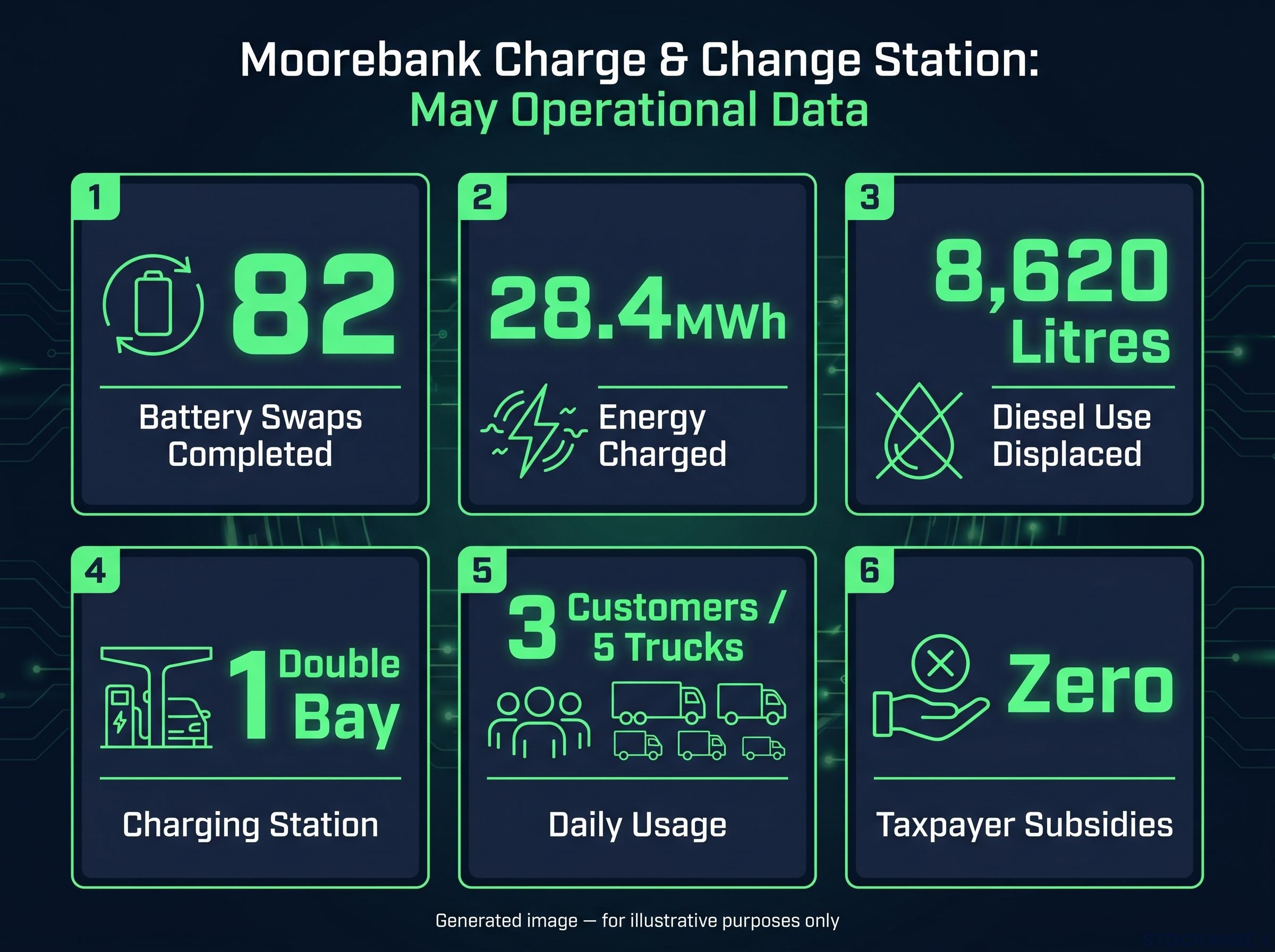
The presentation gave prominence to the Company’s Moorebank Charge & Change Station, framed as a “working proof of concept for scalable battery swap, charging and fleet operations infrastructure.” Management presented new operational data from the month of May.
- 82 battery swaps completed in May
- 28.4MWh of energy charged
- Approximately 8,620 litres of diesel use displaced
- 1 double bay charging station, with 3 customers using 5 trucks daily
- Zero taxpayer subsidies
- A second charging station soon to be deployed
According to the presentation, Moorebank is intended as “a blueprint, not a one-off.” The swap-charge-operate model is designed to replicate across freight corridors and logistics precincts nationally, including in South Australia, providing a template for the network the Company aims to build in its priority state.
Understanding battery swap electrification — and why it matters
Janus Electric operates an integrated electrification model that converts Class 6-8 heavy diesel trucks to electric. The system combines the Janus Conversion Module (JCM), swappable battery systems, and the Janus Charge & Change Station (JCCS), a network of stations that exchange depleted batteries for charged ones.
Battery swap matters because exchanges take approximately 4 minutes, less downtime than a typical diesel refuel, keeping trucks on the road. Depleted batteries are then charged slowly off-peak, which reduces grid pressure and lowers cost.
The presentation noted that 80% of Australian heavy trucks operate under 200km per day on repeat routes, well within single-charge range. South Australia’s high renewable penetration makes depot charging clean and low-cost, while a single distributor, SA Power Networks, simplifies grid connections. Crucially, conversion preserves existing truck assets rather than scrapping them, offering a lower-cost electrification pathway.
Gen 2 drivetrain unlocks more payload and all-road access
A significant technical focus of the update was the new Gen 2 platform. The JCM 2.0 Light reduces drivetrain weight by 400kg, while the new JBS650 battery system saves a further 500kg, delivering up to 900kg of additional freight-carrying capacity per truck.
Range exceeds 450km on the Gen 2 platform, a 12% improvement over the previous generation. Both products operate below the 6.5-tonne steer axle weight limit, providing general access to all roads in Australia with no permits and no route restrictions.
The JBS650 battery platform underpinning the Gen 2 drivetrain is also central to Janus’s North American deployment, with battery partner Electrovaya confirming an in-truck testing schedule for July 2026 ahead of California commercial operations.
The presentation reiterated the conversion cost advantage, with conversion priced from A$150K-175K per truck versus A$500K-900K for a new electric equivalent.
| Metric | Benefit |
|---|---|
| 900kg | Additional payload capacity |
| 450km+ | Range per charge |
| +12% | Range improvement |
| No permits | General road access, all Australia |
What’s next for Janus in South Australia
The presentation closed with a forward roadmap for the state. Converted trucks are expected to roll out of production early next quarter, with the Archer South Australian facility scaling its conversion capacity.
Management outlined five priority freight corridors intended to build a statewide network anchored by the 3 existing SA stations: Port Adelaide/Gillman as the anchor, the Eastern Gateway at Tailem Bend and Murray Bridge, Northern Metro at Gepps Cross and Cavan, Mount Gambier, and Port Augusta.
The South Australian thesis presented draws together proven technology operating in-state, dealer-led conversion capacity, a capital-light commercial model, and a charging network aligned with the state’s renewable energy leadership.
Don’t Miss the Next Clean Energy & Transport Breakout
Big News Blast delivers FREE breaking ASX news straight to your inbox within minutes of release, complete with in-depth analysis already done for you. Join 20,000+ subscribers staying ahead of market-moving announcements across Tech, Healthcare, Manufacturing, and beyond. Click the “Free Alerts” button at StockWire X to never miss a beat.