

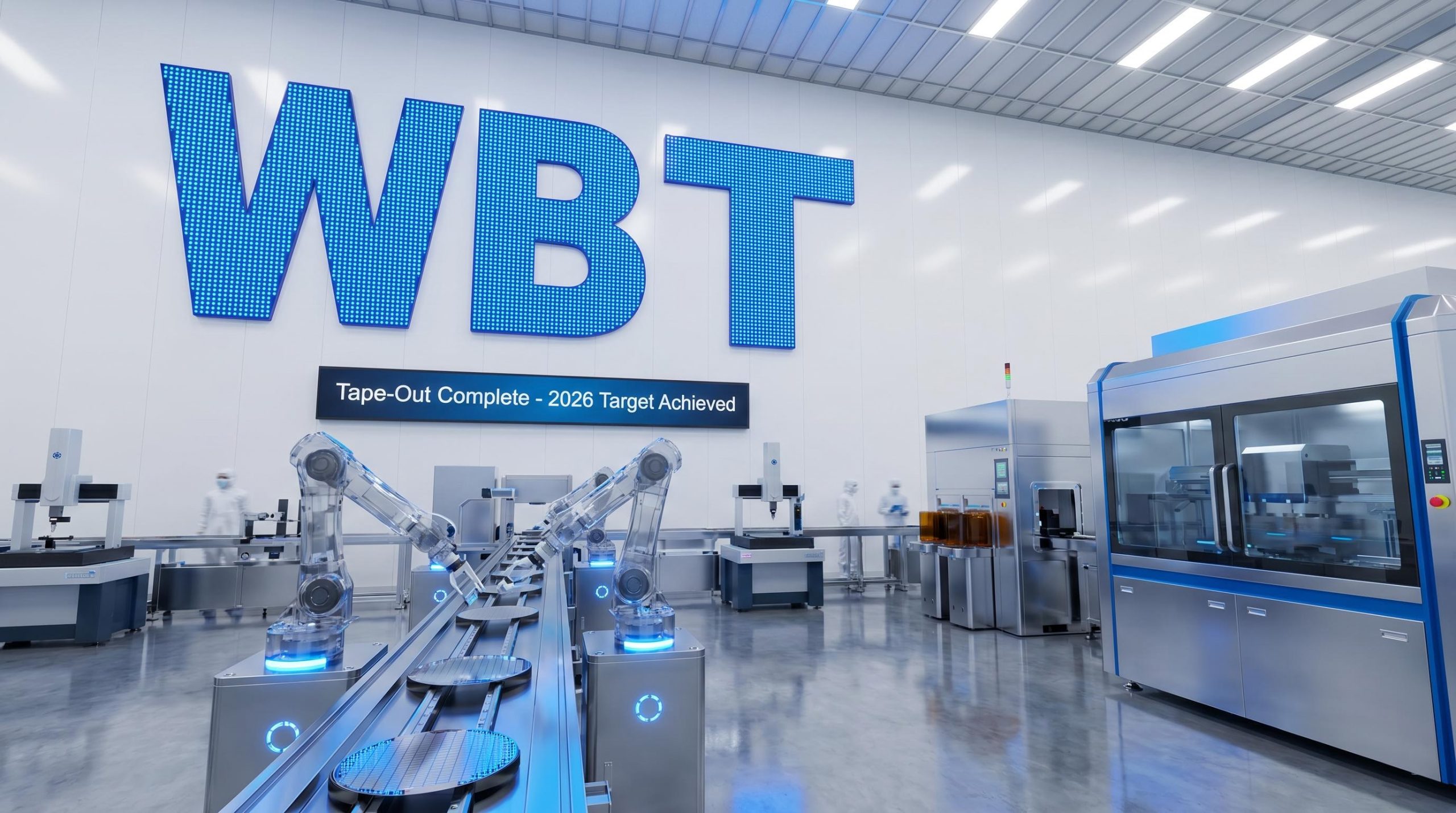
Weebit Nano hits key 2026 milestone as two product customers tape-out ReRAM chips
Weebit Nano (ASX: WBT) has achieved one of three 2026 targets set at its 2025 Annual General Meeting, with two product customers successfully taping-out chip designs integrating the company’s Resistive RAM (ReRAM) module. One customer has already manufactured a functional prototype that has passed initial testing, marking a significant step towards mass production and recurring royalty revenue.
The announcement represents a de-risking milestone for the memory technology licensor, demonstrating real commercial adoption of its ReRAM intellectual property in products intended for high-volume manufacturing.
Key achievements announced:
- Two product customers completed tape-out — chip designs integrating Weebit’s ReRAM module released to manufacturing
- One functional prototype operational — first silicon received and initial tests confirm the chip functions as expected, including the ReRAM component
- 2026 corporate target delivered — achievement of one of three milestones set at the company’s 2025 AGM
Both customers will now undertake testing, characterisation and qualification processes, which typically span 12-18 months before products can progress to mass production. This timeline positions potential royalty revenue generation in late 2027 or early 2028, subject to successful qualification.
The first named customer, Overlord Labs, has integrated Weebit’s ReRAM technology into its next-generation smart battery management system. The chip design was taped-out at DB HiTek foundry and is expected to deliver advantages in power consumption, cost, and overall performance for high-volume applications.
When big ASX news breaks, our subscribers know first
What is tape-out and why does it matter for semiconductor investors?
Tape-out is the point where a chip design is finalised and released to manufacturing, marking the transition from design to physical production. In semiconductor development, tape-out represents a critical commitment point where theoretical design becomes tangible silicon.
For an intellectual property licensing business like Weebit Nano, tape-out by product customers carries significant strategic weight. It demonstrates that paying customers have committed substantial design resources and secured foundry capacity to manufacture products incorporating Weebit’s technology. This is a leading indicator of future royalty revenue, as each successful tape-out increases the probability of products reaching mass production.
The path from tape-out to revenue generation follows a defined sequence: tape-out → first silicon (prototype) → testing and qualification → mass production → royalty payments to the IP licensor.
In Weebit’s case, the fact that one customer has already received first silicon and passed initial functional tests provides further validation. This milestone confirms that the ReRAM technology performs as expected when integrated into a real-world product design, reducing technical execution risk for both the customer and Weebit.
For investors evaluating IP licensing businesses, tape-out announcements represent concrete evidence of commercial traction. Unlike technology demonstrations or partnership announcements, tape-out requires customers to commit capital and resources to manufacturing, signalling genuine commercial intent rather than exploratory interest.
Overlord Labs partnership signals real-world ReRAM applications
The Overlord Labs engagement demonstrates practical application of Weebit’s ReRAM technology in high-growth verticals. The integration targets next-generation smart battery management systems, positioning the technology in automotive, industrial, and energy storage markets where battery efficiency and reliability are critical performance drivers.
Manufacturing of the Overlord Labs chip design will take place at DB HiTek foundry, establishing a production pathway for high-volume applications. The partnership validates Weebit’s market positioning in sectors where embedded non-volatile memory performance directly impacts product competitiveness.
Stated ReRAM advantages in this application:
- Significant gains in power consumption efficiency
- Cost advantages over existing memory solutions
- Improved overall system performance
The battery management use case represents a commercially strategic application area. As electric vehicle adoption accelerates and industrial battery systems scale, demand for efficient, reliable battery management electronics continues to expand. Weebit’s positioning in this vertical through a product customer tape-out establishes a potential revenue stream tied to structural market growth.
The involvement of DB HiTek as foundry partner also carries significance, as it demonstrates Weebit’s ReRAM technology can be manufactured using established production processes without requiring specialised equipment or substantial capital investment from foundry operators.
CEO commentary on commercial progress
Coby Hanoch, CEO
“A first commercial product incorporating our ReRAM, and passing initial functional tests, is a significant achievement for Weebit Nano, marking an important step towards mass production. In addition, the tape-out by Overlord shows the great coordination between Overlord, DB HiTek and Weebit.”
Management has indicated that additional tape-outs are expected during calendar 2026, with discussions advancing with other potential product customers. This suggests a building pipeline of commercial engagements beyond the two tape-outs announced.
The CEO noted that Weebit’s ReRAM intellectual property is currently embedded in the design of several next-generation applications under agreements with multiple product companies. This points to an active design-win pipeline that may generate further tape-out announcements as those projects progress through development cycles.
What this means for Weebit’s 2026 roadmap and investment thesis
The achievement of a product customer tape-out represents one of three 2026 targets established at the company’s 2025 Annual General Meeting, demonstrating management execution against publicly stated objectives. This milestone-based approach provides investors with measurable progress indicators as Weebit transitions from development-stage IP company toward commercial revenue generation.
Management has stated that ReRAM IP is currently being embedded in several next-generation applications under agreements with multiple product companies. The CEO expects additional tape-outs during calendar 2026, with discussions advancing with further potential product customers.
The announcement highlights structural demand drivers supporting Weebit’s commercialisation pathway: growing demand for faster, lower power, higher performing embedded non-volatile memory, combined with increased ReRAM availability through foundries and Integrated Device Manufacturers (IDMs).
Each tape-out and functional prototype reduces execution risk in Weebit’s IP licensing model. Product customers are now manufacturing silicon incorporating Weebit’s technology, moving the company closer to the royalty revenue model that underpins its long-term investment thesis. The 12-18 month testing and qualification timeline positions potential mass production commencement in late 2027 or early 2028, subject to successful qualification outcomes.
Path to mass production
| Stage | Status | Timeline | Revenue Implication |
|---|---|---|---|
| Tape-out | Achieved (2 customers) | Complete | Design win confirmed |
| First silicon / Prototype | Achieved (1 customer) | Complete | Technology validated |
| Testing / Qualification | In progress | 12-18 months | Pre-production phase |
| Mass production | Pending | Post-qualification | Royalty revenue begins |
For investors, the key de-risking element is that Weebit has now moved beyond technology partnerships and foundry agreements into genuine product customer engagements where commercial entities are committing capital to manufacture chips incorporating Weebit’s ReRAM. The progression from tape-out to mass production remains execution-dependent, but each milestone achieved increases the probability of recurring royalty revenue materialising within the next 18-24 months.
Want the Next Tech Breakthrough in Your Inbox?
Join 20,000+ investors getting FREE breaking ASX news delivered within minutes of release, complete with in-depth analysis. Click the “Free Alerts” button at StockWire X to receive real-time alerts the moment market-moving announcements hit the ASX.