
Rubicon Water outlines FY26 results with $156m project pipeline ahead
In its FY26 full-year results presentation delivered on 24 August 2026, Rubicon Water outlined a year of softer reported earnings offset by a strengthening forward pipeline, headlined by $156m of major incremental projects identified entering FY27.
CEO Bruce Rodgerson and CFO Andrew Bendall presented full-year revenue of $61.1m and a net loss after tax of $15.7m, attributing the result to external headwinds rather than deteriorating demand for the water technology group’s control and automation solutions.
The presentation detailed a second-half rebound in contract signings, positioning pipeline conversion and an emerging corporate funding channel as the central FY27 investment narrative.
Key figures from the FY26 results presentation include:
- Revenue of $61.1m (FY25: $69.1m), down 12%
- Net loss after tax of $15.7m (FY25: $7.0m loss)
- Operating cash inflows of $4.5m
- 2H FY26 new contracts signed of $28.4m (up from $24.2m in the prior comparative period)
When big ASX news breaks, our subscribers know first
What drove the FY26 numbers
Management attributed the softer result to three factors: delays in US government funding, foreign exchange headwinds, and a non-cash partial derecognition of deferred tax assets. Notably, gross margin held broadly steady at 40.9% (FY25: 41.2%).
| Metric | FY26 $m | FY25 $m |
|---|---|---|
| Revenue | 61.1 | 69.1 |
| Gross margin % | 40.9% | 41.2% |
| Underlying EBITDA | (8.9) | (4.8) |
| Net Profit/(Loss) after tax | (15.7) | (7.0) |
By region, the presentation showed a mixed performance across Rubicon’s global footprint:
- US: $22.2m (down 30%)
- ANZ: $20.6m (up 3%)
- Europe: $9.4m (down 1%)
- Latin America: $7.7m (up 19%)
- Asia: $1.0m (down 53%)
The presentation noted several largely non-operational headwinds. A stronger Australian dollar reduced translated revenue by $1.5m, while realised FX losses added $2.6m to expenses. The $4.1m partial deferred tax asset derecognition, applied after AASB 112 testing, is a non-cash item and does not represent a cash loss.
Contract momentum builds across global markets
Management highlighted second-half signing strength and a series of named project wins as evidence of underlying demand. The geographic diversity of these contracts is central to the growth story offsetting the reported loss.
Key wins detailed in the presentation include:
-
Three major projects signed in June 2026, including a first project in Oklahoma and a contract with a major Southern California customer
-
Third stage of the SENARA project, Costa Rica: $2.6m (awarded June 2026)
-
Chile: a $2.3m agreement with the Department of Hydraulic Works, ranking among Rubicon’s largest contracts in that market
-
Italy: three pillar projects (Villoresi, Torinese and CER Romagna) totalling more than $4.3m
-
First pilot project in Azerbaijan, marking expansion into new territory
-
Murray-Darling Basin environmental floodplain watering, the first significant win in this new market segment
The presentation also pointed to proven technology outcomes at two reference sites:
- Ceres Main Canal Pilot (Turlock Irrigation District): 69% reduction in operational spills
- FarmConnect (Chaffin Farms): yield +18%, water use −35%
Turlock Irrigation District has publicly linked the pace of its 20-year modernisation roadmap to the results achieved through the pilot, positioning it as a reference-project validation with scaling potential.
The corporate water stewardship funding channel explained
A key theme of the presentation was the emergence of an additional funding pathway that runs alongside traditional government-funded projects. This is described as a complementary revenue channel, not a replacement.
Corporate water stewardship refers to commitments made by large companies to reduce, restore and replenish water in stressed catchments. Increasingly, these commitments are backed by funding and delivery partnerships, opening a growing corporate channel for investment in water efficiency projects.
Central to this trend is the use of volumetric water benefit accounting (VWBA) frameworks. In plain terms, these frameworks require corporates to demonstrate measurable water savings, which the presentation noted aligns strongly with Rubicon’s control, measurement and automation capabilities.
Proof points cited include:
- Fourth privately-funded project secured under corporate water stewardship commitments: $1.4m in Nebraska (21 August 2026)
- Prior corporate-funded projects: Gila River ($3.1m), Bear River ($0.7m) and Glenn-Colusa Irrigation District ($2.3m, FY26)
- Rubicon technology referenced in Google’s 2026 Water Stewardship update (Gila River) and in Procter & Gamble’s Bear River project
The presentation illustrated the trend with a statement from Microsoft on its infrastructure investment approach.
Microsoft
“We invest directly in community water infrastructure by modernizing water systems, expanding access, increasing reliability and helping utilities maintain stable rates and pressure. These investments create shared value for both Microsoft and the local communities we work closely with by strengthening critical infrastructure and supporting long-term water resilience.”
With hyperscalers and multinationals such as Microsoft, Google, Procter & Gamble and PepsiCo operating thousands of facilities globally, management framed the channel as a repeatable, scalable partnership opportunity.
Cash position and balance sheet
Despite the statutory loss, the presentation emphasised positive operating cash flow, supported by strong receivables collections. Notably, further collections of the Indian KBJNL NLBC monies have now cleared all amounts owing from that $81m project.
Balance sheet and cash flow highlights include:
- Operating cash flow: $4.5m (FY25: $5.4m)
- Net debt: $14.6m (30 June 2025: $14.3m), marginally higher
- Total assets: $88.8m; equity: $47.7m
- Deferred tax assets maintained at $8.7m; inventories held at approximately $20m
FY27 pipeline and outlook
The forward-looking growth case centres on a near-term pipeline of $156m, comprising 26 major incremental projects identified as at 24 August 2026. Management also pointed to tailwinds from returning US government funding and forecast California DWR watershed conservation funding.
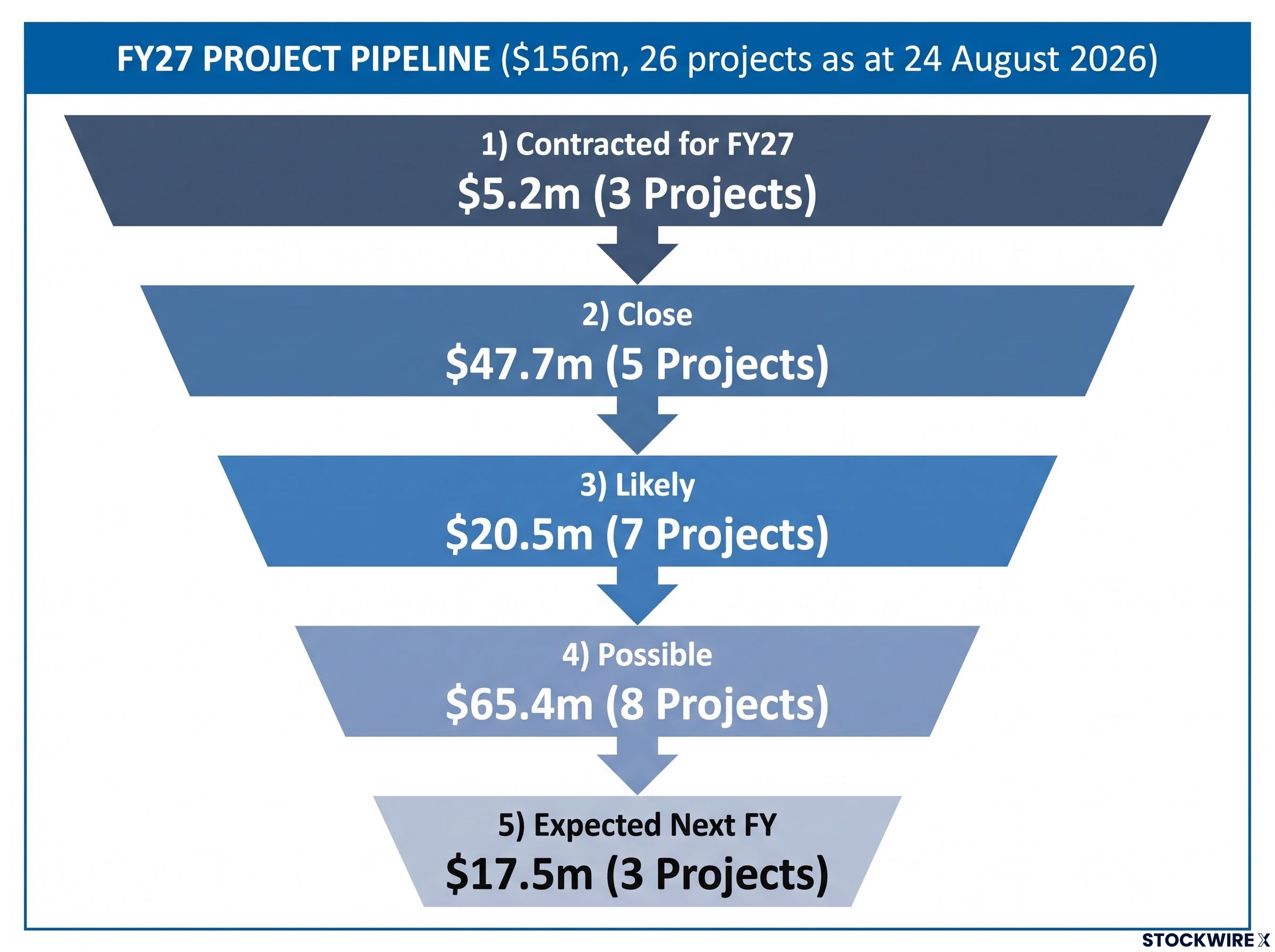
| Category | Value (A$m) | No. of Projects |
|---|---|---|
| Contracted for FY27 | 5.2 | 3 |
| Close | 47.7 | 5 |
| Likely | 20.5 | 7 |
| Possible | 65.4 | 8 |
| Expected Next FY | 17.5 | 3 |
The presentation outlined several FY27 priorities:
- Approximately $47m of major projects currently in tender, under customer evaluation or in the final stages of contract award
- The US Bureau of Reclamation’s post-2026 Colorado River framework to 2036, which favours innovation and efficiency
- A focus on priority water-stressed basins including the Po, Krishna, Indus, Aral Sea and Colorado River
- Converting the active pipeline into contracted revenue and conversion to cash
Management expressed confidence in the growth trajectory, citing the increase in 2H FY26 contract signings together with the size and status of the major project pipeline as support for continued demand for Rubicon’s technology.
The FY27 growth story, as presented, rests on converting the active pipeline into contracted revenue while advancing the dual funding channels of government and corporate water stewardship investment.
Don’t Miss the Next ASX Tech Breakout
Big News Blast delivers FREE breaking ASX announcements straight to your inbox within minutes of release, complete with in-depth analysis already done for you. Join 20,000+ investors who stay ahead of the market the moment news breaks. Click the “Free Alerts” button at Big News Blast to start receiving real-time coverage across ASX tech and beyond.