

ECS-DoT-22 benchmarks show up to 56× lower energy per inference
Nanoveu (ASX: NVU) has released new ECS-DoT-22 results on all four MLPerf Tiny workloads (keyword spotting, visual wake words, image classification and anomaly detection), reported by its wholly owned subsidiary Embedded A.I. Systems Pte Ltd (EMASS). The new models use 17× to 56× less energy per inference than the Syntiant Core 2 on three workloads and the BrainChip AKD1000 on anomaly detection.
These are the first results on models optimised for the ECS-DoT deep-learning accelerator, rather than for general-purpose microcontrollers. The ECS-DoT-22 is a 22nm ultra-low-power edge AI system-on-chip. The results are company-measured and have not been independently verified or certified by MLCommons.
Headline results include:
- 0.56 μJ per inference for keyword spotting
- 0.39 μJ per inference for anomaly detection
- Up to 9× faster processing at 50 MHz
- Higher accuracy than the reference models on every official test set
Dr Mohamed Sabry, Director of Nanoveu and Founder of EMASS
“These models were built for our accelerator, and the difference shows: more accurate than the reference on every workload, up to nine times faster, and keyword spotting and anomaly detection below a microjoule…”
When big ASX news breaks, our subscribers know first
Energy, accuracy and speed results by workload
Energy per inference against the 2024 reference models
Each new model had to equal or exceed the reference model’s accuracy on the same official test set before its latency and energy were measured. All four new models did.
Energy was measured on the evaluation board at 50 MHz with a 0.66 V core supply. Reference-model figures are those published in October and November 2024.
| Workload | New model | Reference model (2024) | Change |
|---|---|---|---|
| Keyword spotting | 0.564 μJ | 3.07 μJ | 5.4× lower |
| Image classification | 2.67 μJ | 5.5 μJ | 2.1× lower |
| Anomaly detection | 0.385 μJ | 0.8 μJ | 2.1× lower |
| Visual wake words | 3.94 μJ | 3.7 μJ | 6% higher |
Visual wake words is the exception. The new model is more accurate and marginally faster than the reference, at 6% more energy.
Accuracy and speed gains on the same silicon
Measured on ECS-DoT-22 at 50 MHz, the new models cleared the MLPerf Tiny quality thresholds by up to 6.3 percentage points:
- Keyword spotting: 92.13% accuracy (reference 91.66%, threshold 90%), with a 9.0× speedup.
- Image classification: 88.25% (reference 86.97%, threshold 85%), with a 4.5× speedup.
- Anomaly detection: AUC 0.861 (reference AUC 0.8595, threshold AUC 0.85), with a 3.0× speedup.
- Visual wake words: 86.30% (reference 84.80%, threshold 80%), with a 1.5× speedup.
How ECS-DoT-22 compares with published peers
The comparison sets each ECS-DoT-22 result against the lowest published result on that workload, the Asygn ColibryNPU, and against the Syntiant Core 2 and BrainChip AKD1000 results the company has reported since 2024.
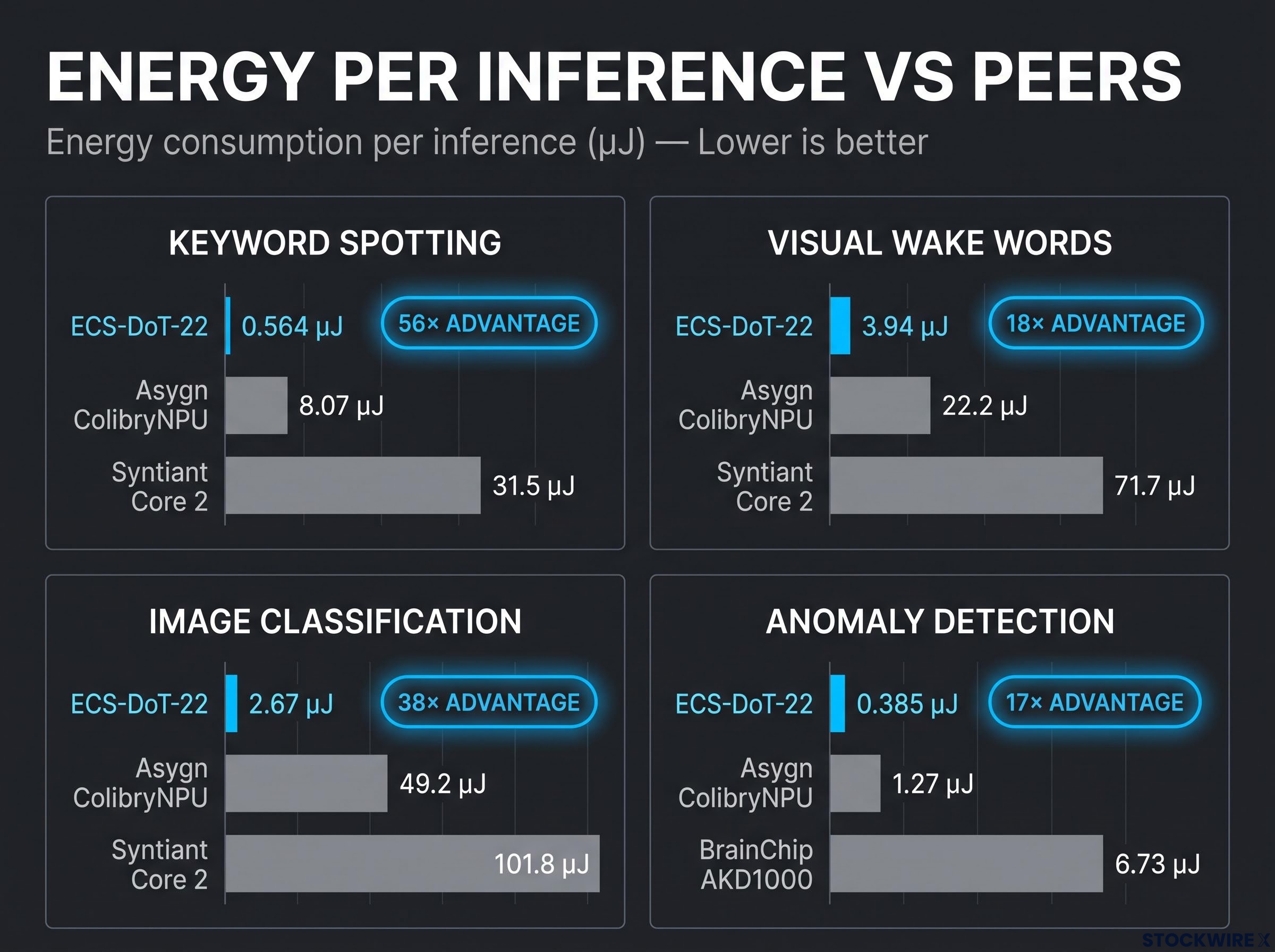
| Workload | ECS-DoT-22 energy | Asygn ColibryNPU 40 MHz (verified) | Syntiant Core 2 (verified) / BrainChip AKD1000 (unverified) | Energy advantage vs Syntiant/BrainChip |
|---|---|---|---|---|
| Keyword spotting | 0.564 μJ | 8.07 μJ | Syntiant Core 2: 31.5 μJ | 56× |
| Visual wake words | 3.94 μJ | 22.2 μJ | Syntiant Core 2: 71.7 μJ | 18× |
| Image classification | 2.67 μJ | 49.2 μJ | Syntiant Core 2: 101.8 μJ | 38× |
| Anomaly detection | 0.385 μJ | 1.27 μJ | BrainChip AKD1000: 6.73 μJ | 17× |
The new models are faster than both the Syntiant Core 2 and the BrainChip AKD1000 on all four workloads. The energy-delay product, which multiplies energy per inference by latency, is 20× to 560× lower than theirs at their lowest-energy operating points.
The Syntiant comparison uses its lowest-energy operating point, 0.9 V and 30.7 MHz. The company describes it as the most conservative available.
The Asygn ColibryNPU at 40 MHz is the lowest published result on each workload. ECS-DoT-22 uses 14× less energy on keyword spotting and 3.3× less on anomaly detection. At its 300 MHz point, the ColibryNPU is faster than ECS-DoT-22 on visual wake words and anomaly detection.
On the unmodified reference models reported in 2024, ECS-DoT-22 already used 10× to 19× less energy than the Syntiant Core 2. The accelerator-native models widen that lead.
What sub-microjoule inference means in a product
At ten keyword-spotting inferences a second, the AI compute cost is approximately 6 μW. The same duty at the Syntiant Core 2’s lowest-energy operating point would require approximately 315 μW, and the company says 6 μW is less than a thousandth of what a Bluetooth or Wi-Fi radio uses to send the same audio to the cloud.
The company outlined three product benefits:
- The AI drops out of the power budget, so always-on listening or watching no longer sets the size of the battery.
- The accelerator finishes early and sleeps, leaving headroom to run several models on one sensor frame.
- Higher accuracy than the reference on every workload means fewer missed wake words and fewer false person detections.
The company points to sensors, wearables, hearables and industrial monitors that run on a battery or harvested energy. Today these either stream raw data to the cloud or run no AI at all.
One early example is the Bosch Sensortec reference design, which pairs five sensors with ECS-DoT inference for event-driven tracking in logistics and cold-chain applications.
EMASS reports two result sets. The unmodified reference models follow the closed-division approach and allow a like-for-like comparison, while the accelerator-native models are open-division-style results and are what a customer will receive from the EMASS integrated development environment (IDE).
Mark Goranson, CEO of Semiconductor Technologies
“Every company at Design-In stage runs ECS-DoT-22 against its own workload before it commits, and the first question is always energy per inference…”
Commercial adoption remains subject to customer qualification, integration and procurement decisions.
What happens next for ECS-DoT-22
Following the DigiKey distribution agreement announced on 10 November 2026, ECS-DoT-22 evaluation kits can be ordered off the shelf.
- The EMASS IDE and AI compiler are being developed for release in November 2026.
- The benchmark models, projects and host scripts behind every table are to be made available with the IDE, so customers and independent third parties can repeat the tests.
Investors exploring the sales channel behind the evaluation kits can read our detailed coverage of the DigiKey distribution agreement, which sets out the stocking arrangement, the initial limited purchase and the termination rights.
Want Alerts Like This on the Technology Stocks You Follow?
StockWire X Market Intelligence scores every announcement in our coverage for how significant it’s likely to be for investors, and which way it points, then alerts you on the stocks you follow. The first 1,000 founding members lock in 50% off for life: A$247 a year instead of the standard A$495. Join the founding waitlist today.