

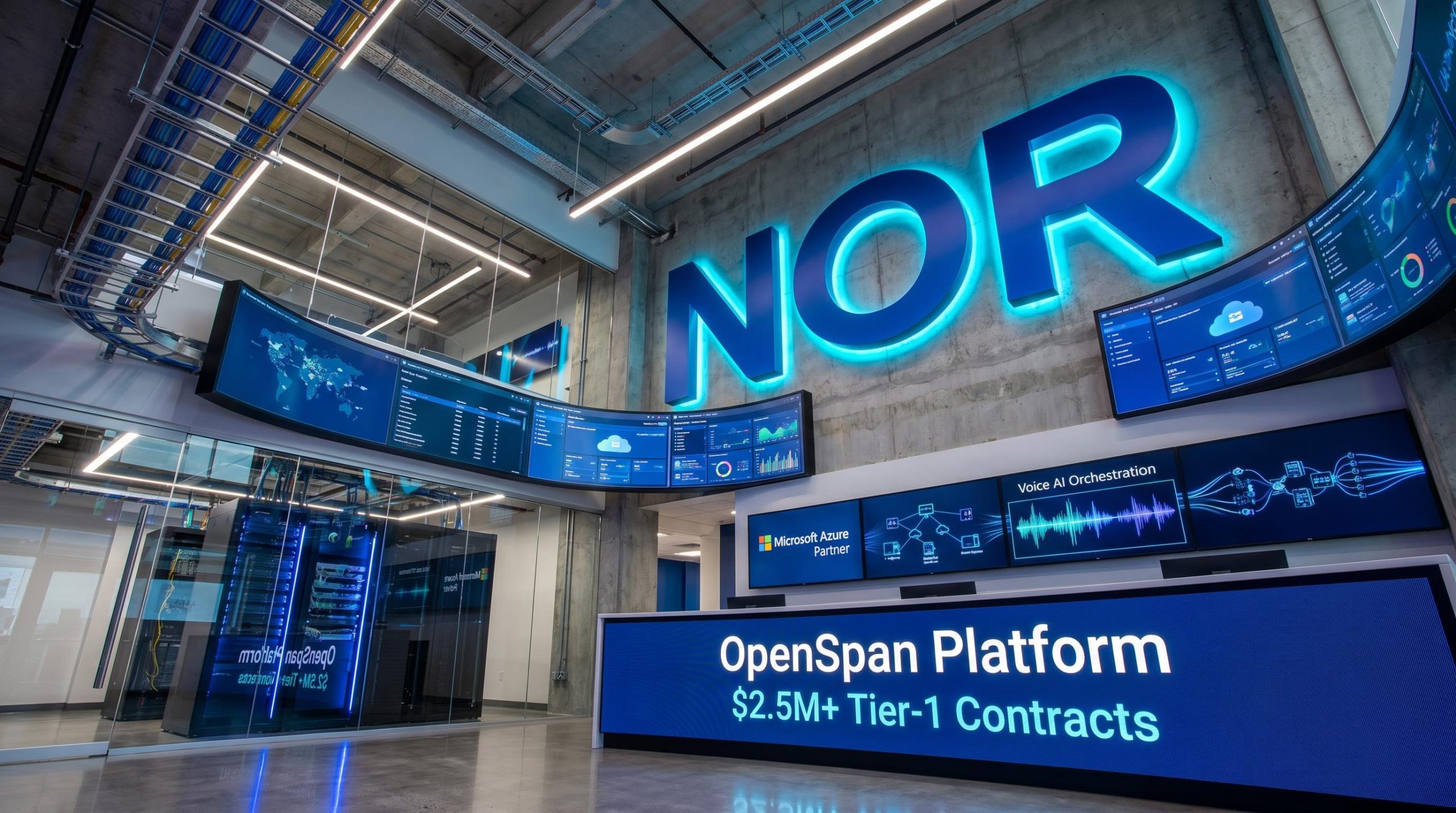
Norwood outlines more than $2.5 million in contracted Tier-1 operator activity
In its June 2026 investor presentation, Norwood Systems detailed more than A$2.5 million in recent contracted activity spanning contract extensions, new works and paid OpenSpan pilots with Tier-1 telecommunications operators. The presentation outlined how the company’s AI services orchestration platform is transitioning from traditional telco workloads into commercial Voice AI deployments across multiple operator accounts.
The contracted activity comprises four separate agreements announced in June 2026, spanning both established production relationships and new paid pilot streams targeting Voice AI services for small and medium enterprises. Management highlighted that the activity represents validation of Norwood’s carrier-native Voice AI strategy, with paid pilot agreements providing pathways toward potential production deployments.
| Contracting Party | Type | Approx. Value | Duration |
|---|---|---|---|
| APAC Tier-1 operator 1 | Contract variation | A$0.6m | Within existing 5-year term |
| APAC Tier-1 operator | Contract extension | A$1.5m | 24 months |
| UK Tier-1 operator | Paid pilot | A$0.3m | 3 months |
| Microsoft / AU Tier-1 operator 2 | Paid pilot | A$0.2m | 2 months |
The presentation emphasised that the June 2026 activity demonstrates expanding commercial traction with existing customers while opening new paid pilot pathways. Two paid OpenSpan pilots with Tier-1 operators represent new Voice AI commercial validation beyond Norwood’s established carrier workloads.
When big ASX news breaks, our subscribers know first
What is AI services orchestration?
The presentation explained AI services orchestration as the middleware layer that allows telecommunications operators to deploy Voice AI services without exposing their core network infrastructure to application-layer risk. Operators require a governed pathway between their live networks and AI services, handling policy enforcement, subscriber consent, security controls, media routing and billing integration.
OpenSpan functions as a controlled gateway, mediating signalling and media between the operator’s voice network and AI service applications. AI services operate behind the orchestration layer while the operator retains governance over service behaviour, network access and customer interactions. The architecture separates the operator’s core infrastructure (numbers, identity, routing, billing systems) from the AI services domain.
This solves a specific telecommunications problem: operators want to monetise Voice AI revenue opportunities but cannot connect untrusted AI applications directly to regulated carrier networks. OpenSpan provides the governance layer that makes carrier-native Voice AI deployable under telco-grade security and compliance requirements.
The revenue problem Voice AI can solve for telcos
The presentation outlined the operator challenge driving demand for Voice AI services: mobile ARPU is declining despite rising data consumption, voice and SMS revenues are commoditised, and network operating costs continue to increase. Global mobile ARPU is projected to decline at -1.3% CAGR between 2024 and 2029, while network operating expenses as a percentage of revenue have increased from 17.4% in 2018 to 18.4% in 2024.
Management positioned Voice AI as a pathway for operators to monetise assets they already own, including subscriber numbers, identity systems, routing infrastructure, billing relationships and customer trust. The presentation identified four service categories where Voice AI can create new ARPU drivers for telecommunications operators:
- Call Protect: Scam and nuisance call protection for consumers, positioned as a low-cost monthly add-on with broad attach potential across mobile and fixed subscriber bases
- Jobs Agent: AI call answering and job qualification for trades and mobile workers, automating inbound call handling 24/7 with clear ROI from reduced missed calls
- SME Assistant: AI front desk automation for small business, handling call routing, appointment booking and follow-up across retail, professional services and hospitality segments
- Live Translation: Real-time voice translation for international customers, enterprise accounts and government sectors, breaking language barriers during live calls
Each service represents a new revenue stream layered onto existing network infrastructure. Norwood’s model is to provide the platform and service modules while operators package and sell the services to their subscriber base under their own brand.
How Norwood scales operator accounts
The presentation detailed a three-phase commercial model designed for account depth rather than breadth, with the core insight that once an operator approves the OpenSpan integration, additional Voice AI services become faster and cheaper to deploy:
- Entry wedge: A paid pilot or first production service establishes the operator approval pathway, generating initial pilot revenue and platform configuration fees
- Production service: The first commercial deployment creates recurring economics through negotiated software licence fees, usage-based pricing or subscriber-linked charges
- Multi-service expansion: Additional Voice AI services reuse the same approved integration, governance framework and launch pathway, increasing account value through more services, segments and usage
Management provided illustrative revenue scenarios to demonstrate how the model could scale with operator account depth. At 5 operators generating A$0.5 million per annum each, annual revenue would reach A$2.5 million. Scaling to 10 operators at A$1.0 million each produces A$10 million annually, while 25 operators at A$1.5 million each generates A$37.5 million. The upper scenario of 50 operators at A$2.0 million per operator represents A$100 million in annual revenue.
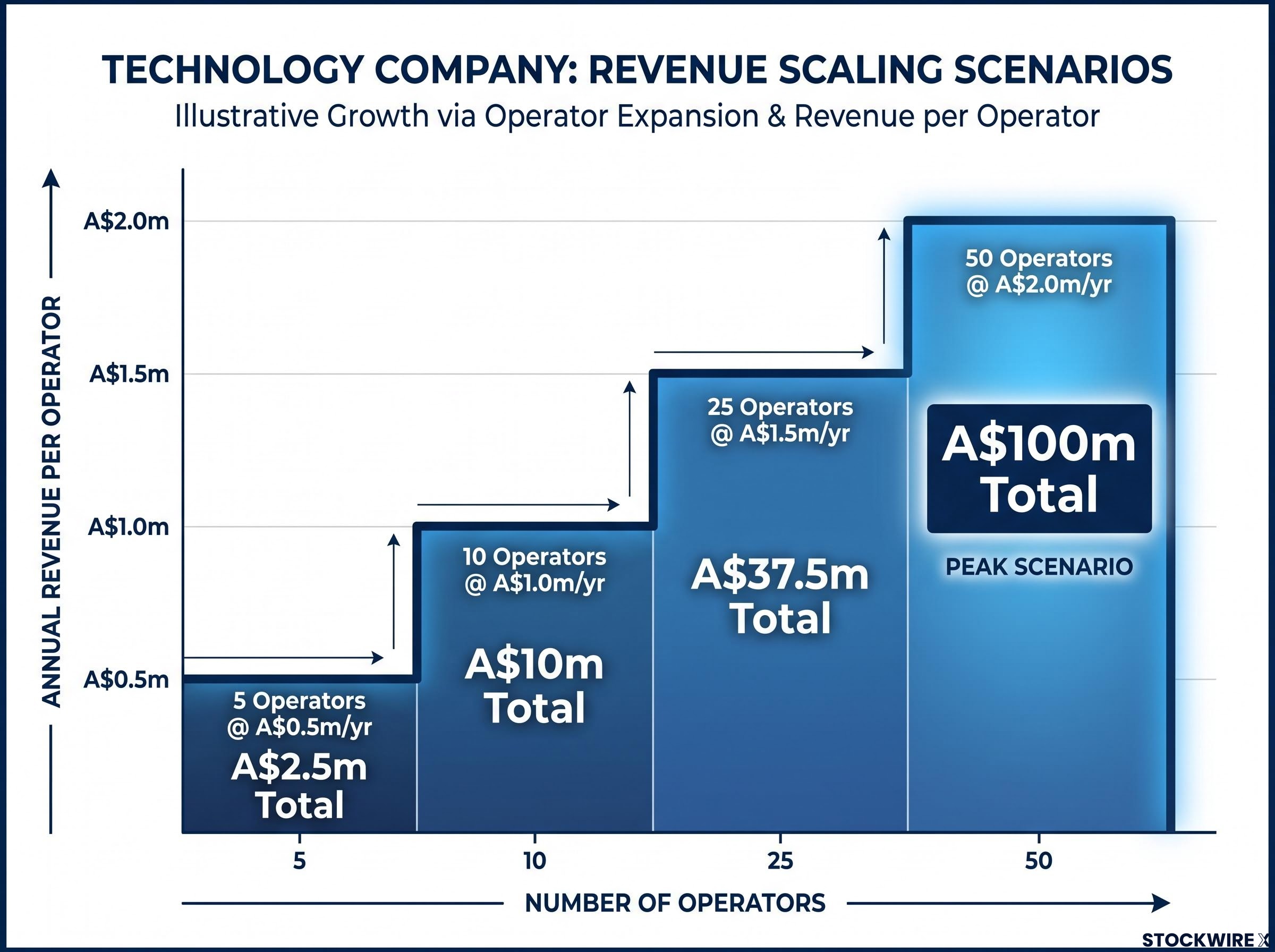
The commercial model is designed so the first approved service creates a platform for multiple follow-on services with the same operator, with recurring software and usage-linked fees driving account economics over time.
The A$1.5 million voicemail contract renewal extends a production relationship first established in 2018, with the platform embedded in the operator’s live network for more than six years, a tenure that illustrates the switching costs and delivery credibility underpinning Norwood’s account expansion strategy.
Current financial position and proof points
The presentation stated preliminary unaudited revenue of A$2.1 million for H1 FY26, with positive operating cash flow achieved through Q3 FY26. Management noted a current market capitalisation of approximately A$10 million as at 17 June 2026, positioning the financial metrics against disclosed commercial proof points.
Norwood’s existing production relationships include ongoing contracted works with Optus and Spark NZ. The company has won four major ICT awards spanning WA, National and International categories, including the 2025 Kaohsiung APICTA Asia Pacific ICT Alliance Gold Winner.
Paul Ostergaard, CEO and Founder
“The recent contracted activity announced by Norwood over the past several weeks brings together a number of important proof points: expanded production work with existing Tier-1 customers, new paid OpenSpan pilot activity and continued validation of our carrier-native Voice AI strategy.”
The presentation positioned a publicly listed Voice AI platform with A$2.1 million H1 revenue, positive year-to-date cash flow and new paid Tier-1 pilot activity for investors to assess against the current market capitalisation.
Strategic relationships and hyperscaler positioning
Management highlighted that Norwood is named as one of Microsoft’s 23 global telco vendor partners, with the Microsoft relationship providing validation and operator access. The presentation included commentary from Microsoft’s CTO for Worldwide Telecommunications:
Rick Lievano, CTO Worldwide Telecommunications, Microsoft
“OpenSpan exemplifies how telcos can leverage Microsoft Azure’s powerful AI and cloud capabilities to redefine their voice service offerings.”
The presentation clarified that while OpenSpan is built for Azure deployment, the architecture is designed to be portable across other hyperscaler environments. Management framed the Microsoft relationship as “partner leverage, not dependency,” with the partnership providing validation and reach while maintaining architectural flexibility for deployment on alternative cloud platforms.
Global pipeline and regional activity
The presentation outlined geographic spread of engagement across four regions. In Australia and New Zealand, Norwood has contracted works with Optus and Spark NZ, plus a paid pilot with a second Australian Tier-1 operator. Asia engagement includes a successful paid APAC Tier-1 pilot focused on Call Protect services, with additional APAC Tier-1 operator engagement underway.
European activity comprises a paid UK Tier-1 pilot and EU Tier-1 operator engagement. North America shows a current US Tier-1 pilot focused on live translation services alongside Canadian operator engagement. The presentation noted this represents engagement across both traditional telco workloads and AI-native services.
The UK Tier-1 pilot, running from late June to mid-September 2026 within the operator’s own Microsoft Azure tenant, tests a wide scope of capabilities including call routing, appointment scheduling, provisioning workflows and unit-economics analysis, with no obligation on the operator to proceed to production.
Management positioned geographic diversification as reducing single-market risk while demonstrating repeatable engagement patterns across regions. The global footprint spans established production relationships, paid pilot streams and active operator engagement at various stages of the commercial pathway.
Execution priorities and trackable milestones
The presentation identified five execution priorities for the next 12-18 months that management committed to deliver:
- Deliver existing carrier programs against agreed milestones and service deployment requirements
- Progress paid OpenSpan Voice AI pilots toward defined production pathways and launch criteria
- Advance priority AI service streams including Call Protect, SME Assistant and Jobs Agent
- Package repeatability through governance frameworks, reference architecture and partner-ready collateral
- Align delivery capacity, working capital and partner support to priority carrier milestones
Management stated that investors can monitor progress through trackable milestones including pilot outcomes, carrier milestone deliveries, cash receipts and customer references where operators approve public disclosure. The presentation outlined specific items for assessment: production next steps from paid OpenSpan pilots, progression of Call Protect and SME Assistant workstreams, delivered carrier milestones with associated cash receipts, and commercial launch criteria agreed for priority paid pilot streams.
Investment thesis summary
The presentation closed with a four-part investment thesis positioning Norwood at an inflection point from concept validation to commercial execution:
- Telcos need new premium Voice AI services: Revenue pressure from declining ARPU and commoditised voice/SMS is driving operator demand for new monetisable services
- These services require telco-grade orchestration: Governance, security, policy enforcement and compliance requirements mean operators cannot connect AI applications directly to carrier networks
- OpenSpan provides the platform governance layer plus CogVoice service modules: A reusable orchestration platform with operator-ready Voice AI applications spanning consumer, SME and enterprise use cases
- Commercial proof points are now visible: Paid carrier contracts, pilot activity, production relationships and trackable execution milestones provide evidence of commercial traction
Management framed the bottom line as a listed Voice AI platform with paid carrier proof points, reusable platform leverage and trackable execution milestones. The presentation positioned Norwood as moving from concept validation to commercial execution with Tier-1 operators across multiple geographies and service streams.
Want the Next Tech AI Winner in Your Inbox?
Join 20,000+ investors receiving FREE breaking ASX news within minutes of release, complete with in-depth analysis. Big News Blast delivers Tech AI announcements straight to your inbox the moment they hit the market. Click the “Free Alerts” button to stay ahead on market-moving news.