
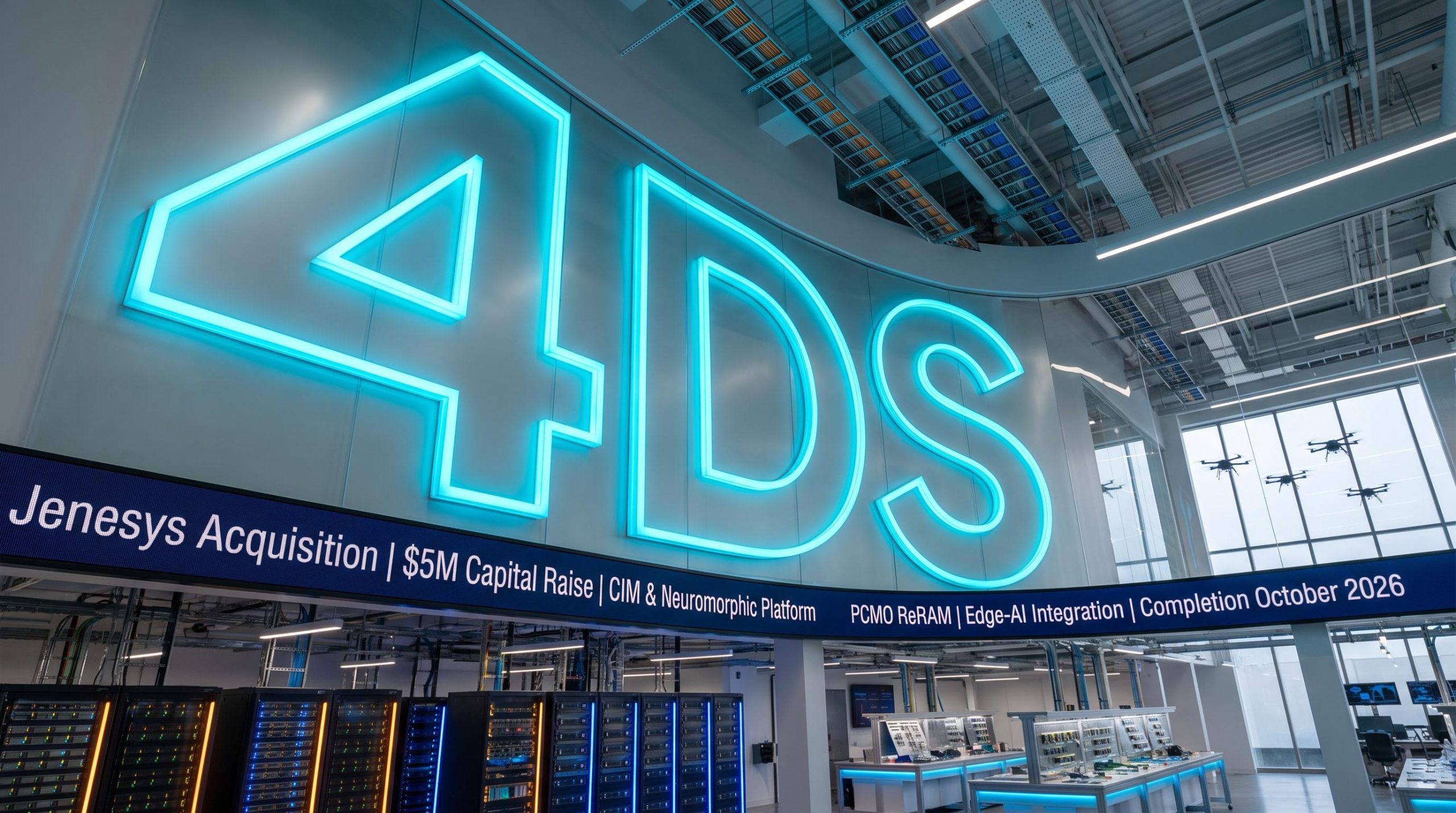
4DS to acquire Jenesys and launch $5 million raise to unlock CIM and neuromorphic markets
4DS Memory Limited (ASX: 4DS) has entered into a binding heads of agreement to acquire 100% of Jenesys Pty Ltd, pairing its proprietary PCMO ReRAM hardware with Jenesys’s Edge-AI software and autonomous systems capability.
The combined goal is an integrated hardware-software platform targeting computing-in-memory (CIM) and neuromorphic computing applications. The Transaction, comprising the Acquisition and a Capital Raising of up to $5 million, is targeted to complete in October 2026 (indicative completion 5 October 2026).
On completion, Jenesys shareholder Jaspal Sarai will join the board as Managing Director and Chief Executive Officer. The move follows the strategic review announced on 5 September 2025.
Key elements at a glance:
- Acquisition: 100% of Jenesys Pty Ltd
- Capital Raising: up to $5 million (before costs)
- Targeted completion: October 2026
- New MD & CEO: Jaspal Sarai
When big ASX news breaks, our subscribers know first
Inside the acquisition — what 4DS is buying
Jenesys is an Australian Edge-AI and autonomous systems software company operating within Australia. It was incorporated on 17 November 2025, consolidating pre-existing intellectual property developed over approximately three years with aggregate expenditure of around $3 million.
The company has developed software enabling intelligent autonomous systems coordination across air, land, sea and space. Its core commercial product is the Distributed Autonomy Stack, a software layer designed to allow fleets of mixed unmanned vehicles to coordinate without a central command node.
The stack is intended for contested DDIL (Denied, Disrupted, Intermittent and Limited bandwidth) environments, where GPS availability and communications integrity cannot be guaranteed.
Jenesys’s key capabilities include:
- AI model optimisation
- Heterogeneous swarm coordination algorithms
- Payload operations software
- Distributed Autonomy Stack (flagship product)
For investors, the addition of this software layer is intended to turn 4DS’s memory hardware into a complete, solution-oriented platform rather than a standalone component.
The strategic rationale — why hardware plus software wins
4DS retains its validated 60nm PCMO ReRAM platform as a leading focus of its technology and development program. The company successfully manufactured a 60nm megabit-scale memory cell array in August 2023, confirming the viability of the underlying architecture.
The September 2025 strategic review resulted in the discontinuation of one development pathway, being the scaling of the technology to 20nm, but did not affect the company’s ability to continue developing and commercialising the validated 60nm platform.
Software is central to the thesis. For CIM and neuromorphic applications, ReRAM performance is determined by the interaction between device physics and machine-learning workloads, meaning the hardware cannot be finalised in isolation.
The Board assessed alternatives, including licensing or divestment, and determined these would limit strategic control and transfer economic upside to counterparties. The acquisition is intended to ensure alignment and enable the company to capture the full economic benefit of commercialisation.
The company draws a parallel with leading chip manufacturers such as Qualcomm and NVIDIA, which bundle software frameworks with silicon to reduce integration risk and accelerate OEM adoption. Recent business development engagement in India, including the India Semiconductor Mission, the Semi-Conductor Laboratory, IIT Delhi, IIT Bombay and the Indian Institute of Science, provided market-level validation. The company also intends to meet with HGST to discuss renewal of the existing Joint Development Agreement.
David McAuliffe, Executive Chairman
“In doing so and ensuring efficient execution on a development plan the Board is of the opinion that this will restore shareholder value and confidence in the short-term, with potentially significant shareholder value into the future.”
Understanding computing-in-memory and neuromorphic computing
Computing-in-memory (CIM) refers to processing data where it is stored, rather than constantly moving it between memory and a separate processor. This approach can improve energy efficiency and speed by reducing data movement.
Neuromorphic computing describes chips designed to mimic how the brain processes information. Such designs are well suited to low-power, real-time AI inference at the “edge,” meaning devices operating away from centralised data centres.
4DS’s 60nm PCMO cell is described as well suited to these applications, where the critical performance parameters are analog behaviour, endurance, retention and energy efficiency.
For investors, these are emerging multi-billion-dollar markets spanning electric vehicles, robotics, drones and edge-AI systems. A platform solution is intended to expand 4DS’s addressable market and support scalable licensing revenues.
Deal terms, consideration and the $5 million capital raising
Under the Agreement, and subject to conditions precedent, the Vendors will receive consideration comprising:
- A $150,000 non-refundable deposit, which has already been paid to the Vendors
- $5,000,000 worth of fully paid ordinary 4DS Shares at a deemed issue price of $0.01 per 4DS Share (Upfront Consideration Shares), with 50% escrowed for 6 months and 50% for 12 months post-completion
- Six (6) Consideration Performance Rights tied to commercial milestones
The performance milestones are set out below.
| Rights | Milestone | Timeframe | Milestone Amount |
|---|---|---|---|
| 2 | Live demonstration of Jenesys technology maintaining operational integrity (autonomous coordination without a central command node), independently confirmed | Within 12 months | $250,000 |
| 2 | At least $2,000,000 in binding contracted revenue from licensing, deployment or commercialisation of the Distributed Autonomy Stack or related Jenesys technology, excluding government grants and one-off or non-recurring items | Within 24 months | $500,000 |
| 2 | At least $5,000,000 in binding contracted revenue from licensing, deployment or commercialisation of the Distributed Autonomy Stack or related Jenesys technology, excluding government grants and one-off or non-recurring items | Within 36 months | $1,000,000 |
The maximum number of shares issuable on conversion of all Performance Rights is 350,000,000 shares.
Separately, the Capital Raising is proposed to raise up to $5,000,000 at $0.01 per share, comprising:
- A non-renounceable pro rata Entitlement Issue to raise approximately $3,000,000, offered at a ratio of 1 new share for every 7 shares held at $0.01 per share
- A Placement to professional and sophisticated investors to raise $2,000,000 at $0.01 per share, for which the company has received firm commitments
JP Equity Holdings Pty Ltd has been appointed Lead Manager, earning a 6% cash fee on Placement funds attributable to its clients, a 2% management fee on funds raised outside the Lead Manager, and 6% on any placed shortfall.
Use of funds and what happens next
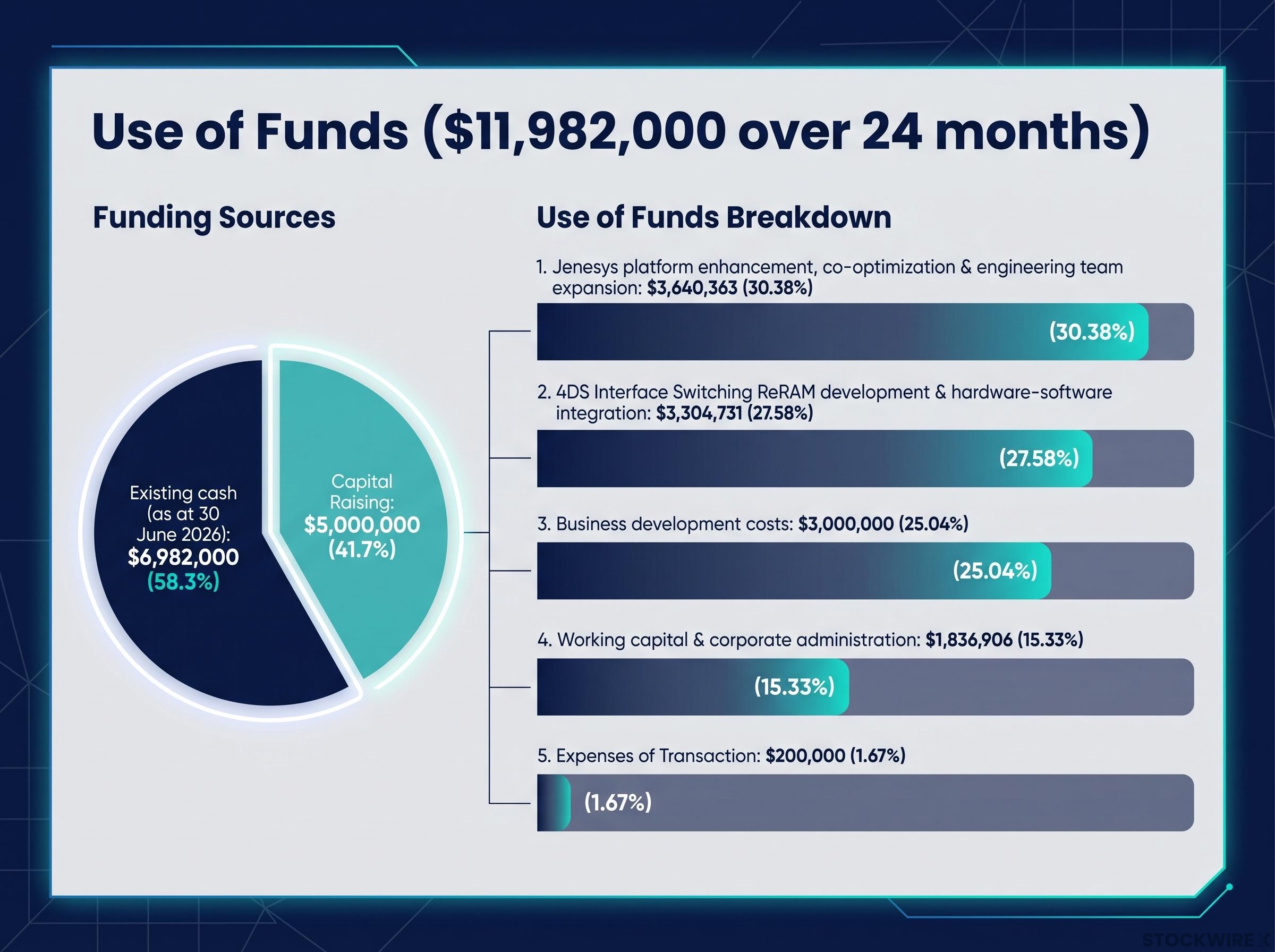
Existing cash and Capital Raising proceeds are intended to be applied over the next 24 months as follows.
| Application | Amount | % |
|---|---|---|
| 4DS Interface Switching ReRAM development & hardware-software integration | $3,304,731 | 27.58% |
| Jenesys platform enhancement, co-optimization & engineering team expansion | $3,640,363 | 30.38% |
| Business development costs | $3,000,000 | 25.04% |
| Expenses of Transaction | $200,000 | 1.67% |
| Working capital & corporate administration | $1,836,906 | 15.33% |
| Total | $11,982,000 | 100% |
The funding pool combines existing cash of $6,982,000 (as at 30 June 2026, 58.3%) with $5,000,000 raised under the Capital Raising (41.7%).
Proposed activities following completion include:
- Re-tuning the validated 60nm PCMO ReRAM platform for neuromorphic and CIM applications
- Integrating Jenesys software with the PCMO ReRAM hardware, including Edge-AI models
- Device fabrication and characterisation with new strategic partners
- Developing proof-of-concept CIM devices demonstrating analog weight storage, in-situ matrix operations and low-power inference
- Business development for commercial partnerships, licensing and pilot programs
The indicative timetable includes the following key dates:
- Launch of Entitlement Issue: 2 September 2026
- Record date: 8 September 2026
- Entitlement Issue closes: 28 September 2026
- 4DS shareholder meeting: 2 October 2026
- Settlement and completion: 5 October 2026
Following consultation with the ASX, the company’s securities will be reinstated to quotation, and 4DS will not be required to re-comply with Chapters 1 and 2 of the Listing Rules. Completion remains subject to conditions precedent, including due diligence, shareholder approval, completion of the Capital Raising, and regulatory and third-party consents.
Don’t Miss the Next ASX Tech Breakout
Big News Blast delivers FREE breaking ASX tech news directly to your inbox within minutes of release, complete with in-depth analysis already done for you. Join 20,000+ subscribers who stay ahead of the market the moment announcements drop. Click the “Free Alerts” button at Big News Blast to get started today.