

Lifestyle communities returns to profit as transformation gains traction in FY26
In its FY26 results presentation for the year ended 30 June 2026, Lifestyle Communities reported a return to statutory profit, recording a statutory net profit after tax of $46.9m, a recovery from an FY25 statutory loss of $195.3m.
The turnaround was supported by rebuilding momentum across the platform. Net new home sales rose 55.4%, net debt fell by $186.8m, and unsold inventory was cut 55.0%.
Management framed the year as delivering tangible progress on a disciplined transformation program, describing a strengthened platform positioned for growth. Operating profit, however, was lower, an outcome the company addressed within the broader transformation context.
When big ASX news breaks, our subscribers know first
FY26 results snapshot, the headline numbers
The presentation detailed clear improvements in sales momentum, annuity income and balance sheet strength, alongside a softer operating result. The table below compares key metrics against FY25.
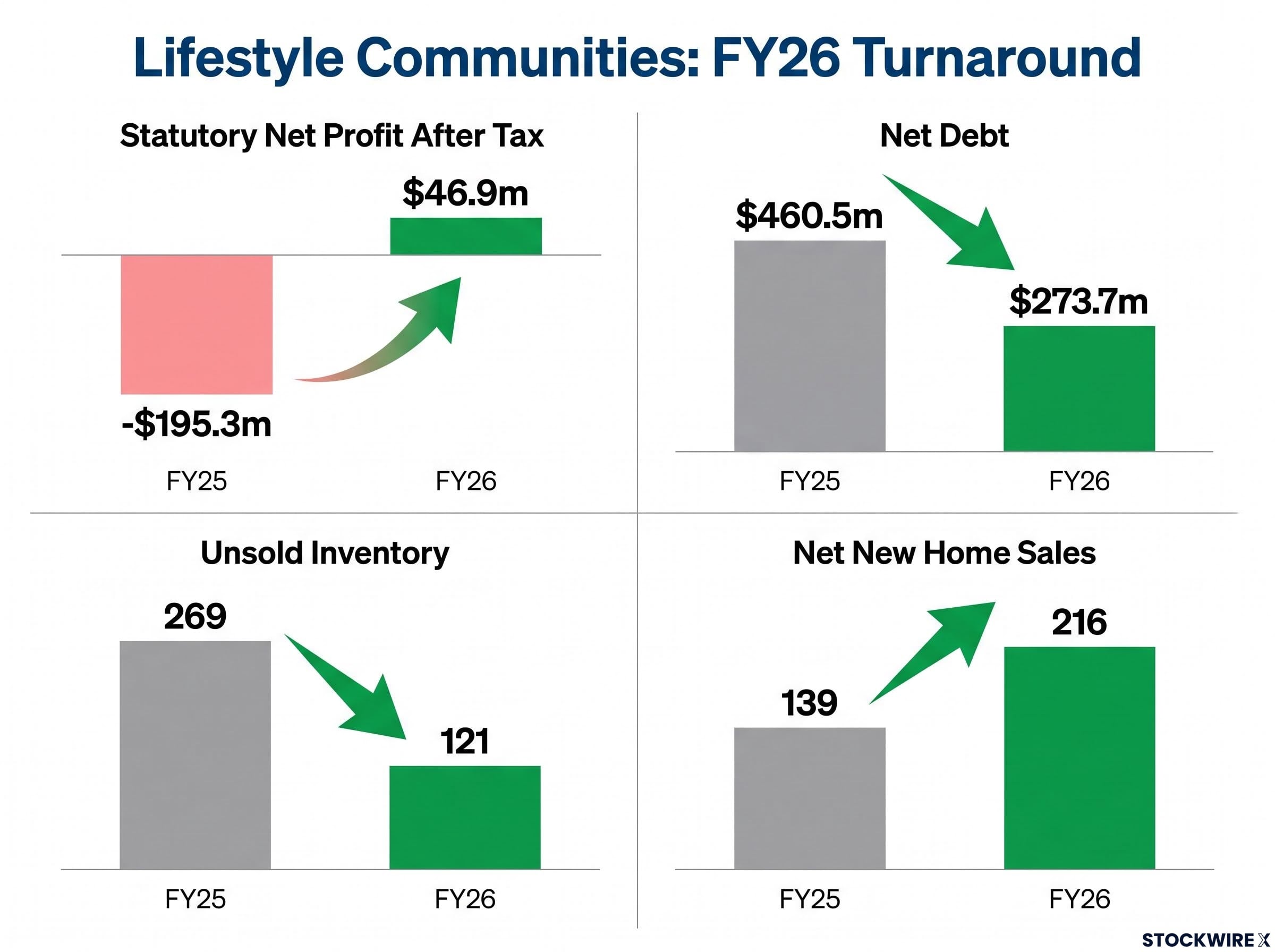
| Metric | FY25 | FY26 | Change |
|---|---|---|---|
| Statutory net profit/(loss) after tax | ($195.3m) | $46.9m | Returned to profit |
| Operating profit after tax | $45.2m | $25.4m | Lower |
| Net new home sales | 139 | 216 | +55.4% |
| Rental annuity income | $45.7m | $51.4m | +12.4% |
| Net debt | $460.5m | $273.7m | Down $186.8m |
| NTA per share | — | $5.59 | — |
| Unsold inventory | 269 | 121 | −55.0% |
Operating profit after tax of $25.4m was lower than the prior period. Management attributed the decline to three key drivers:
-
Lower new home settlements (240 in FY26 versus 268 in FY25)
-
Lower Deferred Management Fee (DMF) revenue following the VCAT decision
-
A greater portion of land bank interest costs being expensed
What is the land lease model?
Lifestyle Communities’ land lease model creates opportunities for working, semi-retired and retired people to downsize from their family home. Homeowners buy their home but lease the land beneath it, paying a weekly site rental fee. This structure can free up equity from the sale of a family home while providing access to resort-style amenities such as pools, gyms and clubhouses.
The model generates two income streams. The first is recurring site rental fees, which provide an annuity income. The second is a Management Fee, structured either as a Deferred Management Fee (DMF) paid on exit or an Upfront Management Fee (UMF) paid at settlement.
For investors, the significance lies in the growing annuity base. With 4,368 homes under management generating $51.4m in rental income, the platform provides recurring revenue designed to support resilience across property cycles.
Sales momentum rebuilds despite a subdued market
The presentation described sales momentum rebuilding quarter-on-quarter through FY26, following a recovery from the first half of FY25. Management noted this was achieved despite ongoing weakness across the property market.
Key sales metrics included:
-
Net new home sales of 216, up 55.4% on FY25’s 139
-
Conversion rate from face-to-face appointment to sale improved from a historical ~22% to ~25%
-
Way to Live brand campaign awareness grew +23% in FY26
-
Established (resale) net sales of 184, the strongest in recent periods
Quarterly net new home sales through FY26 showed a rebuilding trend:
-
Q1: 50
-
Q2: 60
-
Q3: 43
-
Q4: 63
Management indicated the improving conversion rate and brand traction demonstrated that demand-generation levers were working.
A new “No Exit Fee” choice for customers
The company broadened its customer value proposition with a new Management Fee flexibility option introduced in late January 2026. Since launch, 28% of new customers selected the upfront fee option.
Under the “No Exit Fee option”, customers can pay an Upfront Management Fee of 10% of the home’s purchase price at settlement. Alternatively, they can defer up to 20% of the purchase price, payable on exit.
Balance sheet strengthened and de-risked
A core pillar of the update was material de-leveraging across the balance sheet. Net debt was reduced to $273.7m from $460.5m, a reduction of $186.8m, driven by land bank settlements and ongoing inventory realisation.
The Q3 FY26 debt reduction milestones provide useful context for the pace of balance sheet repair: net debt had already fallen $164.1 million to $296.4 million by March 2026, with unsold completed homes down 42.4% over the same period, before the June quarter added the final leg of deleveraging.
The loan to value ratio improved to 28.7% from 47.8%. In January 2026, debt facilities were restructured and right-sized from $571.0m to $375.0m, comprising a $300.0m Note Purchase and Private Shelf Facility with PGIM (initial issuance of $250.0m) and a $125.0m Revolving Bank Debt Facility. Operating cash flows were positive at $94.9m.
Management outlined the following benefits from the debt restructure:
-
A simplified financing structure
-
Facilities right-sized to the medium-term needs of the business
-
A longer-term maturity profile
-
Interest Coverage Ratio covenant relief until 30 June 2028, allowing time for recovery in the Victorian property market
For investors, lower gearing combined with covenant relief points to reduced financial risk and additional runway during the recovery period.
The regulatory picture, DMF model and pending VCAT appeal
A major milestone was VCAT’s decision on DMFs. In response, the company introduced a new DMF model based on the purchase price of the home, which it noted is consistent with the VCAT decision and the recently proposed Consumer Legislation Amendment Bill 2026.
On 18 August 2026, the Court of Appeal, Supreme Court of Victoria advised it would deliver its judgment on the group’s appeals on Friday, 21 August 2026. As at the release of the presentation, the outcome of the appeal and its impact, if any, was unknown.
A provision for the repayment of DMFs collected from previous homeowners impacted by the VCAT decision was recognised. If the appeal is successful, the provisioning is expected to be reversed. DMF collected in the interim is held in quarantined funds of $5.1m.
Management framed the purchase-price DMF model as providing greater long-term certainty for shareholders and the business model. For investors, regulatory alignment reduces a key overhang, though the appeal outcome remained pending at the time of the presentation.
Company positioning
Lifestyle Communities’ stated position
“Commenced a disciplined transformation program to restore confidence, sharpen strategic focus and position Lifestyle Communities for sustainable growth.”
Outlook, a strengthened platform ready for growth
Management stated that Lifestyle Communities, described as Victoria’s leading land lease operator, enters FY27 with 17 established communities, 8 in development and 4 sites poised for activation. The portfolio and pipeline totals 5,750 homes, of which 4,368 are currently occupied.
The company flagged that, due to the lag between sales and settlements, lower prior-period sales rates are expected to temper FY27 settlements. FY27 also presents an opportunity to commence a new community in one of the South-East corridor’s highest-demand catchments, subject to market conditions. Approximately 7% cost reduction benefits are forecast to be realised in FY27.
The presentation set out four forward pillars:
-
Demand Generation & Conversion: brand campaign, homeowner referrals and integrated sales team
-
Balance Sheet Strength: lower net debt, restructured facilities and disciplined capital allocation
-
Regulatory Alignment & Business Model Durability: DMF model durability and customer-centred fee choice options
-
New Community Activation: the FY27 opportunity to commence a new community, subject to market conditions
Underpinning the longer-term thesis is a structural demographic tailwind, with Australians aged 65+ forecast to rise from 4.75m to approximately 7m by 2040.
The FY26 results presentation set out an investment case built on a de-risked balance sheet, rebuilding sales momentum, a growing annuity income stream and supportive demographics. Management positioned these factors as supporting recovery, while acknowledging near-term settlement headwinds and the pending regulatory outcome.
Don’t Miss the Next Real Estate Sector Mover
Big News Blast delivers FREE breaking ASX real estate news straight to your inbox within minutes of release, complete with in-depth analysis. Join 20,000+ subscribers already ahead of the market. Click the “Free Alerts” button at Big News Blast to start receiving alerts the moment market-moving announcements drop.