
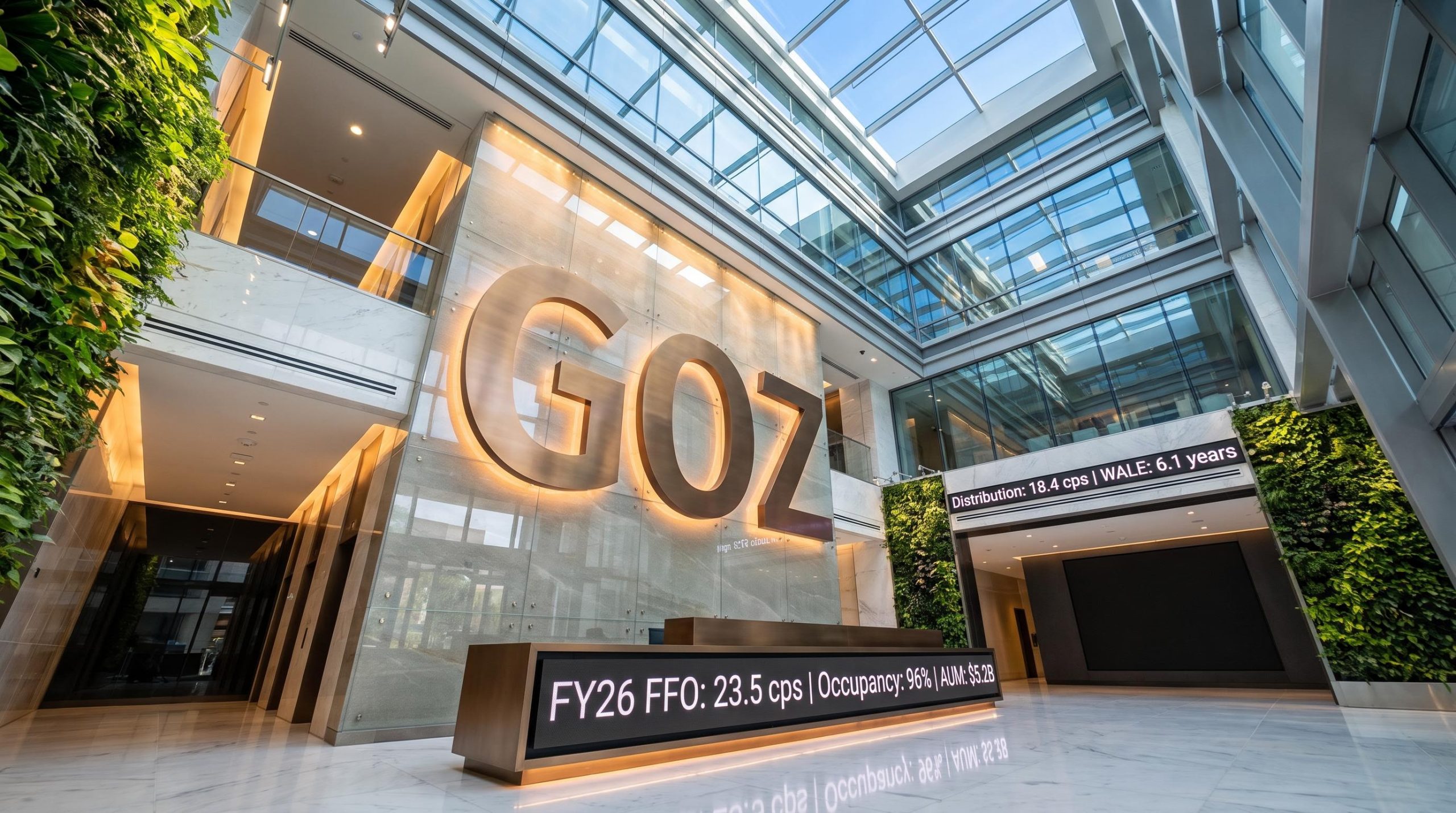
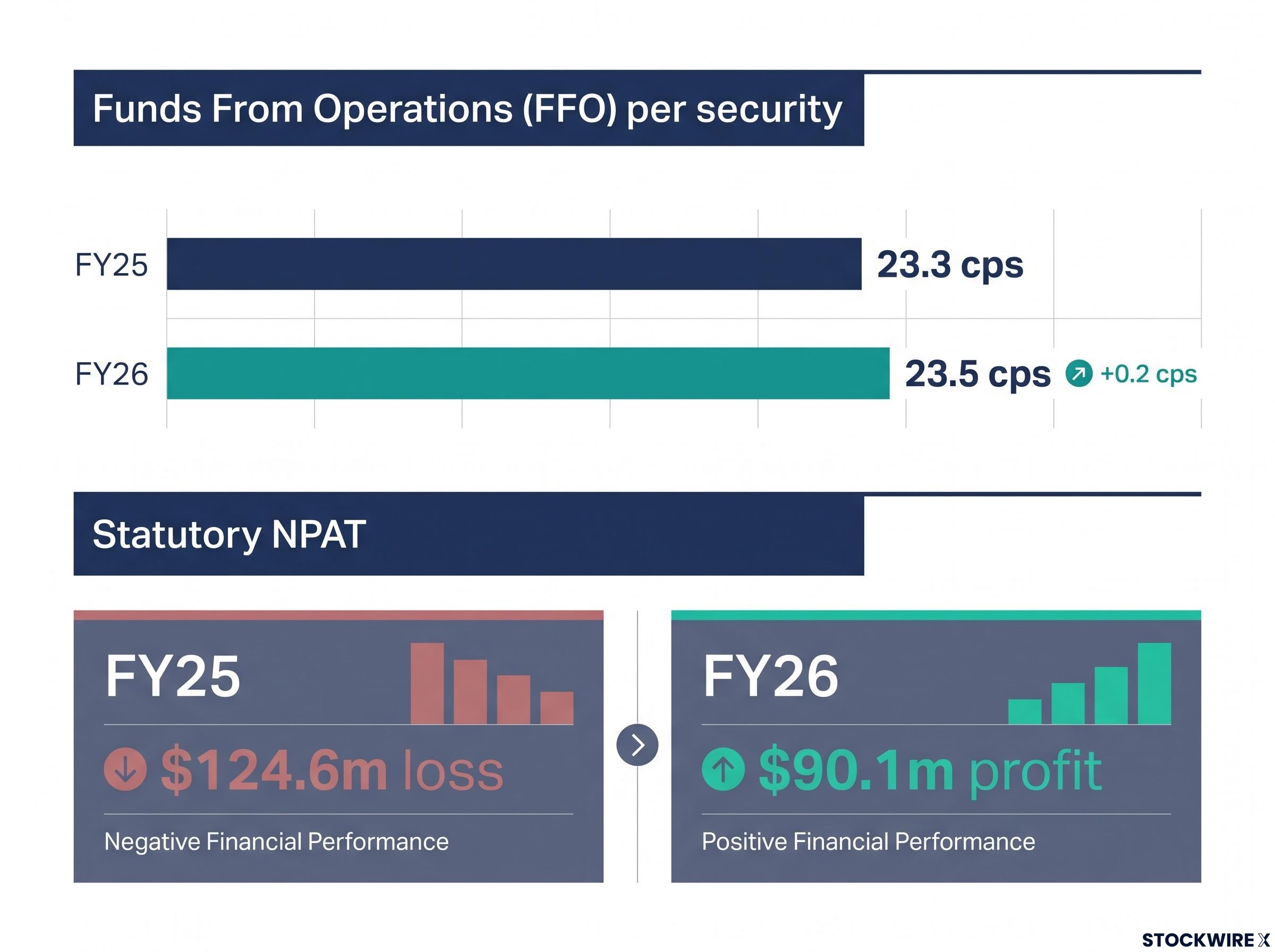
In its FY26 annual results presentation dated 17 August 2026, Growthpoint Properties Australia (ASX:GOZ) outlined a resilient full-year result, with Funds From Operations (FFO) of 23.5 cents per security (cps), at the upper end of guidance and ahead of FY25’s 23.3 cps.
Management detailed a return to statutory profit, with net profit after tax of $90.1m compared with a statutory loss of $124.6m in FY25, a prior-year result driven largely by property revaluations. The company reported assets under management (AUM) of $5.2b across 64 assets, distributions of 18.4 cps, and issued FY27 guidance.
The result was presented by Chief Executive Officer and Managing Director Ross Lees and Chief Financial Officer Melinda Ch’ng.
Group results at a glance
The presentation set out the group’s key financial metrics for the year, reflecting modest earnings growth and a return to statutory profitability.
| Metric | FY26 | FY25 | Change |
|---|---|---|---|
| FFO per security | 23.5 cps | 23.3 cps | +0.9% |
| Distribution per security | 18.4 cps | 18.2 cps | +1.1% |
| Statutory NPAT | $90.1m | ($124.6m loss) | Return to profit |
| NTA per security | $3.05 | $3.09 | -1.3% |
| Gearing | 41.6% | 39.7% | +1.9pp |
| WACD | 5.1% | 4.9% | +0.2pp |
Portfolio headline statistics highlighted the defensive quality of the directly held assets:
-
Portfolio occupancy of 96%, up from 94%
-
Direct portfolio WALE of 6.1 years
-
Weighted average capitalisation rate (WACR) of 6.8%
When big ASX news breaks, our subscribers know first
Record leasing drives portfolio performance
Leasing activity was the operational engine behind the result. Management reported like-for-like property FFO growth of 2.6%, split between office at 2.7% and industrial at 2.6%.
The company recorded record office leasing of 81,022 sqm across 48 leases, alongside 117,934 sqm of industrial leasing. This drove office occupancy up to 95% from 92%, while industrial occupancy held steady at 98%.
Growthpoint’s record office leasing momentum was building well before the financial year closed, with 54,721 sqm executed and a further 27,602 sqm under agreed terms by mid-June 2026, including the Myer Group’s 11-year commitment at 75 Dorcas Street, South Melbourne.
A recurring theme was the company’s tenant advantage, with 75% of FY26 leases completed to existing tenants. Leasing spreads diverged by sector, with industrial spreads of +34.6% contrasting with office spreads of -1.2%, reflecting differing market conditions across the two asset classes.
Notable leasing deals detailed in the presentation included:
-
Office: Myer Group (13,679 sqm), Samsung (13,423 sqm) and Monash University (7,152 sqm)
-
Industrial: Linfox (33,196 sqm), Workwear Group (26,517 sqm) and Qantas (11,427 sqm)
What is FFO and why it matters for A-REIT investors
Funds From Operations (FFO) is the key earnings measure for Australian Real Estate Investment Trusts (A-REITs). It strips out non-cash items such as property revaluations to reflect the underlying income a trust generates from its assets, offering a clearer view of distributable earnings than statutory profit.
Related metrics matter too. WALE (weighted average lease expiry) measures how long tenants are contracted to stay, occupancy shows how much space is let, and gearing indicates debt relative to assets. For Growthpoint, high occupancy combined with a long WALE supports defensive, predictable income that underpins distributions.
Capital management and the $268m divestment
Management detailed a disciplined approach to the balance sheet. Gearing of 41.6% sat within the target range of 35–45%, with a pro forma reduction of approximately 4% expected following settlement of the Woolworths distribution centre (DC).
During the year, the company refinanced $495m of debt, with maturities now covered to the end of FY27. Weighted average debt maturity stood at 3.2 years, with 77.2% of debt fixed. Growthpoint also established $275m of new sustainability linked loans and retained a Baa2/Stable credit rating from Moody’s.
A key capital initiative was the conditional $268m divestment of 20 Colquhoun Road, Perth Airport (the Woolworths DC). The contract was exchanged in August 2026, post balance date, with settlement expected in early calendar year 2027, framed by management as strategic de-leveraging. The estimated cost to complete the current expansion works was $6.4m as at 30 June 2026.
The Colquhoun Road divestment was announced in August 2026, with the $267.7 million sale price representing more than 2.6 times the asset’s 2009 seed portfolio valuation and an unlevered property IRR of approximately 12% across its holding period.
CEO commentary
The presentation did not disclose a verbatim quote. Management characterised the FY26 result as disciplined execution against a volatile macroeconomic environment, with capital recycling and balance sheet optimisation positioned to support the company’s strategy through cycles.
Funds management platform positioned for growth
Alongside the directly held portfolio, the funds management platform was framed as a growth engine. The company reported $125m of new AUM created in FY26 despite geopolitical and interest rate volatility, along with $36m of net new co-investment.
Two transactions anchored the year’s activity. Growthpoint expanded the Growthpoint Australia Logistics Partnership (GALP) through the acquisition of a $24m industrial asset in Bundamba, QLD, and established the GMPT wholesale syndicated fund, which acquired a $101m A-Grade office building in Macquarie Park, NSW. Growthpoint’s holding in GMPT stood at 57.8% as at 30 June 2026.
The platform also delivered $331m of divestments, providing liquidity for fund investors at the end of fund investment terms. Third-party AUM totalled $1.2b, with the company targeting asset sizes of $50–250m across the retail, industrial and office sectors.
Office portfolio positioned against AI disruption
Management presented a thesis on office resilience, pointing to a defensive tenant mix. Head office tenancies accounted for 49% of office portfolio income, with government and public service tenants a further 36%, cohorts management anticipates to be largely insulated from AI-driven downsizing.
A FY26 tenant survey supported the view, with 57% of respondents expecting the same space needs and only 11% anticipating less space due to AI. The presentation noted that Growthpoint’s office occupancy has consistently outperformed the broader market, with national office vacancy at 16.9% at June 2026 against Growthpoint office occupancy of 95%.
These dynamics were tied to structural tailwinds, including a forecast of negative net office supply in Growthpoint’s markets over the 2026–2028 period and record employment growth supporting office demand.
FY27 guidance and outlook
The company issued FY27 FFO guidance of 22.6 – 23.5 cps, with management attributing the range to the ongoing elevated interest rate environment and its impact on earnings. FY27 distribution guidance of 18.4 cps was set in line with FY26, against a target payout ratio of 75–85% of FFO.
A review of the capital management plan is underway, including consideration of a distribution reinvestment plan for FY27 distributions and a review of the target payout ratio to apply in future years. Management reinforced Growthpoint’s positioning, citing 96% occupancy, a reduced lease expiry profile and available liquidity to cover all FY27 maturities.
The presentation outlined four FY27 strategic priorities:
-
Portfolio performance — a focus on leasing, particularly funds management and QLD direct office portfolio assets.
-
Grow with partners — new partnerships within office, industrial and retail.
-
Efficient capital allocation — aligned co-investments with wholesale and institutional partners and ongoing balance sheet management.
-
Sustainable future proofing — delivering the company’s first mandatory climate report.
Growthpoint’s dual strategy remains centred on income-driven returns from its directly held high-quality assets, complemented by growth through the funds management platform.
Don’t Miss the Next ASX Real Estate Mover
Join 20,000+ investors receiving FREE breaking ASX announcements directly to their inbox, with in-depth analysis delivered within minutes of release. Stay ahead of the market on property and real estate news by clicking the “Free Alerts” button at Big News Blast today.