

NSW toll reform terms locked in as Transurban charts value-neutral path for investors
Transurban Group has welcomed the NSW Government’s finalisation of the Direct Deal on proposed toll reform, detailed in an accompanying investor presentation and a market briefing held on 3 August 2026. The reform package is designed to deliver enduring relief for motorists while preserving the value of existing concession contracts on a risk-adjusted basis.
Critically for shareholders, management stated the reforms are expected to preserve concession value while delivering no negative impact to near-term distributions. The presentation framed the outcome as a customer-first reform that is not intended to erode near-term investor returns.
Implementation remains subject to definitive agreements, financier consents and regulatory approvals, with final Government and concession holder approvals and execution of formal documents expected in 2H 2026. Transurban’s CEO, Michelle Jablko, described the finalisation as a demonstration of what can be achieved by placing customers first.
When big ASX news breaks, our subscribers know first
What the reform package delivers
The presentation outlined a series of proposed changes spanning pricing, vehicle classifications and enforcement. Each element is subject to the finalisation of definitive agreements. Key proposed changes include:
-
Toll price reductions on the M2, M7 (dependent on the M7-M2 Widening proceeding), Lane Cove Tunnel (LCT) and Cross City Tunnel (CCT)
-
Two-way tolling on the Eastern Distributor at 53% of the status quo inbound toll
-
A new motorcycle vehicle class carrying a 0.5x multiplier and standardised heavy vehicle multipliers of 3.15x
-
Toll notice digitisation, enforcement reform and the switching off of toll notice administration fees
-
A permanent $60 per week toll cap ($50 per week until July 2027)
-
The proposed M7-M2 Widening to further enhance travel time savings
Management emphasised that the outcome is structured to remain “value neutral” for concessionaires, with pricing changes and traffic impacts assessed on a risk-adjusted basis. The framing positions the package as customer-focused reform that does not compromise near-term investor returns.
How motorists benefit in practice
The presentation provided illustrative examples of light-vehicle trip savings across a range of Sydney routes, giving the reform tangible substance for regular users.
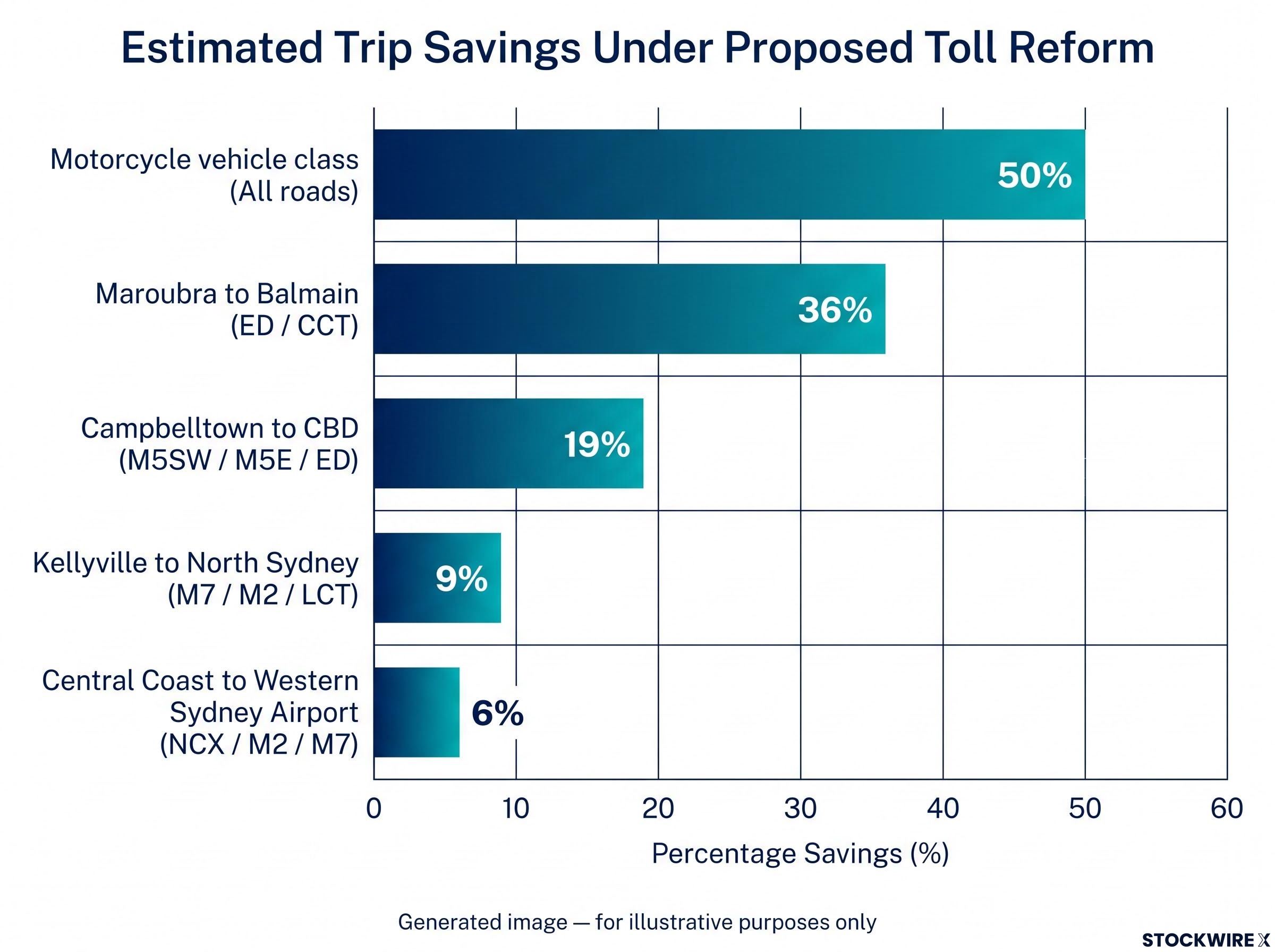
| Trip | Assets travelled | Estimated saving |
|---|---|---|
| Kellyville to North Sydney | M7 / M2 / LCT | 9% |
| Central Coast to Western Sydney Airport | NCX / M2 / M7 | 6% |
| Maroubra to Balmain (one way) | ED / CCT | 36% |
| Campbelltown to CBD (one way) | M5SW / M5E / ED | 19% |
| Motorcycle vehicle class | All roads | 50% |
Beyond the specific price adjustments, the NSW Government’s weekly toll cap has already returned $300+ million to drivers since January 2024. Notably, Transurban stated it has observed no induced demand over the first two and a half years of the toll cap’s operation.
The relief is designed to be delivered through the reform structure rather than at the expense of concession value, a distinction central to the value-neutral outcome.
Why the deal stays value neutral for Transurban
How can motorists pay less while Transurban’s concession value is preserved? The presentation explained that concessionaires are made value neutral through three mechanisms. The first is the early monetisation of the Hills M2 Promissory Notes and the Eastern Distributor Concession Notes. The second is the NSW Government funding the proposed M7-M2 Widening.
The third lever is equalisation payments made over time between the Government and the relevant concessionaires, calculated on the net outcome of pricing changes, resulting traffic impacts and enhanced traffic flow from the proposed widening.
The net financial outcome across the affected assets, presented on a 100% ownership basis, is set out below.
| Asset | C/P Note payment ($b) | Equalisation payments ($b) | Net 5-year funds flow ($b) |
|---|---|---|---|
| Eastern Distributor | (0.1) | (0.2) | (0.3) |
| Hills M2 | (0.5) | 0.4 | (0.1) |
| Westlink M7 | — | 0.2 | 0.2 |
| Lane Cove Tunnel | — | 0.1 | 0.1 |
| Cross City Tunnel | — | 0.1 | 0.1 |
| Total | (0.6) | 0.6 | 0.0 |
A $75m concessionaire contribution to the toll cap forms part of the net nominal equalisation payments, which are calculated on a risk-adjusted basis. The total net 5-year funds flow nets out to $0.0b.
On settlement funding, the ED Concession Notes ($0.1b, 2028 nominal) are expected to be debt funded, while the M2 Promissory Notes ($0.5b, 2028 nominal) are expected to be funded from corporate liquidity. This net-zero funds flow underpins the presentation’s message of no negative impact to near-term distributions.
Corporate liquidity available to fund the M2 Promissory Notes was bolstered in June 2026 when Transurban expanded its syndicated bank debt facility by $825 million to a total of $3.475 billion, with lender participation in the four-year tranche reflecting confidence in the group’s toll road cash flows.
M7-M2 Widening: the growth angle
The proposed M7-M2 Widening represents the network-enhancement upside embedded within the reform package. Key project facts, as outlined in the presentation, include:
-
Approximately 13 km of the M7 (Richmond Road to the M2) and roughly 4 km of the M2 (M7 to Windsor Road) are proposed to be widened to three lanes each way, up from two.
-
The proposed project is to be fully funded by the NSW Government as part of the overall reform package.
-
Construction is expected to commence in CY2028, taking approximately three years, with opening anticipated in CY2031.
-
More than 70% population growth is expected in and around Sydney’s northwest growth areas.
The widening remains proposed and is subject to the parties entering into agreements, planning approvals, financier consents, the Direct Deal outcome and a Government investment decision. Enhanced traffic flow from the project feeds into the value-neutral calculations and supports long-term network performance.
Michelle Jablko, CEO
“The finalisation of key terms demonstrates what can be achieved when we put customers and motorists first. The proposed changes are expected to deliver sustainable, future-focused and customer-orientated solutions for Sydney’s motorists.”
“These reforms draw upon the building blocks of the Government’s independent review. Transurban believes this constructive approach provides a strong foundation for continued investment and innovation, supporting a more integrated and reliable transport network for the people of New South Wales over the long term.”
June traffic: Group up 3.8%
Alongside the reform update, Transurban reported that Group average daily traffic (ADT) increased 3.8% in June compared with the prior corresponding period (pcp), or 2.4% excluding the West Gate Tunnel (WGT).
Sydney traffic increased 2.5%, reflecting the easing of construction-related impacts associated with the M7-M12 Integration Project and the continued return of motorists following project completion. Melbourne traffic rose 6.1%, driven by the contribution from WGT and improved network performance, though it increased just 1.5% excluding WGT. The company noted the WGT ramp-up profile has remained flat since February 2026.
Brisbane traffic increased 1.7%, rebounding from weather-related disruptions in May, although growth remained below longer-term averages. North America traffic rose 6.9%, with average dynamic toll prices up 18.9% on the 95 Express Lanes and 36.1% on the 495 Express Lanes.
Large vehicle traffic across the Australian portfolio increased 11.8% in June, or 5.6% excluding WGT. July traffic, while not yet finalised, was described as broadly consistent with June, with full detail to be presented in the FY26 result on 13 August 2026.
The macroeconomic and geopolitical environment remains a watchpoint, including renewed conflict in energy-producing regions.
What it means for investors
The reform update reinforces a value-neutral outcome with no negative impact to near-term distributions, while embedding growth optionality through the proposed M7-M2 Widening. Portfolio resilience is supported by more than 90% of revenue being CPI-linked or subject to fixed escalators, with inflation impacts typically flowing through over a period of up to 18 months.
On timing, definitive agreements and approvals are expected in 2H 2026. Note payments and two-way tolling are anticipated in 2028, with M2, M7 and LCT equalisation payments expected across the 2028-2032 period and CCT equalisation payments expected across the 2029-2033 period.
The Westlink M7 refinancing completed in May 2026 secured a $300 million syndicated bank facility maturing April 2029, removing near-term rollover risk on a key Sydney asset ahead of the equalisation payment schedule that runs from 2028 under the reform package.
Investors seeking full traffic and financial detail can look to the FY26 result on 13 August 2026. As management noted, distribution guidance remains subject to traffic performance and macroeconomic factors, with any distribution ultimately determined by the Transurban Board.
Don’t Miss the Next ASX Infrastructure Move
Breaking ASX news and in-depth analysis lands in your inbox within minutes of release with Big News Blast, the FREE alert service trusted by 20,000+ active investors. Stay ahead of market-moving announcements across ASX’s biggest sectors before the rest of the market catches up. Click the “Free Alerts” button to start receiving alerts now.