

Audited FY26 results confirm second consecutive year of positive operating cash flow
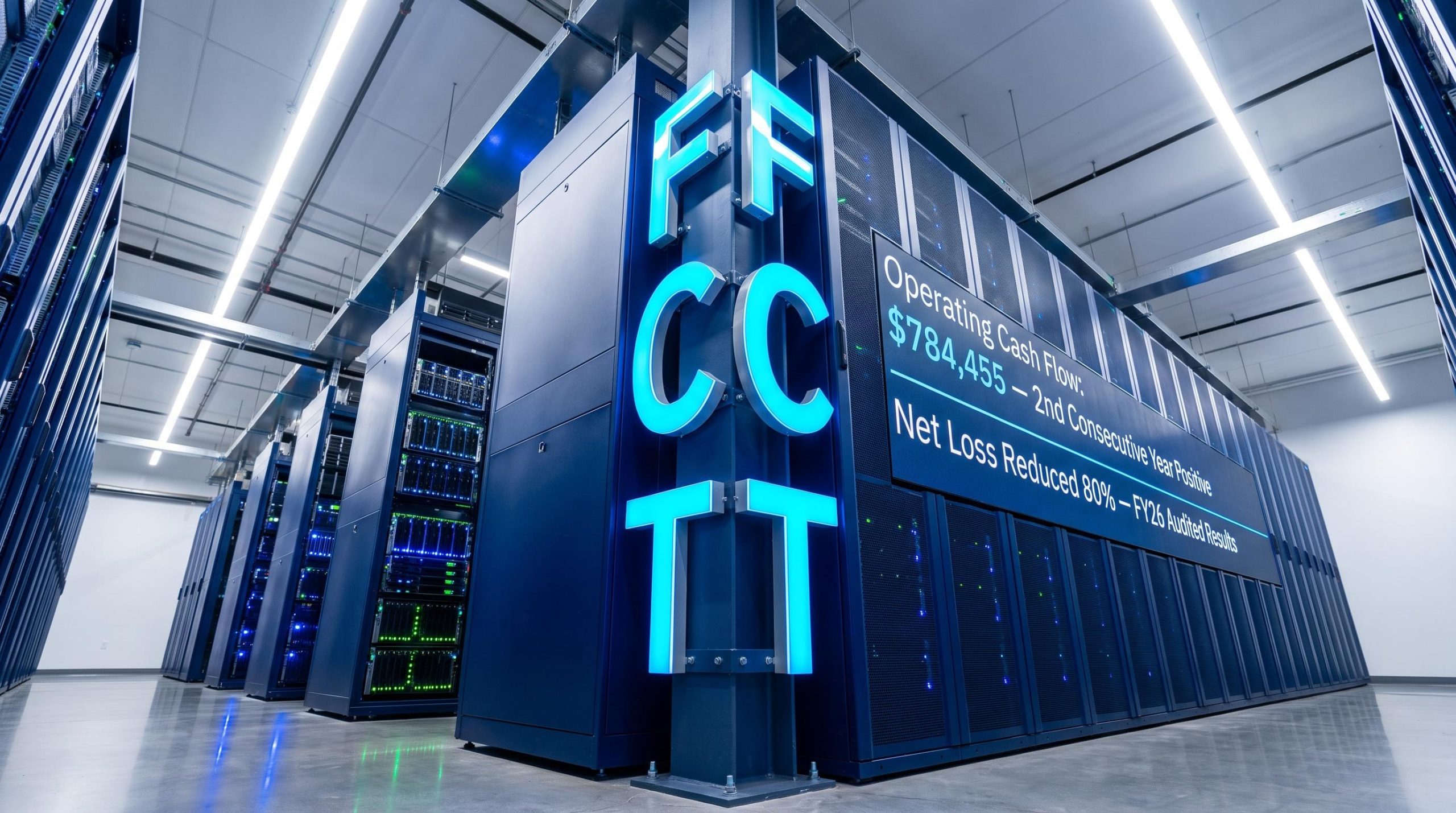
FirstWave Cloud Technology (ASX: FCT) has lodged its Annual Report for the year ended 30 June 2026, with audited results differing favourably from the Appendix 4E lodged on 31 August 2026. The two headline achievements from the audit are operating cash flow of $784,455, positive for a second consecutive year, and a loss after income tax reduced to $2,806,919, representing an 80% reduction in the loss. Across almost all metrics, the audited figures represent an improvement on the preliminary Appendix 4E numbers.
When big ASX news breaks, our subscribers know first
FY26 audited results at a glance
The table below sets out the six metrics disclosed in the announcement, comparing the preliminary Appendix 4E figures against the final audited results.
| Metric | Appendix 4E ($) | Audited ($) | Change ($) | Direction |
|---|---|---|---|---|
| Loss after income tax | (4,103,920) | (2,806,919) | 1,297,001 | Improved |
| Net cash from operating activities | 297,243 | 784,455 | 487,212 | Improved |
| Net assets at 30 June 2026 | 18,661,163 | 19,555,867 | 894,704 | Improved |
| Net tangible assets per share (cents) | (0.36) | (0.34) | 0.02 | Improved |
| Cash at 30 June 2026 | 1,331,040 | 1,331,040 | Nil | Unchanged |
| Revenue | 8,481,126 | 8,378,679 | (102,447) | Lower |
Cash at 30 June 2026 of $1,331,040 is unchanged between the preliminary and audited figures. Revenue is the only metric that moved unfavourably, lower by $102,447, which the company attributes to the timing of recognition of non-recurring revenue. This is a timing issue, not a structural decline in the underlying revenue base.
What’s behind the improved numbers
The lower net loss reflects three key adjustments identified during the audit process:
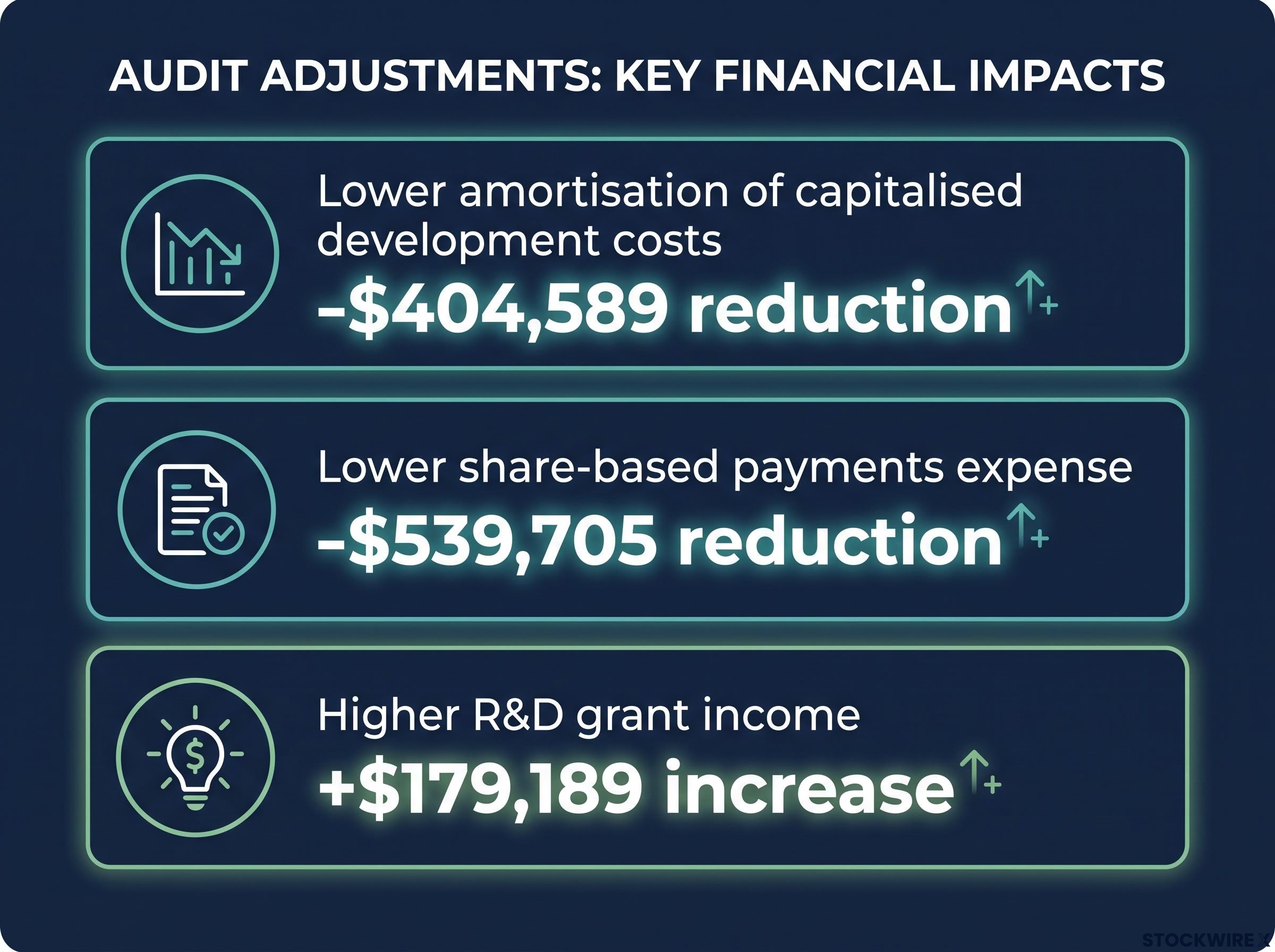
- Lower amortisation of capitalised development costs: $404,589 reduction
- Lower share-based payments expense: $539,705 reduction
- Higher research and development grant income: $179,189 increase
CSIRO-backed AI compliance funding, secured in early 2026 with FirstWave contributing just $48,000 of the $264,982 project cost, is one reason the company’s capitalised development expenditure and R&D grant income lines moved materially during the audit period.
The improvement in operating cash flow was driven by reclassification of certain items:
- Payments for capitalised development ($297,005) reclassified into investing activities
- Interest on borrowings ($190,208) reclassified into financing activities
The company also confirmed two housekeeping corrections noted in the Annual Report. The reference on page 4 to net operating cash flow of $297,243 should read $784,455, and the reference on page 20 to a 2025 outflow of $170,563 should read an inflow of $170,563.
Understanding positive operating cash flow and why it matters for investors
Operating cash flow measures the cash a business generates from its core day-to-day operations, distinct from investing or financing activities. It differs from net profit or loss in that a company can report an accounting loss while still generating positive cash from its operations. This occurs when non-cash charges such as amortisation or share-based payments reduce reported profit without reducing the actual cash in the bank.
For a software company, two consecutive years of positive operating cash flow is a meaningful signal. It indicates the core business is generating enough cash to fund itself, reducing reliance on external capital raises or new debt to keep the lights on.
In FCT’s case, the audited results confirm the company is moving in a measurable direction toward financial sustainability, even as it continues investing in product development. That combination, ongoing investment alongside self-funding operations, is generally viewed as a more stable footing than one where operations consume cash each year.
What the audited results mean for FCT’s investment case
The key takeaways from the audited FY26 results, considered together, present a clearer picture of the company’s financial trajectory:
- Two consecutive years of positive operating cash flow signal improving business quality at the operational level.
- An 80% reduction in net loss demonstrates tangible progress toward breakeven.
- Net assets improved to $19,555,867, reflecting a strengthened balance sheet position.
- Cash of $1,331,040 at 30 June 2026 is confirmed and unchanged from the preliminary figures.
For context, FCT is a global software company established in 2004, providing enterprise-grade, AI-powered network management, automation, audit, and cybersecurity software. Its software is used by over 150,000 organisations across 178 countries, with clients including Telstra, NASA, Telmex, and Claro. The audited improvements sit against that existing customer base. No forward guidance was disclosed in this announcement.
The Telstra government extension, announced in July 2026 and lifting ARR to approximately $0.6 million, is a post-period development that reinforces the recurring revenue trajectory visible in the FY26 audited numbers.
Ready to Explore FirstWave Cloud Technology’s Path to Financial Sustainability?
FCT’s audited FY26 results confirm a second consecutive year of positive operating cash flow and an 80% reduction in net loss, signalling meaningful progress toward breakeven for this globally deployed cybersecurity and network management software company. With over 150,000 organisations across 178 countries relying on its AI-powered platform, the operational foundation underpinning these improvements is well established.
Investors seeking a deeper understanding of FCT’s enterprise software capabilities, recurring revenue model, and ongoing product development can explore the FirstWave investor centre for the full picture.