


PET reports breakthrough in high-performance phosphorus-binding products
Phoslock Environmental Technologies (ASX: PET) has reported significant progress in developing a new family of clay-based phosphorus-binding products, with lanthanum concentrations ranging from 10% to 25%. The standout result: the 20% lanthanum product demonstrated approximately four times the phosphorus-binding capacity of existing Phoslock, which contains 5% lanthanum.
The Company has submitted a patent application, an important step towards protecting its intellectual property and the potential commercial opportunity arising from these products.
While not guaranteed, PET believes that if the remaining development and testing programs succeed, first commercial sales could potentially occur in 2027.
When big ASX news breaks, our subscribers know first
Laboratory results confirm performance close to theoretical maximum
Pilot-scale laboratory testing has produced highly encouraging results. Each product demonstrated phosphorus-binding performance close to its theoretical maximum, confirming the direct relationship between lanthanum concentration and binding capacity.
Higher capacity alone was not the only achievement. All products tested showed acceptably low release of free lanthanum ions into the treated water. The Company describes this combination of substantially increased binding capacity with controlled lanthanum release as a key feature of the new product family.
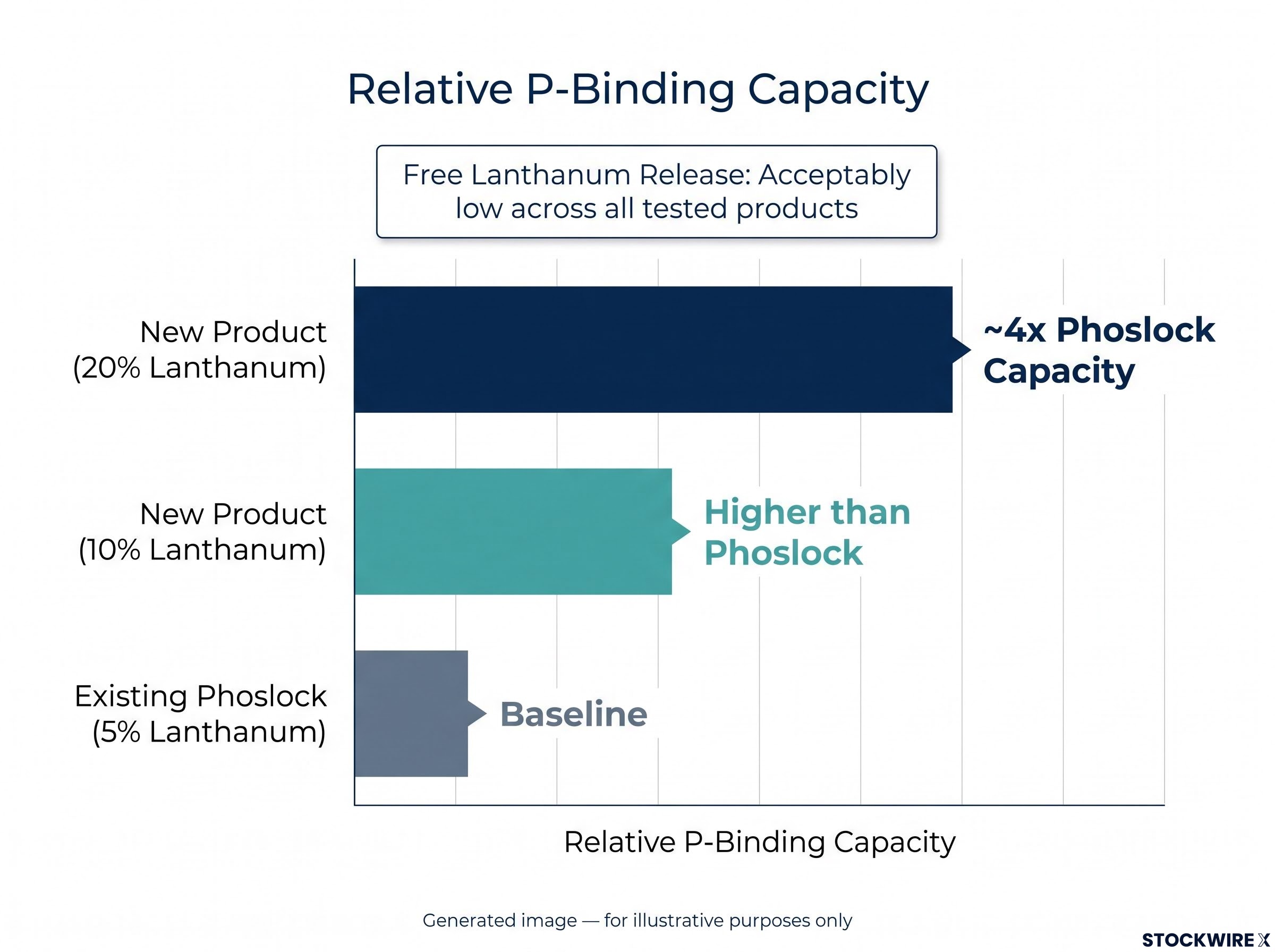
| Product | Lanthanum Concentration | Relative P-Binding Capacity | Free Lanthanum Release |
|---|---|---|---|
| Existing Phoslock | 5% | Baseline | Acceptably low |
| New product (10%) | 10% | Higher than Phoslock | Acceptably low |
| New product (20%) | 20% | ~4x Phoslock | Acceptably low |
Manufacturing validated on existing plant — a key strategic signal
An important milestone was achieved in April when the Company successfully produced a 2-tonne test batch of the 10% product using its existing commercial manufacturing plant. Laboratory testing of the production material demonstrated binding and free-lanthanum characteristics consistent with the pilot-scale product.
This provides early evidence that the new products can be manufactured using existing production infrastructure, requiring only minor modifications. The production roadmap proceeds as follows:
-
April 2026 — 2-tonne test batch of the 10% product (completed)
-
September 2026 — further 2-tonne production run of the 10% product (planned)
-
Following — 2-tonne production run of the 20% product (planned)
The ability to manufacture on existing plant carries potentially significant strategic importance. It could allow the Company to introduce higher-performance products without a major new manufacturing facility, while providing scope to increase capacity as commercial demand develops.
How phosphorus-binding works and why capacity matters
Phoslock is a lanthanum modified bentonite (LMB), a treated clay that permanently binds excess phosphorus in the water column and sediments. By locking away this excess phosphorus, the product helps prevent the formation of cyanobacteria, a toxic blue-green algae that can render water unsafe.
A higher lanthanum concentration means more phosphorus can be captured per tonne of product. That efficiency directly affects project economics. Less product would be needed to treat a given waterbody, which could reduce the logistics and application costs associated with each project.
For investors, this matters because reduced product volumes per project could lower total treatment costs for customers while creating scope for premium pricing. Phoslock is currently certified for use in drinking water in North America, Europe, Brazil, Australia and China.
Field testing underway across the US and China
The development program is now progressing from laboratory and production-scale validation towards bulk field testing. Testing of the 10% product in ponds is about to commence.
A 1-tonne sample has been sent to the USA for pond testing under the supervision of Orion. In China, an application of the 10% product to a fishpond in Shanghai is planned for September, with sampling and analytical work conducted by an independent research team, providing an important level of external validation.
Successful field testing would represent a significant further milestone in the development program. The Company notes that successful commercialisation is not guaranteed. The involvement of an independent research team offers external validation that could help de-risk the commercialisation pathway.
The investment thesis — potential to transform PET’s economics
A substantially higher phosphorus-binding capacity has the potential to change the economics of phosphorus removal for both customers and the Company. Subject to successful commercialisation and the Company’s product pricing strategy, several potentially significant outcomes could occur simultaneously:
-
Lower dosage and product volumes — substantially less product could be required to capture a given quantity of phosphorus, sharply reducing the volume needed per lake or waterbody.
-
Reduced logistics, handling and application costs per unit of phosphorus captured.
-
Higher-value product — although manufacturing cost per tonne is expected to increase, the greater binding capacity could support a significantly higher selling price per tonne.
-
Improved margins and higher profitability — the potential price increase could exceed the increase in manufacturing cost, providing scope for materially higher gross margins and profit.
-
Stronger competitive position and increased market share — a lower cost of phosphorus removal could reduce competitive pressure and enable the Company to pursue markets that are less attractive using lower-capacity products.
-
Extended manufacturing capacity — higher efficiency could defer the need for major expansion.
Crucially, these potential benefits are not dependent on a single factor. They could compound, delivering lower customer costs and higher PET profitability at the same time.
What comes next for shareholders
The Company is now moving from product development and laboratory validation into larger-scale production and field testing. These next stages will be critical in demonstrating whether the laboratory performance can be replicated consistently under commercial and real-world conditions.
There can be no assurance that the development, testing or commercialisation program will be successful. However, if the current results are confirmed through field testing and the products are successfully commercialised, first commercial sales could potentially occur in 2027.
The announcement, approved by Chairman Mr Fred Bart, states that the Company believes these products have the potential to transform the economics of phosphorus capture, for its customers and for Phoslock, and ultimately to transform the Company’s long-term future.
Don’t Miss the Next Environmental Tech Breakthrough on ASX
Big News Blast delivers FREE breaking ASX news straight to your inbox within minutes of release, complete with in-depth analysis already done for you. Over 20,000+ subscribers trust it to stay ahead of market-moving announcements. Click the “Free Alerts” button to start receiving alerts the moment ASX news breaks.