
Orbital secures A$3.7 million Power by the Hour contract with AATI
Orbital Corporation Limited (ASX: OEC) has entered its first Power by the Hour (PBH) agreement with American Aerospace Technologies Inc. (AATI), supporting AATI’s AiRanger unmanned aircraft fleet currently deployed in US coastal surveillance operations.
The contract carries revenue of US$2.6 million (A$3.7 million) over the initial term to 31 December 2027, via a take-or-pay commitment underpinning minimum monthly engine hours.
The agreement progresses the PBH opportunity outlined in Orbital’s 24 July 2026 ASX announcement. It converts the existing propulsion supply relationship with AATI into an ongoing service arrangement, establishing a new recurring revenue stream beyond the upfront engine sale.
The AiRanger first flight on 24 July 2026 validated the 150HFE integration and triggered a follow-on order, lifting cumulative AATI orders to eight propulsion systems and setting up the move toward recurring service revenue.
Stephen Pearce, CEO
“The growth of commercial UAV operations creates an opportunity for Orbital to build a recurring service business alongside engine sales…”
“Minimum monthly commitments provide better revenue visibility, with scope to grow as customer fleets expand…”
When big ASX news breaks, our subscribers know first
How the agreement works
Key contract terms
Under the PBH model, Orbital retains ownership of its engines and provides maintenance, overhaul, performance support and replacement in return for an hourly service charge.
The key terms of the initial agreement are:
- Fleet progressively expanding to 10 aircraft by May 2027
- Take-or-pay commitment of 200 engine hours per aircraft per month
- US$2.6 million in revenue over the initial term to 31 December 2027
- Renewal options to extend beyond that date
The agreement establishes a recurring monthly revenue stream derived through engine operations and associated maintenance, overhaul, replacement and performance support.
What it means for the engine order book
Two of the engines previously ordered and not yet delivered will now be converted to the PBH fleet. Orders for Gen II Power Management Systems sit outside the PBH contract, with 5 units ordered to date for a value of US$60,000.
| Term | Detail |
|---|---|
| Initial term | To 31 December 2027 |
| Fleet size | Progressively expanding to 10 aircraft by May 2027 |
| Minimum hours | Take-or-pay of 200 engine hours per aircraft per month |
| Contract revenue | US$2.6 million (A$3.7 million) |
| Renewal | Options to extend beyond the initial term |
Power by the Hour explained for investors
Under a Power by the Hour model, the customer pays a service charge for engine hours rather than buying the engine upfront. Orbital keeps ownership of the engines and handles their support.
According to Mr Pearce, this “reduces the upfront cost for operators to deploy our engines, while allowing us to earn greater revenue over their operating life.”
Take-or-pay means the customer commits to a minimum number of engine hours each month, which Orbital says provides better revenue visibility.
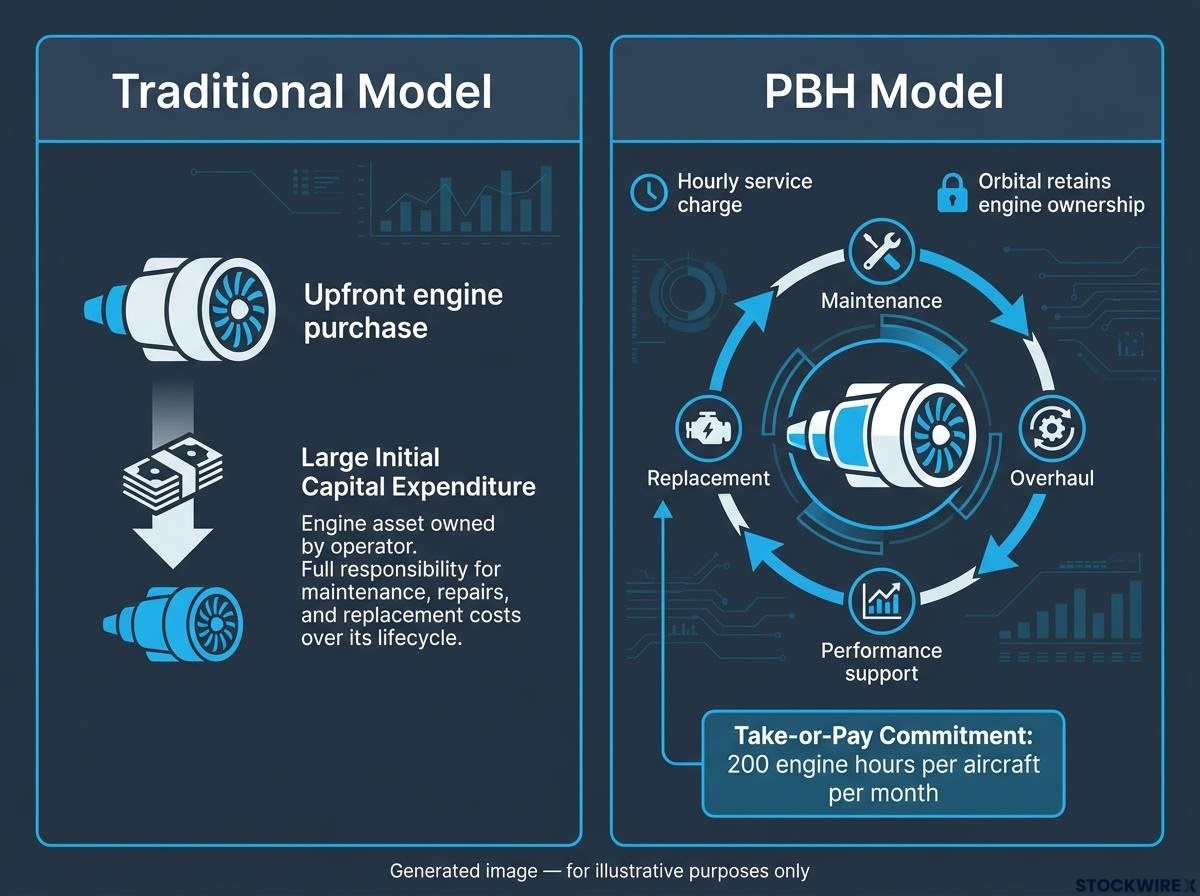
The earlier A$600,000 engine order for five 150HFE units was positioned as a precursor to this service model, with Orbital estimating Power by the Hour could generate roughly three times the hardware revenue per engine.
The announcement describes the agreement as a progression from supplying propulsion systems for aircraft development to fully supporting customer flight operations. It builds on operational outcomes including intelligence, surveillance and reconnaissance (ISR) mission durations of up to 20 hours flight time.
Orbital describes the initiative as “market leading” and says it is enabled by proven engine performance and reliability, with a history in excess of 1 million hours of US maritime operations.
Growth pathway beyond the initial 10 aircraft
Expansion potential
There is potential to expand beyond the initial fleet as AATI’s operations grow, subject to extended end-user contracts and a separate Phase II agreement. The announcement does not confirm that expansion will occur.
The model also provides a foundation to offer PBH to other UAV fleet operators. Mr Pearce said the broader focus is on “building a more diversified customer base across commercial and defence applications” while “reducing our reliance on any single program over time.”
US Coast Guard opportunity
AATI is positioning the AiRanger platform for a range of government and commercial opportunities. In April 2026, the USCG Robotics and Autonomous Systems PEO issued a request for information (RFI) for contractor-owned, contractor-operated (COCO) Group 2/3 medium-range UAS ISR services.
Details of the RFI include:
- Up to 35 shore-based sites across the Atlantic, Pacific and Alaska/Arctic regions
- A Basic Ordering Agreement with a five-year base and one five-year option (up to 10 years)
- Orders competed among eligible vendors by platform or shore region
To date, no contract has been awarded under the RFI. AATI is currently providing COCO ISR services to the US Coast Guard.
About the partners
AATI is a US-based developer and operator of long-endurance unmanned aircraft and airborne sensing systems. Its AiRanger platform holds commercial Beyond Visual Line of Sight (BVLOS) operating approvals in the United States and uses Orbital’s 150HFE propulsion system.
Orbital is a Perth, Western Australia-based designer and manufacturer of integrated heavy fuel propulsion systems for Group 2 and Group 3 UAVs, with customers including Boeing and Textron Systems.
Don’t Miss the Next Industrials Breakout
Get FREE breaking ASX news delivered to your inbox within minutes of release, complete with in-depth analysis already done for you. Join 20,000+ investors staying ahead of the market. Click the “Free Alerts” button at Big News Blast to receive market-moving industrials announcements the moment they break.