
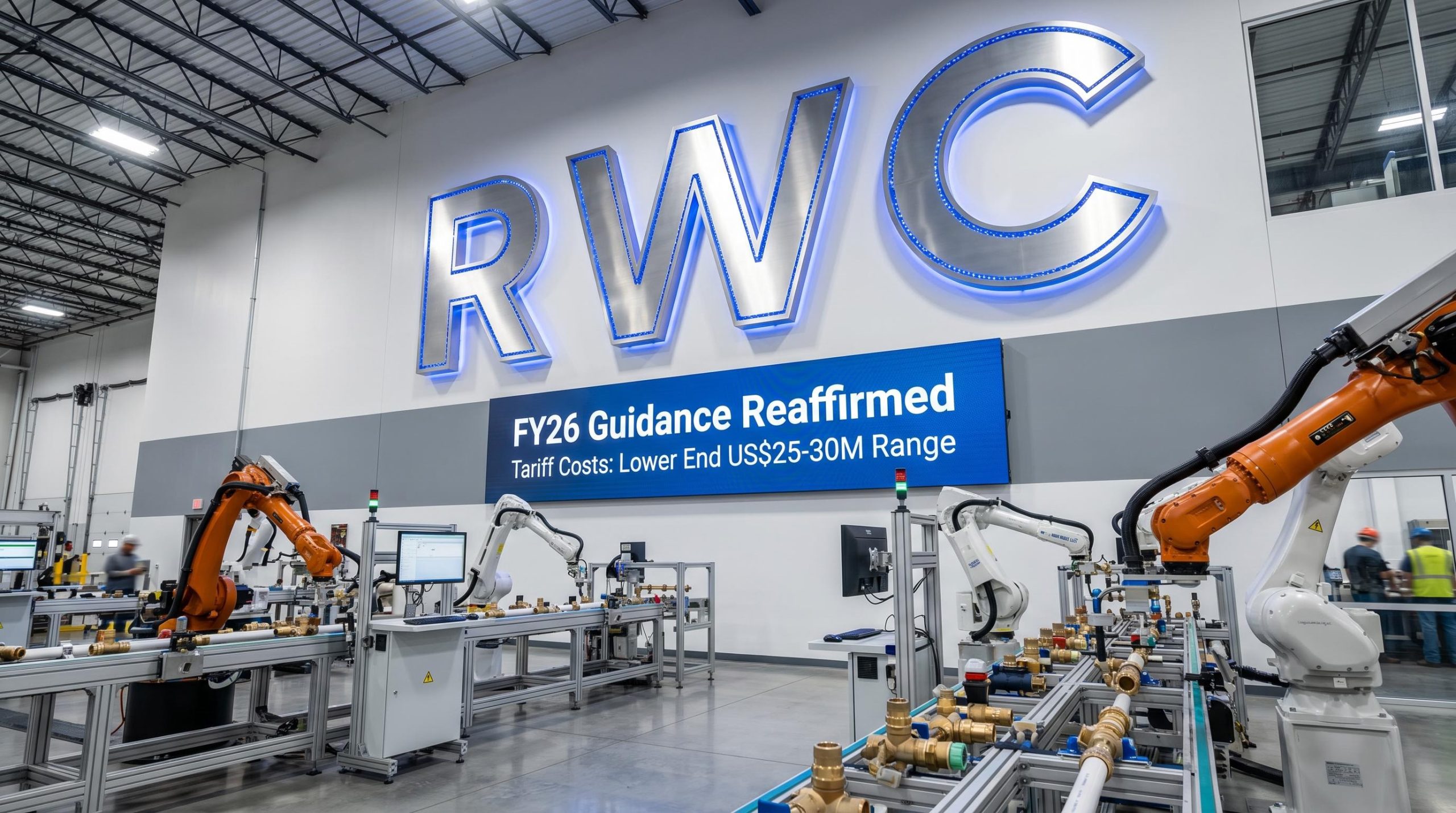
Reliance Worldwide reaffirms FY26 guidance, tariff costs tracking below estimates
Reliance Worldwide Corporation has reaffirmed all FY26 guidance issued on 17 February 2026 following nine months of trading to 31 March 2026. The company’s latest trading update confirms its existing outlook remains intact across all key metrics, with no material changes to regional or Group earnings expectations, cash flow conversion, capital expenditure, depreciation and amortisation, net interest, effective tax rate, or cost savings targets.
In a positive development, the FY26 net tariff impact is now expected at the lower end of the previously indicated US$25-30 million range. For FY27, based on current tariff rates, the estimated net cost impact remains unchanged at US$5-7 million, excluding any potential tariff refund.
The reaffirmation removes near-term uncertainty for investors, signalling the business is tracking in line with management’s expectations despite a volatile US tariff landscape and Middle East geopolitical disruption.
When big ASX news breaks, our subscribers know first
What is a trading update and why does it matter?
A trading update is a company’s confirmation or adjustment of previously issued guidance based on actual trading performance. When a company states “no material change” — as RWC has done — it signals the business is performing in line with management’s expectations.
Investors watch trading updates closely because they can provide early warnings if trading conditions deteriorate. A clean reaffirmation, such as this one, suggests operational stability and management visibility over earnings. It confirms that the assumptions underpinning the original guidance remain valid.
US tariff landscape shifts but RWC impact contained
Since RWC reported its half-year results in February 2026, two significant US tariff developments have occurred:
-
IEEPA struck down; Section 122 introduced: On 20 February 2026, the US Supreme Court struck down International Economic Emergency Powers Act (IEEPA) based tariffs. A Section 122 tariff (a 10% levy on most imported goods) has been introduced and is set to expire on 24 July 2026 unless extended. A federal refund portal opened on 20 April 2026, and RWC has lodged a claim for a refund of IEEPA tariffs previously paid, though recoverable amounts are yet to be verified.
-
Section 232 metals overhaul: From 6 April 2026, Section 232 tariffs on steel, aluminium and copper apply to the full customs entry value on a tiered basis (50%/25%/10%/0%, depending on metal content).
Despite these changes, the net tariff impact estimate is unchanged from February 2026 guidance, which is positive given the tariff volatility. Any future new US tariffs or changes to existing tariff rates will necessarily impact these estimates.
Middle East conflict exposure limited
RWC has no direct exposure to the war in Iran or the closure of the Strait of Hormuz. Higher oil prices have driven increases in resin, logistics and energy costs, but these are being offset through price increases.
The company does not expect the war in Iran will materially impact its FY26 operating earnings at this point. However, prolongation of the war may impact the outlook for FY27. RWC’s supply chain and cost management appear resilient to current geopolitical disruption.
Looking ahead
Investors will next focus on the full FY26 results, with guidance remaining intact across all key metrics. The trading update confirms operational stability despite external headwinds, with tariff costs tracking better than initially feared.
Stay Ahead on Industrial Sector News
Join 20,000+ investors getting FREE breaking ASX news delivered within minutes of release, complete with in-depth analysis. Click the “Free Alerts” button at Big News Blast to receive real-time coverage of market-moving announcements the moment they drop.