
Strong FY26 revenue underpinned by OEM licensing traction
In its 20 August 2026 FY26 results presentation, LaserBond (ASX:LBL) detailed a strong full-year performance across both revenue and earnings, reinforcing the surface engineering specialist’s shift toward a higher-margin licensing model.
The LaserBond FY26 results showed revenue of $48.2m (+10.8%) and EBITDA of $10.4m (+15.1%). Net profit before tax rose to $6.5m (+30.0%), with net profit after tax of $4.9m (+27.7%) and earnings per share of 4.17cps (+27.2%). The company declared a fully franked dividend per share of 1.6c.
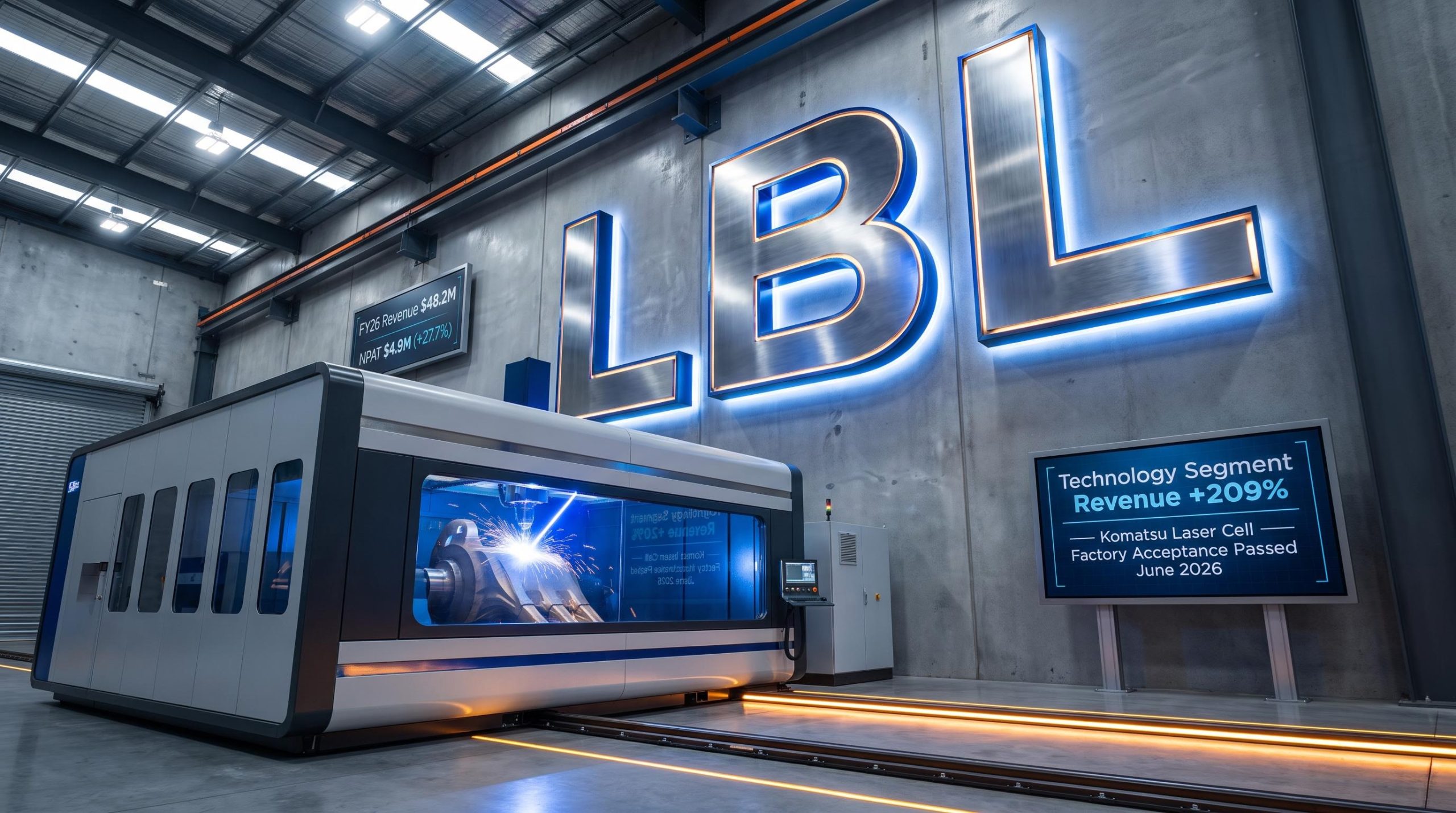
Management attributed the growth to revenue growth and continued cost discipline across the business, with the completion of a modular laser cell for Komatsu standing out as a strategic proof point for the company’s licensing ambitions.
When big ASX news breaks, our subscribers know first
FY26 financial results at a glance
The presentation detailed sustained momentum through the year, with second-half revenue of $25.2m underpinning the full-year outcome. Gross margin came in at 51.0%, modestly lower than the prior year due to sustained high tungsten price levels, partly offset by strong margin expansion in the Services segment.
Return on capital employed improved to 13.05%, up from 10.88% in FY25, reflecting the earnings uplift alongside disciplined cost management.
Cash and equivalents ended the period at $2.9m, down from $5.6m. Management attributed the movement to ongoing strategic investment in tungsten carbide powder inventory, noting that collections improved significantly from FY25 and offset higher inventory balances.
Reported revenue excludes contributions from the company’s 40% stake in Gateway Group, as the two sets of accounts are not consolidated.
| Metric | FY26 | FY25/pcp | Change | Investor takeaway |
|---|---|---|---|---|
| Revenue | $48.2m | $43.5m | +10.8% | Top line growth across the group |
| EBITDA | $10.4m | $9.0m | +15.1% | Cost discipline supporting operating leverage |
| NPAT | $4.9m | $3.8m | +27.7% | Profit growth outpacing revenue |
| EPS | 4.17cps | 3.28cps | +27.2% | Higher per-share earnings for holders |
| ROCE | 13.05% | 10.88% | +2.17pts | Improved returns on deployed capital |
| DPS | 1.6c | 1.2c | Fully franked | Increased dividend, fully franked |
Segment performance: Products and Technology lead the way
The presentation broke down performance across the company’s three operating segments, with Products and Technology driving the top-line growth while Services delivered notable margin expansion.
Services
Services revenue eased modestly to $27.3m (from $27.7m) amid a slower-than-expected recovery in the mining industry. Gross margin expanded to 58%, up from 53.6% in the prior period, driven by improved cost control and operational efficiency.
Looking ahead, management noted a new partnership progressing from trial to commercial work in FY27, alongside alternate coating solutions reducing reliance on tungsten carbide.
Products
Products revenue rose to $17.5m (+18.8%) on strong demand from global OEM customers. Gross margin compressed to 36.9% (from 51.1%) as sharp tungsten price rises outpaced pricing pass-through.
The presentation also noted softer US sales in the second half, as one major OEM reduced inventory levels amid tungsten price concerns, compounded by the material impact of US steel tariffs on affected customers. Management flagged X-Clad coatings, a lower-cost tungsten carbide alternative, as progressing through OEM trials with field validation targeted for FY27.
Technology
Technology revenue grew to $3.4m (from $1.1m). The modular laser cell for Komatsu was completed on time and on budget, passing factory acceptance in June 2026, with site operation to commence in Q1 FY27.
These arrangements sit under long-tail licensing agreements covering equipment supply, technology usage and the supply of associated consumables.
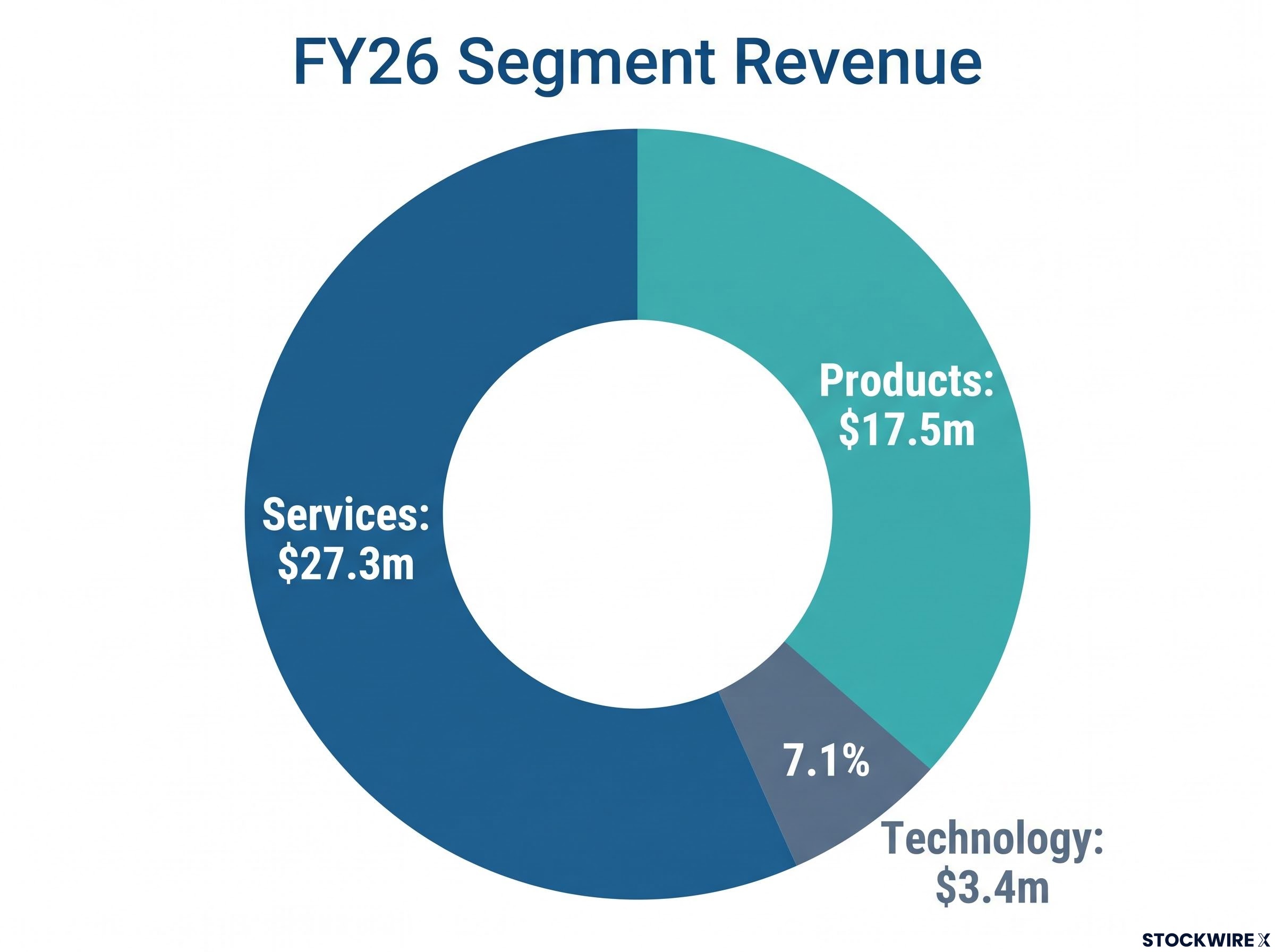
Segment revenue for FY26 was as follows:
- Services: $27.3m
- Products: $17.5m
- Technology: $3.4m
Understanding LaserBond’s surface engineering moat
Surface engineering, and specifically laser cladding, involves applying specialised coatings to metal components to extend their wear life. This is particularly valuable for high-wear parts used in mining, power generation and heavy industry, where component failure carries significant downtime and replacement costs.
LaserBond operates a three-pronged model. Services covers reclamation and re-engineering of worn components. Products manufactures an exclusive range of coatings embedded with the company’s patented technologies. Technology licenses the company’s Laserbond® cladding technology to OEMs under long-tail agreements.
The licensing model is high-margin and relatively capital-light. Management positioned the Komatsu deal as validation of the intellectual property’s commercial value with a blue-chip original equipment manufacturer.
The company emphasised its in-house R&D approach, with core intellectual property developed internally and no outsourcing of core IP.
Balance sheet strength and Gateway contribution
The presentation detailed net assets of $45.1m, up from $41.1m, with no financial debt on the balance sheet. Total liabilities decreased 13.6% to $18.8m, primarily due to reduced financial liabilities and lower creditor balances. Working capital increased 22.8% to $18.6m.
Gateway contributed $1.0m in NPAT (from $0.7m), with laser cladding revenue growing significantly following the cell’s commissioning in May 2025.
LaserBond gained 40% ownership of Gateway in March 2024. The company holds a “Right to 51% ownership in March 2027, at the same multiple of 4.5 times EBITDA as the original purchase consideration.”
FY27 growth drivers and the investment case
Management outlined a strategic roadmap framed around three horizons: strengthening the core in the near term, scaling what works in the medium term, and pursuing global leadership over the longer term.
Key FY27 growth drivers identified in the presentation include:
- Technology licensing expansion, with discussions underway for additional laser cells in new markets.
- Tungsten carbide alternatives, including X-Clad and hard chrome replacement technology progressing from trial into commercial application.
- Products division momentum, as US customers work through current stock positions supported by international growth.
- Gateway diversification, with laser cladding growth continuing and additional revenue streams expected.
- Mining sector recovery, with anticipated improvement in services volumes as maintenance cycles normalise.
- Strategic roadmap execution, focused on competitiveness, sales alignment and R&D speed.
The investment case, as presented, rests on proprietary and defensible IP validated by the Komatsu deal, multiple revenue streams with operating leverage, a debt-free balance sheet, a scalable capital-light licensing model, and an innovation pipeline that includes new products expected to launch in 2H FY27. Management also noted that hard chrome replacement technology is progressing toward market in FY27.
Strategic intent
“Position Laserbond as a globally relevant technology and solutions leader.”
Company snapshot
Key company data as at 14 August 2026:
- Shares on issue: 118.6m
- Market capitalisation: $68.0m
- Share price: $0.57
- 52-week range: $0.485–$0.67
The company is led by Chief Executive Officer Robert Freeman and Executive Director Wayne Hooper, with Philip Suriano serving as Non-Executive Chairman.
Don’t Miss the Next ASX Industrials Winner
Big News Blast delivers FREE breaking ASX announcements straight to your inbox within minutes of release, complete with in-depth analysis already done for you. Join 20,000+ subscribers who stay ahead of the market the moment news breaks. Click the “Free Alerts” button at Big News Blast to start receiving real-time alerts across ASX industrials and beyond.