

Kelsian completes Tourism Portfolio sale, pockets $149.9 million
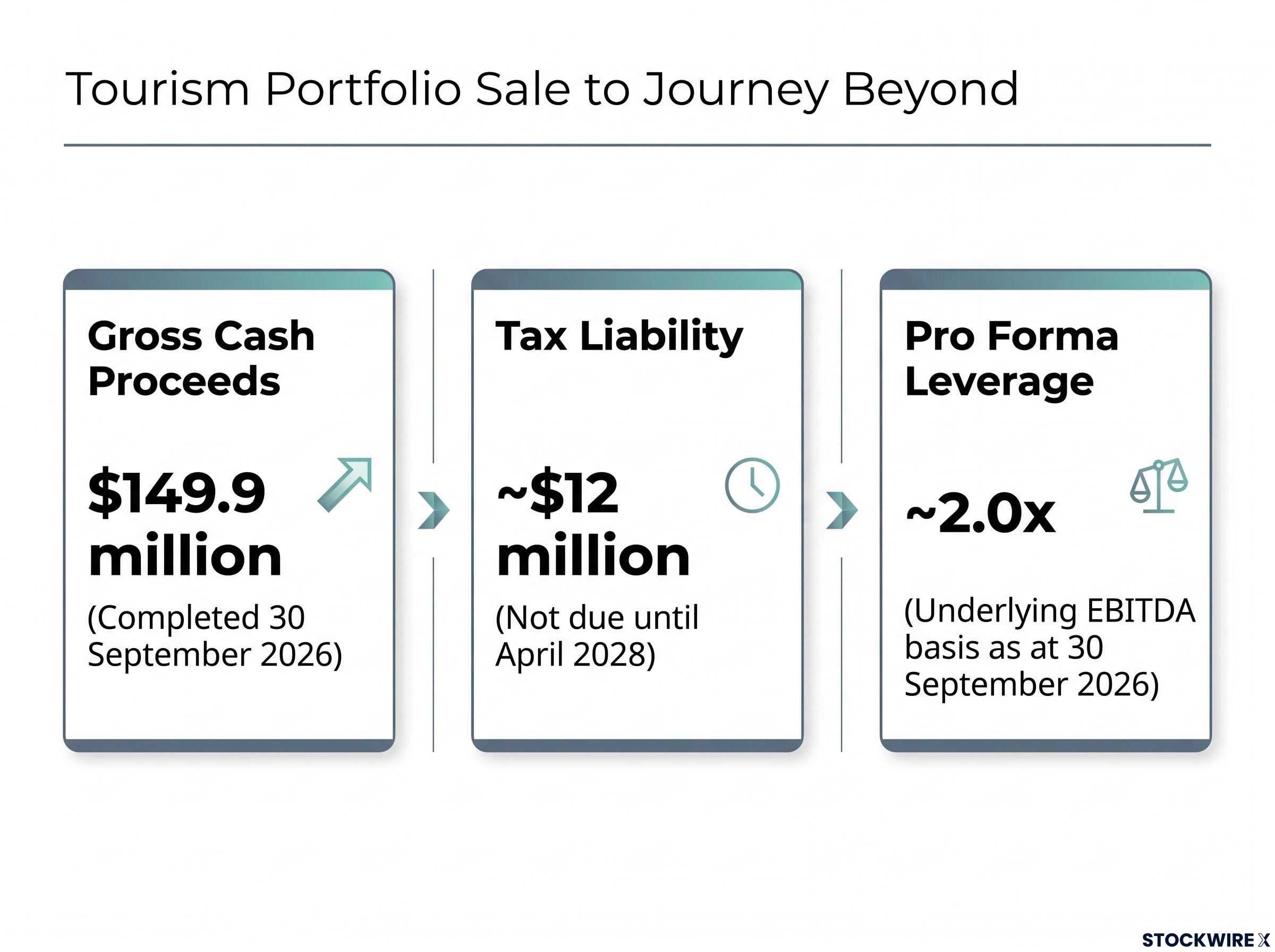
Kelsian Group (ASX: KLS) confirmed on 30 September 2026 the successful completion of its Tourism Portfolio sale to Journey Beyond, with the company receiving gross cash proceeds of $149.9 million on the same day. The proceeds include $4.3 million for preliminary working capital and net debt adjustments, and are stated before transaction costs and tax.
Tax of approximately $12 million is not expected to be due and payable until April 2028, providing meaningful near-term cash flow flexibility. This transaction marks a deliberate strategic repositioning for Kelsian, not simply an asset sale.
When big ASX news breaks, our subscribers know first
A leaner, more focused Kelsian
The Tourism Portfolio comprised a collection of discretionary, experience-focused travel businesses that carried earnings exposure to consumer spending cycles. By divesting this portfolio, Kelsian reduces its cyclicality and focuses more heavily on bus, motorcoach, and marine transportation services underpinned by government and contracted revenue streams.
CEO Graeme Legh framed the significance of the milestone directly:
Graeme Legh, Kelsian Group CEO
“…Kelsian emerges as a more focused global commuter and contracted transport business, delivering bus, motorcoach and marine transportation services with low earnings exposure to fuel price volatility.
“The divestment reduces capital intensity and exposure to discretionary consumer spending while enhancing the stability and predictability of Group earnings; reinforcing the infrastructure-like characteristics of our business.”
Following receipt of the proceeds, pro forma leverage is estimated to drop to approximately 2.0x on an Underlying EBITDA basis, pre-AASB 16 and excluding SPV, as at 30 September 2026. That reduction meaningfully strengthens the balance sheet and expands Kelsian’s capacity to pursue its stated growth agenda.
What “infrastructure-like earnings” means for investors
The distinction between contracted and discretionary transport businesses matters to how investors value a company over time. Contracted transport operators generate revenue through multi-year agreements with government and institutional clients, which insulates earnings from short-term economic volatility. Discretionary operators, by contrast, depend on consumers choosing to spend, making their revenues more sensitive to economic conditions.
By focusing more heavily on the contracted model, Kelsian’s earnings profile more closely resembles that of an infrastructure business than a tourism or leisure operator, which typically commands a different valuation framework in equity markets.
Even before the Tourism Portfolio sale, Kelsian’s 93% contracted or non-discretionary revenue base was already delivering infrastructure-like earnings predictability, as the 1HFY26 result demonstrated with underlying EBITDA rising 16.4% to $153.8 million.
The difference between contracted and discretionary transport
- Revenue predictability: Contracted transport revenue is secured through long-term agreements; discretionary revenue fluctuates with consumer sentiment and spending capacity.
- Customer type: Contracted operators serve governments and institutions; discretionary operators serve individual leisure consumers.
- Earnings cyclicality: Contracted earnings are relatively stable across economic cycles; discretionary earnings can decline sharply during downturns.
- Capital requirements: Contracted businesses typically carry lower capital intensity relative to revenue, supporting stronger returns on invested capital over time.
Updated FY27 guidance and financial estimates
Prior FY27 guidance, issued on 26 August 2026, included the Tourism Portfolio for the entirety of FY27. The updated guidance announced today excludes it entirely. Kelsian now anticipates FY27 Underlying EBITDA of between $295 million and $310 million, assuming no significant deterioration in the operating environment. This range includes approximately $3 million of stranded costs.
| Metric | FY27 Estimate | Notes |
|---|---|---|
| Underlying EBITDA | $295m–$310m | Excludes Tourism Portfolio; includes ~$3m stranded costs |
| Depreciation | ~$132m | Core ~$87m, ROU ~$36m, SPV ~$9m |
| Amortisation | ~$23m | — |
| Interest | ~$50m | Corporate ~$37m, ROU ~$8m, SPV ~$5m; reflects lower debt costs following reduction in debt |
| Capex | ~$116m | Includes $15.0m deferred from FY26 |
| Effective Tax Rate | 22%–25% | — |
Trading in FY27 has so far been in line with expectations. The updated guidance reflects a structurally smaller business, but one with a more predictable and stable earnings base than the prior combined group.
Growth pipeline: US and UK in focus
Kelsian’s stated priority is to deploy capital selectively into organic and inorganic growth opportunities, with particular emphasis on the United States and United Kingdom. CEO Graeme Legh referenced a “substantial pipeline of organic and inorganic growth opportunities particularly in the United States and United Kingdom,” while noting that the approach to growth “remains disciplined.”
The company’s existing global footprint provides a substantial platform from which to pursue those opportunities:
UK franchised bus market entry is already underway, with the Liverpool Bus Franchise Contract awarded in April 2026 generating approximately $80 million in revenue over its term and positioning Kelsian for the larger Tranche 2 tender involving around 500 vehicles.
- Over 13,300 employees globally, as at 30 June 2026
- 6,317 buses and 122 vessels in operation
- More than 384 million customer journeys delivered over the past year
- Operations spanning Australia, the UK, Singapore, the USA, and the Channel Islands
- Businesses include Transit Systems, All Aboard America! Holdings, Inc. (AAAHI, described in the announcement as the second-largest motorcoach operator in the USA), Tower Transit, and SeaLink
Management’s stated approach is to focus on core strengths, target long-term defensive earnings, and selectively deploy capital in accordance with its Capital Management and Allocation Framework, rather than pursue growth at any cost.
Stay Ahead on ASX Transport and Industrials News
Get FREE breaking ASX announcements delivered to your inbox within minutes, complete with in-depth analysis already done for you. Over 20,000 subscribers rely on Big News Blast to stay ahead of the market the moment news drops. Click the “Free Alerts” button to start receiving real-time coverage of ASX industrials and transport stocks today.