

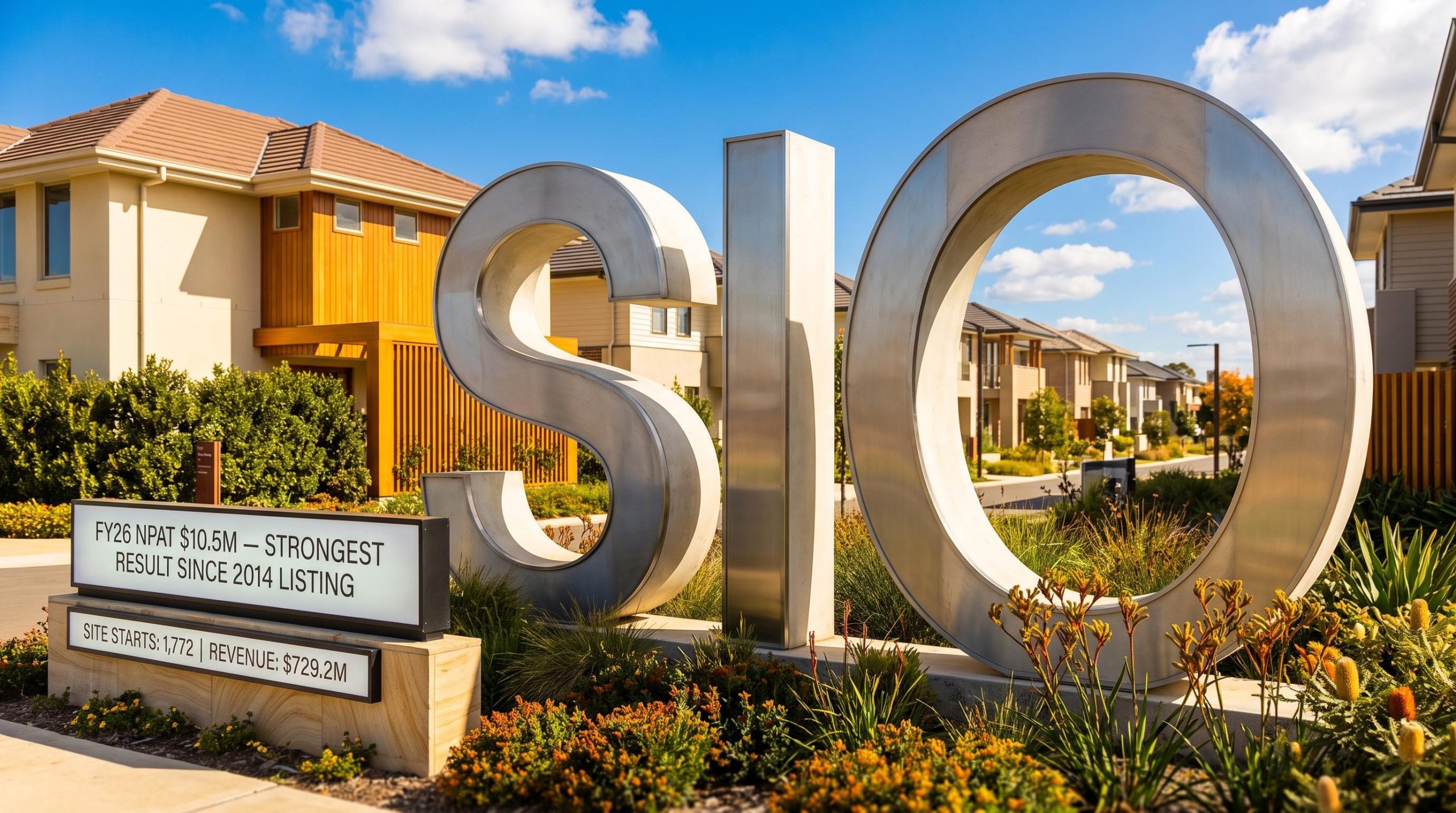
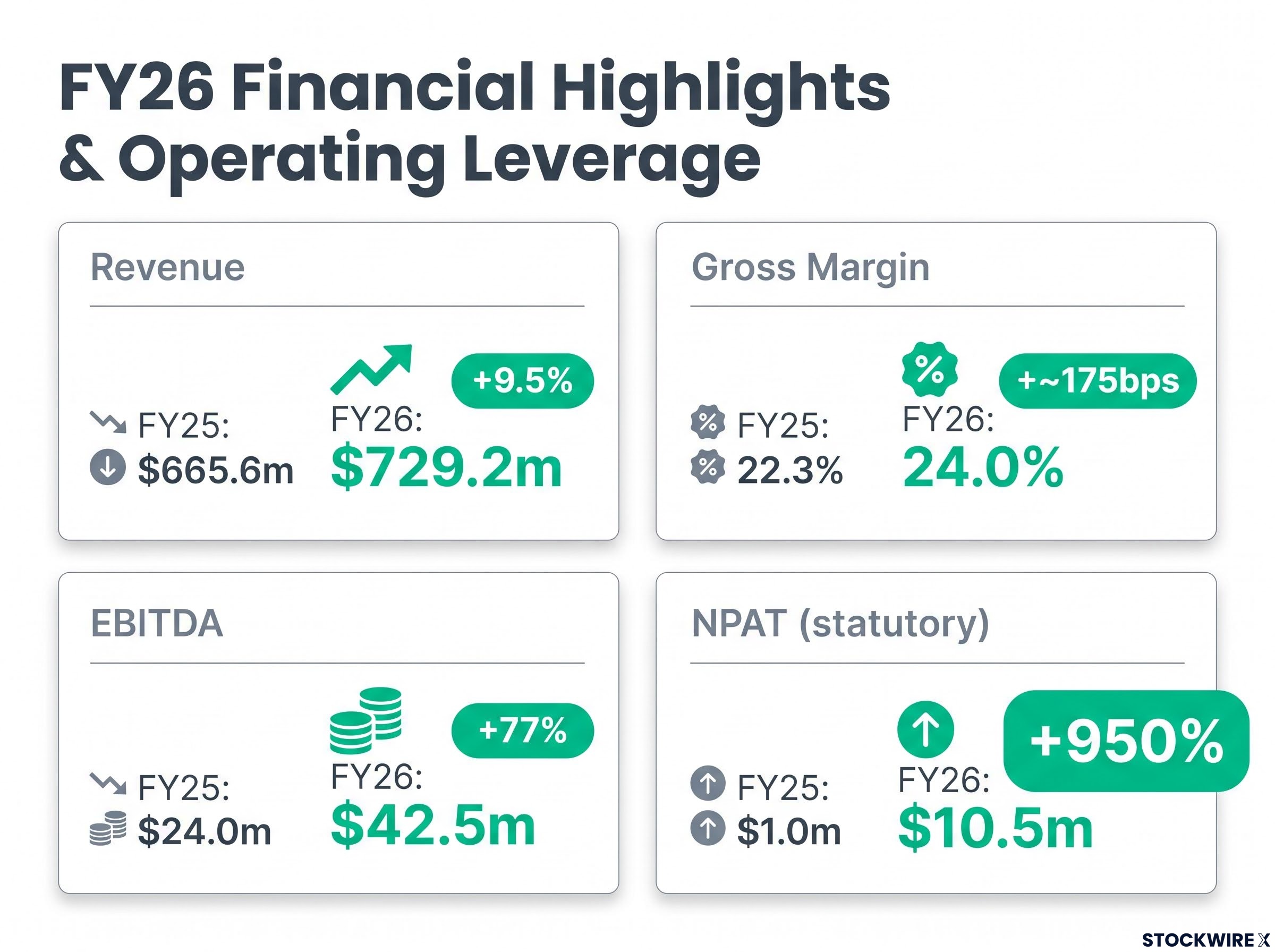
Simonds Group has delivered its strongest annual profit result since its 2014 ASX listing, with its FY26 full-year results presentation revealing net profit after tax (NPAT) of $10.5 million, up 950% from $1.0 million in FY25. Revenue grew 9.5% to $729.2 million, while EBITDA expanded 77% to $42.5 million, reflecting the operating leverage now flowing from the company’s maturing multi-channel strategy.
FY26 financial results — a year of genuine operating leverage
The headline numbers tell a clear story: a $729 million revenue business has delivered the strongest statutory NPAT result since listing in 2014, driven by volume growth, margin expansion, the full-year contribution from Dennis Family Homes (DFH), and disciplined overhead management. Site starts rose 16.1% to 1,772 for the year.
Key financial metrics at a glance
| Metric | FY26 | FY25 | Change |
|---|---|---|---|
| Revenue (continuing ops) | $729.2m | $665.6m | +9.5% |
| Gross Margin | 24.0% | 22.3% | +~175bps |
| EBITDA | $42.5m | $24.0m | +77% |
| NPAT (statutory) | $10.5m | $1.0m | +950% |
It is worth noting the statutory NPAT of $10.5 million includes a $0.5 million loss from discontinued Madisson operations. Profit after tax from continuing operations was $11.0 million.
What drove the margin expansion
Gross margin improved by approximately 175 basis points to 24%, reflecting several converging factors:
- Disciplined pricing and procurement management
- Favourable sales mix and scale efficiencies
- Construction productivity initiatives
- Progressive realisation of DFH integration benefits
The operating leverage dynamic is the key investor signal here. Revenues grew roughly 10%, yet EBITDA expanded 77% and NPAT grew 950%. This is the inflection point the presentation highlights as evidence of structural improvement, not a one-off uplift.
When big ASX news breaks, our subscribers know first
Strategic growth — DFH integration and the WA expansion
Two major strategic moves underpinned FY26 results and now set the platform for FY27.
Dennis Family Homes — integration complete, benefits flowing
The DFH integration is presented as substantially complete, with benefits now flowing through the financial results. The acquisition expanded Simonds’ product range to over 300 designs, broadened regional reach, extended the display network, deepened employee capability, and strengthened the customer pipeline.
The balance sheet reflects progress on the deferred consideration: contingent consideration reduced from $9.5 million to $2.5 million, indicating the acquisition payments are now substantially settled. Depreciation and amortisation increased during the period, reflecting additional DFH display leases and amortisation of the acquired forward order book.
Western Australia — a new growth frontier
Simonds entered Western Australia during FY26 via a strategic joint venture with Atlas Building, broadening the company’s national exposure to what the presentation describes as a high-growth residential market. The $0.3 million share of joint venture loss was recorded in FY26. The FY27 focus is on expanding the WA pipeline and commencing construction starts in the state.
The WA joint venture with Atlas Building was structured as a 50/50 arrangement specifically to limit balance sheet exposure while preserving the option to scale if the Perth market supports faster volume ramp-up, with management projecting a 5-9% uplift to annual build volume once construction starts flow through.
Understanding Simonds’ multi-channel model — why diversification matters
Simonds operates across multiple residential construction channels: traditional retail display homes, Knockdown Rebuild (KDRB), Dual Occupancy, wholesale and developer partnerships, and medium density. This structure means the business is not dependent on any single sales segment to sustain volumes.
In practical terms, if one channel faces pressure — as retail has in a higher interest rate environment — others can absorb the shortfall. The presentation frames this channel diversification as the structural reason FY26 results held up despite ongoing affordability headwinds, and the basis for management’s confidence entering FY27.
Balance sheet, cash position and FY27 outlook
Financial position remains sound
Liquidity at 30 June 2026 stood at $39.1 million, comprising $16.5 million in cash and $22.6 million in unused facilities. Net assets improved from $19.5 million to $30.2 million over the period.
The increase in right-of-use assets and lease liabilities reflects new leases for the corporate office, a customer experience centre, and an expanded display footprint. These are growth investments associated with the DFH integration and the new Simonds Gallery, rather than indicators of financial stress.
Operating cash flow of $25.3 million was lower than FY25’s $39.4 million. The presentation attributes this to higher working capital requirements driven by increased site-start volumes, rather than any deterioration in underlying performance.
FY27 priorities — four focus areas
Management outlined four strategic pillars for the year ahead:
- Geographic and channel expansion — building on DFH’s retail and regional reach, progressing the WA pipeline and construction start ramp-up, and expanding wholesale and developer partnerships across key growth corridors and expanding alternative channels in Queensland and South Australia
- Operational excellence — maintaining procurement discipline, construction productivity initiatives, and continued investment in leadership capability and succession planning
- Product diversification — scaling KDRB and Dual Occupancy with dedicated general manager leadership, broadening affordable small-lot, entry-level and Townhome ranges, and leveraging the 300+ DFH designs across value and premium segments
- Customer experience and digital enablement — launching the Simonds Gallery at Collins Square as an immersive design centre, and scaling the HomeHub AI-powered customer portal across the customer journey
The presentation frames these as specific, named initiatives rather than broad aspirations, positioning FY26 profit momentum as the foundation for building structural capability in FY27.
On the demand side, the First Home Guarantee and shared equity schemes are identified as continuing supports for first-home buyers, an important demographic for Simonds’ entry-level product ranges. The company acknowledges that affordability pressures and constrained borrowing capacity are expected to persist through much of FY27. Its stated response is to grow through the cycle by concentrating on entry-level and government-supported segments while defending margins through scale and technology.
ESG and community — 75 years of building Australian homes
Simonds marks more than 75 years of residential construction in Australia, having built homes for over 60,000 families. The FY26 presentation highlighted the following across environment, social, governance and safety:
- ISO 14001 (environment) and ISO 45001 (safety) certifications maintained, with independent audits conducted twice yearly
- $208,000 raised for sick children through the Chain Reaction initiative
- More than 25 community organisations, sporting clubs, and events supported across Australia
- Digital site-material tracking introduced to reduce over-ordering and waste
- Board capability strengthened with the appointment of Michael Sukkar, adding depth across housing, finance, economic policy, and government
Don’t Miss the Next Consumer Discretionary Winner
Big News Blast delivers FREE breaking ASX news straight to your inbox within minutes of release, complete with in-depth analysis already done for you. Join 20,000+ subscribers who stay ahead of the market the moment announcements hit. Click the “Free Alerts” button to start receiving real-time coverage across ASX consumer and beyond.