

£370m (~A$700m) counter-drone contract signed, the largest in EOS history
Electro Optic Systems Holdings Limited (ASX:EOS) has entered into a Contract with the government of a Middle Eastern Gulf state (a Gulf Co-operation Council member) for a nation-wide counter-drone defence system valued at £370m (~A$700m). The Contract is subject to the satisfaction of a number of conditions.
The announcement, dated 9 October 2026, states that this represents the largest contract ever secured by EOS. The customer is not named in the source.
Company statement
EOS believes the Contract “represents an inflection point for the Company in its strategy to become a major player in the global integrated, counter-drone market…”
The company says the Contract is a significant expansion of both the products and services it has previously provided. It follows the recent MARSS acquisition, whose NiDAR system sits at the core of the System to be deployed.
When big ASX news breaks, our subscribers know first
What the Contract delivers
The Contract requires the rapid deployment of a cellular, nation-wide counter-drone system. EOS is acting as prime contractor and systems integrator, leveraging MARSS’ extensive product capability and engineering expertise.
The MARSS acquisition completed on 21 May 2026 gave EOS a counter-drone command and control platform already operating in the Middle East, which is why NiDAR could be positioned as the core of a nation-wide system so soon after closing.
NiDAR at the core
NiDAR is an AI-enabled command and control (C2) system, acquired as part of the recent MARSS acquisition. It is designed specifically for counter-drone defence and covers both airborne and coastal seaborne drone detection.
The scope of the Contract includes:
- Rapid deployment of a cellular, nation-wide System with NiDAR C2 at its core
- Third-party sensors (electro-optical, radar and sonar) feeding central command centres
- Initial supply of third-party effectors, such as hard-kill interceptors and soft-kill jammers
- Ongoing support over a four-year period
The sensors detect threats at longer and medium ranges. NiDAR then fuses the data inputs to create intelligent, user-friendly and actionable threat assessments.
Revenue profile
EOS expects most of the revenue to be earned early in the Contract’s life, with a smaller portion tied to ongoing support. The table below summarises the financial profile outlined in the announcement.
| Item | Detail | Investor relevance |
|---|---|---|
| Contract value | £370m (~A$700m) | The largest contract ever secured by EOS |
| Revenue timing | Over 80% of revenue expected to be earned over the initial 12-24 months after the Contract becomes unconditional | Revenue timing depends on the conditions being satisfied |
| Ongoing support | Approximately 20% of the Contract’s value, over a four-year period | Provides a support component beyond the initial deployment |
| Profitability | Expected to be profitable and cashflow positive over its term | A significant short-term working capital funding requirement is expected early, turning positive during mid-2027 |
The company notes that, as is the nature of integration projects such as this, there will be a significant short-term working capital funding requirement in the early stages of the Contract.
How counter-drone systems work and why demand is rising
A counter-drone system generally works in three steps: detect, fuse and respond. Sensors such as electro-optical, radar and sonar detect threats, command and control software combines those inputs into a single picture, and effectors then respond to the threat.
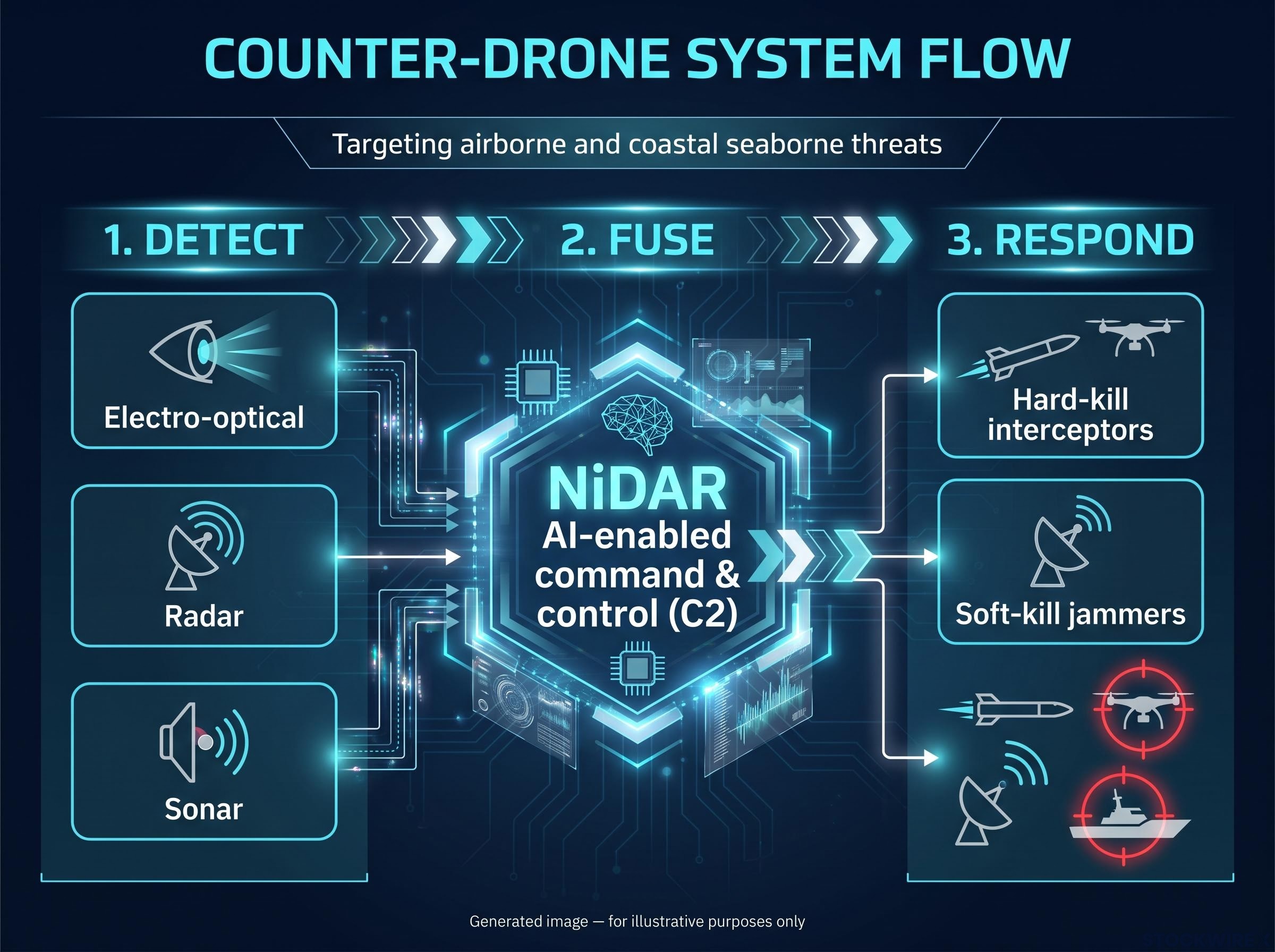
In this Contract, NiDAR performs the fusing role, while the effectors include hard-kill interceptors (which physically destroy a target) and soft-kill jammers (which disrupt a target’s control or navigation).
The announcement states that recent conflicts in the Middle East have highlighted the urgent need for advanced counter-drone systems. Drone attacks have inflicted significant physical and economic damage, and traditional air-defence systems based on expensive interceptor missiles have faced challenges.
According to EOS, systems fielded by MARSS in the Middle East have shown throughout the recent crisis to be an effective and economical counter-drone system. EOS believes this is driving an acceleration of market demand and sales opportunities.
EOS also believes that completing this work may lead to further sales opportunities in future, although there is no guarantee this will occur.
Conditions to satisfy and what comes next
A number of conditions need to be satisfied before performance of the Contract can commence. EOS will work to satisfy them in the coming months, however there is no guarantee if or when this will occur.
The conditions include:
- A performance bond guarantee for 10% of the Contract value (£37m), which was provided on 12 August 2026 and is secured by a cash security deposit of £40.3m (~A$77.0m) held with a commercial bank
- A bank guarantee of £74m provided by EOS, with an advance payment of the same amount paid by the Customer to EOS
- Relevant export licences for the various components of the System, to be obtained within two months following receipt of necessary documentation from the Customer
EOS also notes that it requires certain consents and further accommodation from WHSP and providers of guarantee facilities in connection with the performance bond and guarantee for the Contract.
Execution and funding
EOS will deploy a team to the Customer’s country to execute the Contract and pursue other growth opportunities in the region. It is also recruiting new resources to build and expand on existing MARSS resources for this and other projects.
The company carried out a capital raising in May 2026 to fund the upfront consideration of the MARSS acquisition, provide working capital to support contract ramp-up and development, and increase balance sheet flexibility. EOS thanked both the UK Government and the Australian Government for their support in enabling it to secure this opportunity.
The A$175 million capital raising launched in May 2026 was priced at A$8.00 per share and left EOS with pro-forma net cash of roughly A$195 million, a balance sheet position that now has to absorb the early working capital demands of this Contract.
EOS acknowledges that the Contract contains financial and operational risks, some significant, including termination rights, warranties of 5 years from acceptance by the Customer, and both capped and uncapped damages payable for failure to perform or delay. The Customer may also terminate the Contract or withdraw the work and execute it at EOS’ expense if EOS fails to fulfil any condition, including failure to obtain export licences.
Don’t Miss the Next Defence Tech Breakout
Get FREE breaking ASX news delivered to your inbox within minutes of release, complete with in-depth analysis. Join 20,000+ investors already staying ahead of the market. Click the “Free Alerts” button at Big News Blast to receive market-moving announcements the moment they break.