

MARSS’ NiDAR system proves itself in live combat — and the orders are following
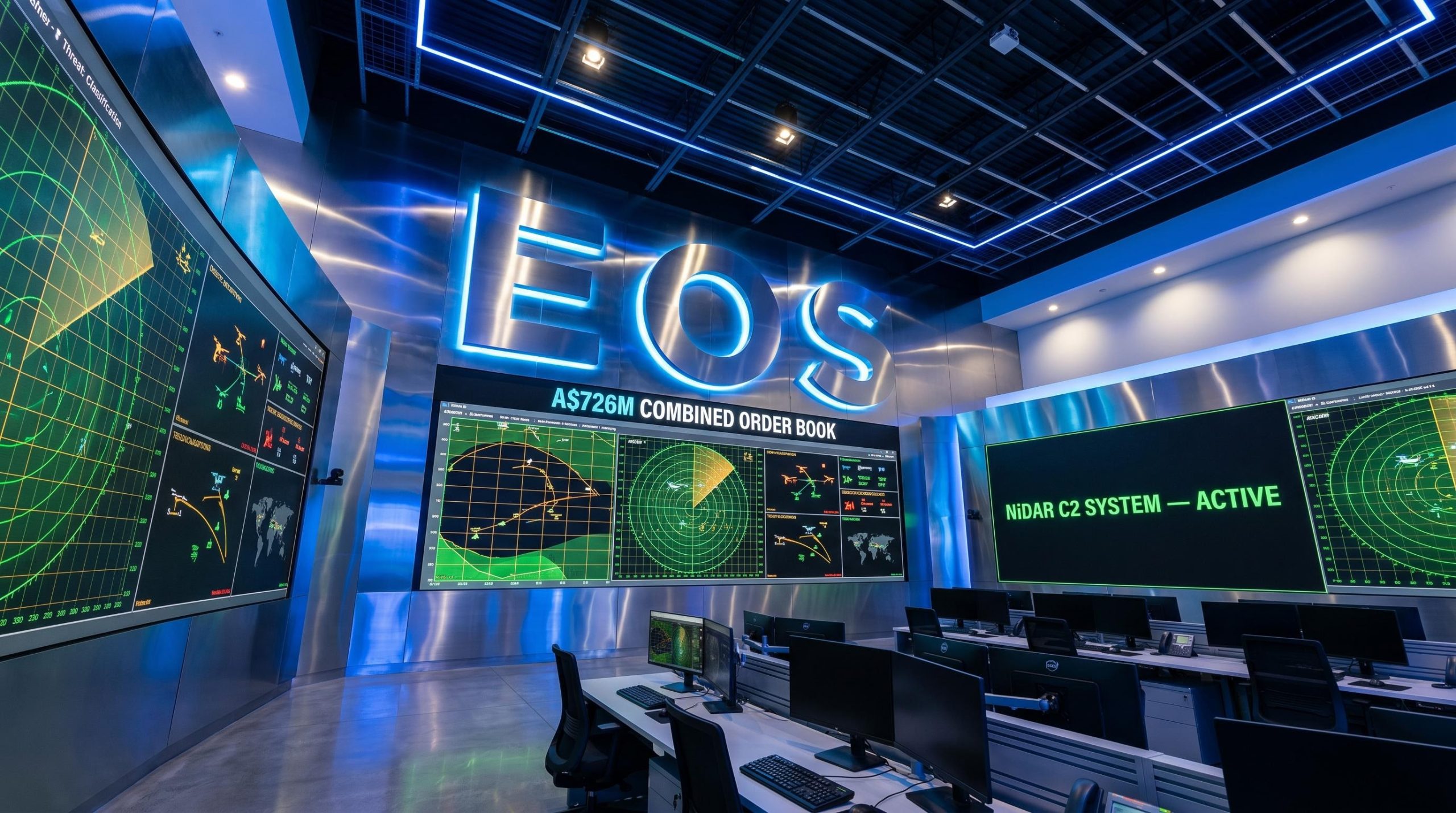
Electro Optic Systems Holdings Limited (ASX: EOS) has agreed revised acquisition terms for the MARSS group business, drawn A$70m from its Washington H. Soul Pattinson (WHSP) secured term loan facility, and transmitted the upfront payment of US$36m to MARSS vendors on 15 May 2026, with completion expected in the coming days. Adding to the transaction’s momentum, MARSS secured €102m (~A$165m) in new orders from an existing Middle Eastern customer in May 2026 alone, lifting the illustrative combined order book to A$726m (subject to completion).
MARSS is a turnkey counter-drone systems provider, with its NiDAR Command and Control (C2) software at the core of its offering, detecting, tracking and defeating drone threats in real time. The NiDAR system has been operationally deployed in the Middle East, where it has successfully defeated multiple attacks involving Shahed drones and missiles against critical infrastructure targets. According to the announcement, customers have “expressed deep satisfaction” with the system’s performance.
The most recent contract win reflects that battlefield credibility directly. MARSS has entered into a £85m (~A$160m) agreement with an existing Middle Eastern national defence force, expanding its installations to deliver a country-wide drone detection and mitigation capability, with NiDAR C2 software at its core. Given the urgent operational need, approximately 70% of revenue and cash from this contract is expected to be earned during 2026 and 2027, with the remaining 30% recognised over the following three years through support services. EOS notes that battle-proven performance is driving accelerated customer enquiry and broader industry interest in MARSS’ integrated counter-drone capabilities.
What the order book looks like today
| Date | MARSS Order Book | Notes | Illustrative Combined EOS + MARSS Order Book |
|---|---|---|---|
| 31 Dec 2024 | A$136m | Pre-acquisition baseline | — |
| 31 Dec 2025 | A$217m | Post-new contract growth | — |
| 15 May 2026 | A$217m | At announcement date, post-€102m new orders added in May 2026 | A$726m (subject to completion; EOS existing order book of A$509m + MARSS A$217m) |
Beyond the current order book, MARSS also has additional pipeline opportunities with individual contract values exceeding A$100m that are not yet reflected in these figures.
When big ASX news breaks, our subscribers know first
What is a counter-drone C2 system — and why does NiDAR matter to investors?
A counter-drone Command and Control (C2) system integrates three functions into a single, real-time loop: sensors detect incoming drone threats, C2 software processes and classifies those threats, and effectors (such as jammers or kinetic interceptors) neutralise them. NiDAR is software-led, meaning it can integrate third-party original equipment manufacturer (OEM) sensors and effectors from multiple hardware vendors. This hardware-agnostic design makes the platform scalable across different customer environments without requiring proprietary equipment throughout.
The “turnkey” model is commercially significant. MARSS handles custom system design, integration and ongoing support for each customer, generating upfront installation revenue that is typically recognised over one to two years, alongside recurring support revenue earned under contracts running three to five years. For investors, this structure means a meaningful portion of MARSS’ contracted order book converts to cash over an extended, predictable horizon, adding revenue visibility to EOS’s combined business.
Why the drone threat environment is driving urgency
The active use of Shahed drones and missiles in Middle Eastern conflicts has created demonstrable, near-term demand for proven counter-drone solutions. NiDAR’s live operational track record in that environment positions MARSS as a tested provider at exactly the moment customer urgency is highest. The structure of the new £85m contract reflects this directly, with approximately 70% of implementation expected in 2026–2027, indicating near-term revenue realisation rather than a long-dated pipeline promise.
Amended acquisition terms: how the deal has evolved
The following summarises how the transaction terms have changed from the original 12 January 2026 announcement:
-
Upfront consideration: US$36m in cash remains unchanged. Payment was transmitted on 15 May 2026.
-
Finance facility: EOS drew A$70m from its WHSP secured term loan facility. Of that drawdown, A$50m has been allocated to fund the upfront cash consideration. (The A$70m is an EOS loan drawdown; it is not the MARSS acquisition price.)
-
Maximum earnout cap: Increased from €100m to €140m, reflecting a strengthened MARSS business outlook. The earnout is entirely contingent on new order intake achieved between 12 January 2026 and 12 months from completion date. The recently announced contract is included in earnout order intake calculations.
-
Earnout conversion mechanics: The first €500m of new order intake earns contingent consideration of €100m, payable in EOS shares at the previously agreed conversion price of $7.40 per EOS share (this is an EOS share conversion price for earnout settlement purposes, not a MARSS asset valuation). Vendors may elect to receive up to €20m of this first tranche in cash. A further €200m of order intake earns additional consideration of €40m, payable in EOS shares at a New Conversion Price equal to the 5-day volume weighted average EOS share price prior to completion. The maximum total number of EOS shares issuable across both tranches is 28,942,814, representing 15% of EOS’ current issued capital. Any earnout amount exceeding the share capacity is payable in cash.
-
Earnout payment schedule: Restructured from two tranches to three, payable at 90 days from completion, 270 days from completion, and at the end of the earnout period (31 May 2027). If sufficient contracts are signed within any single tranche period, the full €140m earnout cap could potentially be earned in that tranche alone.
-
Board representation: EOS has agreed to appoint a MARSS management nominee as a director to the EOS Board if MARSS management shareholders collectively hold shares exceeding 15% of EOS issued capital. Any such director fills a casual vacancy and must stand for re-election by shareholders at the first Annual General Meeting (AGM) following their appointment. MARSS management shareholders have also agreed to vote their EOS shares (up to a 19.99% cap) in line with the EOS Board’s recommendation at shareholder meetings.
Shareholder approval not required
No EOS shareholder approval is required for the issuance of the additional performance rights or the EOS shares that may be issued on their vesting. The total share issuances fall within EOS’s placement capacity under ASX Listing Rule 7.1, given the 15% placement capacity cap applied to the Maximum Shares calculation.
What completion means for EOS’s investment case
The acquisition, once finalised, represents a material expansion of EOS’s addressable market and contracted revenue base. Key strategic implications include:
- Illustrative combined order book of A$726m (EOS A$509m + MARSS A$217m), subject to completion
- EOS expects to receive the full economic benefit of all current MARSS contracts under the agreed transaction arrangements, with formal novation of contractual rights to follow completion where applicable
- Adds the battle-proven, software-led NiDAR C2 platform to EOS’s existing Defence Systems division, complementing its existing counter-UAS and C4 capabilities
- Exposes EOS to accelerating counter-UAS demand, supported by live operational proof of NiDAR’s effectiveness in active conflict environments
- MARSS pipeline includes additional opportunities with individual contract values exceeding A$100m, not yet reflected in the current order book
It is important to note that earnout payments of up to €140m are contingent on future order intake, and there is no guarantee that further contracts will be signed during the earnout period. Completion of the acquisition remains subject to receipt of funds by the MARSS vendors and other customary steps, with EOS expecting that to occur in the coming days.
Don’t Miss the Next Defence Tech Winner on the ASX
Big News Blast delivers FREE breaking ASX news straight to your inbox within minutes of release, complete with in-depth analysis already done for you. Join 20,000+ subscribers staying ahead of market-moving announcements across Defence, Tech, Healthcare and more. Click the “Free Alerts” button at Big News Blast to start receiving alerts the moment news breaks.