

A record dividend caps a year of broad-based growth for Computershare
In its FY26 full year results presentation, delivered on 11 August 2026 by CEO Stuart Irving and CFO Nick Oldfield, Computershare reported growth across all three core business lines alongside a materially higher dividend for the year ended 30 June 2026.
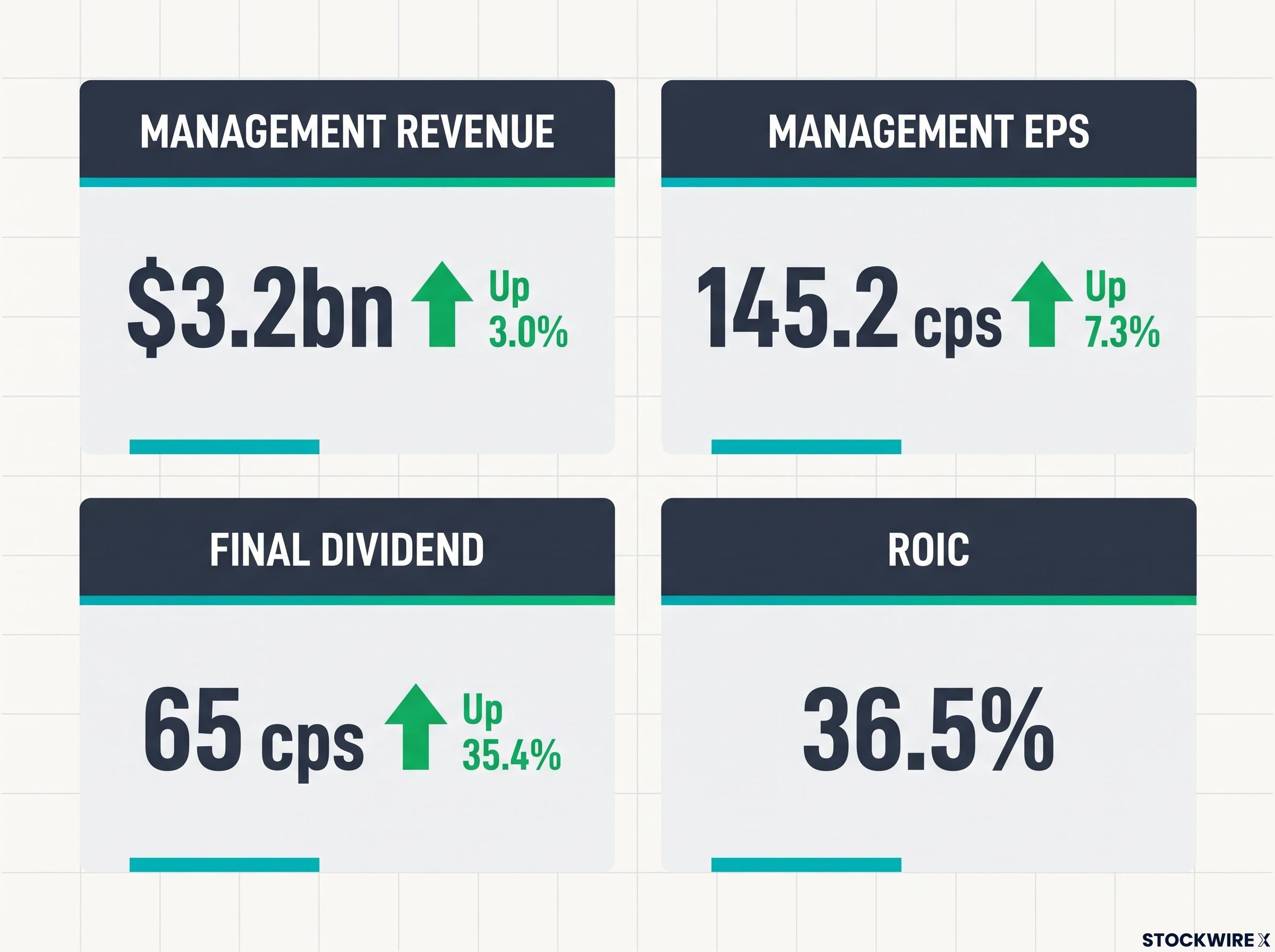
Management EPS beat the company’s upgraded February 2026 guidance, and the final dividend stepped up by more than a third. Headline metrics for the period included:
The 145.2 cps result sits modestly ahead of the company’s FY26 guidance affirmation from May 2026, when management reconfirmed the 144 cps target on the back of client balances tracking higher than previously forecast.
- Management Revenue: $3.2bn, up 3.0%
- Management EPS: 145.2 cps, up 7.3% (ahead of upgraded February 2026 guidance of around 144cps)
- Management EBIT ex. Margin Income: $447.5m, up 8.3%, with margin expanding 70bps to 18.2%
- Final Dividend (AUD): 65 cps, up 35.4% (unfranked), representing a 58% payout ratio
- Return on Invested Capital (ROIC): 36.5%, up 70bps
The combination matters for investors because it reflects quality earnings growth funding materially higher shareholder returns, rather than distributions outpacing underlying performance.
When big ASX news breaks, our subscribers know first
Growth across all three business lines
Each of the company’s core divisions recorded revenue growth in FY26. Employee Share Plans led on both revenue and earnings, while Issuer Services delivered strong top-line growth despite a decline in divisional EBIT.
| Business Line | Revenue | Revenue Growth | Management EBIT | EBIT Growth |
|---|---|---|---|---|
| Issuer Services | $1,310.6m | +4.4% | $436.5m | −4.2% |
| Corporate Trust | $1,032.0m | +5.7% | $526.4m | +2.8% |
| Employee Share Plans | $559.7m | +10.2% | $260.8m | +24.3% |
Employee Share Plans leads the way
The Employee Share Plans division recorded revenue growth of 10.2% and Management EBIT up 24.3%, with the EBIT margin expanding by 530bps to 46.6%. Assets under Administration (AuA) reached $289bn, up 8% on the prior period, and transaction fees rose 18% on growth in the book.
Management attributed the strength in part to a structural trend of increasing equitisation of remuneration, with clients issuing around 5% more units as new issuance exceeded exercises.
Corporate Trust and Issuer Services deliver
Corporate Trust posted revenue growth of 5.7%, supported by fee revenue up 9% and average client balances up 3.7% to $19.7bn. The presentation noted $80m Wells Fargo synergies delivered one year early.
Issuer Services grew revenue 4.4%, led by Corporate Actions revenue up 22% as US M&A activity rose 50% and Hong Kong IPOs doubled. The 4.2% decline in divisional EBIT reflected margin dilution as newly acquired businesses scale, rather than underlying weakness.
Understanding Margin Income: the interest-rate balancing act
Margin Income refers to the interest Computershare earns on client cash balances it administers on behalf of issuers, trustees and plan participants. It is a meaningful contributor to group earnings and sensitive to central bank interest rate movements.
In FY26, Margin Income was $748.7m, down 1.6%. Lower central bank rates across several jurisdictions weighed on yields, yet the result stayed resilient as higher client balances and hedging offset much of the rate impact.
Key drivers of the outcome included:
- Average client balances up around 6% to $31.7bn
- A hedge book that has locked in $1.5bn of margin income over the next 5 years
- Interest expense down 29.4% to $81.9m
This last point illustrates what management describes as a natural hedge. As interest rates fall, the interest cost on Computershare’s own floating-rate debt also declines, partially offsetting the lower Margin Income. Understanding this sensitivity helps explain why management expects Margin Income to rise in FY27 even in a broadly stable rate environment.
Balance sheet strength funds growth and rising dividends
A materially stronger balance sheet underpinned both the step-up in dividends and the company’s optionality for acquisitions. Net debt leverage reduced to 0.11x, down from 0.42x in FY25.
Supporting metrics for the period included:
- Operating cash flow of $836.6m
- FY26 total dividend up 29%, with the payout ratio stepped up to 55–58%
- Capex of just $39.2m, or 1.2% of revenue, reinforcing the capital-light model
Management reiterated its view that buybacks remain inefficient for Computershare under Australian tax law, with the acquisition pipeline focused on building scale in Corporate Trust and Entity Solutions.
CEO Commentary
Management, led by CEO Stuart Irving, characterised FY26 as a year of growth across all business lines, with a strengthened balance sheet providing optionality for both higher dividends and acquisitions, and momentum carrying into FY27.
FY27 outlook: earnings growth set to continue
For FY27, management issued guidance for continued earnings growth, framed as forward-looking expectations rather than committed outcomes.
Key elements of the guidance included:
- Management EPS expected to be around 154 cps, up approximately 6%
- Margin Income anticipated to increase to around $770m on average client balances of $32.8bn
- EBIT ex Margin Income expected up around 3.5%, with a full-year EBIT ex MI margin of approximately 19%
- Interest expense expected down around 15% on lower debt levels
Over the longer term, the presentation pointed to a Management EPS CAGR of approximately 10.4% across FY23 to FY27E. Strategic drivers highlighted included selective investment in AI and digital markets, where the company positions itself as a trusted bridge between traditional and digital markets, alongside exposure to growth trends across bond securitisation, equity-based remuneration and new entity creation. The EBIT ex MI margin target was reaffirmed at 20%.
The investment case in brief
Management framed the result within a longer-term investment thesis built on recurring revenues and structural growth exposure.
- High-quality, capital-light business with recurring revenues and high client retention
- Leading positions in large markets with structural growth tailwinds
- Long-term track record: group revenue CAGR of approximately 9.8% and dividends CAGR of approximately 18.6% over the long run
- Strong balance sheet funding both growth investment and rising shareholder returns
- ROE of 38.3% and ROIC of 36.5%
With growth anticipated across all business lines and Margin Income set to rise, management pointed to clear momentum carrying Computershare into FY27.
Don’t Miss the Next ASX Financial Services Winner
Big News Blast delivers FREE breaking ASX news and in-depth analysis to your inbox within minutes of release. Join 20,000+ investors already staying ahead of market-moving announcements across Finance, Tech, Healthcare and more. Click the “Free Alerts” button to start receiving alerts the moment news breaks.