
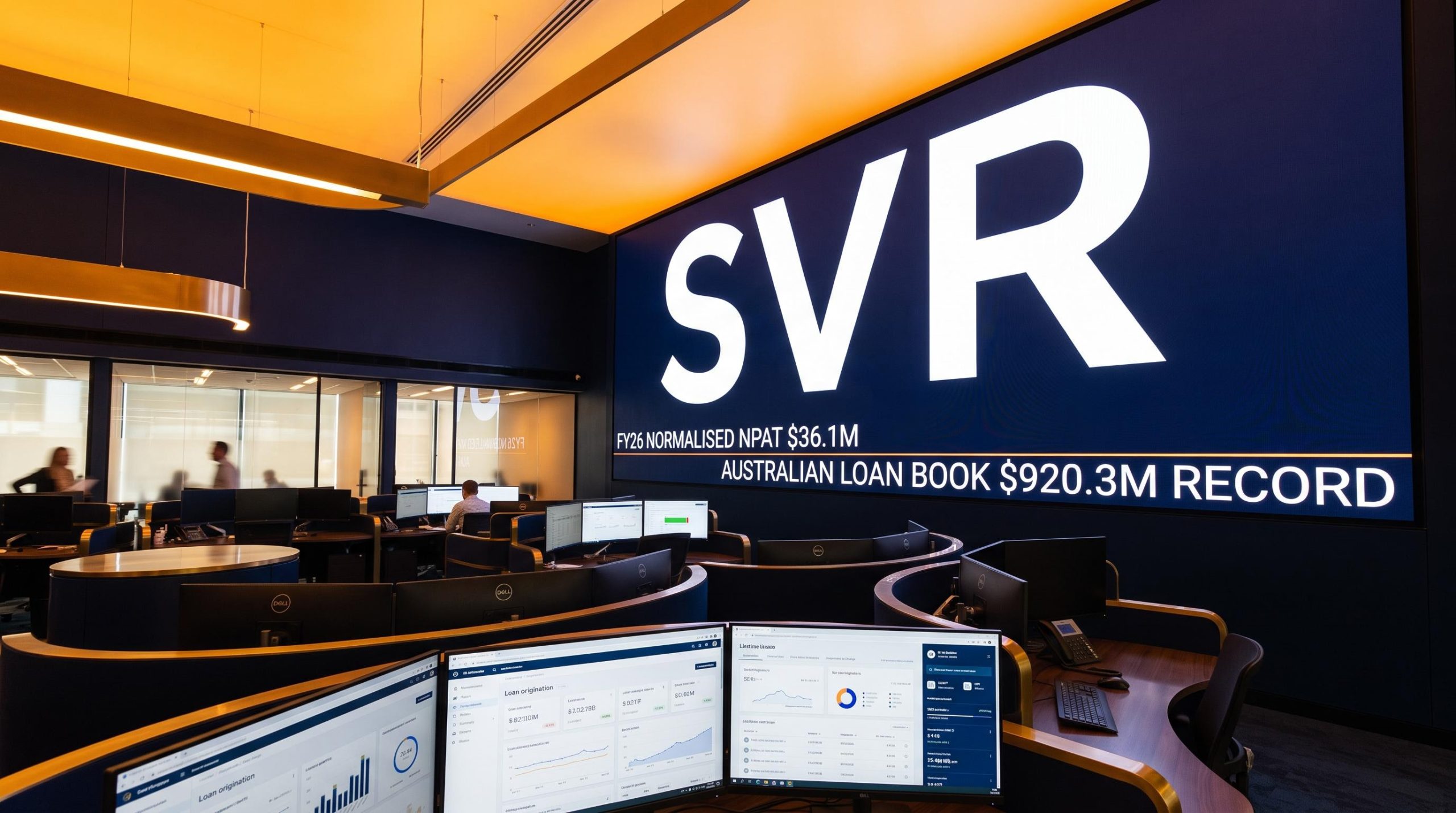
Solvar delivers on FY26 profit guidance as loan book hits record $920.3m
In its FY26 full-year results investor presentation dated 19 August 2026, Solvar outlined a year in which it achieved profit guidance, grew its Australian loan book to a record level, and stepped up capital returns to shareholders. The presentation was delivered by Managing Director and CEO Scott Baldwin alongside CFO Siva Subramani.
Management highlighted Normalised Net Profit After Tax (NPAT) of $36.1m, up 7.5% on the prior corresponding period (pcp), against a Statutory NPAT of $29.5m. The Australian loan book from continuing operations closed at a record $920.3m, a 10.5% increase, while fully franked dividends rose 39.3% to 19.5 cents per share.
The strategic theme running through the update was diversification into commercial lending as a second growth engine, supported by disciplined capital allocation. Solvar closed the presentation period with a share price of $1.590 and a market capitalisation of $295.8m.
When big ASX news breaks, our subscribers know first
FY26 results summary — earnings quality and record metrics
The presentation drew a clear distinction between statutory and normalised earnings. Statutory NPAT of $29.5m was 6.2% lower than the prior year, while Normalised NPAT of $36.1m represented a 7.5% improvement, lifting the Normalised NPAT margin to 18.7% from 16.2%.
Group interest income declined 6.7% to $193.4m, which management attributed to the reduced New Zealand loan book. Australian loan book growth is expected to replace New Zealand interest income in FY27. Group net interest income eased 6.2% to $145.7m.
The company recorded record Australian originations of $470.7m, up 21.0%, and record Australian cash collections of $478.8m, up 5.1%. Group bad debts (net) improved to 3.6% from 4.4%, though this figure includes the one-off sale of New Zealand’s written-off book.
Financial performance snapshot
The table below summarises the Group financial results presented for FY26 against the prior year.
| Metric (Group) | FY26 | FY25 | Variance |
|---|---|---|---|
| Net Interest Income | $145.7m | $155.3m | (6.2%) |
| NPAT (Normalised) | $36.1m | $33.6m | +7.5% |
| NPAT (Statutory) | $29.5m | $31.4m | (6.2%) |
| EPS (Normalised) | 19.0c | — | +14.7% |
| Bad Debts (net, Group) | 3.6% | 4.4% | Improved |
The earnings bridge explained
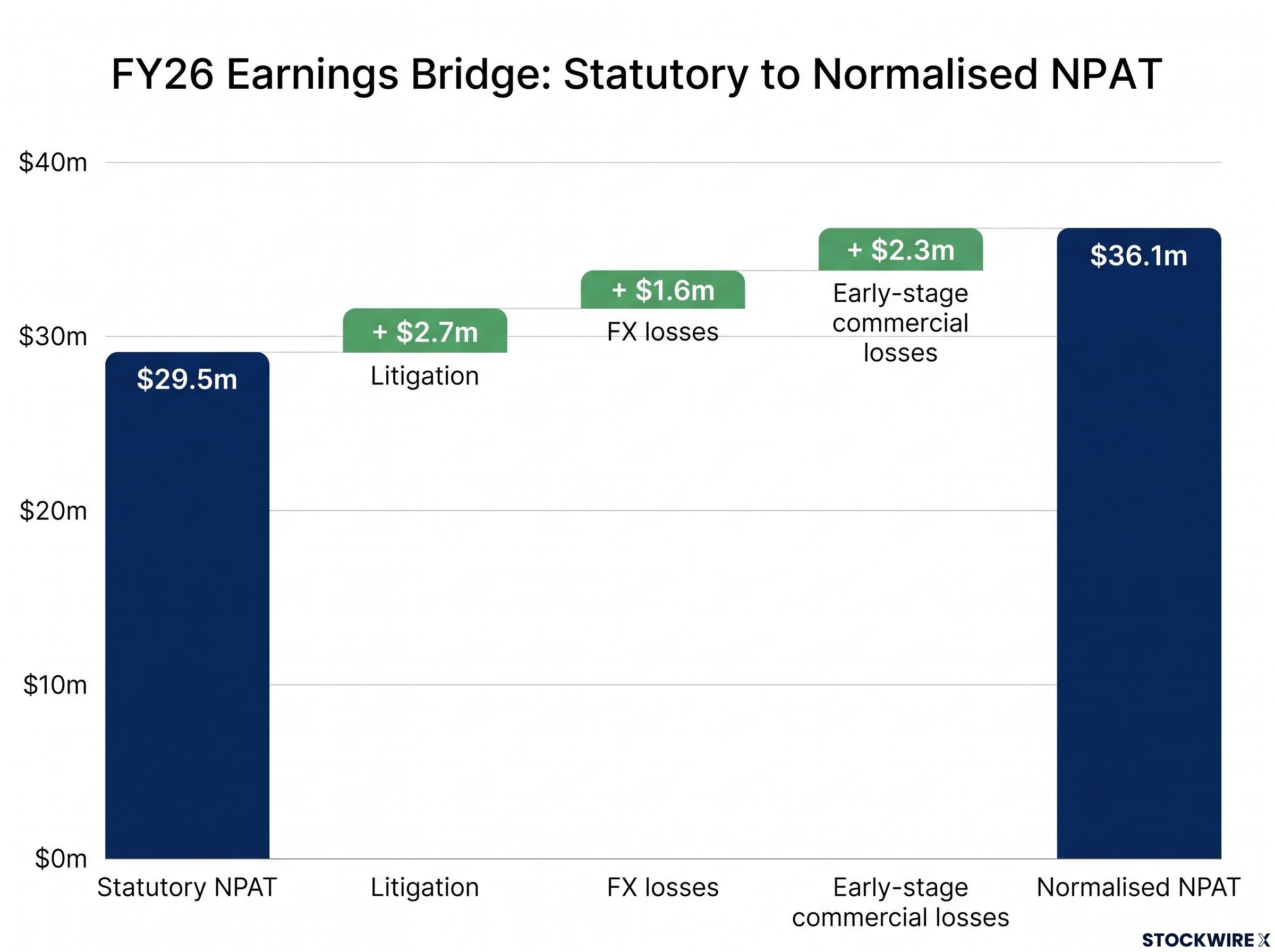
Management detailed three one-off adjustments that bridged Statutory NPAT to Normalised NPAT:
-
Litigation — conclusion of the ASIC v Money3 regulatory matter, including a $1.55m penalty, added back $2.7m.
-
FX losses — realised foreign exchange losses on the transfer of funds from New Zealand to Australia added back $1.6m.
-
Early-stage commercial losses — Year 1 implementation costs of establishing the Bennji Commercial Division, including an impairment provision, added back $2.3m.
For investors, the earnings bridge suggests the underlying business is stronger than the statutory figure indicates, with several one-off drags now largely behind the company.
Commercial lending emerges as a second growth engine
A central plank of the presentation was Solvar’s commercial lending expansion, which management described as building a second growth engine to broaden the Group earnings profile. The commercial loan book closed FY26 at $109.8m, up 88.2% on the prior year, moving from start-up into a growth phase.
Origination momentum was evident in the second half. H2 Australia originations grew 45.2% over the pcp, while a new customer onboarding strategy delivered a 24.0% uplift in direct customer originations in H2.
Solvar’s lending operates across three product arms, each targeting a distinct addressable market:
-
Money3 — secured and unsecured consumer loans, addressing an estimated ~$37b market.
-
AFS (Automotive Financial Services) — consumer and commercial secured lending, addressing an estimated ~$83b market.
-
Bennji — secured commercial asset finance for sole traders and small businesses, addressing an estimated ~$37b market.
Diversifying revenue across consumer and commercial lending is intended to reduce reliance on any single segment and improve earnings resilience.
How Solvar’s high-return lending model works
Solvar operates as a non-bank lender, providing finance to consumer and small business customers who are often under-served by mainstream banks. The model prices loans for risk, funds them through warehouse facilities and its own balance sheet, and aims to protect portfolio quality while growing profitably.
Several terms help explain how the model generates returns. The loan book is the total value of outstanding loans. The net interest margin is the difference between what the company earns on loans and its funding cost, a spread that drives profitability. The bad debt ratio measures loans unlikely to be recovered, while franking credits allow Australian shareholders to offset tax already paid at the company level.
Two levers support future earnings under this model: the approximately 1% reduction in Money3 funder margins, which widens the spread, and portfolio quality, with 81% of the Australian portfolio rated “Strong and Good”.
Funding capacity and shareholder returns
Management pointed to the funding platform as a key enabler of growth without the need for additional equity.
Funding platform
Key funding points from the presentation included:
-
A new $488.0m Money3 warehouse facility was introduced during the year.
-
The platform holds over $400m in funding capacity, with headroom of $409m against $681m drawn of a total $1,090m facility.
-
Money3 funder margins reduced by approximately 1% compared with previous years.
-
Funding is diversified across four senior lenders.
-
Australian leverage sat at 74%, with capacity to increase to approximately 80%, enabling loan book growth.
This headroom is expected to fund planned growth over the coming 12 to 24 months without diluting existing shareholders.
Capital returns to shareholders
Management noted that surplus capital arising from the New Zealand run-down supported both share buybacks and special dividends, with the buyback price sitting below Net Tangible Assets (NTA) of $1.66, an outcome described as accretive to remaining shareholders.
Key capital return measures from FY26 included:
-
Declared $36.6m in fully franked dividends (special, interim and final), aggregating to 19.5 cents per share.
-
Purchased 7.5m shares for $11.5m at an average price of $1.54.
-
Reduced shares on issue to 186,651,516.
-
Held a franking credits balance of $70.0m at 30 June 2026.
-
The final 6.0c and special 2.5c dividends are payable on 7 October 2026.
FY27 outlook — targeting the $1 billion loan book milestone
Looking ahead, management set out FY27 guidance centred on scaling the Australian business. Notably, the $1.0 billion loan book is a FY27 target rather than an achieved milestone, with the loan book sitting at $966.4m as at 31 July 2026 (including $30.9m in New Zealand).
Management’s stated FY27 priorities included:
-
Double-digit loan book growth, expected to surpass the $1.0 billion milestone.
-
Double-digit interest income growth in continuing operations.
-
An increasing contribution from commercial lending.
-
Investment in credit decisioning, automation and AI-powered call record keeping and customer chat capability.
-
Technology investment aimed at reducing operating expenditure in FY28.
On market conditions, management noted a supportive labour market, with used car affordability expected to support demand. The company also flagged elevated regulatory focus on the sector and positioned itself to take advantage of potential M&A activity in the non-bank space.
For investors, the outlook presents a roadmap in which Australian growth is expected to replace exited New Zealand interest income in FY27, supported by ample funding headroom and a diversifying earnings base.
Stay Ahead on ASX Fintech and Finance News
Big News Blast delivers FREE breaking ASX announcements directly to your inbox within minutes of release, complete with in-depth analysis already done. Join 20,000+ investors who stay ahead of the market on finance and fintech news. Click the “Free Alerts” button at Big News Blast to start receiving real-time alerts the moment market-moving news breaks.