
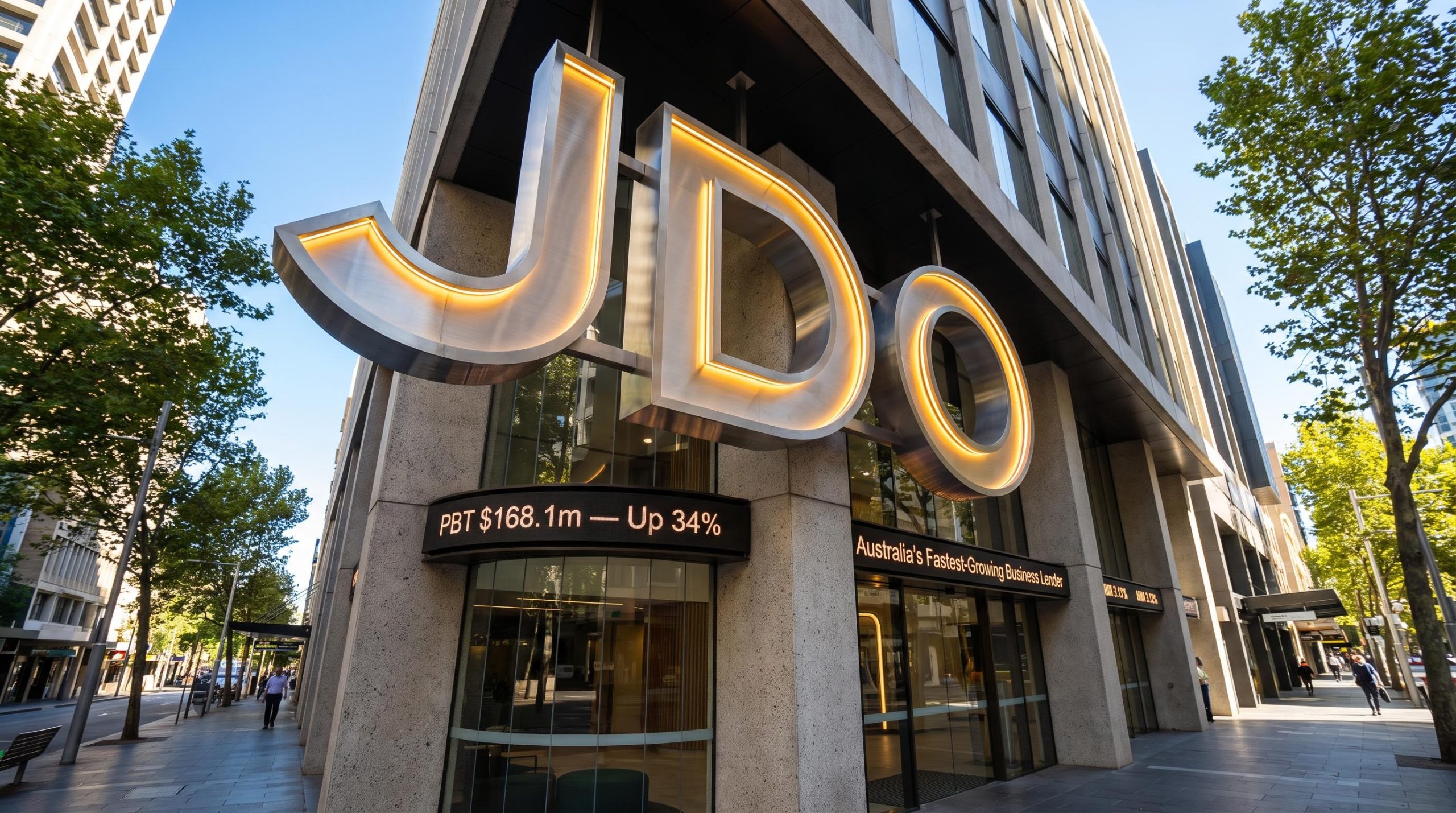
Judo delivers 34% lift in pre-tax profit as scale ambitions near reality
In its FY26 full year results presentation dated 18 August 2026, Judo Capital Holdings reported profit before tax (PBT) of $168.1m, up 34%, and net profit after tax (NPAT) of $111.1m, up 29% on the prior year.
Income rose 24% to $522.4m, while profit before impairment jumped 42% to $285.8m. The one blemish sat squarely in the cost of risk, which climbed to $117.7m, up 56%, a provision increase CEO Chris Bayliss described as disappointing.
Management reiterated the strategic anchor underpinning the result: a target of a sustainable return on equity (ROE) in the low-to-mid teens at scale.
When big ASX news breaks, our subscribers know first
FY26 result headlines at a glance
The table below sets out the key financial and operating metrics disclosed in the FY26 result.
| Metric | FY26 | FY25 | Change |
|---|---|---|---|
| Income | $522.4m | $422.9m | +24% |
| Profit before impairment | $285.8m | $201.1m | +42% |
| Profit before tax | $168.1m | $125.6m | +34% |
| NPAT | $111.1m | $86.4m | +29% |
| GLA | $14,672m | $12,465m | +18% |
| Deposits | $12.2bn | $9.9bn | +24% |
| NIM | 3.13% | 2.93% | +20bps |
| CTI | 45.3% | 52.4% | −710bps |
| ROE | 6.4% | 5.3% | +110bps |
| EPS | 9.9c | 7.7c | +29% |
In his reflections on the year, Bayliss noted that aside from cost of risk, FY26 was a year of strong underlying performance.
Chris Bayliss, Chief Executive Officer & Managing Director
Bayliss reflected that aside from the disappointing provision increase, FY26 was a year of strong underlying performance. He noted Judo remains highly confident in its business model, underpinned by a clear competitive advantage, and continues to focus on executing its strategy to deliver a sustainable ROE in the low-to-mid teens.
What makes Judo different: the SME lending model explained
Judo is a challenger bank that exists to serve small and medium enterprise (SME) customers who do not fit the systemised, one-size-fits-all credit assessment processes used by incumbent banks.
The trade-off is straightforward. Judo charges higher margins for premium service: faster decisions, smarter judgement and stronger relationships. The model is designed to generate above-system returns provided credit risk stays within expected bounds.
Two ratios help explain how this plays out. Net interest margin (NIM) measures the gap between what the bank earns on lending and what it pays for funding. A high NIM of 3.13%, described as the highest of listed authorised deposit-taking institutions (ADIs), reflects Judo’s premium positioning.
The cost-to-income ratio (CTI) measures operating expenses as a share of income. A falling CTI, down to 45.3% from 52.4%, indicates improving operating leverage as the bank scales.
Judo’s portfolio settings are set consistent with an at-scale cost of risk (COR) of 50bps, its expected through-the-cycle write-offs. This is based on a portfolio probability of default (PD) of 2.08% and cumulative loss given default (LGD) of 27%.
Management framed continued ROE improvement around four levers:
- Growth
- Margins
- Operating leverage
- Risk management and capital
Underlying momentum: lending, deposits and margins
Gross loans and advances (GLA) grew 18% to $14.7bn, described as approximately 2.8x system growth, with Judo noted as Australia’s fastest-growing business lender over five years.
Deposits grew 24% to $12.2bn, now representing 71% of total funding. FY26 saw the launch of two new at-call savings products, intermediated savings accounts in October 2025 and direct online savings accounts in February 2026, expanding the addressable deposit market beyond term deposits.
NIM improved 20bps to 3.13%, with a second-half NIM of 3.23% driven by favourable deposit pricing. Customer and staff engagement metrics also strengthened, with an industry-leading Lending Net Promoter Score (NPS) of +58 (up from +53) and JEDI employee engagement of 74.
Funding diversification continued through the wholesale market:
- $150m Tier 2 issue completed in October 2025, with a 120bps pricing improvement versus the prior issuance
- $750m capital-relief securitisation completed in June 2026, contributing 60bps to the CET1 ratio
The $750m capital-relief securitisation completed in June 2026 was upsized from an initial $500m target on strong domestic and international demand, with notes pricing at a weighted average of 171bps over BBSW, a 102bps improvement on Judo’s inaugural 2023 transaction.
The impairment story: honest look at asset quality
The cost of risk rose to $117.7m, or 0.88% of average GLA, from $75.5m, driven by higher individually assessed provisions and an increase in the collective provision.
The three individually assessed exposures driving the provision increase were first flagged in Judo’s FY26 asset quality update in late June, which identified the deterioration following a Q3 customer review and confirmed that 90-days-past-due loans were tracking toward approximately 3% of gross loans at year end.
The share of 90+ days past due (DPD) and impaired assets rose to 2.90% of GLA, up from 2.43%, with pressure concentrated in specific sectors including rental, hiring and real estate services, accommodation and food services, and retail trade.
There were offsetting positives. The 30–89 DPD ratio fell to 0.39% of GLA from 1.04%, resolution activity remained strong, and provision coverage remained prudent at 1.47% of GLA. Management stated relevant exposures have been reviewed with learnings incorporated.
On portfolio strength, 86% of credit exposure is fully or partially secured, and 94% of customer groups sit below $10m. The numbers point to cyclical, sector-specific pressure within an otherwise diversified book rather than a structural change to the model.
Capital strength and the path to scale
CET1 stood at 12.4% at 30 June 2026, above management’s operating range of 11.0–12.0%, with Total Capital of 16.2%.
Management stated it has no plans to issue additional core equity to achieve its target at-scale loan book, and flagged potential capital management initiatives in due course.
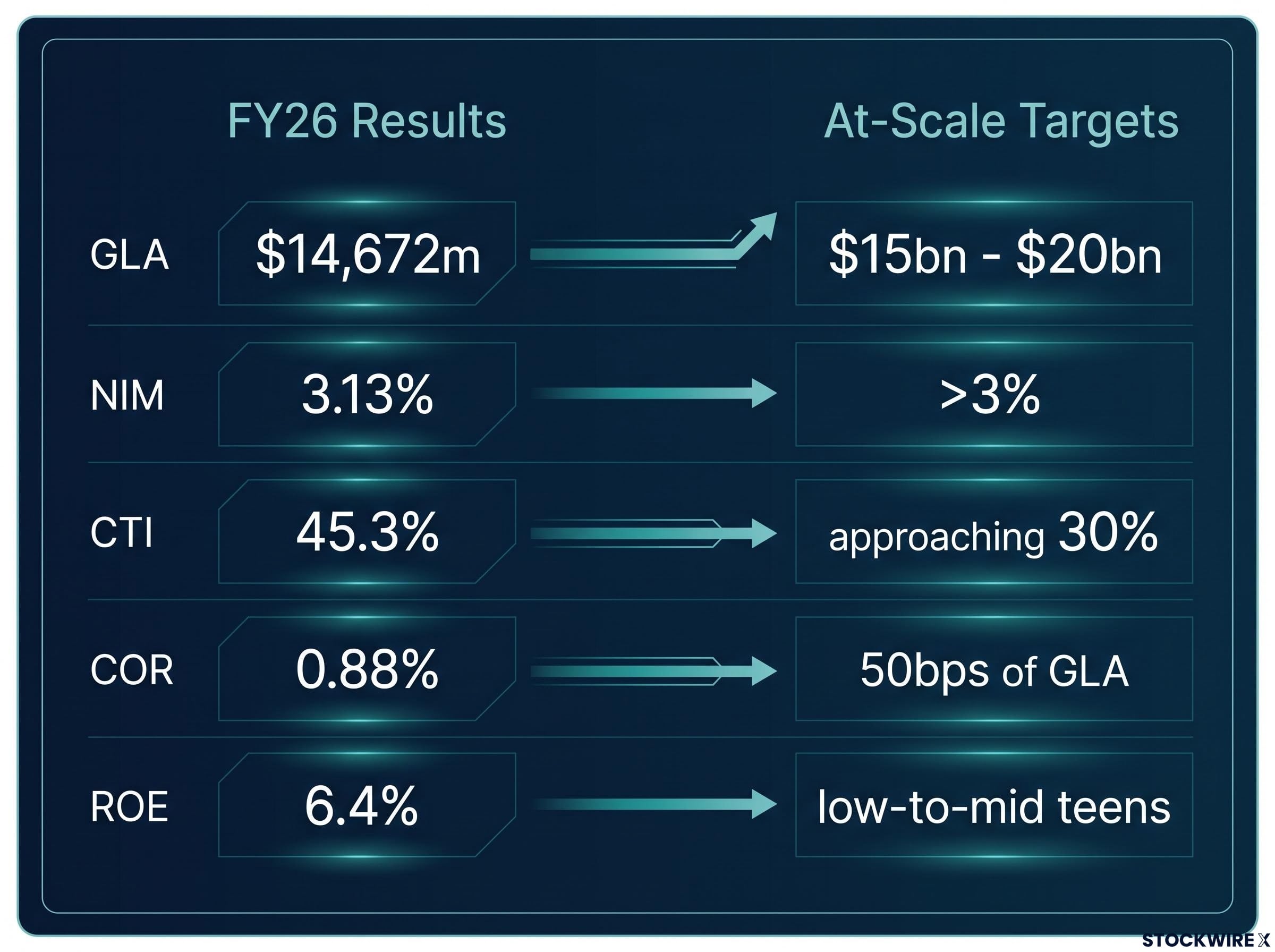
The presentation set out the following metrics-at-scale targets:
- GLA: $15bn – $20bn
- NIM: >3%
- CTI: approaching 30%
- COR: 50bps of GLA
- ROE: low-to-mid teens
Management said Judo is now nearing scale, with focus increasingly shifting toward optimising returns.
FY27 guidance and outlook
The company provided the following FY27 guidance.
| Metric | FY27 guidance |
|---|---|
| PBT | $210–$220m (~25–31% growth) |
| ROE | Circa 8% (assuming 31% effective tax rate) |
| GLA | Disciplined above-system growth |
| NIM | Broadly stable vs FY26 |
| CTI | Continued improvement |
| COR | Broadly consistent with FY26 |
Management framed FY27 as continued PBT momentum and progress toward the low-to-mid-teens ROE ambition. Stated priorities include scaling warehouse lending, deepening broker partnerships through the Broker Black Belt program, AI-led productivity with around 230 use cases identified, and enhanced early-warning risk indicators. Management said Judo remains firmly on track to deliver sustained ROE expansion.
Stay Ahead on ASX Finance and Fintech News
Breaking ASX financial sector news lands in your inbox within minutes of release, with in-depth analysis already done. Join 20,000+ investors who rely on Big News Blast for FREE real-time alerts the moment market-moving announcements hit. Click the “Free Alerts” button to start receiving coverage across finance, fintech, and beyond before the broader market catches on.