
Kina Bank delivers 4% profit lift and 13% dividend boost in HY2026 results
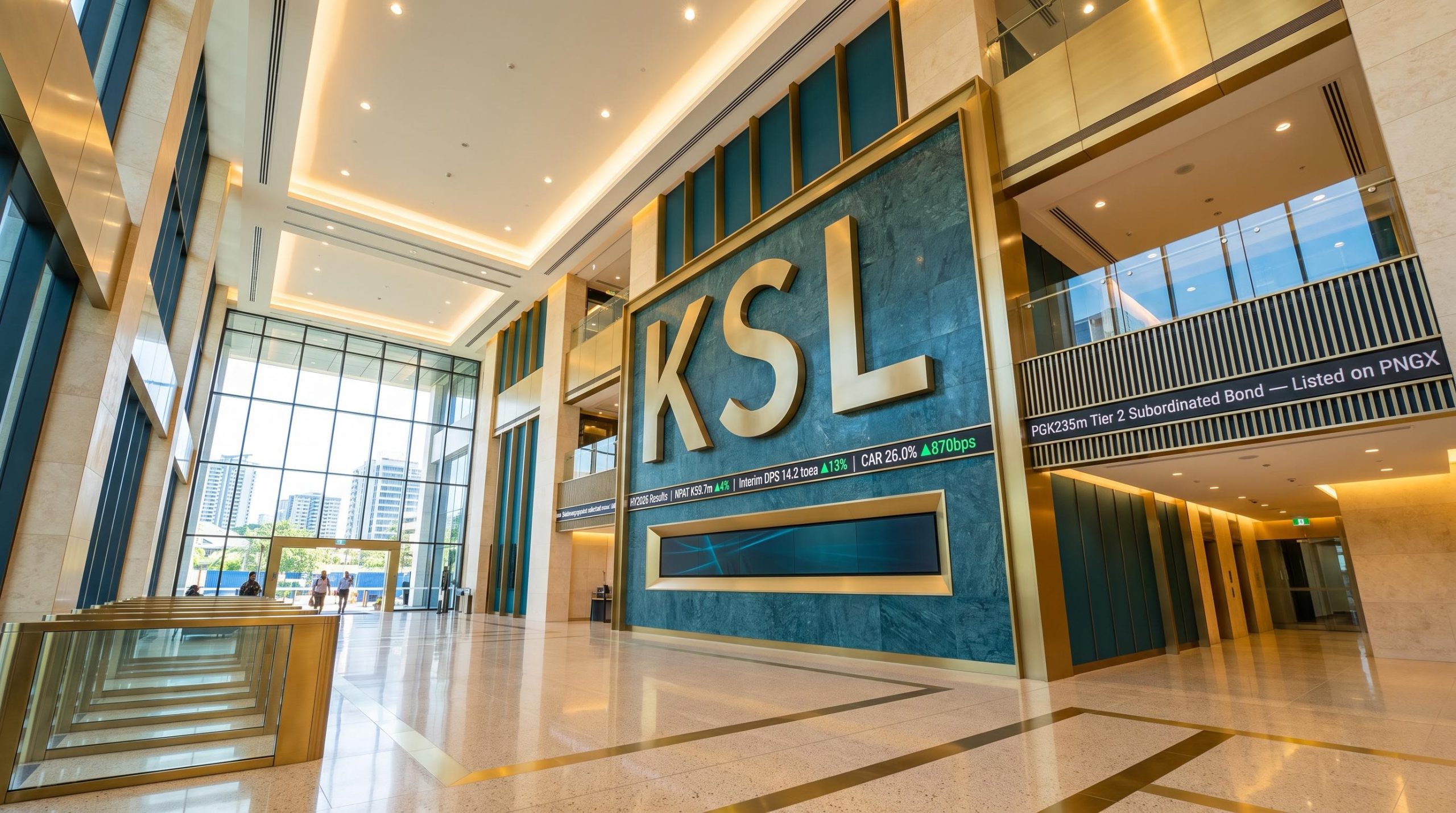
In its HY2026 results presentation dated 31 August 2026, Kina Securities (KSL) reported net profit after tax (NPAT) of K59.7m, up 4% on the prior comparative period, alongside revenue of K254.8m (▲2%) for the half year to June 2026.
Management highlighted an interim dividend of 14.2 toea per share, a 13% increase, together with a materially transformed capital position that saw the capital adequacy ratio (CAR) climb 870 basis points to 26.0%.
The standout capital event of the half was the successful, oversubscribed PGK235m Tier 2 subordinated bond listed on the PNG National Stock Exchange (PNGX). Together, profit growth and a stronger balance sheet position the diversified financial services group for future lending growth.
When big ASX news breaks, our subscribers know first
HY2026 results at a glance
The table below summarises the key financial metrics disclosed in the presentation, with all comparisons versus June 2025 unless otherwise stated.
| Metric | HY2026 Value | Change vs Jun-25 |
|---|---|---|
| NPAT | K59.7m | ▲ 4% |
| Revenue | K254.8m | ▲ 2% |
| EPS | 20.3 toea | ▲ 1% |
| NIM | 5.8% | ▼ 10bps |
| ROE | 16.6% | ▼ 50bps |
| Cost of Credit Risk | 0.2% | ▼ 10bps |
| CAR | 26.0% | ▲ 870bps |
| Interim DPS | 14.2 toea | ▲ 13% |
Return on equity (ROE) of 16.6% eased 50 basis points. The most striking movement was the CAR jump to 26.0%, positioning the group well above regulatory requirements.
Revenue drivers and lending discipline
Revenue growth of 2% was underpinned by a 12% rise in loan interest income and an 11% increase in wealth income, while digital income remained broadly stable year-on-year. The main components of the revenue mix included:
- Loan interest income: up 12% to PGK129.1m
- Wealth income: up 11%, driven by growth in client funds and membership
- Digital income: stable at PGK43.5m
- Foreign exchange income: PGK48.3m, down 5% on the prior period
Net interest income rose to PGK119.3m, though the net interest margin (NIM) eased 10 basis points to 5.8%. The interest spread on loans increased slightly to 6.5%, while the investment spread eased to 4.4% on declining government security yields. Management noted that net interest gains were partly offset by a planned increase in the cost of funds associated with the corporate bond.
Loan book growth of 2% versus the prior comparative period reflects, in the company’s words, “deliberate balance sheet optimisation and de-risking initiatives,” including the targeted reduction of selected lending exposures. Excluding these strategic actions, management indicated underlying growth would have been 7%.
Lending market share held steady at 16.9%. Deposit market share declined to 10.9%, which the company attributed to the “intentional run-off of higher-cost Fixed Deposits and CMA balances,” reflecting a deliberate focus on optimising funding costs and enhancing margin performance.
Wealth business scales up
The wealth franchise continued to build scale. Funds under Administration (FuA) rose 15% to PGK25.1bn, while Funds under Management (FuM) increased 16% to PGK14.4bn. Superannuation membership grew to approximately 1,017,000, supporting recurring revenue growth across the superannuation business.
A stronger balance sheet: the PGK235m Tier 2 bond
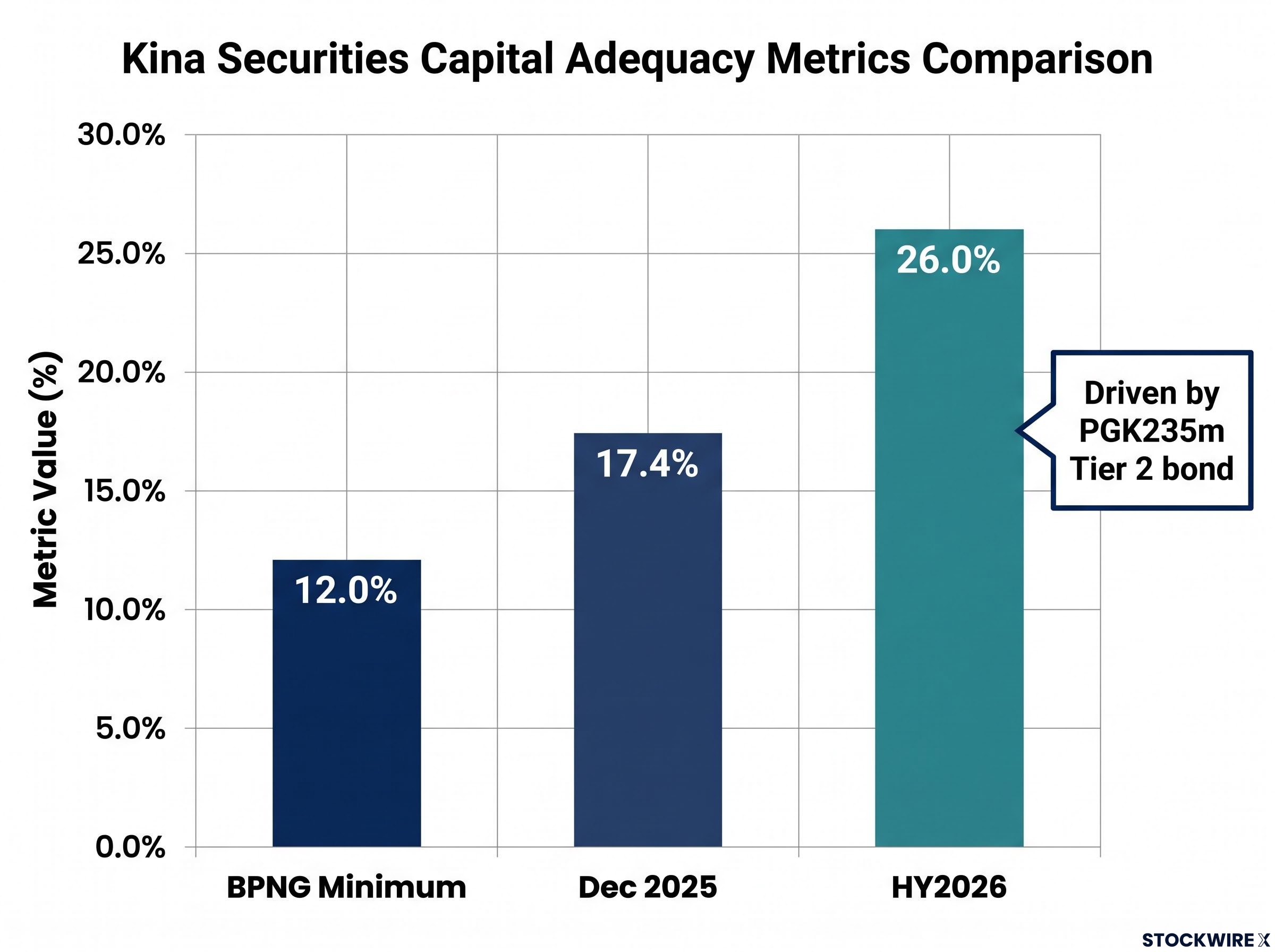
Capital adequacy was the most material development of the half. CAR rose to 26.0% (December 2025: 17.4%) following the successful, oversubscribed PGK235m Tier 2 subordinated bond listed on PNGX. This sits well above the Bank of Papua New Guinea (BPNG) minimum total risk-based capital requirement of 12.0%, enhancing KSL’s capacity to support future lending and growth.
The PGK235m Tier 2 instrument represents PNG’s first wholesale corporate bond listed on PNGX, structured as an unsecured subordinated note over a 10-year tenor that extends Kina’s liability maturity profile and reduces reliance on short-term deposit funding.
Asset quality metrics also strengthened. Provision coverage improved to 2.6% of gross loans (June 2025: 2.1%), while the cost of credit risk fell to 0.2%.
The non-performing loan (NPL) ratio moved to 8.9%, a figure that requires careful interpretation. The company updated its NPL reporting to include suspended interest on credit-impaired loans, which raised the December 2025 figure from 7.7% to 8.7% under the same methodology. Management stated this movement “does not represent a decline in credit quality but a reporting realignment under IFRS9.”
Understanding Kina’s PNG banking market
Kina Securities is a diversified financial services group operating in Papua New Guinea, spanning banking, foreign exchange, digital payments, and wealth and superannuation administration. This breadth gives the group multiple revenue streams beyond traditional lending.
Two metrics matter particularly to bank investors. The net interest margin (NIM) measures the difference between the interest a bank earns on loans and what it pays on deposits, expressed as a percentage of interest-earning assets. The capital adequacy ratio (CAR) measures a bank’s capital against its risk-weighted assets, indicating its buffer to absorb losses. A higher CAR generally signals greater financial resilience.
The PNG kina (PGK) operates under a “managed crawl” currency arrangement, involving measured depreciation against the USD and AUD. This affects AUD-reported figures. For instance, the interim dividend remained steady at 4.5 AUD cents despite the 14.2 toea increase in local terms. Understanding this currency dynamic helps investors interpret local-currency growth against AUD-translated returns.
Strategy execution and outlook
Management stated that execution of the 2030 Strategy remains on track. Key milestones referenced in the presentation included the launch of the Pei Beta digital wallet, the rollout of a new Corporate Online Banking platform, and the continued deployment of the CHANGE culture transformation programme. The group also indicated it is pursuing organic growth and “selective value-accretive M&A opportunities.”
Digital revenue of PGK43.5m was constrained by a cards interoperability issue affecting a major PNG bank’s new debit cards, which delayed income from KSL’s payment acquiring business. The company noted the issue was external to Kina Bank and is expected to be resolved through industry-wide system upgrades before the end of H2 2026, though a full revenue recovery may extend into 2027.
On the macroeconomic backdrop, the Papua LNG Final Investment Decision (FID) is targeted for Q4 2026, while the 2026 CPI forecast has been revised up to 4.3%. El Niño conditions were flagged as a downside risk to mining export volumes.
What management sees for H2 2026
The presentation set out the following outlook points:
- Positive H2 2026 momentum supporting delivery of the 2030 Strategy.
- Resolution of the cards interoperability issue expected by year-end.
- Stronger FX activity and loan growth anticipated.
- Strong balance sheet and capital position supporting profitable growth opportunities.
Management outlook commentary
“Confident outlook with continued focus on long-term shareholder value creation.”
What it means for investors
For investors, the half combined profit growth, a 13% higher interim dividend, a materially stronger capital base, and a scaling wealth franchise. Total Shareholder Return, comprising capital gain and dividends, stood at 10% over one year, 117% over three years, and 72% over five years. The strengthened balance sheet leaves the group positioned to pursue future lending growth from a position of capital strength.
The HY2026 result sits against a backdrop of a FY26 NPAT guidance upgrade issued in July 2026, which forecast full-year NPAT of PGK132-138 million, a 15-20% lift on the prior year’s audited result, supported in part by a structural corporate tax rate reduction from 40% to 35% for smaller PNG banks.
Stay Ahead on Finance Sector News
Big News Blast delivers FREE breaking ASX financial sector news directly to your inbox within minutes of release, complete with in-depth analysis. Join 20,000+ investors already getting the edge on market-moving announcements the moment they drop. Click the “Free Alerts” button at StockWire X to start receiving alerts today.