
Cuscal delivers 20% earnings lift as Indue and Paymark acquisitions bed down
In its FY26 results presentation dated 20 August 2026, Cuscal Limited (ASX: CCL) reported Underlying Net Profit After Tax (NPAT) of $46.2m, up 20%, and Underlying Net Operating Income (NOI) of $347.7m, up 20% for the financial year ended 30 June 2026. Management characterised FY26 as a “defining year, focused on increasing scale and strengthening market position,” anchored by the completed acquisitions of Indue and Paymark.
Underlying earnings per share rose 20% to 23.9 cents, while transaction volume increased 12% to 4,798m. The company declared a final dividend of 7.0 cents per share, taking the full-year dividend to 11.5 cents, fully franked.
When big ASX news breaks, our subscribers know first
FY26 results at a glance
The presentation contrasted Underlying and Statutory outcomes. Statutory NPAT rose 49% to $42.7m, but that figure includes non-recurring acquisition and integration costs alongside prior-year tax items. Underlying results, which strip out these one-off effects, provide the cleaner comparison of operational performance.
| Metric | Underlying FY26 | Underlying FY25 | Growth |
|---|---|---|---|
| Net Operating Income | $347.7m | $290.4m | +20% |
| NPAT | $46.2m | $38.4m | +20% |
| EPS | 23.9c | 20.0c | +20% |
| Transaction volume | 4,798m | 4,277m | +12% |
| Dividends per share | 11.5c | 10.0c | +15% |
Beneath the headline figures, the presentation highlighted organic strength independent of the acquisitions:
-
Organic NOI growth of +6% and organic transaction volume growth of +6%
-
Underlying operating expenses excluding acquisitions rose only approximately 4%, pointing to operating leverage
For investors, the composition matters. Growth was both organic and acquisition-led, suggesting a scalable model rather than numbers inflated solely by M&A.
How Cuscal makes money: the payments infrastructure model explained
Cuscal is described as a leading independent Australian B2B payments provider. In plain terms, it provides the underlying “rails,” licences and connectivity that allow banks, fintechs and corporates to move money. Its independence is a defining feature: Cuscal does not compete with its clients in the consumer market (B2C), a trust differentiator for institutions relying on its infrastructure.
The business is built around three core capabilities:
-
Issuing — making a card payment. This covers debit, credit and prepaid solutions, connecting clients to networks such as Visa and Mastercard, plus digital wallets.
-
Acquiring — accepting a card payment, both in-store and online, via connections to global payment networks.
-
Payments — account-to-account transfers, including real-time payments through the New Payments Platform (NPP), BPAY and direct debit.
Supporting adjacencies include Financial Crimes and Data Services, the latter incorporating the Consumer Data Right (CDR).
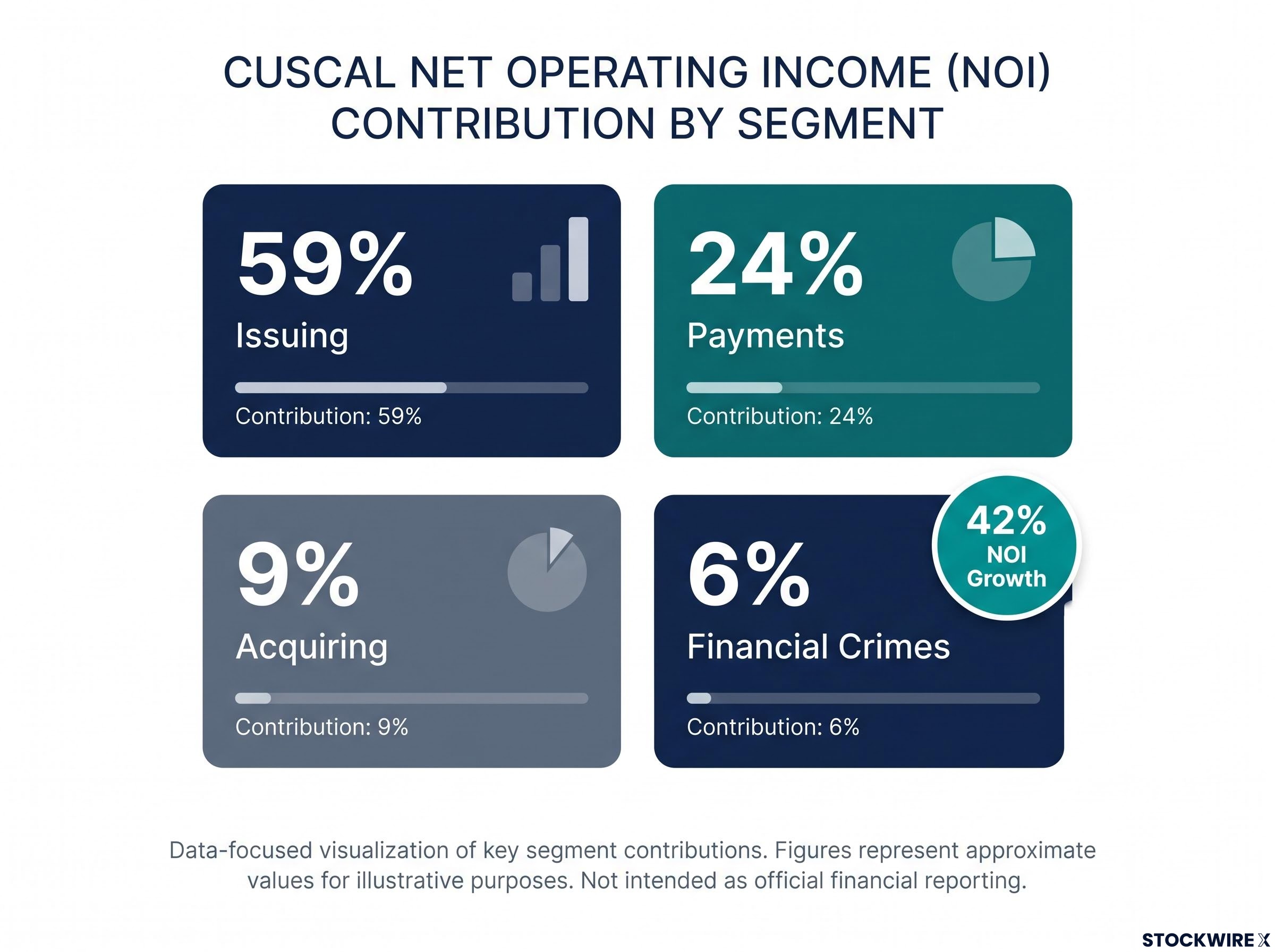
By NOI contribution, Issuing represented 59%, Payments 24%, Acquiring 9% and Financial Crimes 6%. Financial Crimes NOI grew 42%, the fastest of the core lines.
Why does this matter to investors? A transaction-volume-led model provides what management calls “natural resilience through economic cycles.” Access to core payment rails is difficult and expensive to replicate, forming a competitive moat that is not easily challenged.
Indue and Paymark: the acquisitions reshaping scale
Two distinct transactions formed the strategic engine of FY26.
Indue (Australia) completed on 1 December 2025 and contributed $34.8m to NOI during the year. The company reported $2.1m post-tax realised integration synergies against $4m post-tax integration costs to date. Management targets $15–$20m post-tax annual run-rate cost synergies fully realised by FY29, run-rate post-synergy EPS accretion of 25%+, and a ROIC of 20%+. Non-recurring post-tax integration costs are expected to total $25–$30m over three years.
The presentation confirmed that Peter Wright was appointed as Non-Executive Director, an Integration Advisory Committee was established, and integration remained on track. Synergies are limited by vendor contracts in place until FY28.
Paymark (New Zealand) is a separate transaction providing “immediate scale in New Zealand,” contributing $5.2m to NOI over a partial period. It is an established business with material presence in New Zealand payments infrastructure and a blue-chip client base spanning the country’s major banks. With “limited integration requirements,” Paymark will “continue to operate as a largely standalone entity.” The acquisition was supported by an equity raise conducted over April and May 2026.
Paymark’s New Zealand payments switch processed over 1.5 billion transactions annually at the time of acquisition, with master service agreements across all major New Zealand acquiring banks adding roughly 24% to Cuscal’s pro forma transaction volumes.
The Indue integration roadmap runs as follows:
-
FY26: Client migration enabled and first synergies realised
-
FY27: Roll-off of supplier contracts drives transaction cost synergies; client migration completes
-
FY28: Approximately $15–$20m run-rate synergies and full transition to the Cuscal operating model
-
FY29: Full synergy realisation
Management characterisation
Management framed FY26 as “a defining year, focused on increasing scale and strengthening market position,” underpinned by the “disciplined execution of growth strategy.”
The acquisitions add scale, revenue diversification through Indue’s Government clients, and a New Zealand growth platform. Notably, the largest synergy benefits remain ahead.
A strong balance sheet and normalised capital position
Cuscal maintained an S&P AA-/Stable credit rating. Cash and cash equivalents rose to $2,978.8m from $2,215.3m, while total assets increased to $5,045.6m from $3,465.2m.
The Capital Adequacy Ratio (CAR) moved to 19.1% from 27.3%. Management framed this as a normalisation into the target operating range of 18–19% following the Indue acquisition, rather than a weakening. The capital raise over April and May 2026 largely offset the impact of the acquisitions on regulatory capital.
Underlying Return on Equity (ROE) improved to 11.7%, extending a multi-year uptrend from 10.5% in FY25 and 9.6% in FY24. Net cash from operating activities rose to $457.2m from $152.8m.
-
CAR 19.1% (target 18–19%)
-
Underlying ROE 11.7% (up from 10.5%)
-
Operating cash flow $457.2m
The result presents a well-capitalised, investment-grade and cash-generative profile, supporting both dividends and further investment capacity.
FY27 outlook and strategic priorities
Management expects mid-20s% year-on-year Underlying NPAT growth in FY27, supported by transaction volume growth in the mid-20s%. The presentation set out the building blocks:
-
Organic growth — double-digit % Underlying NPAT growth, driven by ongoing transaction volume growth and margin expansion
-
Indue — mid-single-digit % contribution, reflecting an additional five-month contribution in FY27 plus cost synergies
-
Paymark — double-digit % contribution, reflecting an additional eleven-month contribution in FY27
Strategic priorities for FY27 include continued technology uplift, extending products to new segments and markets, enhanced transaction monitoring, advancing Indue integration and client migration, and driving execution of the Cuscal Paymark strategy.
The company’s dividend policy targets a payout ratio of 40–60% of statutory NPAT, fully franked, on a discretionary basis. The guidance frames a quantified growth pathway with multiple levers, combining organic tailwinds with a full year of acquisition contributions.
The investment case in brief
The presentation closed with a synthesis of the shareholder proposition, structured around four pillars:
-
Competitive moat — end-to-end capabilities, fully licensed, and an independent B2B model that does not compete with clients
-
Predictable model — long-tenured clients contracted for 2+ years, transaction-volume resilience, and $200m+ invested in technology across FY22–FY26 now yielding operating leverage
-
Multiple growth levers — organic growth, a track record of M&A, and new market opportunities
-
Structural tailwinds — continued cash decline, the shift to real-time and digital payments, embedded payments, and banking sector consolidation
With acquisitions bedding down and synergy benefits still to come, Cuscal enters FY27 positioned around its “Moving Payments Forward. Together.” strategy.
Stay Ahead on ASX Fintech and Finance News
Get FREE breaking ASX announcements delivered to your inbox within minutes of release, complete with in-depth analysis already done. Join 20,000+ investors who never miss a market-moving update. Click the “Free Alerts” button at StockWire X to start receiving alerts the moment news breaks.