


FDA authorisation secured — a four-year journey reaches its defining milestone
In its September 2026 investor presentation, Bubs Australia (ASX: BUB) outlined a transformational regulatory milestone: permanent FDA authorisation secured for three infant formula products — Bubs Goat, Bubs 365 Day Grass Fed, and Bubs Essential. The achievement places Bubs among a limited group of non-US manufacturers authorised to supply what is one of the most tightly regulated consumer product categories in the world.
The USA is already Bubs’ dominant revenue market, generating $66M and representing 59% of FY26 group revenue. The presentation framed FDA authorisation not as an endpoint, but as the confirmed foundation from which management intends to accelerate profitable, sustainable growth — five years after the company first entered the US market.
When big ASX news breaks, our subscribers know first
Inside the US infant formula market — and why authorisation is the key to the door
FDA authorisation is not simply a quality credential. For a non-US infant formula manufacturer, it is a legal prerequisite to supply the market at all. The regulatory, supply chain, and capital requirements associated with entry create genuine barriers that few international companies clear, making authorisation a structural competitive advantage for those that do.
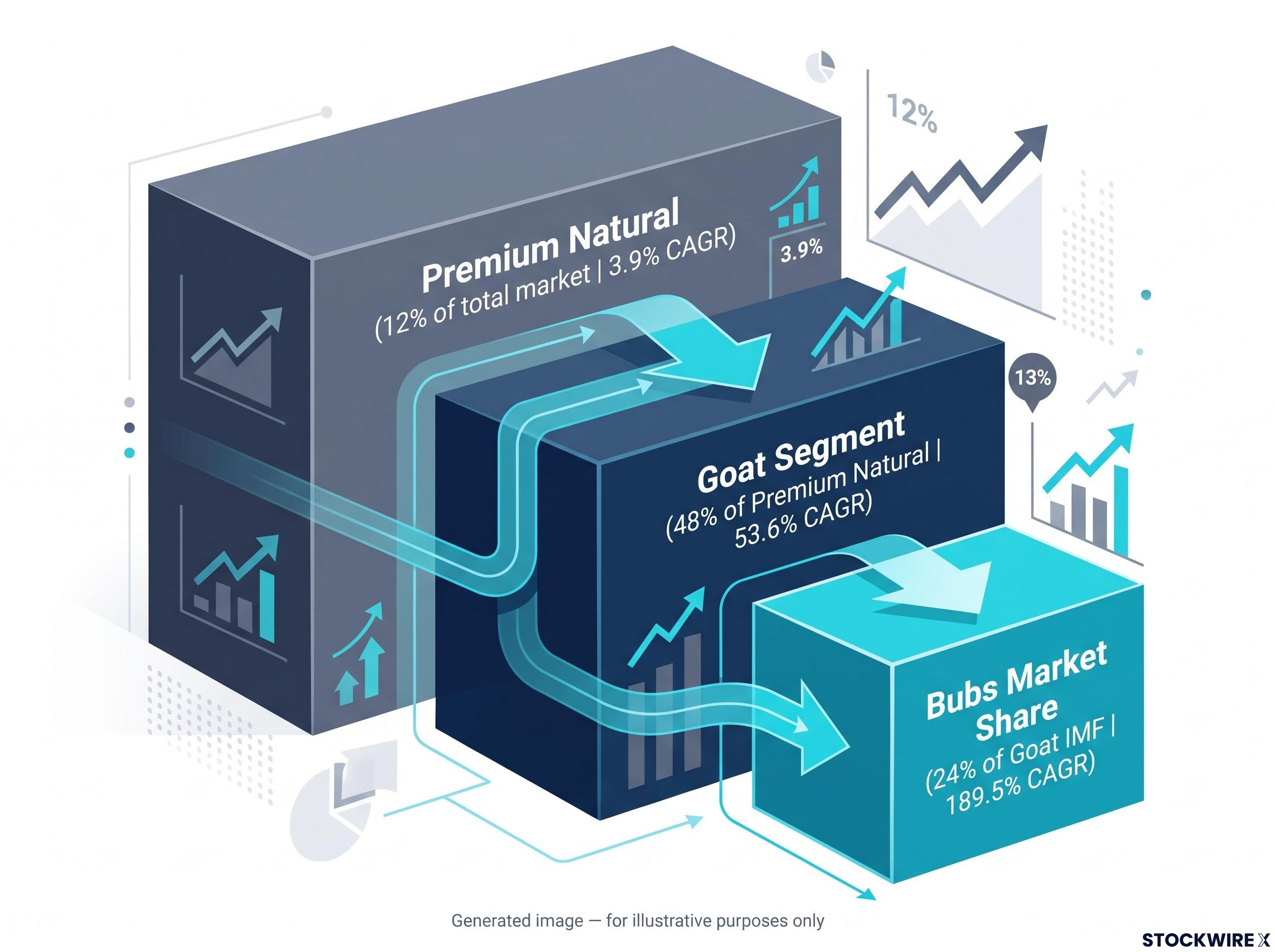
The market data Bubs presented illustrates why that access matters. Within the broader US infant formula (IMF) market, Premium Natural represents 12% of the total market, with a four-year compound annual growth rate (CAGR) of 3.9%. Within Premium Natural, the Goat segment accounts for 48% of the sub-category, growing at a four-year CAGR of 53.6%. Bubs itself holds 24% market share in Goat IMF, with a four-year CAGR of 189.5%.
All figures are sourced from Circana, Total Mula+, 2025, with CAGR calculations covering calendar years 2021 to 2025. All figures are in AUD.
Permanent authorisation now gives Bubs confirmed, ongoing access to the fastest-growing segments within this market — a position it has spent four years building toward.
Five years of US growth — and the platform Bubs has built to scale from
Revenue from $8.1M to $65.8M in four years
The USA revenue trajectory presented by management reflects a business that has already demonstrated consistent, compounding growth. The figures below, sourced from the presentation’s bar chart, show annual USA sales revenue from FY22 through FY26.
| Year | USA Sales Revenue (AUD) |
|---|---|
| FY22 | $8.1M |
| FY23 | $23.9M |
| FY24 | $35.0M |
| FY25 | $53.1M |
| FY26 | $65.8M |
| CAGR | 52% |
This is not a speculative growth story. Over four years, Bubs built a distribution network of scale, invested in supply continuity, and established category awareness in the Goat IMF segment. Management stated the company is now confident to invest for long-term growth from this base.
The FY26 full-year results confirmed group revenue of $111.9M, with the 800 basis point gross margin miss attributed to $7.1M in one-off costs spanning air freight, a regulatory reset, and US tariffs, costs management has flagged as non-recurring heading into FY27.
Distribution doors expanding — from 4,368 to 10,000+
Alongside revenue growth, the presentation detailed a substantial expansion in US retail distribution. Bubs has scaled across Mass, Grocery, Natural, Drug, and Club channels, with total distribution doors growing from 4,368 in 2025 to 5,558 by February 2026, and targeting 10,000+ doors by September 2026.
Channel-level figures as presented:
- Natural: 3,301 doors (2025); 477 (Sep-26, reflecting a subset or channel realignment)
- Drug: 2,500+ doors (Sep-26)
- Club: 50 doors (Sep-26)
Key retail partners named in the presentation include Walmart, Target, Kroger, Whole Foods Market, Sam’s Club, Sprouts Farmers Market, CVS Pharmacy, HEB, Meijer, and Giant Eagle. The breadth and quality of these relationships signals a distribution infrastructure operating at genuine national scale.
What permanent FDA authorisation unlocks from here
Renovate the core, innovate to broaden
The presentation outlined a two-track product strategy to build on the authorisation milestone.
The first track, “Renovate the Core,” focuses on strengthening Bubs’ existing shelf proposition. This includes a packaging refresh to support price and mix improvement, better conversion at shelf, and a lift in distribution quality.
The second track, “Innovate to Broaden,” is aimed at widening the portfolio. Management highlighted plans to scale the infant formula range, capture premium-led mix, and extend into adjacent formats within the US market.
Contract manufacturing — a $350M+ TAM opportunity now in play
FDA authorisation also opens access to the US infant formula contract manufacturing segment, which the presentation cited as a total addressable market (TAM) of $350M+, sourced from Circana, Total Mula+, calendar years 2021 to 2025. A FDA variant submission was lodged on 9 September 2026, representing a concrete near-term step toward participation in this segment.
The asset base supporting this ambition is Bubs’ end-to-end “farm to formula” value chain, covering ingredient sourcing, milk collection, spray drying, blending, canning, and distribution. Management noted that supply network options across buy, build, and rent scenarios are being assessed against clear growth, risk, and return hurdles. The presentation framed this as disciplined optionality rather than speculative expansion.
The marketing flywheel — measuring ROI to reinvest at scale
Bubs’ 360° marketing campaign is designed to educate consumers on goat milk benefits and Australian provenance. The presentation described a four-step flywheel intended to compound returns as the authorised US platform scales:
- Reach priority parents through scalable, measurable channels
- Build trust and convert demand
- Measure incremental return on investment via Marketing Mix Modelling (MMM), Numerator, Circana, and platform-native analytics
- Reinvest to scale growth
Each turn of the flywheel is intended to generate more buyers, more reviews, and sharper, more cost-efficient reach. This is the mechanism management outlined by which FDA authorisation translates into compounding commercial returns over time.
Why the investment case has structurally strengthened
The presentation closed by summarising the six pillars management views as the foundation of Bubs’ differentiated platform:
- Attractive category with high barriers to entry and strong margins
- Building financial momentum
- Proven brand equity in the premium natural market
- Experienced board and leadership team with deep US infant formula experience
- Diversified and large global markets (USA 59%, China 19%, Australia 16%, Rest of World 6%)
- Resilient and responsive supply chain
In management’s framing, permanent FDA authorisation is the foundation of Bubs’ US ambitions — not the ceiling.
Don’t Miss the Next Consumer Sector Winner on ASX
Big News Blast delivers FREE breaking ASX news straight to your inbox within minutes of release, with in-depth analysis already done. Join 20,000+ investors who stay ahead of the market the moment announcements drop. Click the “Free Alerts” button at Big News Blast to start receiving real-time coverage across ASX consumer, healthcare, tech, and beyond.