
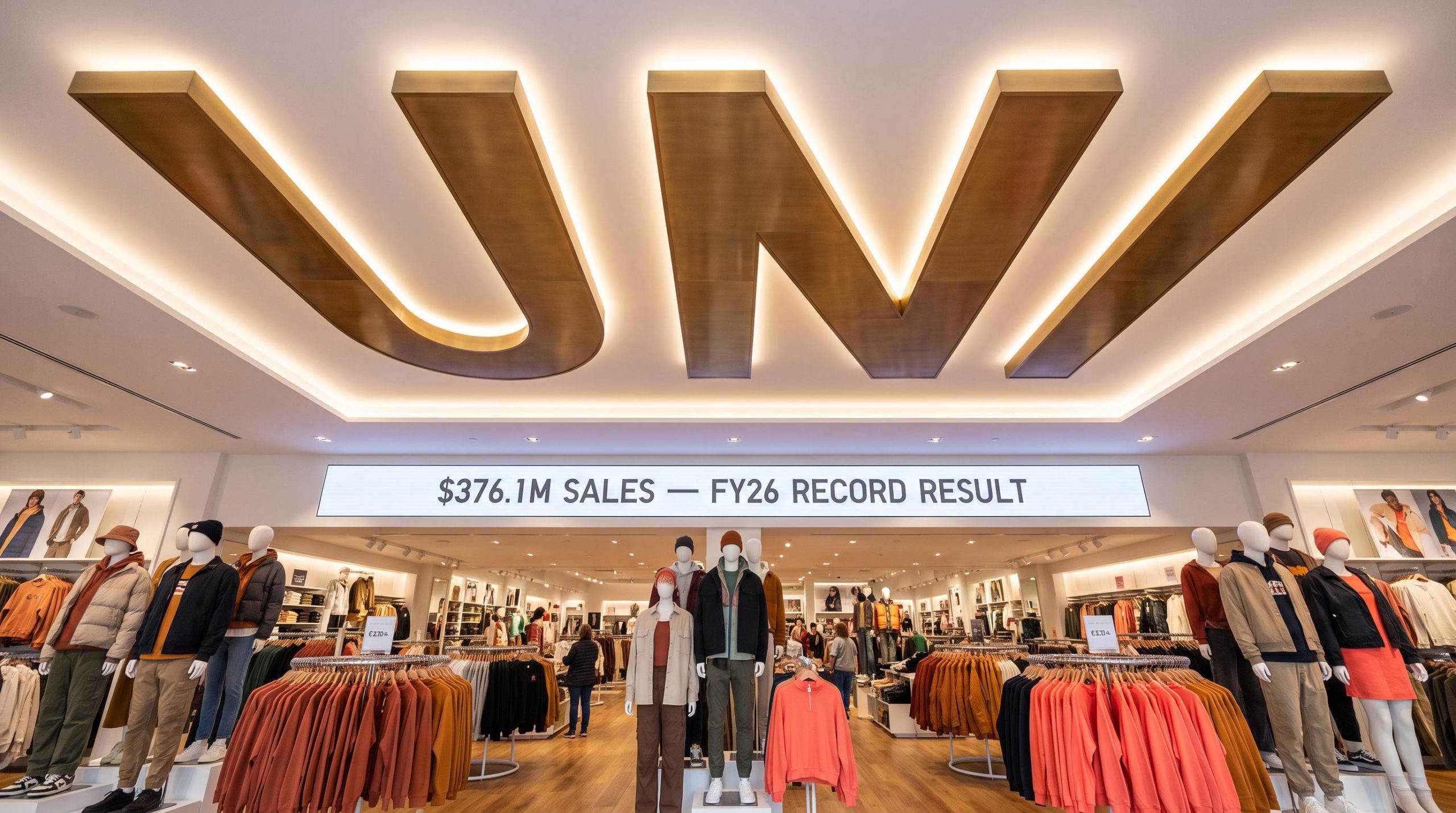
Universal Store lifts underlying EBIT 17% as FY26 sales top $376 million
In its FY26 results presentation released 20 August 2026, Universal Store Holdings reported record annual sales of $376.1m, up 12.9% on the prior corresponding period (pcp), alongside double-digit profit growth across an expanding store network.
The result was delivered across the Group’s three-brand structure: Universal Store (US, which includes the Perfect Stranger format), Perfect Stranger (PS) as a standalone concept, and CTC, comprising the THRILLS and Worship brands.
Management also confirmed a leadership transition, with Alice Barbery continuing as Group CEO and George Do named Incoming Group CEO.
Underlying EBIT rose 17.2% to $64.0m, an increase of $9.4m, while underlying NPAT lifted 16.3% to $40.5m. The Board declared a full-year dividend of 43.0 cents per share (cps), up 11.7% on FY25. Growth was driven by both higher sales and margin expansion, pointing to earnings quality rather than top-line growth alone.
When big ASX news breaks, our subscribers know first
FY26 financial results at a glance
The headline scorecard below summarises the Group’s FY26 performance. The standout margin story was gross profit percentage, which expanded 140bps to 62.5%.
The FY26 guidance upgrade issued in May 2026 pointed to exactly this outcome, with management lifting the sales range to $368-$375 million and underlying EBITA to $61.5-$64.5 million after 43 weeks of trading confirmed that margin expansion was tracking ahead of the prior year.
| Metric | FY26 | Change |
|---|---|---|
| Sales | $376.1m | +12.9% |
| Gross Profit % | 62.5% | +140bps |
| Underlying EBIT | $64.0m | +17.2% |
| Underlying NPAT | $40.5m | +16.3% |
| Underlying EPS | 52.8c | +16.3% |
| Net cash | $23.3m | +35.5% |
| Statutory NPAT | $18.2m | -21.6% |
| Full-year dividend | 43.0cps | +11.7% |
The gap between underlying and statutory NPAT was driven by a $23.8m impairment of CTC intangible assets, comprising CTC goodwill of $18.6m and the THRILLS brand name of $5.2m. This is a non-cash accounting charge rather than an operating deterioration.
Why the statutory vs underlying gap matters
The impairment reflects weaker CTC wholesale performance, not the core US and PS engine that generates the bulk of Group earnings. Statutory NPAT of $18.2m absorbed this charge, whereas underlying NPAT of $40.5m isolates the ongoing operating result. In short, the write-down relates to a smaller, repositioning part of the business.
Segment performance — US and Perfect Stranger drive the result
The Group reported growth across all three segments, with US and PS providing the momentum and CTC repositioning through a defined turnaround strategy.
-
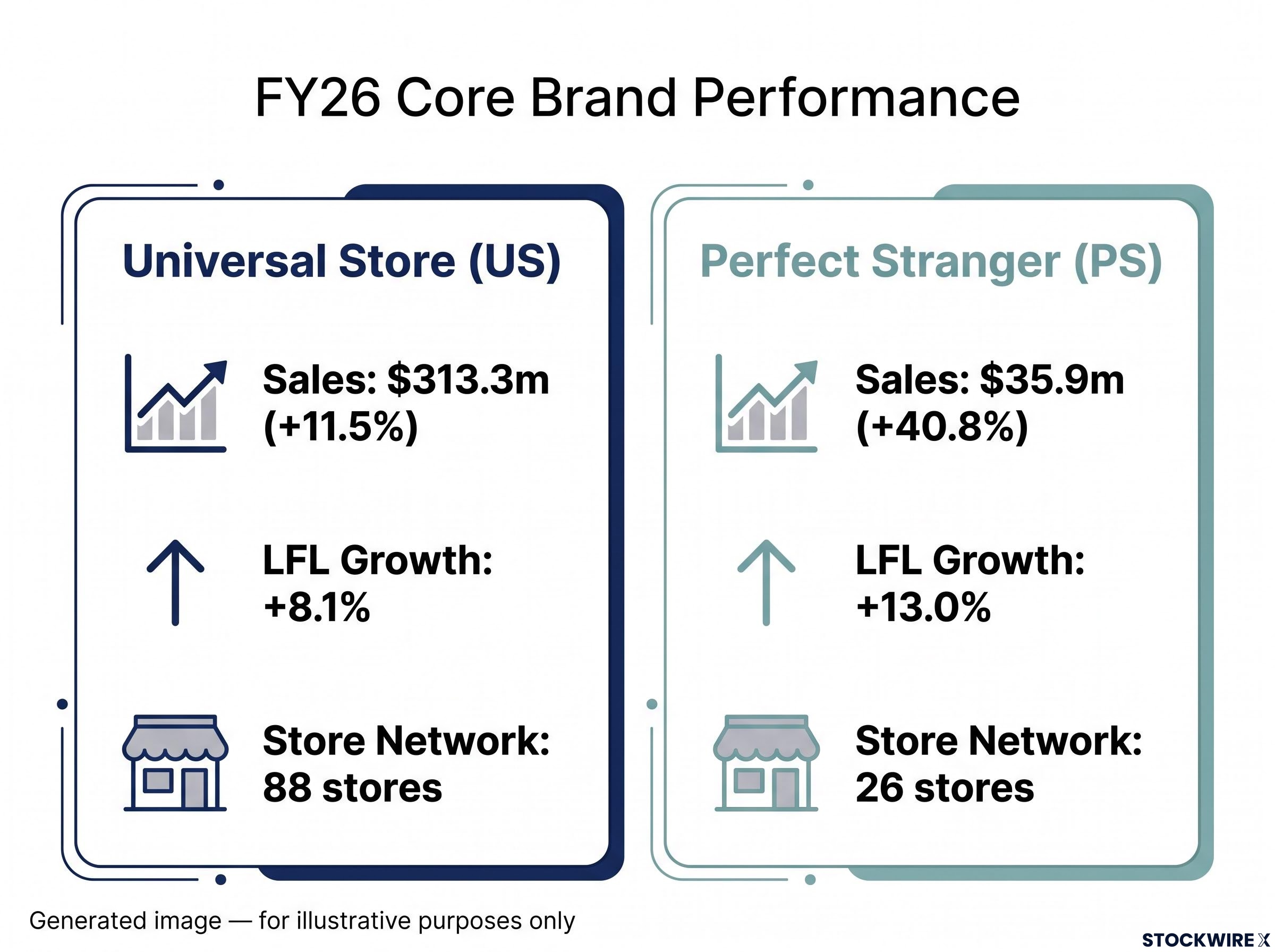
Universal Store (US): Sales of $313.3m (+11.5%) with like-for-like (LFL) growth of +8.1% across a network of 88 stores (five opened, one temporary closure to reopen mid FY27). Growth came from both transaction volumes and average transaction value (ATV), with private brand penetration at 51% of sales.
-
Perfect Stranger (PS): Sales of $35.9m (+40.8%) with LFL growth of +13.0% across 26 stores (seven opened). PS now represents 9.4% of Group sales, up from 7.6% in the pcp, with growth supported by an elevated range lifting ATV.
-
CTC (THRILLS/Worship): Retail sales of $12.7m (+16.9%) with retail LFL of +4.2%, while wholesale sales fell 18.9% to $23.7m on reduced USA exports and the closure of a small number of key retail accounts. In-store LFL growth was a strong +17.8%.
Combined US and PS sales grew 13.9%, forming the Group’s growth engine. CTC remains a smaller business under repositioning, with its wholesale channel representing less than 5% of Group sales net of intercompany eliminations.
Key result
Underlying US EBIT (including the PS contribution) reached $63.6m, up $10.4m (+19.7%) on the pcp.
A closer look — how a premium apparel retailer compounds growth
For readers less familiar with retail metrics, three concepts help explain how the Group compounds growth.
Like-for-like (LFL) sales measure growth from stores that have been trading for a full comparable period, stripping out the effect of new openings. Investors watch LFL closely because it signals the underlying health of an established network rather than growth simply bought through expansion.
Gross profit margin expansion reflects how disciplined pricing, private brands, and a lower clearance sales mix can lift the percentage of each sales dollar retained as profit. On $376m of sales, a 140bps improvement is material to earnings.
Network rollout economics describe the trade-off in opening new stores. New stores add sales but also cost of doing business (CODB). LFL sales growth helps spread fixed costs across a larger revenue base, and the Group reported that LFL growth fractionalised CODB as a percentage of sales by 170bps in FY26.
Universal Store is compounding through both new stores and same-store growth, while widening margins, the combination that supports operating leverage.
Balance sheet and cash generation
The Group ended FY26 with a debt-free, cash-generative balance sheet underpinning its dividend.
-
Closing cash of $23.3m with nil borrowings excluding lease liabilities, a net cash position up 35.5% on the pcp
-
Operating cash flow after capex of $71.3m
-
EBITDA cash conversion of 104%
-
Inventory of $32.6m, lower on improved CTC stock turns
-
Dividend payout ratio of 81.5% of underlying profit, with a final dividend of 17.0 cps fully franked
Strong cash conversion combined with no debt provides capacity to fund the store rollout while sustaining fully franked dividends.
FY27 trading update and growth roadmap
Management outlined early FY27 trading and its forward store rollout as part of the presentation. Over the first seven weeks of FY27 (29 June to 16 August 2026), Group direct-to-customer (DTC) sales rose 9.1% on the pcp.
- US total sales +5.5% (LFL +2.9%, cycling +10.7%)
- PS total sales +45.8% (LFL +17.6%, cycling +19.3%)
- CTC DTC sales +10.1% (LFL +3.8%)
Management expects continued weakness in the CTC wholesale channel in FY27, noting that wholesale represents less than 5% of Group sales.
On store expansion, management intends to open 16 to 20 new stores across the Group in FY27:
- Nine to ten new US stores
- Six to eight new PS stores
- One to two new THRILLS stores
In addition, the US store temporarily closed in FY26 is expected to reopen mid FY27. Management reiterated a national target of 60+ stores for Perfect Stranger and network potential of 100+ stores for Universal Store.
Operationally, a new point-of-sale (POS) system was completed in August 2026, with a new warehouse management system (WMS) planned for FY27. The early FY27 comparatives are positive despite cycling strong prior-year numbers, alongside a continued expansion runway.
The investment case
Universal Store presents as a proven compounder, delivering a five-year sales CAGR of +12.3% and an underlying EBIT CAGR of +7.3% across FY21 to FY26. Growth is supported by dual levers of new stores and LFL performance, combined with margin expansion. A debt-free balance sheet funds the rollout while supporting a rising fully franked dividend.
Key elements of the thesis include:
- Dual growth levers: new store openings plus LFL growth, with widening gross margin
- A debt-free, cash-generative balance sheet funding expansion and dividends
- A clear runway with US network potential of 100+ stores and PS targeting 60+
- A defined CTC turnaround focused on retail execution
- An orderly leadership succession, with George Do bringing 20 years at Universal Store to the Incoming Group CEO role
Don’t Miss the Next Consumer Discretionary Winner
Big News Blast delivers FREE breaking ASX announcements with in-depth analysis straight to your inbox within minutes of release. Join 20,000+ investors already staying ahead of the market on results, trading updates, and sector moves. Click the “Free Alerts” button at Big News Blast to make sure the next market-moving announcement lands in your inbox before the crowd reacts.