
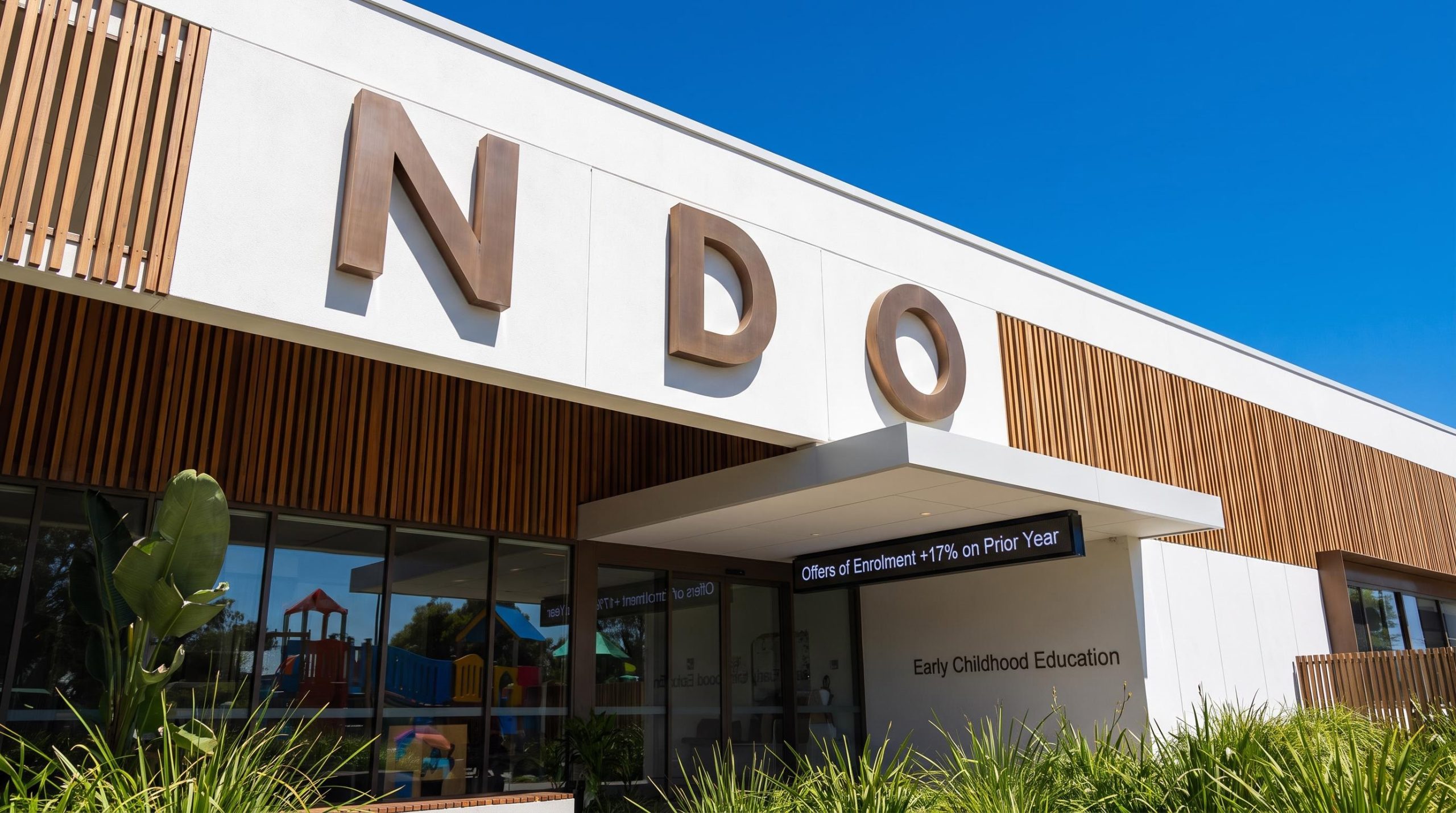
Nido Education posts $85.8m half-year revenue as earnings soften and FY26 growth target withdrawn
In its half year results for the period ended 30 June 2026, Nido Education recorded group revenue of $85.8 million, up 4% on the prior comparable half, while earnings declined materially. Group Adjusted EBITDA (AEBITDA) fell to $4.3 million from $6.6 million, and adjusted net profit after tax (ANPAT) dropped to $2.1 million from $4.6 million.
The Board formally withdrew its previously communicated FY26 AEBITDA growth target of around 20% on FY25. Against that softer backdrop, the early childhood education operator noted a constructive lead indicator: offers of enrolment tracked approximately 17% ahead of the prior year. This coverage examines what unfolded across the half and where management is steering the business next.
When big ASX news breaks, our subscribers know first
H1 2026 results at a glance
Nido described the half as one of disciplined execution in a challenging and evolving operating environment for the early childhood education sector. Revenue and fee income grew, but margin compression flowed through to a materially lower bottom line.
| Metric | HY26 | HY25 | Movement |
|---|---|---|---|
| Group revenue | $85.8m | $82.8m | +4% |
| Service revenue | $81.4m | $79.5m | +2% |
| Establishment & management fees | $4.4m | $3.3m | +33% |
| Service AEBITDA | $10.7m | $12.8m | -16% |
| Group AEBITDA | $4.3m | $6.6m | -35% |
| ANPAT | $2.1m | $4.6m | -54% |
AEBITDA and ANPAT figures are adjusted for the impact of AASB 16 and stamp duty costs on acquisitions. The 33% lift in establishment and management fees reflects value generated through Nido’s incubator model, while the 35% fall in group AEBITDA underscores the earnings pressure carried into the result.
Service performance and what drove the margin squeeze
Operating metrics
At the service level, Nido delivered the following across the half:
- 434,000 days of learning, down from 453,000
- Average daily fee of $183, up from $172
- Wage-to-revenue ratio steady at 57%
- Service AEBITDA margin of 13%, down from 16%
- Average number of services of 60.3, up from 56
Occupancy commenced the half at a lower base. Service costs rose 6% to $70.7 million while total service revenue grew only 2% to $81.4 million, compressing the service margin.
Holding quality while managing cost
Despite the cost pressure, management maintained quality ratings above sector averages and continued investing in curriculum, environments and leadership. The 12-month moving average employee retention sat at 83%, and the Group delivered over 7,500 hours of training during the half.
The result illustrates a real cost challenge, yet the operating platform and quality proposition were protected through the period.
Understanding Nido’s incubator model
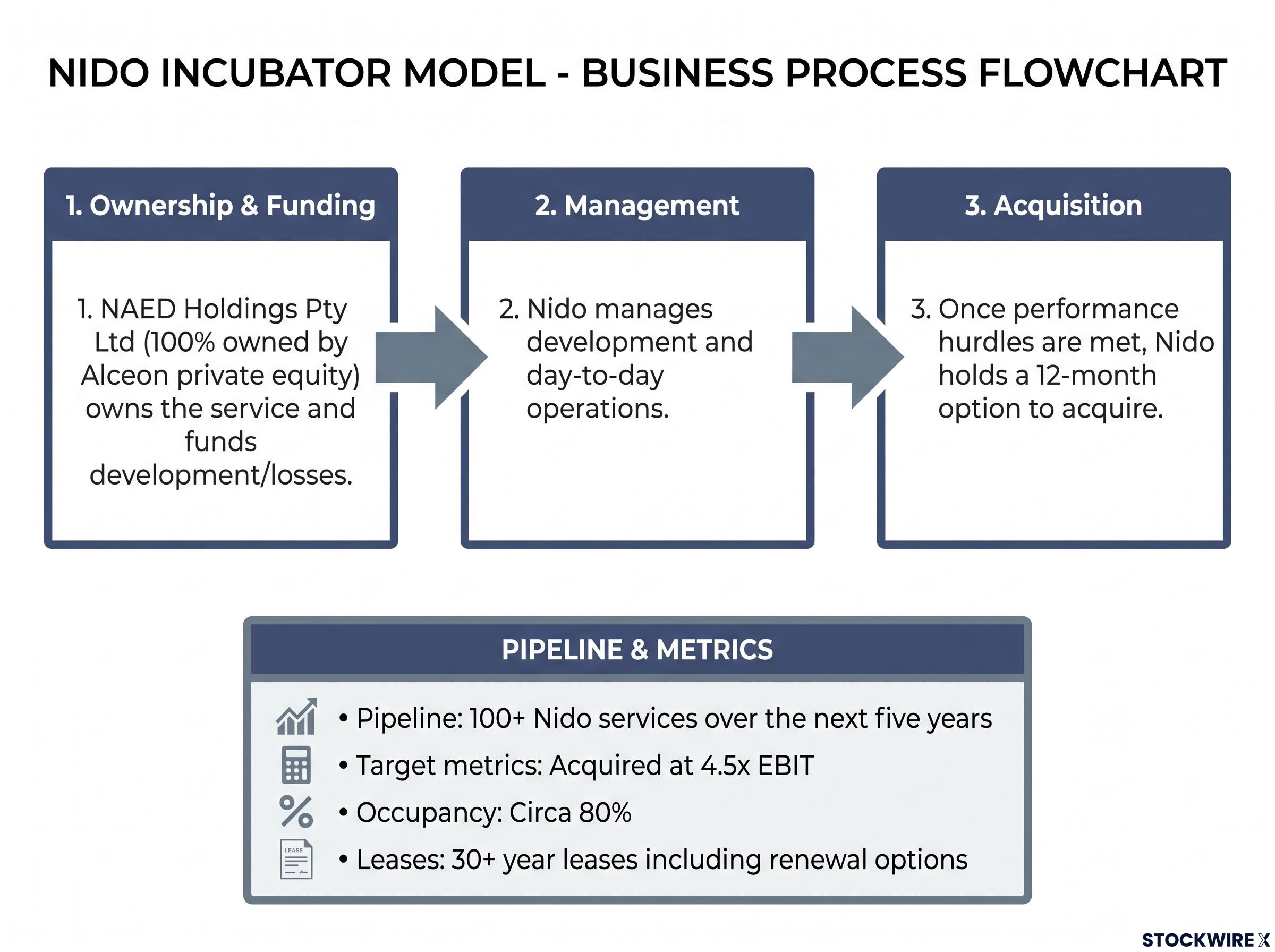
Nido’s network expands primarily through a greenfield incubation strategy designed to reduce the risks associated with a traditional roll-up approach to acquiring services. In plain terms, someone else carries the early-stage risk before Nido buys a proven service.
The mechanics work as follows:
- A third-party incubator, NAED Holdings Pty Ltd (100% externally owned by Alceon private equity), initially owns the service and funds development and trade-up losses.
- Nido manages the development and day-to-day operations from site selection onward.
- Once acquisition performance hurdles are met, Nido holds a 12-month option to acquire.
This provides a de-risked pipeline of 100+ Nido services over the next five years, with proven services acquired at 4.5x EBIT at circa 80% occupancy and built on 30+ year leases including renewal options. The model also explains the establishment and management fee income line.
During the half, Nido opened 4 services and acquired 4 services, with a further 2 services opened after the reporting period, taking the 2026 total to six openings.
The four child care services acquired in April 2026 across South Australia and Western Australia form part of that cohort, each averaging 140 weeks of operation before acquisition and generating estimated annualised EBITDA of $1.9 million at a 4.8x implied multiple.
Balance sheet and capital position
Nido strengthened its capacity to pursue acquisitions during the half. The Group extended its existing NAB facility to February 2028 and increased the limit from $55.0 million to $65.0 million.
The NAB facility extension announced in June 2026 lifted the bank guarantee facility to $17.5 million and built on a capital structure that was already conservatively geared at 1.1x net debt leverage entering the period.
Key capital points included:
- Facility drawn to $47.0 million at 30 June 2026, with $18.0 million available headroom
- Cash conversion of 110%
- Free cash conversion of 77%
Drawings increased by $19 million across the half due to acquisitions, NAED funding and working capital. Together, these changes provide firepower for the acquisition pipeline while preserving flexibility.
The Board remains focused on creating long-term value through a disciplined approach to both organic growth and selective acquisitions.
The FY26 outlook and withdrawn growth target
In its ASX announcement dated 25 February 2026, Nido stated it was targeting FY26 AEBITDA growth in the order of 20% on the FY25 result. Based on the first seven months of trading, where days of learning and labour cost were unfavourable to the assumptions underpinning that target, the Company does not expect to achieve it within the current financial year.
Accordingly, Nido formally withdrew the previously communicated FY26 AEBITDA growth target. The Company continues to pursue a number of potential acquisitions but noted their timing and completion remain uncertain, and it is not currently in a position to quantify their potential impact on the FY26 result. The market will be updated if this becomes clearer.
The Company set out its priorities for the balance of the year:
- Convert enquiry into occupancy, with offers tracking approximately 17% ahead of the prior year.
- Convert improved systems and processes into productivity.
- Convert the strengthened operating platform into sustainable earnings growth.
- Continue disciplined growth via incubation and acquisitions.
From August 2026, Nido increased fees within the parameters allowed under the Government Funded Work Retention Grant, and it commenced a review of its cost base with benefits expected to phase in through the year. The Centre Management Agreement with Busy Bees has reached its conclusion, ending on 31 August 2026. No dividend was determined for the half, though the Board intends to continue paying dividends over the longer term.
What it means for investors
The half presented a mixed picture. Revenue growth and network expansion were offset by margin pressure and the withdrawal of the FY26 AEBITDA growth target, amounting to a reset of near-term expectations.
The investment case now rests on the medium-term structural demand story for early childhood education, the de-risked incubator pipeline, resilient enquiry levels tracking ahead of the prior year, and management’s cost and occupancy initiatives. The Board reiterated its focus on long-term value through disciplined organic growth and selective acquisitions.
Shareholders can look to the investor briefing call scheduled for 27 August 2026 as the next touchpoint for further detail on the result and outlook.
Don’t Miss the Next Consumer Sector Move
Big News Blast delivers FREE breaking ASX news straight to your inbox within minutes of release, complete with in-depth analysis already done for you. Over 20,000+ subscribers rely on it to stay ahead of market-moving announcements across Consumer, Healthcare, Tech and more. Click the “Free Alerts” button at StockWire X to get started today.