

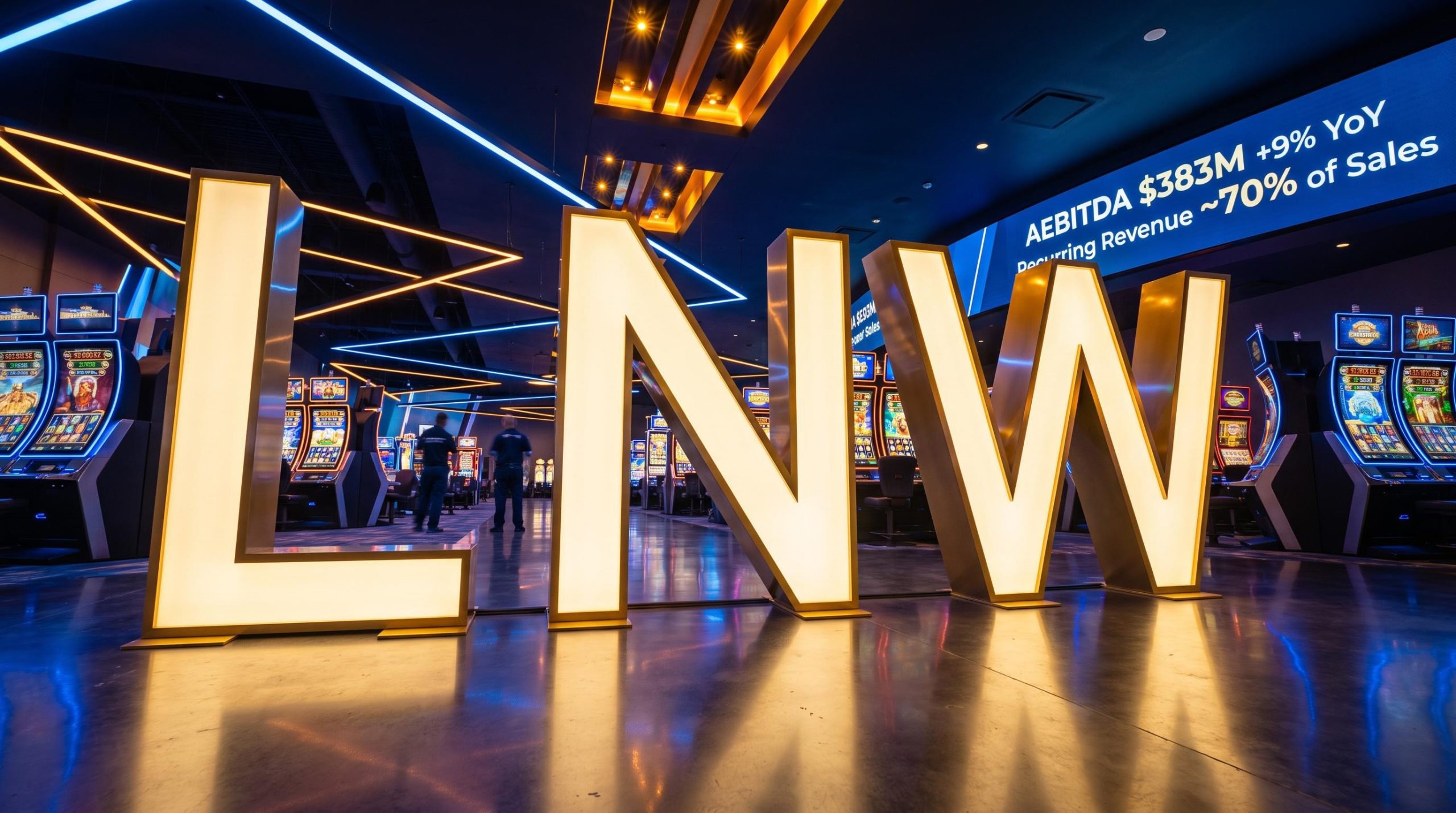
Light & Wonder posts 9% AEBITDA growth as recurring revenue hits ~70% of sales
In its 2Q26 earnings presentation delivered to the market on 4 August 2026 (U.S.) and 5 August 2026 (Australia), Light & Wonder reported consolidated AEBITDA of US$383M, up 9% year-on-year, powered by a business model increasingly anchored in recurring revenue. All figures in this coverage are stated in US dollars.
The result reflected a broader shift toward higher-quality, predictable earnings. Adjusted NPATA reached US$156M (+16%), EPSa came in at US$1.99 (+26%), and recurring revenue climbed to US$580M (+6%), representing approximately 70% of consolidated revenue for the quarter.
For investors, the presentation framed a business tilting toward cash-generative, more resilient income streams, a profile management argues supports wider margins and stronger free cash flow.
When big ASX news breaks, our subscribers know first
The 2Q26 numbers that mattered
Management presented a clean scorecard for the quarter, with profitability metrics outpacing top-line growth. The table below summarises the headline results.
| Metric | 2Q26 | YoY Change | Why it matters |
|---|---|---|---|
| Consolidated AEBITDA | $383M | +9% | Core earnings growth |
| Adjusted NPATA | $156M | +16% | Bottom-line strength |
| EPSa | $1.99 | +26% | Per-share value, aided by buybacks |
| Net income | $120M | +26% | GAAP profitability |
| AFCF Conversion | 41% | +1,100 bps | Cash quality of earnings |
| AEBITDA Margin | 46% | +200 bps | Operating efficiency |
Consolidated revenue reached US$828M (+2%), with AEBITDA margin expanding across all three operating segments. The company reported growth across its three revenue engines:
-
Gaming — $554M (+5%)
-
iGaming — $92M (+14%)
-
SciPlay — $182M (-9%)
Why recurring revenue is the story for investors
For a gaming supplier, recurring revenue is income that repeats rather than arriving as a one-off. It flows from installed gaming machines earning a daily fee, ongoing systems maintenance, table product rentals, and the SciPlay and iGaming digital businesses. This contrasts with selling a machine outright, where the revenue lands once and does not repeat.
That mix has shifted meaningfully. Recurring revenue climbed from 63% of total revenue in 2022 to approximately 71% in 1H26, equating to roughly US$1.2B.
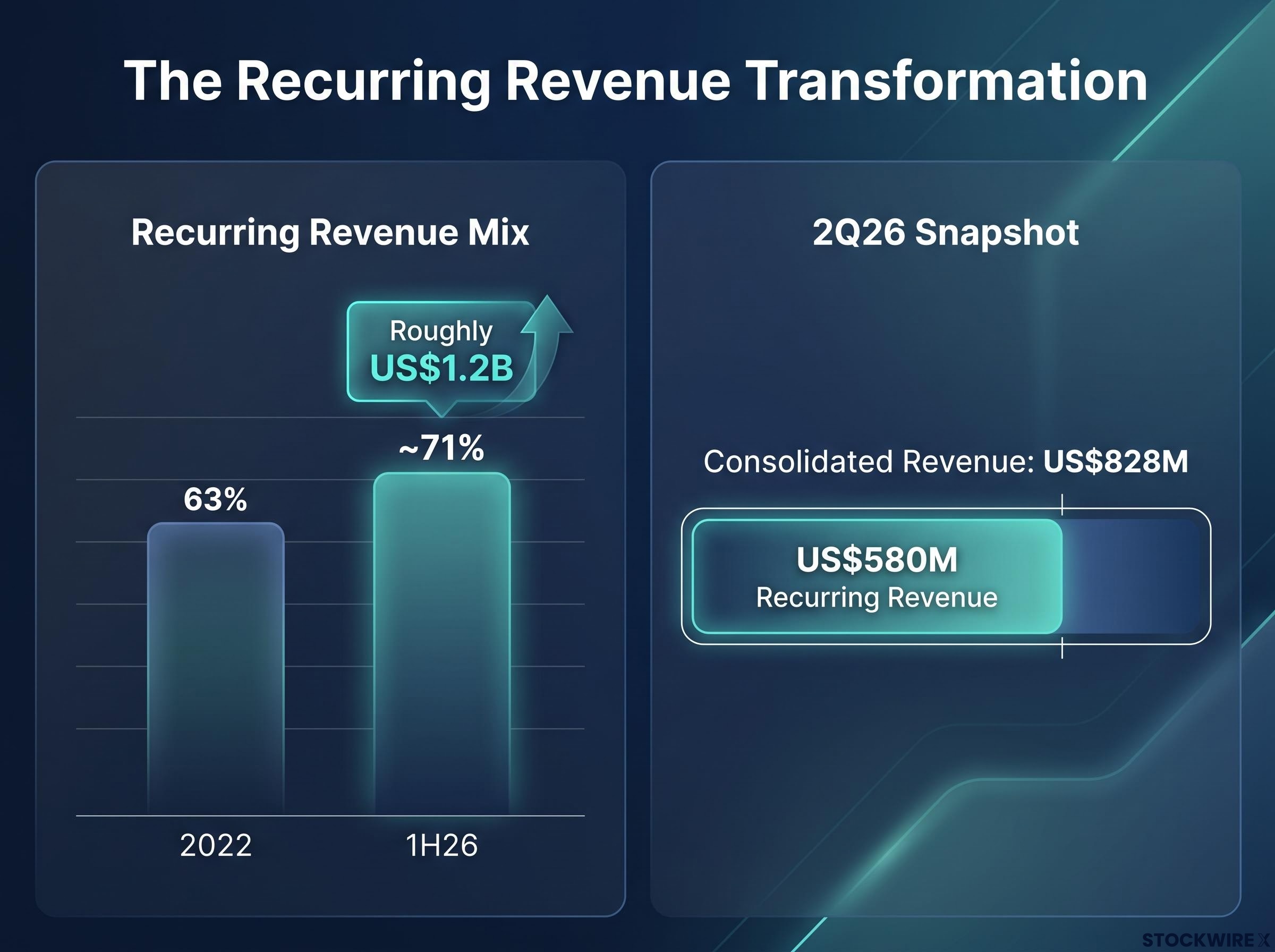
The market tends to reward this profile because it supports wider margins, greater earnings predictability, and stronger free cash flow. The effect is visible in the quarter’s 41% adjusted free cash flow conversion, an improvement of 1,100 bps year-on-year.
Gaming and iGaming drive the growth engine
The Gaming segment delivered AEBITDA of US$307M (+10%), with margin expanding to 55% (+200 bps), led by recurring revenue growth and a favourable product mix.
Gaming operations momentum
Gaming operations, the recurring core of the segment, showed continued strength:
-
Gaming operations revenue rose +18% year-on-year
-
N.A. installed base reached 48,639 units (+5%)
-
Average daily revenue per unit was $48.88 (+6%)
-
Premium units logged a 24th consecutive quarter of install base growth, adding 652 units sequentially and now representing over 58% of the N.A. base excluding Grover
Gaming machine sales fell 4%, primarily on timing of unit shipments deferred into 2H FY26. Gaming systems declined 16%, primarily driven by lower hardware sales. Management expects game sales to accelerate in 2H26 as product and content launches ramp.
Grover scaling on integration
Grover contributed revenue of US$45M in the quarter, with its install base surpassing 12,550 units after adding 277 units sequentially. More than 1,500 units have been added post-acquisition.
On the content side, TANK BLAST launched as Indiana’s highest first-14-day performer, and more than 30 LNW titles are slated for launch across six operating jurisdictions in 2H26.
iGaming’s content-led expansion
iGaming reported revenue of US$92M (+14%) and AEBITDA of US$33M (+18%), at a 36% margin. Wagers processed through the OpenGaming System (OGS) reached US$31.3B (+18%), and 8 of the top 10 OGS games were first-party (1PP) titles. The segment entered the Alberta, Canada market on 1 July, the first day it opened to commercial operators.
SciPlay: managing through a softer social casino market
SciPlay revenue declined 9%, reflecting a broad-based contraction in the social casino market. According to Eilers data cited in the presentation, industry revenue fell from US$7.05B in FY20 to US$6.82B in FY25.
Segment AEBITDA was US$72M (-3%), cushioned by cost base optimisation. The constructive angle came from the direct-to-consumer (DTC) channel, where revenue hit a record US$53M (+51%), now representing 29% of segment revenue. Average monthly revenue per paying user (AMRPPU) rose to $133.80 (+4%).
The DTC channel offers higher-margin direct monetisation, partially offsetting top-line softness in a shrinking addressable market.
A cash machine funding deleverage
Cash generation was a defining feature of the quarter. Net cash provided by operating activities reached US$241M, up 127% year-on-year, while adjusted free cash flow rose to US$156M (+50%). On a trailing-12-month basis, adjusted free cash flow totalled US$692M.
The company remains committed to a deliberate strategy to grow the quality of recurring revenues and expand its highly cash generative business model.
The deleverage roadmap
The company reported a net debt leverage ratio of 3.4x, against a principal face value of debt of US$5.2B and available liquidity of US$928M, with an effective interest cost of 6.30%.
Management reaffirmed its commitment to reduce leverage to below 3.0x during 1H27, with the intention to move toward an investment grade level leverage profile.
On capital returns, the company completed US$134M of buybacks in 2Q26 and has returned approximately US$2.1B to shareholders since 2022, equivalent to roughly 27% of shares outstanding prior to the programme. Buyback activity is expected to pare back in favour of debt reduction in 2H26.
What management guided for the rest of FY26
Management reaffirmed its FY26 outlook of mid-to-high single-digit consolidated AEBITDA growth, with earnings weighted to the second half and scaling into 4Q, in line with prior-year phasing.
The guidance takes into account several identified FY26 headwinds:
-
External factors including US tariffs and UK iGaming tax changes (estimated US$40M adverse impact)
-
Strategic and AI investments (estimated US$20M adverse impact)
-
Legal costs (estimated US$10M adverse impact)
Looking further out, the company remains focused on its FY28 targets:
-
EPSa of >US$10.55
-
Consolidated AEBITDA of US$2.0B
Management indicated it continues to target reinvestment of approximately 17% of consolidated revenue across R&D and capital expenditure to self-fund growth. The throughline of the presentation remained consistent: a growing recurring revenue base feeding a cash-generative model, directed toward deleveraging the balance sheet while sustaining disciplined capital returns.
Don’t Miss the Next Consumer Discretionary Mover
Big News Blast delivers FREE breaking ASX news and in-depth analysis directly to your inbox within minutes of release. Join 20,000+ subscribers who stay ahead of the market the moment announcements drop. Click the “Free Alerts” button at StockWire X to get started today.