

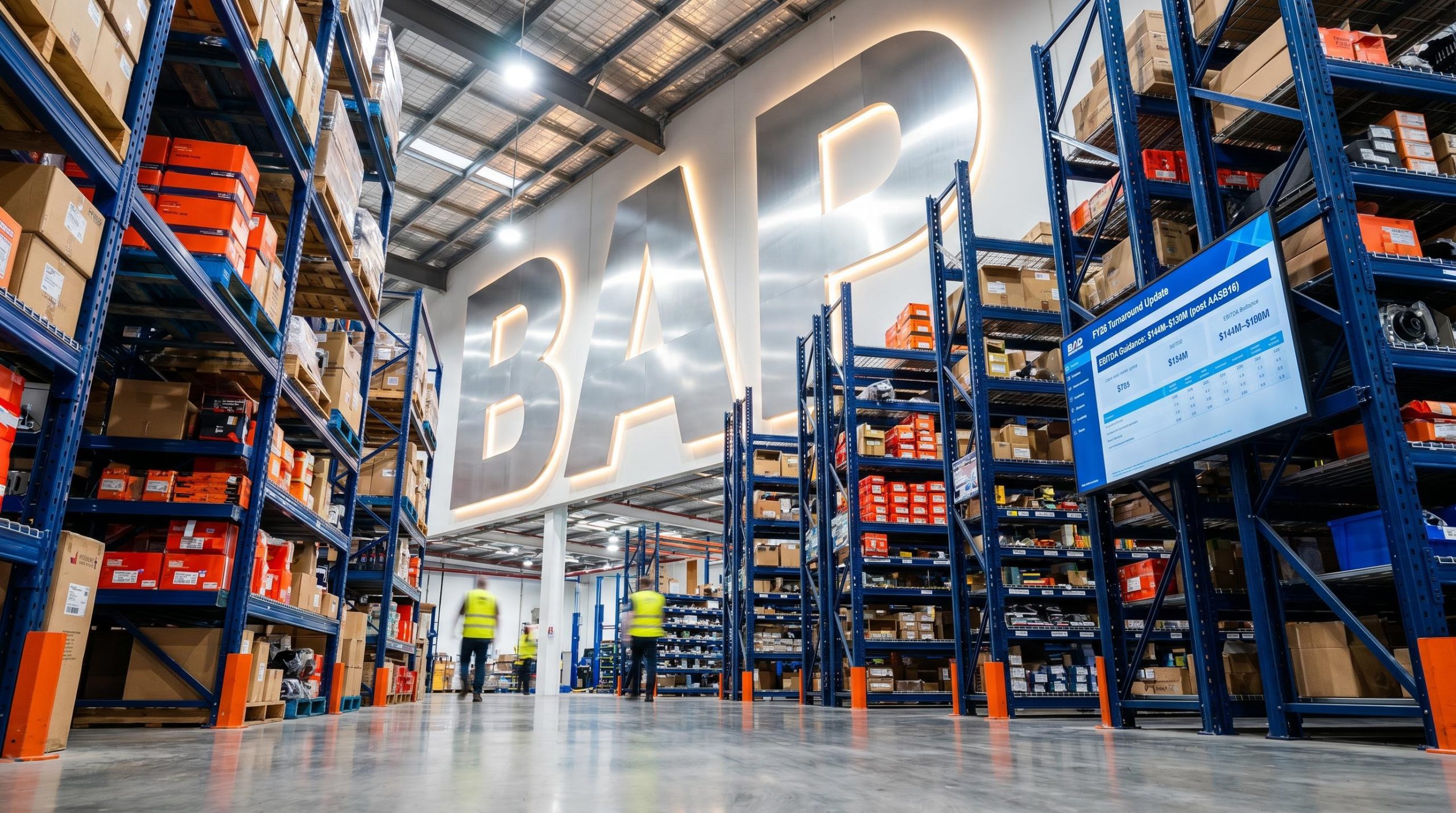
Turnaround gains traction as external headwinds force guidance revision
Bapcor Limited (ASX: BAP) is presenting investors with a two-sided story in its 14 May 2026 trading update: the Bapcor FY26 turnaround earnings guidance narrative reflects genuine operational progress across all four business segments, but external shocks have simultaneously forced a downward revision to the earnings outlook issued on 26 February 2026.
Sales across all segments were negative against the prior comparative period (pcp) from July 2025 through to January 2026. That trend reversed in February 2026, with all four segments returning to positive sales growth versus pcp through April 2026. However, the onset of the Middle East conflict in late March 2026, compounded by rising interest rates, materially deteriorated trading conditions and rendered the February guidance no longer achievable.
Revised FY26 earnings guidance
Bapcor has reduced its FY26 earnings guidance as a direct result of the external headwinds that emerged after the turnaround was underway. The company now expects to deliver:
- Underlying FY26 EBITDA of $144M–$150M (post AASB16)
- Underlying FY26 EBITDA of $62M–$68M (pre AASB16)
The drivers behind this downward revision include:
- Softer trading conditions in April, driven by lower business confidence and consumer sentiment, expected to continue through the end of FY26
- Higher fuel, freight and supplier costs stemming from the Middle East conflict, forecast to persist through May and June 2026
- Depreciation of the NZD against the AUD, negatively affecting earnings from the New Zealand segment
CEO commentary
Chris Wilesmith, Chief Executive Officer & Managing Director
“We are pleased with the positive momentum of the turnaround, which has been delivered through decisive actions we’ve taken to improve pricing, stock availability and team engagement. This is despite the challenging external environment which was not contemplated when we began this turnaround, and which has slowed the rate of improvement contemplated in our previous guidance. We will continue driving initiatives during the important trading months of May and June.”
When big ASX news breaks, our subscribers know first
Segment-by-segment sales recovery
The shift from broad-based sales declines to positive growth across all four segments marks a clear inflection point in the turnaround. The table below summarises the movement in sales performance from the first phase of 2H FY26 through to the February–April 2026 period versus pcp.
| Segment | July 2025 – January 2026 (% vs pcp) | February 2026 – April 2026 (% vs pcp) | Movement |
|---|---|---|---|
| Trade | -2.4% | +0.7% | +3.1% |
| Networks | -2.8% | +3.8% | +6.6% |
| Retail (LFL) | -1.2% | +1.6% | +2.8% |
| New Zealand (NZD) | -3.8% | +0.7% | +4.5% |
Note: Retail is measured on a like-for-like basis, reflecting the reduction in store count. New Zealand performance is assessed in NZD.
Two segments warrant particular attention within this recovery:
- The Trade segment achieved market share growth in Parts during 2H FY26 compared to 1H FY26, indicating competitive positioning is strengthening
- The Networks segment delivered positive sales growth from January to April 2026 versus pcp, with both the Wholesale and JAS businesses showing positive momentum across that period
What’s driving the improvement — and what comes next
Turnaround initiatives already delivering
Management is executing on four improvement pillars announced in February 2026, each targeting a distinct area of the business:
- Enhancing profitability: Improved discount management through greater visibility of price overrides, and expansion of the product range in selected Burson stores
- Optimising cost of doing business: Establishment of an in-house recruitment function to reduce external recruitment spend, and better replenishment planning to reduce high-cost emergency orders from distribution centres
- Capital efficiency: Direct customer engagement and improved credit discipline to reduce overdue debtors, alongside an ongoing rationalisation of low commercial value product ranges
- Returning to growth: High-velocity stock relocated from distribution centres into the store and branch network; targeted price reductions across more than 10,000 Burson products reaching over 70% of customers; loyalty programmes to win back lost customers; and leadership development programmes alongside targeted recruitment into key roles to improve team retention
Balance sheet and impairment watch
Bapcor’s unaudited net debt at the end of April 2026 stood at approximately $168 million. The company reports improving working capital conditions, with several specific developments:
- Overdue debtors are being reduced through direct customer engagement and tightened credit discipline
- Expected one-off cash receipts have been collected
- In-stock availability at stores and branches has improved
Inventory reduction, however, is taking longer than anticipated. The softer trading environment is expected to defer some of the benefits of inventory management initiatives into FY27.
Bapcor has also flagged that current trading conditions could give rise to a non-cash impairment charge. This assessment will be conducted as part of the standard year-end process and does not represent a confirmed impairment event at this stage.
Why investors are watching Bapcor’s 2H FY26 closely
The combination of a genuine operational recovery and a downward guidance revision creates a nuanced signal for investors. The segment-level sales data confirms that management’s turnaround actions are producing measurable results, including pricing improvements, stock availability gains, and early market share recovery in Trade. These are internal levers that management controls.
The complicating factor is that the Middle East conflict introduced cost pressures, specifically higher fuel, freight and supplier costs, that were not factored into the February 2026 guidance. Bapcor has responded by implementing targeted pricing adjustments in select business units to partially offset these cost increases, demonstrating a degree of operational responsiveness to the changed environment.
May and June represent the final and most commercially significant months of FY26. Whether the turnaround trajectory can sustain itself against ongoing macro headwinds will shape how investors assess FY27 prospects. If the improvement in underlying operations holds through year-end, FY27 becomes the true test of whether management’s structural initiatives have reset the business’s competitive position. For now, the announcement confirms progress is real, but the external environment remains the primary uncertainty.
Don’t Miss the Next Consumer Discretionary Turn Around
Big News Blast delivers FREE breaking ASX news directly to your inbox within minutes of release, complete with in-depth analysis already done for you. Join 20,000+ subscribers staying ahead of market-moving developments across Consumer and beyond. Click the “Free Alerts” button at StockWire X to start receiving alerts the moment news breaks.