
Bapcor secures revised lender covenants to support turnaround
Bapcor Limited (ASX: BAP) announced on 12 August 2026 that its lenders have approved revised covenant arrangements for the FY27 financial year testing periods. The amendments provide additional financial flexibility as the automotive parts supplier continues its ongoing business reset and operational turnaround.
The update relates solely to covenant amendments.
For investors, the additional covenant headroom reduces near-term breach risk while management executes its turnaround programme.
When big ASX news breaks, our subscribers know first
What the revised covenants mean
Bapcor disclosed two amended covenant terms tied to the FY27 testing dates. Both provide temporary relief before reverting to standard levels.
-
Net Leverage Ratio: increases to 3.5 times adjusted EBITDA at 31 December 2026, before reverting to 3.0 times adjusted EBITDA for testing at 30 June 2027 and thereafter.
-
Fixed Charge Cover Ratio: reduces to 1.30 times adjusted EBITDA at 31 December 2026 and 30 June 2027, before reverting to 1.75 times adjusted EBITDA for testing at 31 December 2027 and thereafter.
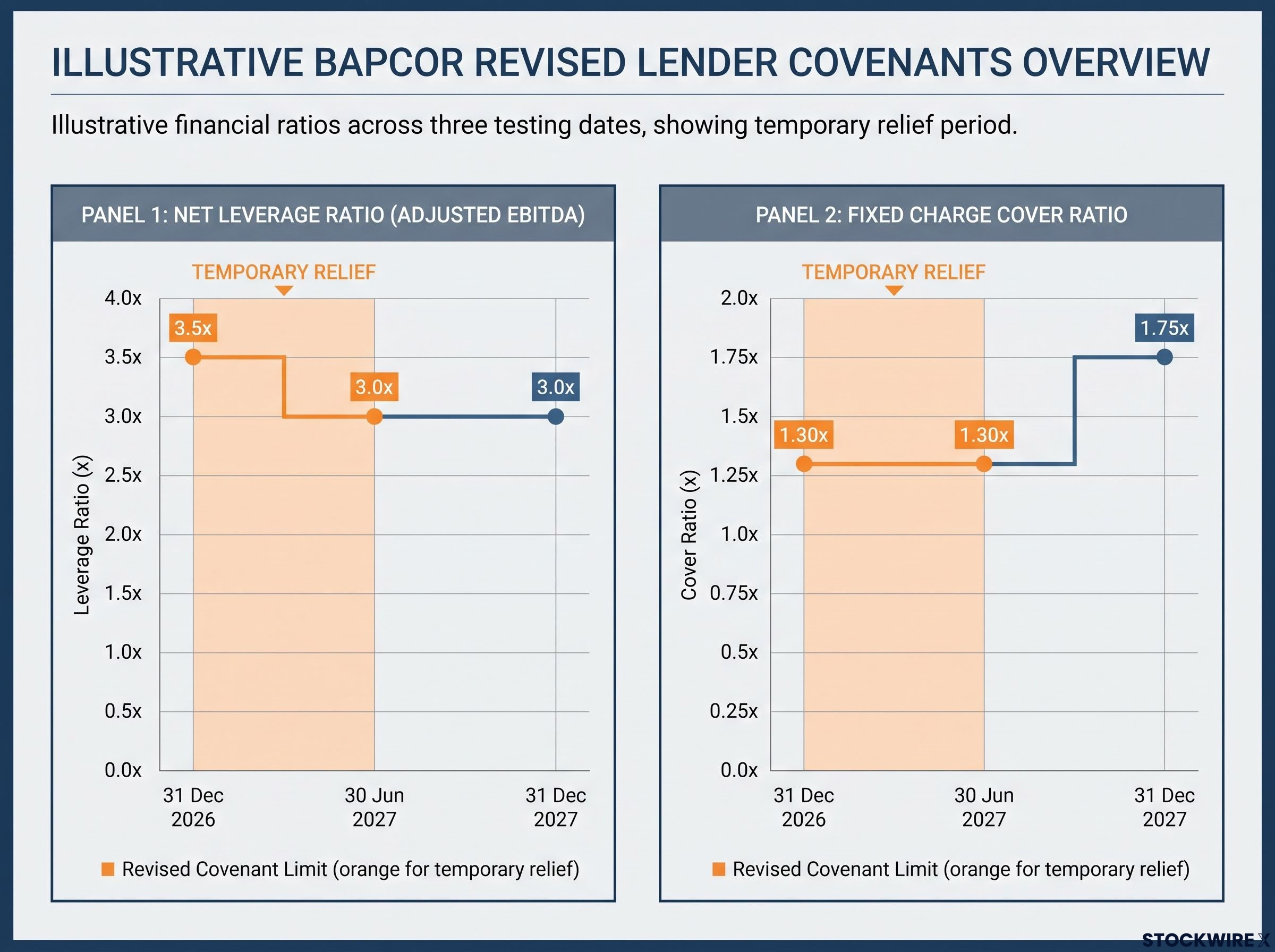
| Covenant | Revised level (31 Dec 2026) | Interim (30 Jun 2027) | Reverts to (from 31 Dec 2027) |
|---|---|---|---|
| Net Leverage Ratio | 3.5x | 3.0x | 3.0x |
| Fixed Charge Cover Ratio | 1.30x | 1.30x | 1.75x |
Understanding debt covenants and why the headroom matters
Lender covenants are conditions attached to a company’s debt facilities. A borrower must meet these conditions at set testing dates to remain compliant with its lending agreements.
The Net Leverage Ratio measures a company’s debt relative to its earnings. A higher permitted ratio means the company can carry more debt against its adjusted EBITDA before breaching the covenant.
The Fixed Charge Cover Ratio measures a company’s ability to cover its fixed financial obligations, such as interest and lease costs, from its earnings. A lower permitted ratio gives the company more room during periods when earnings are compressed.
For investors, temporarily loosened covenants provide a company with more breathing room to execute a turnaround. This reduces the risk of a technical breach during a lower-earnings period, which can otherwise trigger penalties or renegotiation with lenders.
Management’s view and the road ahead
Chief Financial Officer Kim Kerr framed the amendments as a reflection of continued lender support during the company’s reset.
Kim Kerr, Chief Financial Officer
“We appreciate the ongoing support of our lenders. The additional headroom provides Bapcor with further financial flexibility as it continues to execute its business reset and operational turnaround.”
The revised terms are temporary and tied to the FY27 testing periods. The Net Leverage Ratio reverts to standard testing levels from 30 June 2027, while the Fixed Charge Cover Ratio reverts from 31 December 2027, signalling that the arrangement is designed to support a defined window rather than a permanent change to the lending terms.
For shareholders, the amended terms provide financial flexibility through FY27 as management progresses its operational reset and turnaround.
For investors wanting to understand how external headwinds have shaped the earnings trajectory the revised covenants must accommodate, our detailed coverage of Bapcor’s FY26 guidance revision examines the segment-level sales recovery alongside the cost pressures from Middle East conflict impacts and currency movements that pushed EBITDA guidance lower.
Don’t Miss the Next Consumer Sector Move
Big News Blast delivers FREE breaking ASX news straight to your inbox within minutes of release, complete with in-depth analysis already done for you. Join 20,000+ investors who stay ahead of the market the moment announcements drop. Click the “Free Alerts” button at StockWire X to start receiving alerts today.