
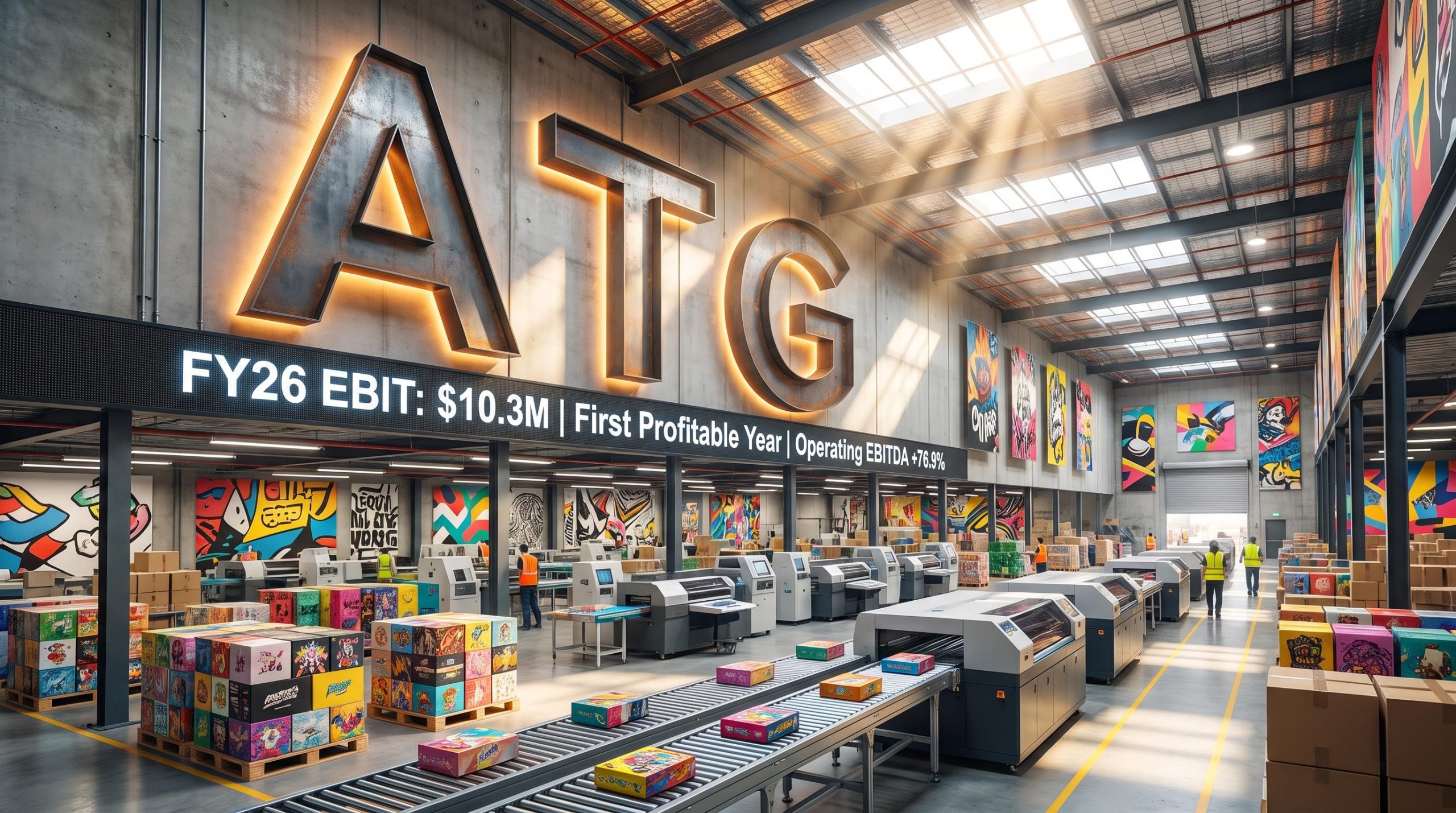
Articore reports first profitable full year since listing with $10.3m EBIT
In its FY26 full-year results investor presentation released on 28 August 2026, Articore Group (ASX: ATG) reported group earnings before interest and tax (EBIT) of $10.3 million, a $20.1 million turnaround from the prior year’s -$9.8 million loss.
The result marks the company’s first profitable full year since its 2016 listing, excluding the pandemic-driven spike in FY21. Management confirmed FY26 guidance was achieved, with the print-on-demand marketplace operator prioritising margin and profit over top-line revenue growth.
When big ASX news breaks, our subscribers know first
FY26 financial results at a glance
The presentation framed FY26 as a deliberate trade-off: marketplace revenue eased while profitability and margins reached record levels.
| Metric | FY25 | FY26 | Change |
|---|---|---|---|
| Marketplace revenue | $379.1m | $354.5m | -6.5% (-3.8% cc) |
| Gross profit | $173.0m | $175.9m | +1.7% (+5.0% cc) |
| GPAPA | $100.6m | $101.4m | +0.8% (+3.6% cc) |
| Operating EBITDA | $9.3m | $16.4m | +76.9% |
| EBIT | -$9.8m | $10.3m | +$20.1m |
The company delivered record margins across the board:
-
Gross profit margin of 49.6%, up 400 basis points
-
Gross profit after paid acquisition (GPAPA) margin of 28.6%, up 210 basis points
-
Operating expenses reduced to $85.0 million, down 6.9%
The message from the presentation was clear: margin discipline, not volume, drove the profit story.
What drove the turnaround
Management outlined several levers behind the EBIT swing:
-
A new artist account fee structure that “enhanced marketplace dynamics”.
-
Supply chain efficiencies.
-
Scale economies from 44 third-party fulfiller sites.
-
Pricing and paid marketing effectiveness.
-
Continued cost discipline, with operating expenses down for the third consecutive year.
-
A streamlined capitalisation process that lowered amortisation and aligned EBIT more closely with cash flow.
The presentation also highlighted an embedded operational hedge. With approximately 75% of both revenue and costs denominated in US dollars, the roughly 5% decline in the USD during FY26 was largely neutralised at the EBIT level.
Understanding the print-on-demand model
Articore operates a capital-light marketplace built around two connected loops. Creators upload unique designs, customers buy those designs printed on products, and third-party fulfillers manufacture and ship each order.
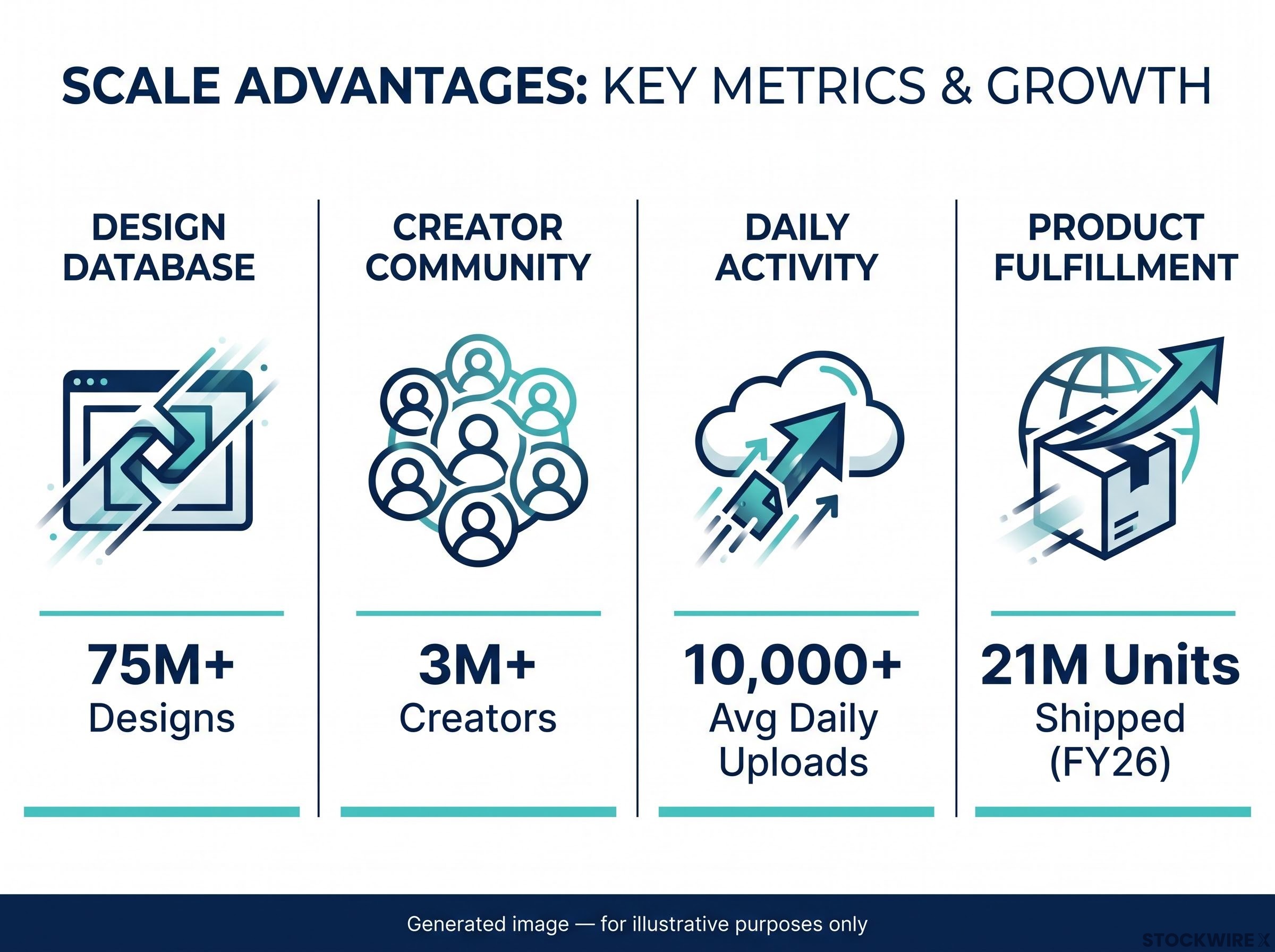
This model is supported by four scale advantages: more than 75 million designs, over 3 million creators, more than 10,000 average daily uploads, and 21 million units shipped in FY26.
The broader market backdrop remains supportive. The global print-on-demand market is projected to grow from US$11 billion in 2025 to US$58 billion by 2033, a +23.6% CAGR, according to Grand View Research (June 2026). This positions a high-margin, asset-light model within a structurally growing market.
Marketplace performance: TeePublic grows, Redbubble expands margins
The presentation contrasted the trajectories of the two established marketplaces.
TeePublic — consistent growth
TeePublic recorded marketplace revenue (MPR) of $182.0 million, up 2.8% in constant currency. Gross profit grew 10.9% in constant currency, with GPAPA up 7.2% in constant currency, driven by pricing and promotional optimisation alongside supply-chain efficiencies.
Redbubble — margin-led, high cash generation
Redbubble recorded MPR of $170.1 million, down 11.1% in constant currency, but delivered a record quarterly gross profit margin of 55.2% in 4QFY26. Full-year gross profit margin reached 52.2%, with GPAPA broadly flat in constant currency.
Redbubble’s unit-economics improvements largely offset softer volumes, reflecting a focus on quality of earnings over quantity.
Growth engines: Frankly Wearing and Dashery
The presentation detailed two high-growth businesses layered on top of the established marketplaces.
Frankly Wearing
Frankly Wearing is an Indian-based print-on-demand marketplace acquired in May 2026. The stated strategic rationale is to advance technology platform consolidation, establish a Global Capability Centre to drive sustained operating efficiencies, and add a profitable business to the group.
The acquisition opens access to the US$1B+ Indian print-on-demand market, growing annually by approximately 25%. Management noted triple-digit year-on-year growth since acquisition and is targeting more than 30 hires by the end of FY27.
The Frankly Wearing acquisition was structured with 75% payable at close and 25% as an earn-out tied to 18-month performance milestones, funded entirely from existing cash reserves without affecting FY26 underlying cash flow guidance.
Dashery
Launched in January 2025, Dashery reported strong early traction:
-
Gross processed sales (GPS) of $4.0 million, up 450%
-
MPR of $2.4 million, up 482%
-
GPAPA margin of 36.5%
-
More than 1,500 active selling accounts
A Shopify integration is launching to widen the target market, and the presentation noted that some creators generated more than $100k in their first year.
AI embedded across the business
The presentation highlighted AI adoption as a driver of efficiency and user experience:
-
Artist approval workflows are 100% AI-powered
-
Customer search is 100% AI-powered
-
AI-driven marketing spans content creation and campaign optimisation
-
Approximately 80% of customer contacts are handled via AI-powered chat
Management also flagged the launch of a TeePublic advertising program on ChatGPT as an early move into conversational commerce, noting the group’s large artist catalogue is well suited to long-tail conversational queries.
Balance sheet strengthened, ROE turns positive
The presentation pointed to the group’s financial position as evidence of durability:
-
Underlying cash flow of $10.1 million (FY25: $0.6 million)
-
Closing cash balance of $40.5 million, up 42%
-
Return on equity of +21.8% (FY25: -22.8%)
-
Net profit after tax of $10.9 million (FY25: -$11.3 million)
This cash flexibility provides the group with capacity to fund future growth.
FY27 guidance and strategic roadmap
Management outlined the following guidance ranges for FY27:
-
GPAPA margin: 27% – 30%
-
Operating expenses: $79 million – $85 million
-
Operating EBITDA: $17 million – $23 million
The presentation noted that achieving these aims is dependent on factors including consumer demand, foreign exchange rates, and geographic and product mix.
FY27 initiatives span customers, creators, high-growth businesses and a unified platform. These include improving search, discovery and merchandising, increasing creator earnings, expanding new revenue streams such as advertising, adding Shopify features to Dashery, and leveraging unified marketing technology (MarTech).
The company reiterated its stated vision:
Articore vision (FY26 results presentation)
“To be the leading destination for customers to discover and buy unique design-first products driven by a global creator ecosystem built to turn passion into profits.”
The investment takeaway
Articore delivered a profitable turnaround in FY26, with margins at record levels and a strengthened cash position of $40.5 million. Two high-growth businesses, Dashery and Frankly Wearing, now sit alongside the established marketplaces within a structurally growing print-on-demand market.
Don’t Miss the Next Consumer Discretionary Turnaround
Big News Blast delivers FREE breaking ASX news to your inbox within minutes of release, complete with in-depth analysis. Join 20,000+ investors who stay ahead of market-moving announcements the moment they drop. Click the “Free Alerts” button at Big News Blast to get consumer sector news delivered straight to you.