
S&P confirms Chorus’ BBB/positive rating after NIFF reclassification
Chorus announced on 15 October 2026 that S&P Global Ratings (S&P) has released an update confirming its long-term rating at BBB/positive. The S&P report, dated 13 October 2026, states that it does not constitute a rating action.
The update follows the August 2026 sale of Chorus’ UFB equity and debt funding securities held by National Infrastructure Funding and Financing Limited (NIFF) to a select group of domestic and international institutional investors. S&P has revised its treatment of the NZ$683 million of NIFF equity securities from 100% equity to 100% debt.
The rating and positive outlook were retained despite a material increase in S&P’s adjusted debt.
S&P Global Ratings
“Chorus Ltd. will maintain significant headroom under the ‘BBB’ rating despite a material increase in our adjusted debt following a reclassification of NIFF securities to debt from equity.”
When big ASX news breaks, our subscribers know first
What the NIFF reclassification means for Chorus’ credit metrics
Why S&P changed its treatment
S&P had anchored its high equity assessment of the securities to the condition that they were held by, or on behalf of, the government. Following the sale, this condition is no longer met.
The NIFF securities were originally issued by Chorus in favour of the government to provide funding for the buildout of the Ultra-Fast Broadband (UFB) network. The reclassification is an S&P analytical adjustment to its credit metrics, not a new debt raise.
Before and after
S&P’s adjusted figures show the effect on leverage. The table below reproduces S&P’s actuals, estimate and forecasts.
| Metric | FY26a | FY27e | FY28f | FY29f |
|---|---|---|---|---|
| Debt (NZ$ million) | 3,304 | 4,070 | 4,210 | 4,350 |
| Debt/EBITDA | 4.6x | 5.5x | 5.5x | 5.5x |
| FFO/debt | 17.0% | 13.3% | 13.2% | 12.7% |
S&P now expects its ratio of adjusted funds from operations (FFO) to debt to fall from a presale 17% to slightly over 13% over the next two years. S&P describes this as just in line with its rating upside trigger of above 13%.
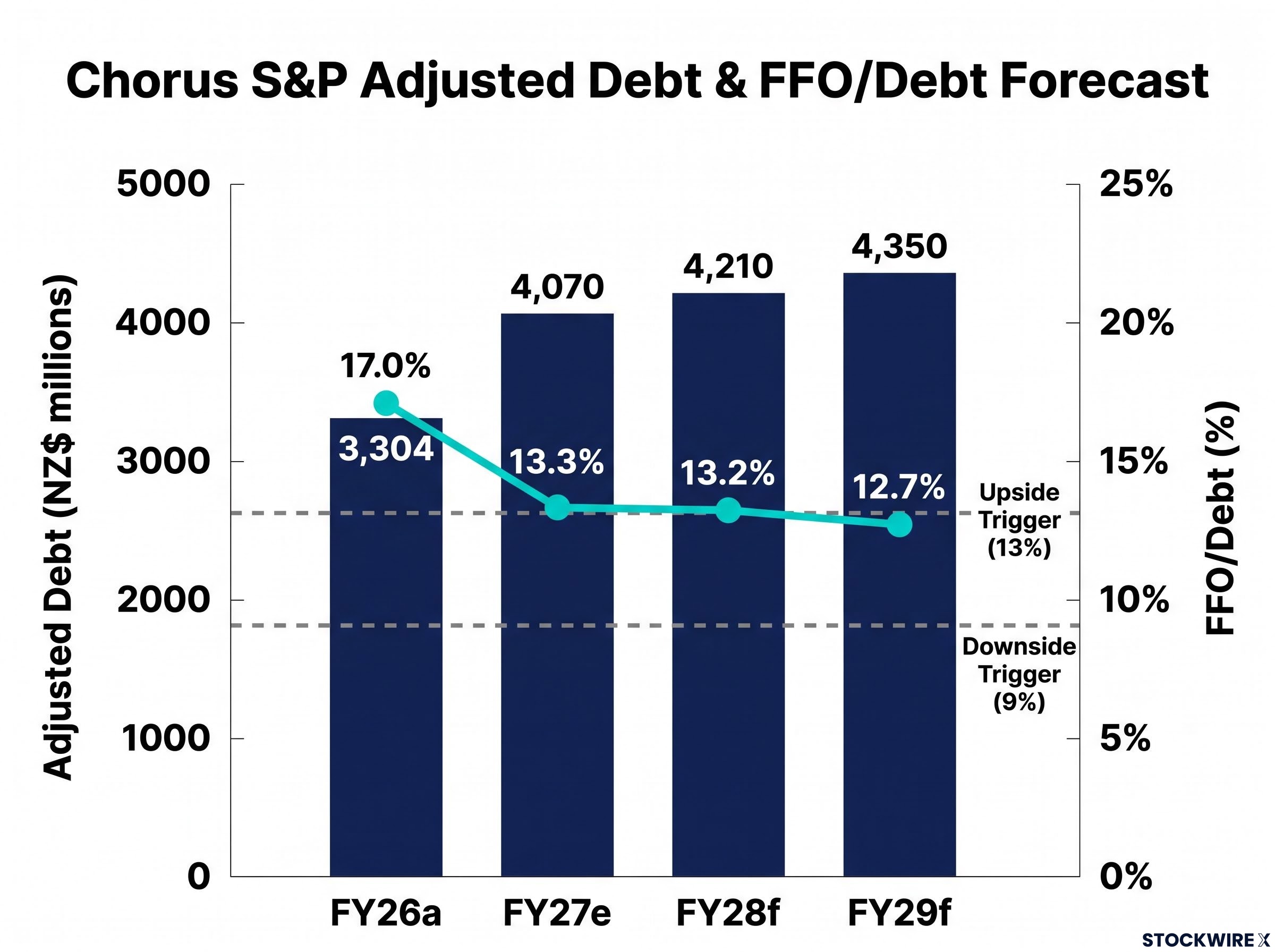
S&P’s chart places its downside trigger at 9%. The FY29 forecast of 12.7% sits below the upside trigger, and all figures are S&P forecasts.
How regulation and business strength support the positive outlook
A revenue cap sets the maximum annual revenue a regulated company can earn over a regulatory period. A wash-up mechanism adjusts for any under or over recovery of revenue arising from differences between projected and actual demand, which S&P says adds a layer of earnings certainty.
Chorus entered the four-year regulatory period Price-Quality Path 2 (PQP2) on 1 January 2025. The New Zealand Commerce Commission has applied a revenue cap of NZ$4.1 billion over the period to 31 December 2028.
S&P rates Chorus’ business risk as “Excellent”, citing a near monopoly over New Zealand’s fixed-line wholesale access network and high barriers to entry. Regulated fibre revenue could increase to 84%-87% of total revenue over the next two years, given the company aims to retire its remaining copper network by 2028.
S&P’s base-case assumptions include:
- Annual revenue growth of 2%-3% in fiscal 2027-2028
- EBITDA margins of about 70% over the next three years
- Annual capex of NZ$370 million-NZ$380 million over the next three years
- Dividends of 62 cents per share in fiscal 2027, subject to no material adverse changes in circumstances or outlook
S&P considers Chorus’ liquidity adequate, expecting sources to cover uses by about 1.2x over the 12 months ending 30 June 2027. As of 30 June 2026, sources included cash of about NZ$200 million and undrawn committed bank facilities of about NZ$450 million, expiring beyond 12 months.
Path to a BBB+ upgrade and what to watch
S&P may raise the rating to ‘BBB+’ over the next 12 months if it expects Chorus to maintain the following:
- FFO/debt above 13%, supported by robust financial policies.
- No material expansion into unregulated businesses.
- A regulatory regime that does not evolve in a manner that materially reduces the predictability and sustainability of earnings and cash flow.
S&P could revise the outlook to stable if it believes FFO/debt will trend to 13% or below. This could occur if:
- An adverse regulatory outcome reduces earnings and cash flow.
- S&P does not consider Chorus’ financial policy supportive of a higher rating, including significant debt-financed returns to shareholders, growth capex or acquisitions.
A key consideration is clarity on Price-Quality Path 3 (PQP3), starting 1 January 2029. The regulator is expected to extend PQP3 to a five-year term (January 2029-December 2034), and S&P’s monitoring points include stability of the regulated asset base, WACC inputs and calculation methodology, allowed expenditure and the resulting revenue path.
S&P views Vector and Powerco as Chorus’ closest peers. The figures below are FY26 pre-reclassification figures from S&P’s peer table.
| Company | EBITDA margin | FFO/debt |
|---|---|---|
| Chorus | 70.6% | 17.0% |
| Vector | 67.8% | 19.8% |
| Powerco | 67.6% | 9.4% |
The positive outlook reflects S&P’s view that strong regulated cash flow, prudent capital management and a robust balance sheet could support an upgrade to ‘BBB+’ over the next 12 months. This remains S&P’s view rather than a certainty.
Stay Ahead on Telecommunications News Before the Market Moves
Get FREE breaking ASX news delivered to your inbox within minutes of release, complete with in-depth analysis and the full announcement. Join 20,000+ subscribers already getting the edge on market-moving updates. Click the “Free Alerts” button at Big News Blast to receive alerts the moment news breaks.