
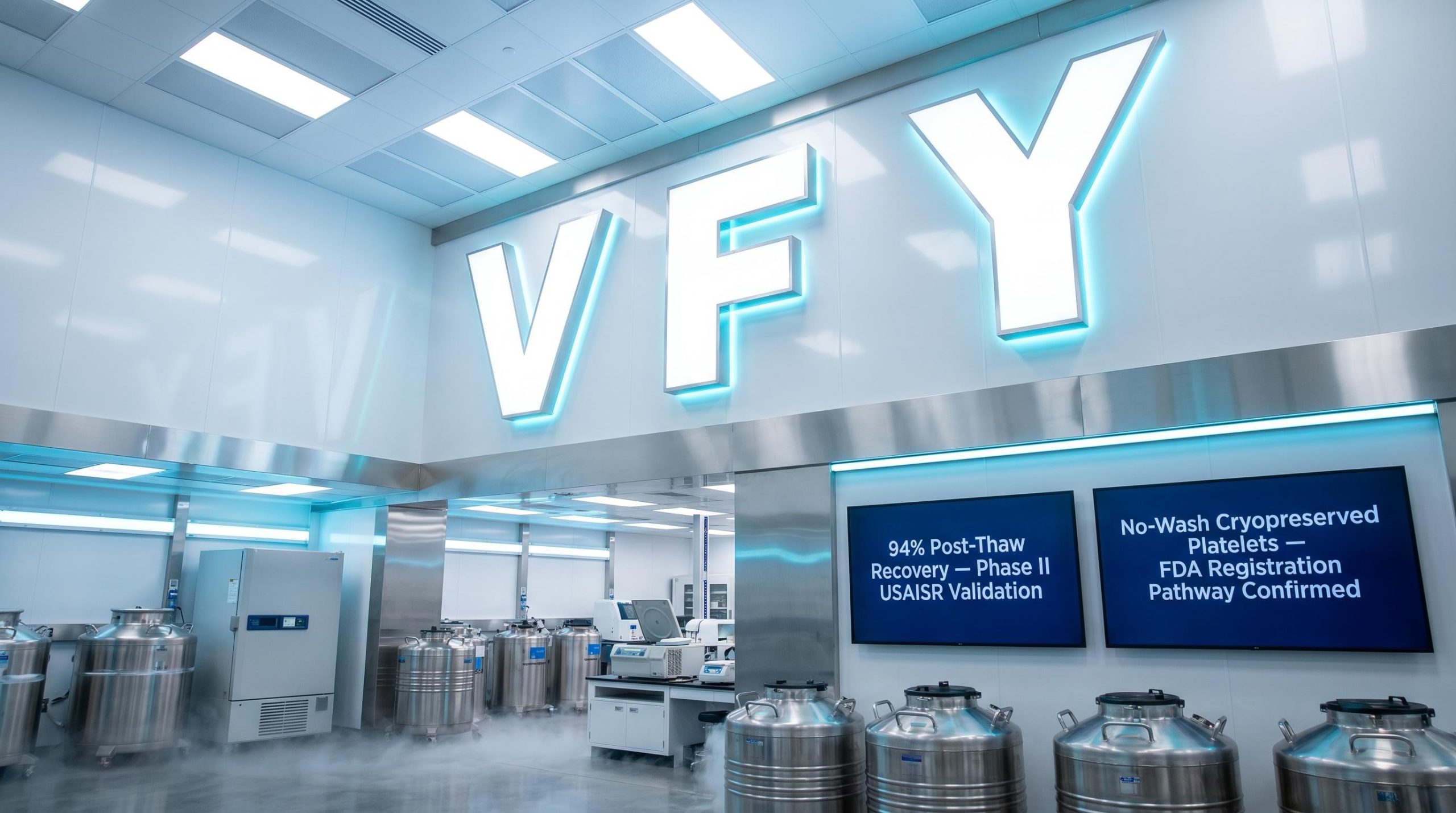
Vitrafy’s Phase II US Army platelet study delivers standout results — 94% post-thaw recovery validated
Vitrafy Life Sciences Limited (ASX: VFY) has announced the successful completion of its Phase II in-vitro platelet cryopreservation study conducted by the United States Army Institute of Surgical Research (USAISR), with all tested protocols exceeding existing regulatory and quality guidelines for platelet use in humans. The headline result is the 3% DMSO no-wash protocol, which achieved a 94% mean post-thaw recovery, outperforming every other protocol tested on all critical measures. With no FDA-approved no-wash cryopreserved platelet product currently available in the United States, the study positions Vitrafy as a potential category-first solution in an unaddressed market.
Key highlights from the Phase II study:
- All protocols exceeded FDA/AABB and European regulatory guidelines for platelet use
- 3% DMSO no-wash protocol achieved 94% mean post-thaw recovery
- No-wash protocol retained nearly twice the level of key platelet receptors compared to the wash protocol
- Independent, U.S. Army-authored validation conducted across 20 donors at commercial volumes
When big ASX news breaks, our subscribers know first
Breaking down the Phase II results
Post-thaw recovery — how the three protocols compared
Phase II tested apheresis platelets from 20 donors across three cryopreservation protocols: a no-wash 3% DMSO protocol, a no-wash trehalose-based protocol, and the standard 6% DMSO wash protocol. All samples were cryopreserved and thawed using Vitrafy’s cryopreservation ecosystem.
Because no FDA or AABB-specific standards currently exist for cryopreserved platelets, all units were assessed against commonly accepted liquid-stored (fresh) platelet quality metrics. All protocols met or exceeded those benchmarks.
The comparative results across three measures of cryopreserved platelet performance are summarised below:
| Protocol | Post-Thaw Recovery | Clot Strength (TEG MA) | Receptor Retention (CD42b) |
|---|---|---|---|
| 3% DMSO (no-wash) | 94.4% | Outperformed wash protocol | ~2x wash protocol |
| 6% DMSO (wash) | 84% | Baseline wash result | 20.5% |
| Trehalose (no-wash) | 78.9% | 45.8% | Below no-wash 3% DMSO |
All figures are normalised to fresh (pre-freeze) platelet baseline, per Figure 2 of the USAISR Phase II report.
Why the no-wash result is the standout
The wash protocol requires centrifuge-based cryoprotectant removal, sterile specialised equipment, and trained personnel, making it impractical in time-critical or resource-constrained environments. By contrast, the no-wash approach requires no specialised post-thaw processing at the point of use, enabling platelet deployment wherever it is needed most. This operational difference is what separates a laboratory protocol from a field-ready solution.

Why this matters — the case for cryopreserved platelets
The logistical problem with fresh platelets today
Fresh platelets have a very short shelf life and require continuous refrigeration, which makes stockpiling impractical for many healthcare settings. This constraint is particularly acute in battlefield environments, rural hospitals, and emergency preparedness scenarios where supply chains are unreliable and demand can be sudden.
Cryopreservation addresses this by freezing platelets for extended storage, extending their usability well beyond the window available with fresh products. Within this context, the no-wash format is the critical differentiator: it removes the need for specialised infrastructure at the point of use, making decentralised deployment viable.
The settings this technology could serve
A scalable, no-wash cryopreserved platelet solution could address supply gaps across a range of settings where existing platelet access is logistically constrained, including:
- Battlefield and military trauma response
- Rural and regional hospital access
- Stockpiling for event preparedness
- Streamlined emergency response supply chains
Notably, based on Vitrafy’s review of publicly available FDA and AABB regulatory information at the date of the announcement, there is currently no FDA-approved no-wash cryopreserved platelet product commercially available in the United States.
USAISR Research Lead — Dr. Kristin Reddoch-Cardenas
“The ability to effectively utilize frozen platelets represents a vital advancement in addressing critical, growing needs across both civilian and military trauma response. We are proud of the scientific achievements resulting from this Phase II work and look forward to developing these findings into a peer-reviewed publication. Our ongoing collaborative research with Vitrafy offers a valuable scientific pathway toward implementing these essential capabilities.”
What’s next — FDA pathway and upcoming milestones
Vitrafy has confirmed its next major milestone: FDA medical device registration, targeted for the first half of FY2027. The company and USAISR intend to present the Phase II findings at international scientific conferences in the coming months, with the complete Phase II report to be published in conjunction with those presentations.
Brent Owens, Managing Director and CEO
“The final Phase II report from USAISR delivers independent validation that our decentralised, no-wash platelet preservation platform exceeds regulatory and quality guidelines on every meaningful measure. Across 20 donors and at commercial volumes, we achieved 94% post-thaw recovery with superior clot strength and receptor retention — results that speak for themselves. This milestone brings us firmly within reach of addressing one of transfusion medicine’s most persistent logistical challenges, and we look forward to building on our partnership with USAISR as we progress toward FDA medical device registration in the first half of FY2027.”
To coincide with the announcement, Brent Owens hosted an investor webinar on 22 May 2026 at 9:30am AEST to discuss the Phase II in-vitro study results. Investors can access the registration link via Zoom.
With independent U.S. Army-authored science now validating the platform at commercial volumes, Vitrafy’s path from Phase II completion to FDA medical device registration represents a clearly defined progression in what remains an entirely unaddressed segment of the U.S. transfusion medicine market.
Don’t Miss the Next Healthcare Breakthrough on the ASX
Big News Blast delivers FREE breaking ASX healthcare news directly to your inbox within minutes of release, complete with in-depth analysis. Over 20,000+ subscribers already rely on it to stay ahead of market-moving announcements. Click the “Free Alerts” button at StockWire X to ensure you never miss critical healthcare sector updates the moment they break.