

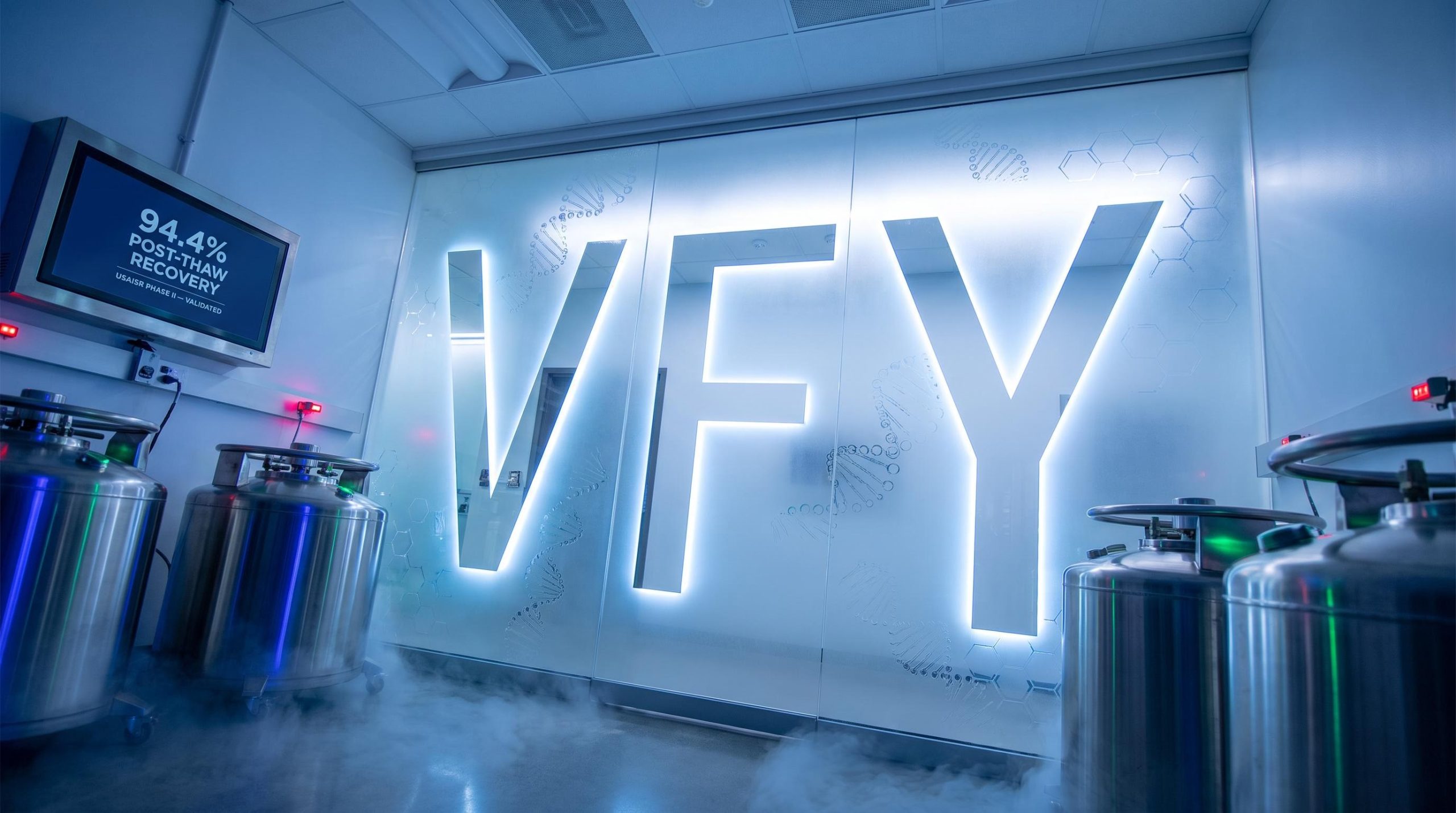
In its FY2026 annual results presentation, Vitrafy Life Sciences framed the year as one in which scientific validation converted into partnerships, revenue and manufacturing capacity. The company closed the period ended 30 June 2026 with $41.2m in total cash and term deposits, alongside a 94.4% post-thaw platelet recovery result from its USAISR Phase II study.
Management positioned Vitrafy as building foundational infrastructure for the global biologics economy, entering FY27 with 5 partnerships signed across two sectors and animal revenue up 159% year-on-year to $169k. The presentation detailed a business fully funded with multiple catalysts ahead.
FY26 delivery: validation converted into commercial momentum
The presentation summarised the year’s execution across Market, Product and Financial pillars. Most milestones were marked as delivered, with the Guardion device fleet build-out and FDA regulatory approval work commenced.
| Pillar | Milestone | Status |
|---|---|---|
| Market | Commercial Partnerships | Delivered |
| Market | USAISR Phase II Platelets Study | Delivered |
| Market | U.S. Market Establishment | Delivered |
| Product | Guardion & LifeChain | Delivered |
| Product | Device Fleet Build-out | Commenced |
| Product | FDA Regulatory Approval | Commenced |
| Financial | Capital Raise | Delivered |
| Financial | Revenue Growth | Delivered |
Key validation-to-commercial data points from the update included:
-
94.4% post-thaw platelet recovery from the USAISR Phase II study
-
5 partnerships signed (Hoxworth, Huon, IMV Technologies, Tassal, Vitalant)
-
~132 U.S. blood collection sites exposed via partnership
-
10 first Guardion units built, with fleet scale-up planned through FY27
-
~$1.0m contracted revenue across FY26 and FY27
When big ASX news breaks, our subscribers know first
Blood breakthrough: from military validation to civilian conversion
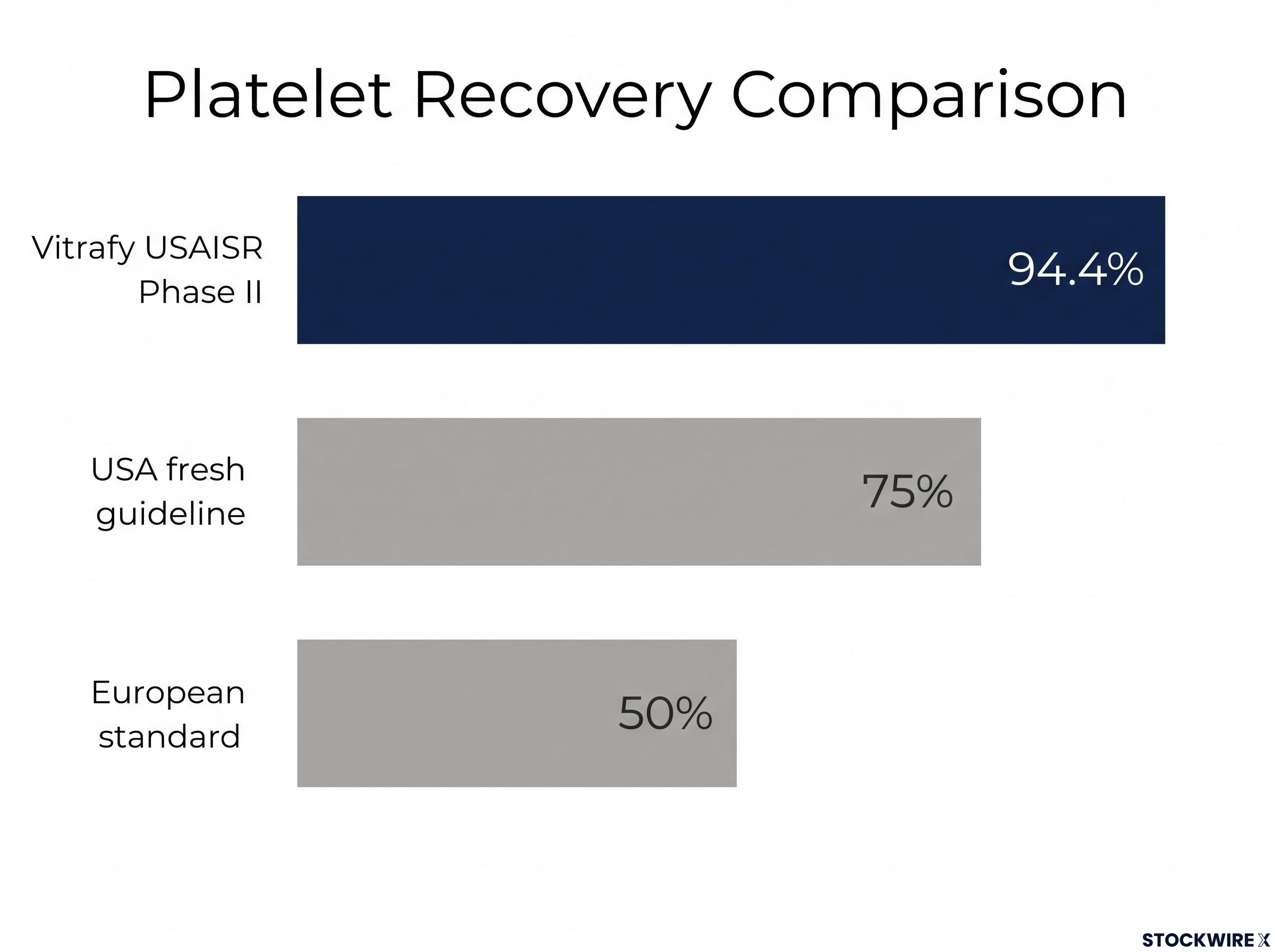
Management outlined the blood segment as the flagship story of the year, with USAISR-validated performance converting into the first civilian blood-network agreements. The presentation highlighted a 94.4% mean post-thaw, no-wash platelet recovery, described as best-in-class and exceeding both the USA fresh guideline of 75% and the European standard of 50%.
The company detailed the quarterly progression across FY26:
-
Q1 FY26 – Blood validation expanded, with Phase I results co-presented at the AABB Conference and the U.S. Phase II platelet program commenced.
-
Q2 FY26 – U.S. platform established for customer demonstrations.
-
Q3 FY26 – Phase II completed at 94.4%, with civilian networks beginning direct engagement.
-
Q4 FY26 – Agreements entered into with Vitalant and Hoxworth.
Why cryopreservation matters: the structural blood crisis explained
The presentation framed blood preservation as a structural challenge rather than a cyclical one, explaining why the technology matters to investors seeking to understand the underlying demand drivers.
A market under structural strain
According to data cited in the presentation, the blood donation rate has fallen 40% over the past 20 years, with only around 3% of the eligible population donating annually. At the same time, demographic pressures are widening the supply-demand gap.
Since 2013, the population aged 65 and over has increased by 30%, while red blood cell (RBC) units collected have declined by 19%. The American Red Cross declared a national blood “crisis” in July 2026, described in the presentation as only the second time this has occurred in its 150-year history.
Two structural failures
The presentation identified two distinct structural failures in the blood market:
-
Chronic platelet shortages — platelets carry a shelf life of under 7 days, driving approximately US$280m in annual wastage, with no FDA-approved cryopreserved platelet product currently available.
-
End-of-life technology — the sole legacy RBC cryopreservation method is being discontinued, with a 2027 phase-out deadline and no approved replacement in place.
Management framed the 2027 deadline as a forcing event, creating urgent and non-discretionary market demand as the U.S. blood network must adapt.
Beyond blood: CGT pipeline and animal reproduction traction
The presentation covered two secondary growth engines developing alongside the flagship blood segment.
Cell & gene therapy pipeline
Vitrafy made its first public exhibition in the cell and gene therapy (CGT) space at Phacilitate (Advanced Therapies Week), engaging contract development and manufacturing organisations (CDMOs) and therapy developers. The company anticipates its first revenue-generating CGT contract, with deployment targeted for 1H FY27.
Management outlined a U.S. CGT opportunity comprising approximately 1,800 manufacturers and around 300 CDMOs across North America, with focus areas including T-cell therapies and peripheral blood mononuclear cells (PBMCs).
Animal reproduction
In animal reproduction, Vitrafy secured a global partnership with IMV Technologies to co-develop a global go-to-market offering, alongside continued aquaculture validation with Huon and Tassal. Animal revenue rose 159% year-on-year to $169k, which the presentation framed as important commercial de-risking given the company’s ability to generate revenue pre-commercialisation and pre-scale.
The IMV Technologies partnership is structured as a 12-month exclusive arrangement covering distribution across 128 countries, with up to $930,000 in non-dilutive CY2026 revenue contingent on successful validation, giving Vitrafy a commercial de-risking mechanism that operates independently of its FDA-regulated human health workstreams.
Product and regulatory progress: Guardion and LifeChain
The presentation detailed product delivery and the regulatory pathway across the year. The Guardion freezing device transitioned from design concept into Research Use Only (RUO) device manufacturing, with the first manufactured units delivered in Q2 2026.
The LifeChain enterprise cloud platform was released alongside Guardion, built to 21 CFR Part 11 compliance to enable integrated device control and workflow orchestration.
An FDA Class 2 510(k) exempt listing is expected in 1H FY27, described in the presentation as clearing a key regulatory hurdle to market access. On the manufacturing side, 10 units were built in FY26, with a further 15 scheduled across 1H FY27 and U.S. manufacturing operations set to commence in 1H FY27.
Financials: fully funded for the growth phase
The presentation set out FY26 results against the prior comparative period, highlighting a strengthened balance sheet and a narrowed net loss.
| Metric | FY2025 (A$’000) | FY2026 (A$’000) |
|---|---|---|
| Sales revenue | 65 | 169 |
| Total income | 2,032 | 3,659 |
| Operating loss | (14,556) | (16,777) |
| Loss after tax | (32,710) | (16,171) |
| Cash & term deposits | 29,595 | 41,173 |
| Net assets | 28,768 | 41,107 |
Key financial notes from the presentation included:
-
Loss after tax narrowed to $16.2m from $32.7m. The FY25 figure included a $12.4m fair value loss on an embedded derivative that did not recur in FY26.
-
The $41.2m cash position followed a successful $30m placement (net of $2m costs), with a further $2m received under the share purchase plan (SPP) after year-end.
-
Grant income of $3.45m was recognised from the Industry Growth Program, with a further $0.4m expected in 1H FY27.
-
From FY27, Guardion devices will be capitalised to the balance sheet and depreciated over 5 years.
The FY27 roadmap: multiple value inflection points
Management outlined a roadmap of catalysts across FY27, spanning both regulated and unregulated markets. Key milestones ahead include:
-
FDA Guardion device registration
-
Civilian and military blood market development
-
U.S. commercial pipeline conversion across blood and CGT
-
Guardion manufacturing at scale in the U.S.
-
IMV partnership growth
-
U.S. staff scale-up and CEO relocation to the U.S. in 1H FY27
On the commercial beachhead, the presentation noted approximately 13% exposure to U.S. blood collection sites via the Vitalant and Hoxworth partnerships, covering around 132 fixed sites and approximately 1.7m annual units. Three units are set to be deployed in early FY27.
Vitrafy FY2026 results presentation
“Cryopreservation is broken. Vitrafy is the fix.”
“Pioneering technology, preserving life.”
The presentation closed on an investment thesis anchored by four elements: validated best-in-class technology framed as a competitive moat, a clear forcing event in the 2027 deadline, revenue generated today, and a fully funded balance sheet positioned for FY27 catalysts.
Don’t Miss the Next Healthcare Breakthrough on ASX
Big News Blast delivers FREE breaking ASX healthcare and biotech news directly to your inbox within minutes of release, complete with in-depth analysis. Join 20,000+ subscribers already staying ahead of the market. Click the “Free Alerts” button at StockWire X to make sure the next major healthcare announcement lands in your inbox the moment it breaks.