
MRI muscle endpoint design and testing complete
Resonance Health (ASX: RHT) has completed the design and testing of its MRI muscle volume and quality endpoint (MRI Muscle Endpoint) for use in clinical trials, the company announced on 11 November 2026. The MRI muscle endpoint was developed at customers’ request.
It forms part of the MRI endpoint acceleration programme set out in the investor presentation released to ASX on 27 October 2026.
The endpoint will be offered to customers as an investigational endpoint, subject to completion of software verification and validation activities and associated documentation under the company’s ISO 13485 quality management system. It is for investigational use in clinical trials only and is not cleared for clinical diagnostic use in any jurisdiction.
Completion expands the portfolio of quantitative MRI biomarkers Resonance already provides to clinical trial sponsors: liver fat (PDFF), liver iron concentration (LIC), liver stiffness (MR elastography) and visceral and subcutaneous adipose tissue (VAT and SAT).
Andrew Harrison, CEO & Managing Director
“…Sponsors will be able to measure liver fat, visceral fat and muscle in one MRI session with all scans being centrally analysed in our core lab….”
When big ASX news breaks, our subscribers know first
What the endpoint measures
Measurements are derived from axial chemical-shift-encoded (Dixon) MRI images acquired across approximately 10 cm of the mid-thigh. They are analysed centrally by the company’s ISO 13485 core lab.
By assessing an extended anatomical region rather than a single image slice, the endpoint provides a more representative and robust evaluation of muscle composition and quality. The company said the analysis demonstrates excellent repeatability, accuracy and robustness across all reported metrics.
Intramuscular fat fraction (IMFF) is measured as a proton density fat fraction (PDFF), using the technology underlying the regulatory-cleared HepaFatScan®.
The endpoint reports five mid-thigh muscle quality metrics:
- Intramuscular fat fraction (IMFF)
- Intermuscular adipose tissue (IMAT) volume
- Muscle volume
- Fat-free (contractile) muscle volume
- Subcutaneous adipose tissue (SAT) volume
Four of the five are also reported as percentages (normalised values). The company said these are more useful for cross-sectional comparison between participants, while absolute measures may be more informative for assessing longitudinal treatment effects.
| Metric (unit) | Additional metric | What it measures | Why it matters |
|---|---|---|---|
| Intramuscular Fat Fraction (IMFF, PDFF) (%) | n/a | Fat within the muscle tissue that is not visible on the image (myosteatosis), measured as a proton density fat fraction using the technology underlying HepaFatScan® | Marker of muscle quality, independently linked to health outcomes |
| Intermuscular Adipose Tissue (IMAT) Volume (mL) | IMAT Percentage (%) | Fat visible between and within the thigh muscles, segmented from the image | Ectopic fat depot associated with insulin resistance and physical function |
| Muscle Volume (mL) | Muscle Percentage (%) | Volume of thigh skeletal muscle | Direct measure of skeletal muscle quantity, providing assessment of muscle mass changes over time |
| Fat-Free (Contractile) Muscle Volume (mL) | Fat-Free Muscle Percentage (%) | Muscle volume with the intramuscular fat removed | Separates contractile muscle from fat for a clearer assessment of muscle preservation or growth |
| Subcutaneous Adipose Tissue (SAT) Volume (mL) | SAT Percentage (%) | Fat between the skin and the muscle fascia surrounding the thigh | Shows the peripheral fat distribution and helps characterise body composition changes along muscle and other adipose tissue measurements |
Why muscle matters in obesity and metabolic trials
Preserving muscle mass and quality has become an increasingly important measure for sponsors in obesity and metabolic clinical trials. The question has moved from how much weight is lost to what is lost and what health improvements are achieved, according to the company.
Key points the company cited:
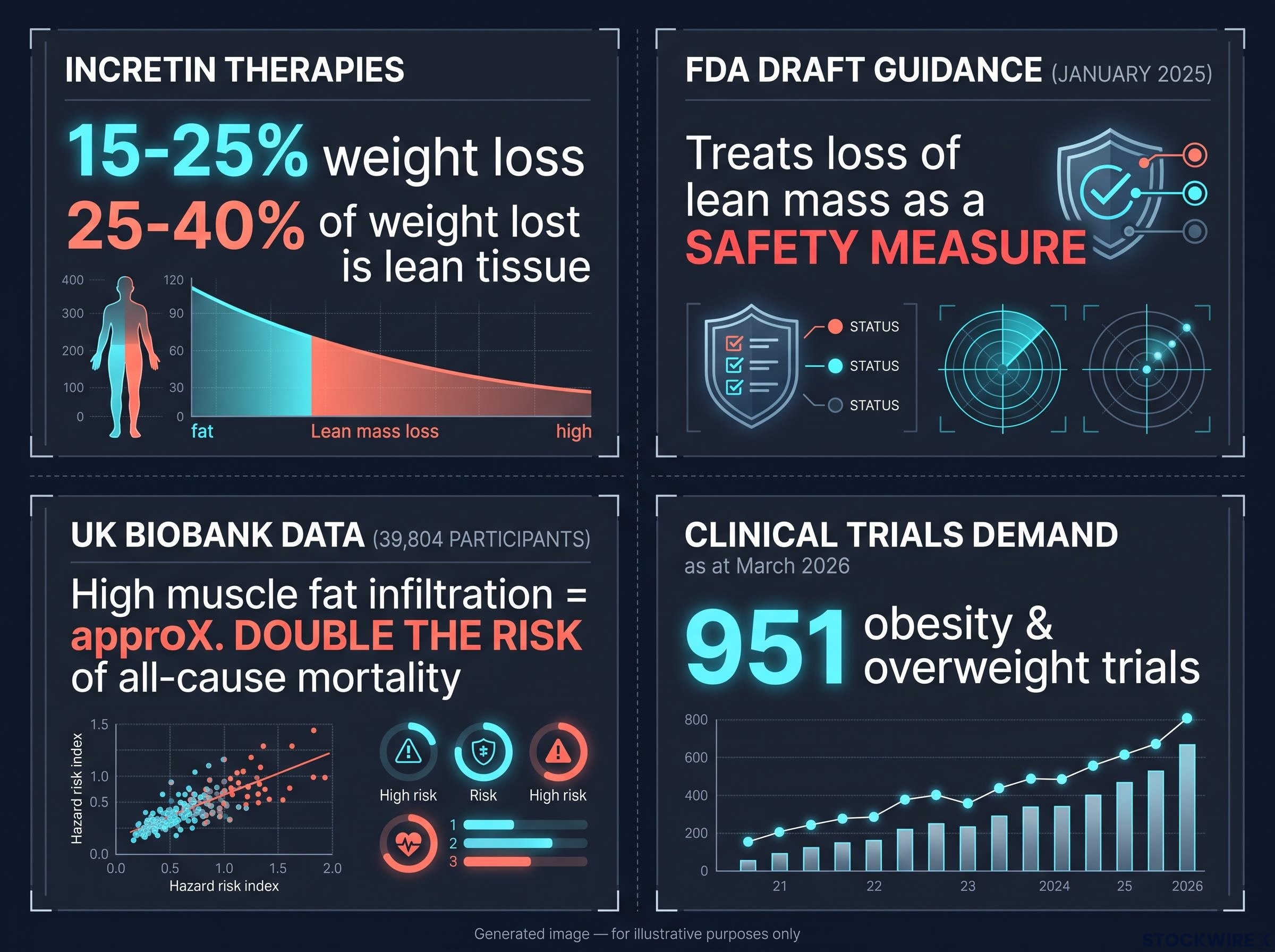
- Modern incretin (GLP-1-based) therapies produce weight loss of 15-25%, and roughly 25-40% of the weight lost is lean tissue.
- The US Food and Drug Administration’s (FDA) January 2025 draft guidance on weight-reduction drugs frames the goal as reducing excess adiposity rather than weight alone, and treats loss of lean mass as a safety measure to be assessed.
- Next-generation obesity therapies, including combinations with activin and myostatin pathway antibodies, are being developed and positioned on preserving muscle.
- Dual-energy X-ray absorptiometry (DXA), a commonly used body composition method in trials, estimates regional fat and lean mass but lacks the ability to characterise muscle composition or directly quantify intramuscular and intermuscular fat. MRI can directly measure both muscle volume and fat infiltration in one examination.
- In UK Biobank MRI data from 39,804 participants, high muscle fat infiltration was associated with around double the risk of all-cause mortality.
- As at March 2026, 951 obesity and overweight trials were listed on ClinicalTrials.gov.
Sponsors are increasingly asking imaging core labs for a single protocol that reports liver PDFF, VAT, SAT, muscle volume and intramuscular fat together. That is the combination Resonance’s single-session offering is designed to deliver.
One session, one core lab
With the MRI Muscle Endpoint, a sponsor can schedule a single MRI session for a participant and receive liver fat, liver iron, VAT and SAT, and muscle volume and quality from one ISO 13485 core lab under one quality system.
Imaging sites use their existing scanners, and images are transferred securely to the company’s core lab for central analysis. Sites are qualified using standardised methods to ensure measurement comparability across sites.
Resonance endpoints are also accessible to the global imaging customers of Image Analysis Group (IAG) under the alliance announced to the ASX on 17 September 2026.
The Image Analysis Group arrangement is non-exclusive and carries no minimum volume commitments, so any uptake of the muscle endpoint through that channel will depend on work orders actually executed, beginning with two pilot studies.
What happens next for Resonance Health
The company outlined the following next steps:
- Software verification and validation activities and associated documentation are being completed in line with the quality management system, after which the endpoint will be offered to customers.
- Further muscle measures are in development on the same platform, including muscle-group composition (quadriceps, hamstrings, adductors and erector spinae), a composite muscle score combining quantity and quality, and whole-body total-adipose-tissue (TAT) and total-lean-tissue (TLT).
- Further regulatory approval for the product will be dictated by customer demand and requirements.
The company’s recent $6.0M placement at 7.2c lifted pro forma net cash from $2.3M to $7.9M, which funds the software verification and validation work and the wider endpoint pipeline.
Want Alerts Like This on the Biotech and Healthcare Stocks You Follow?
StockWire X Market Intelligence scores every announcement in our coverage for how significant it’s likely to be for investors, and which way it points, then alerts you on the stocks you follow. The first 1,000 founding members lock in 50% off for life: A$247 a year instead of the standard A$495. Join the founding waitlist to claim your spot.