

AN-ACC price rises 2.55% from October — but Regis flags funding shortfall
The Australian Government announced on 2 September 2026 that the Australian National Aged Care Classification (AN-ACC) starting price will rise 2.55%, from $295.64 to $303.19, effective 1 October 2026. The hotelling supplement will remain unchanged at $22.15 per resident per day.
The uplift reflects the Government’s annual pricing determination, based on advice from the Independent Health and Aged Care Pricing Authority (IHACPA). Regis Healthcare, one of Australia’s largest aged care operators, has publicly voiced disappointment, noting the increase sits well below prevailing cost inflation across the sector.
When big ASX news breaks, our subscribers know first
The funding gap: why 2.55% falls short
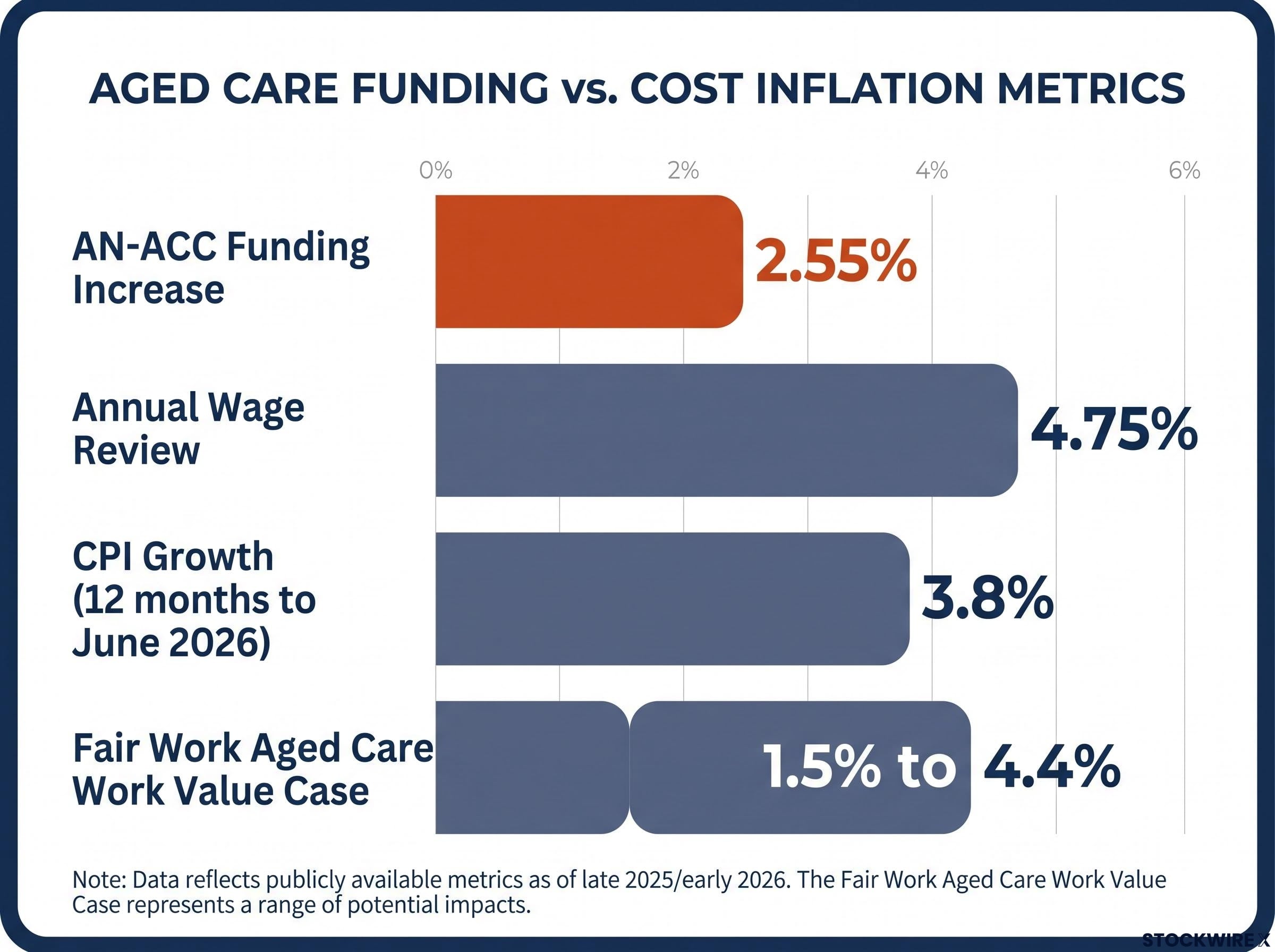
In its assessment, Regis stated the headline 2.55% increase is significantly below the cost pressures now bearing on operators. The table below contrasts the funding uplift against the key cost inputs the company identified.
| Cost Pressure | Increase | Effective Date | Applies To |
|---|---|---|---|
| Annual Wage Review | 4.75% | 1 July 2026 | All award-based workers |
| Fair Work Aged Care Work Value Case (final stage) | 1.5% to 4.4% | 1 August 2026 | Registered & enrolled nurses |
| Enterprise Agreement wage increases | Not quantified | — | Employees under Enterprise Agreements |
| CPI growth (12 months to June 2026) | 3.8% | 12 months to June 2026 | Broader economy |
Put plainly, the 2.55% funding increase sits below every one of these cost inputs. For a large operator, that gap between what funding delivers and what care costs is the central margin-pressure story for investors.
The Regis FY26 EBITDA result of approximately $135 million, delivered at the top end of guidance, was underpinned by 95.9% mature home occupancy and $223 million in net RAD cash inflows, providing the earnings baseline against which this funding shortfall will now be measured.
Regis’s response and mitigation initiatives
As previously announced, Regis is undertaking a range of initiatives to mitigate ongoing margin pressure associated with government funding settings. These include:
-
Increases to room prices
-
Rollout of Higher Everyday Living Fee (HELF) services
-
Other revenue optimisation
-
Operational efficiency initiatives
These levers are how Regis works to protect margins when government funding lags cost inflation. Their effectiveness is the key watch-point for investors monitoring the company’s earnings trajectory.
Executing those mitigation strategies now falls partly to incoming CEO Andrew Kinkade, who joined from Bupa Villages and Aged Care in July 2026 with a mandate to accelerate growth in a sector reshaped by the Aged Care Act 2024.
Regis (company position)
Regis is disappointed that the funding outcome does not reflect the underlying cost of care. Adequate sector funding is required to encourage new greenfield developments at a time when demand for residential aged care continues to grow.
Understanding AN-ACC: how aged care funding works
The Australian National Aged Care Classification (AN-ACC) is the model the Government uses to fund residential aged care. It is paid as a daily rate per resident, meaning operators receive funding for each person in their care every day.
The “starting price” is the base daily rate under this model. For this cycle, the Government has confirmed that current care minute requirements and AN-ACC fixed and variable funding categories will be maintained, so the change relates to the daily price rather than the underlying funding structure.
Why does the daily rate matter? Because it directly drives an operator’s top-line revenue. Funding per bed per day, multiplied across a large portfolio of residents, forms a substantial share of revenue.
For a large operator like Regis, small percentage moves in the daily rate scale meaningfully. A shift of a few dollars per resident per day compounds across thousands of residents over a full year.
What it means for investors
Demand for residential aged care continues to grow, yet the latest funding setting is below prevailing cost inflation. That combination places pressure on operator margins and, as Regis noted, on the case for new greenfield developments.
Scale remains a relevant factor for Regis, which describes itself as one of Australia’s largest aged care operators, providing services to more than 10,000 older Australians through a team of over 13,000 employees. With the funding uplift trailing cost growth, the company’s mitigation initiatives, from room price increases to HELF services, become the swing factor for margin outcomes going forward. The announcement discloses no financial impact estimate, so the ultimate earnings effect remains to be seen.
Don’t Miss the Next Healthcare Stock Move
Get FREE breaking ASX healthcare news delivered to your inbox within minutes of release, complete with in-depth analysis. Join 20,000+ investors already staying ahead of the market with Big News Blast. Click the “Free Alerts” button to receive the moment market-moving healthcare news breaks.