

Racura outlines preclinical MYC data at the FCS 2026 Conference
In its poster presentation at the Frontiers in Cancer Science (FCS) 2026 Conference in Singapore (11-13 November 2026), Racura Oncology highlighted preclinical data showing that (E,E)-bisantrene is the active isomer behind MYC gene inhibition. The poster was presented on 12 November 2026.
The company highlighted that (E,E)-bisantrene is the major isomer (molecular form) of bisantrene able to stabilise the MYC promoter G-quadruplex (G4), which inhibits MYC gene transcription and reduces MYC protein levels. In these preclinical studies, light exposure converted (E,E)-bisantrene into less active isomers, resulting in significantly less MYC G4 stabilisation and less inhibition of MYC gene expression and activity.
The poster was titled “Light-Induced Isomerization Attenuates (E,E)-Bisantrene G-Quadruplex Binding and MYC Silencing”. The company said the findings support the use of RC220 in the EMILI, HARNESS and CPACS clinical programs.
The CPACS Phase 1 data cleared the trial to double the RC220 dose to 80 mg/m2 after no dose-limiting toxicities in Cohort 1, though the dataset covers only three patients.
Dr Daniel Tillett, CEO and Managing Director
“These data show that (E,E)-bisantrene is the form that stabilises G-quadruplex structures and inhibits MYC gene expression… confirming that the (E,E)-isomer is the active form supports our development of RC220 as a proprietary formulation of (E,E)-bisantrene. While these are preclinical findings, they add to the growing body of evidence for the MYC-directed mechanism of action of RC220.”
When big ASX news breaks, our subscribers know first
What the poster data showed
The central result is simple: the (E,E)-form does the work. Mixtures containing less (E,E)-bisantrene showed decreased MYC G4 stabilisation, reduced ability to suppress MYC gene and protein expression, and weaker reduction of cancer cell viability.
Key results from the poster included:
- MYC G4 stabilisation: an isomer mixture containing 62% (E,E)-bisantrene stabilised MYC G4 significantly less than 100% (E,E). Raising the mixture to 16 μM, equimolar to 10 μM (E,E), restored stabilisation to the original level.
- Light exposure: blue light (440 nm) exposure of 0.25 h, 1 h and 4 h reduced (E,E)-bisantrene content to ~60%, ~40% and an unquantifiable level respectively.
- Cell viability: in MDA-MB-231 breast cancer cells, the IC50 was 266 nM for 100% (E,E), rising to 310-825 nM for the isomer mixtures.
The table below sets (E,E) content against the IC50 for cell viability and the EC50 for MYC expression.
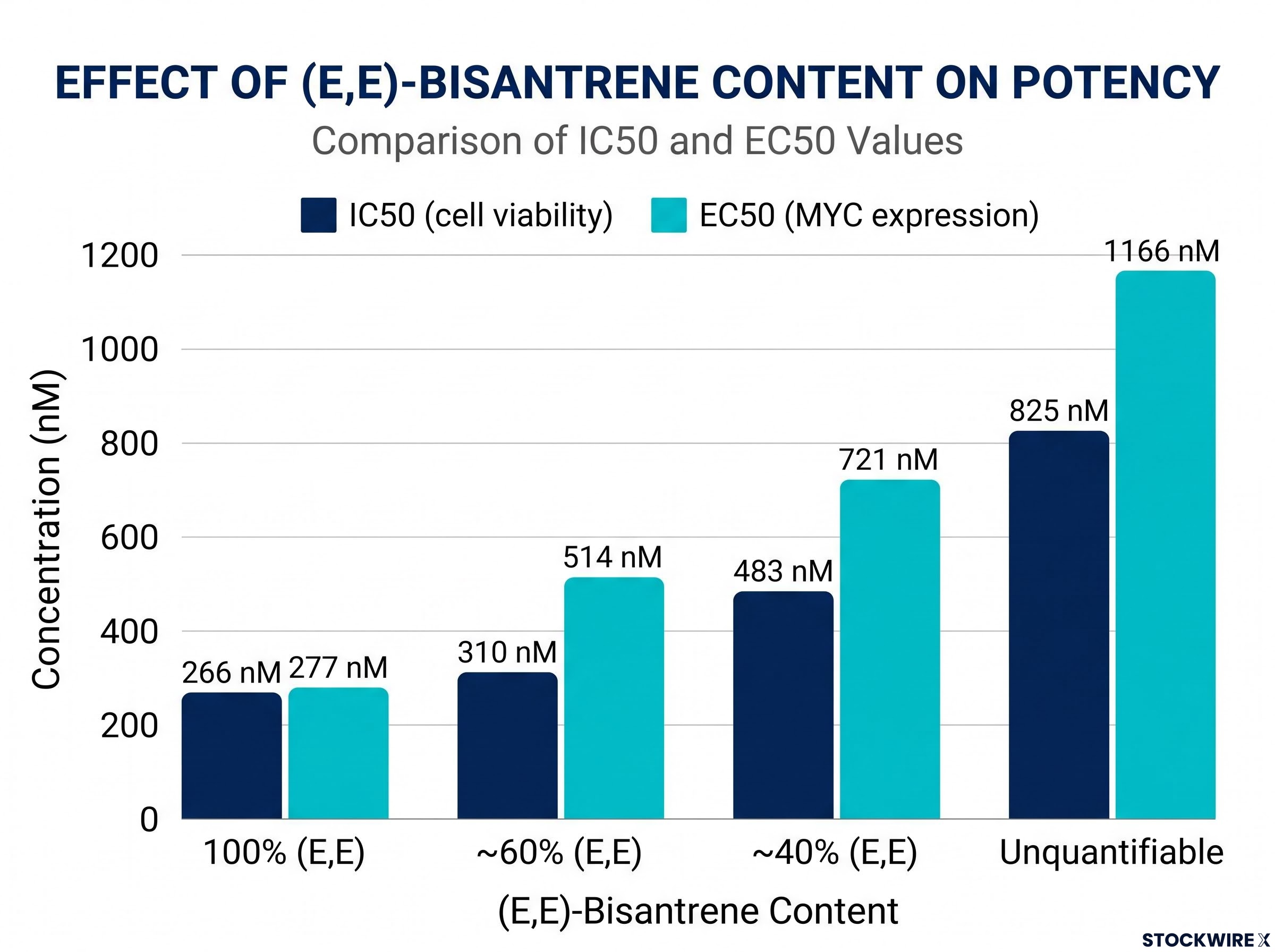
| (E,E)-bisantrene content | IC50 (cell viability) | EC50 (MYC expression) |
|---|---|---|
| 100% (E,E) | 266 ± 51 nM | 277 ± 47 nM |
| ~60% (E,E) | 310 ± 26 nM | 514 ± 93 nM |
| ~40% (E,E) | 483 ± 84 nM | 721 ± 112 nM |
| Unquantifiable | 825 ± 166 nM | 1166 ± 68 nM |
Molecular dynamics simulations also predicted a trend toward higher affinity for (E,E)-bisantrene over (E,Z)-bisantrene at the top G-tetrad binding site on MYC G4.
Why isomer form matters for bisantrene
MYC is a key cancer gene, described by the company as dysregulated in up to 70% of all cancers. A G-quadruplex is a secondary structure found in the promoter regions of key oncogenes such as MYC, and it can regulate the expression of those genes.
An isomer is a different molecular form of the same compound. Bisantrene can exist as several isomers, and the poster noted that pure (E,Z)- and (Z,Z)-isomers cannot be isolated, so activity was compared using HPLC-characterised isomer mixtures.
Because light converts (E,E)-bisantrene to less active isomers, the poster stated that preventing photoisomerisation is critical in clinical studies. The poster referenced three programs:
- EMILI: Phase 2b/3 trial of RC220 monotherapy in relapsed/refractory acute myeloid leukaemia.
- HARNESS-1: Phase 1 trial of RC220 with osimertinib in EGFR-mutant non-small cell lung cancer.
- CPACS: Phase 1 trial of RC220 with doxorubicin in advanced solid tumours.
Building on earlier MYC evidence
The new findings build on the MYC gene expression inhibition data for (E,E)-bisantrene presented at the 2026 American Association for Cancer Research (AACR) Annual Meeting (ASX announcement 22 April 2026). The company said they match the lower cancer cell killing activity observed when (E,E)-bisantrene is exposed to light.
The AACR MYC silencing data measured binding affinity to the MYC G4 at 208 nM and showed MYC expression suppressed in breast and lung cancer cells within two hours.
Racura continues to investigate this mechanism through its ongoing research collaboration with Purdue University (ASX announcement 26 March 2026). The poster research was carried out with the University of Wollongong and funded by Racura Oncology.
RC220 is Racura’s proprietary formulation of (E,E)-bisantrene, and the data remain preclinical. Racura describes itself as a late-stage clinical biopharmaceutical company.
Want Alerts Like This on the Biotech Stocks You Follow?
StockWire X Market Intelligence scores every announcement in our coverage for how significant it’s likely to be for investors, and which way it points, then alerts you on the stocks you follow. The first 1,000 founding members lock in 50% off for life: A$247 a year instead of the standard A$495. Join the founding waitlist today.